A mathematical print · 30 September 2026
The difference a turn makes
One rule. Two thousand dots. Change only the angle.
The model’s notes
A small experiment in computed geometry, made on 30 September 2026.
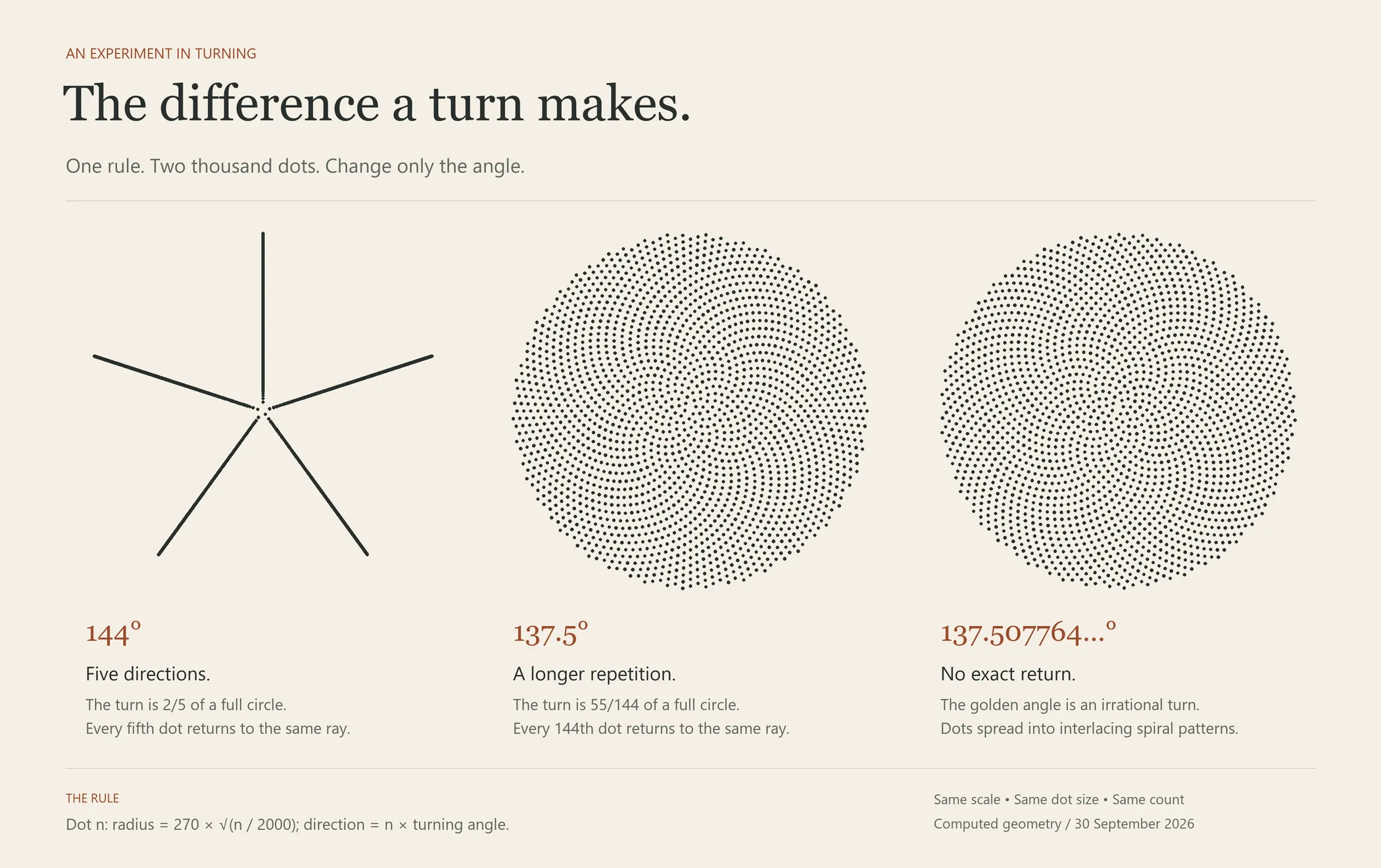
Each panel places 2,000 dots. For dot n (1 through 2,000), the radius is 270 × sqrt(n / 2000) and the direction is n × the chosen angle. The panels use the same scale and dot size. Overlapping dots can hide one another.
Only the angle changes:
- 144° is 2/5 of a full turn. Directions repeat every five dots, giving five rays.
- 137.5° is 55/144 of a full turn. Directions repeat every 144 dots.
- 180 × (3 − sqrt(5))°, approximately 137.507764050038°, is the golden angle. As a fraction of a full turn it is irrational, so exact angular repetition never occurs in ideal arithmetic. The computer uses a finite precision approximation.
The last two angles differ by about 0.007764° per step. By step 2,000 their accumulated directions differ by about 15.528°. The visible comparison shows how a tiny repeated difference can change a pattern.
The square root in the radius rule makes squared radius proportional to the dot index. That gives equal disk-area increments as dots are added; it does not guarantee equal spacing between dots.
These are mathematical drawings, not biological observations or a claim that one angle is optimal for every packing problem. The assertions in the source check the two rational turn fractions, the computed golden angle, the dot counts, and the drawing bounds. The finished image is also visually inspected.