Hepatobiliary surgery · Lecture 6
Cholecystectomy · Operative safety · 51 slides
Cholecystectomy and safe surgery.
Before, during and after cholecystectomy: preparation, the operative steps, difficult anatomy, bile duct injury and recovery.
About the downloads
PowerPoint without speaker notes. SHA-256 checksums verify the downloaded files.
Contents · 11 parts
Opening
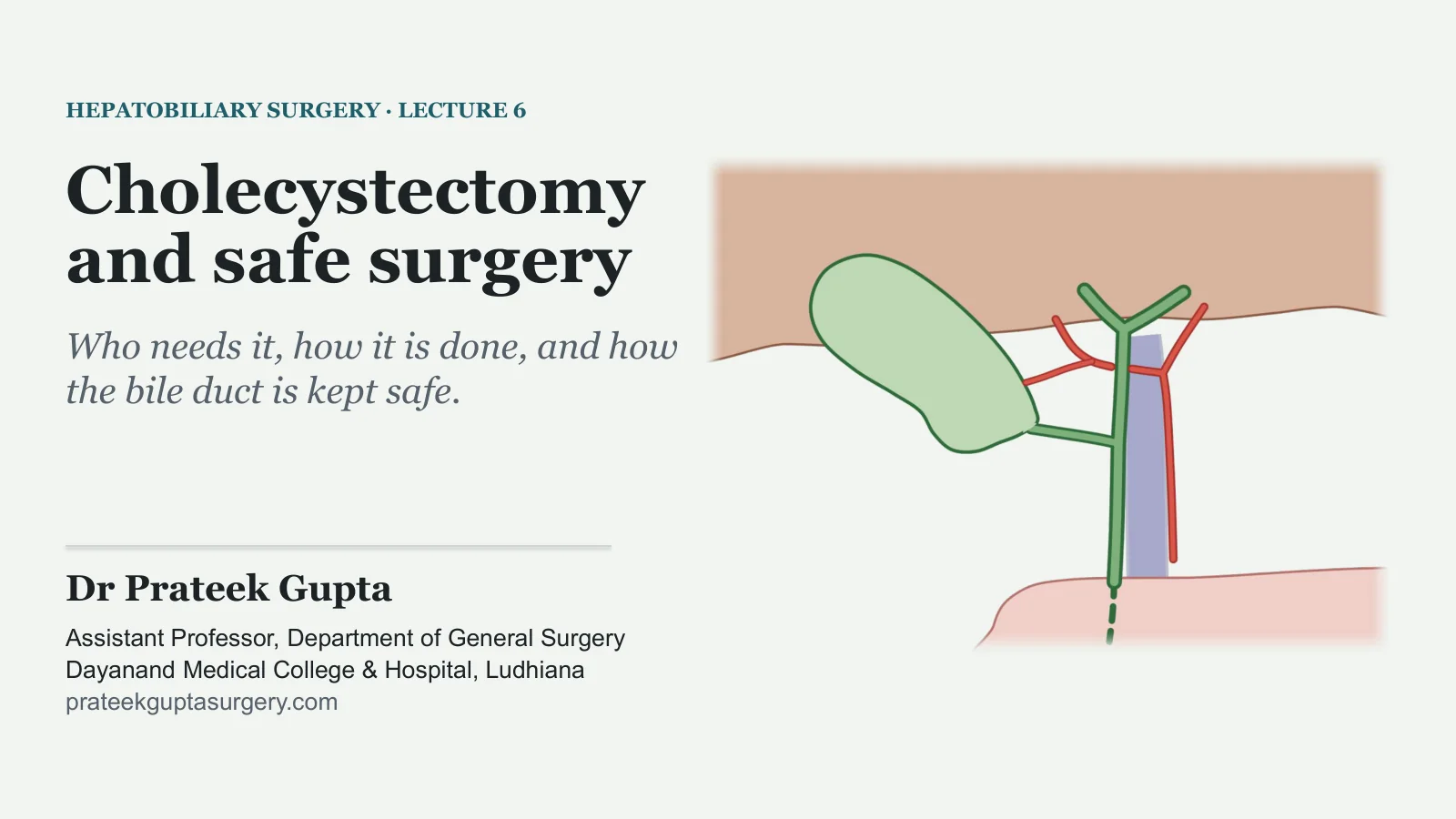
Cholecystectomy and safe surgery
HEPATOBILIARY SURGERY · LECTURE 6
Cholecystectomy and safe surgery
Who needs it, how it is done, and how the bile duct is kept safe.
Dr Prateek Gupta
Assistant Professor, Department of General Surgery Dayanand Medical College & Hospital, Ludhiana prateekguptasurgery.com
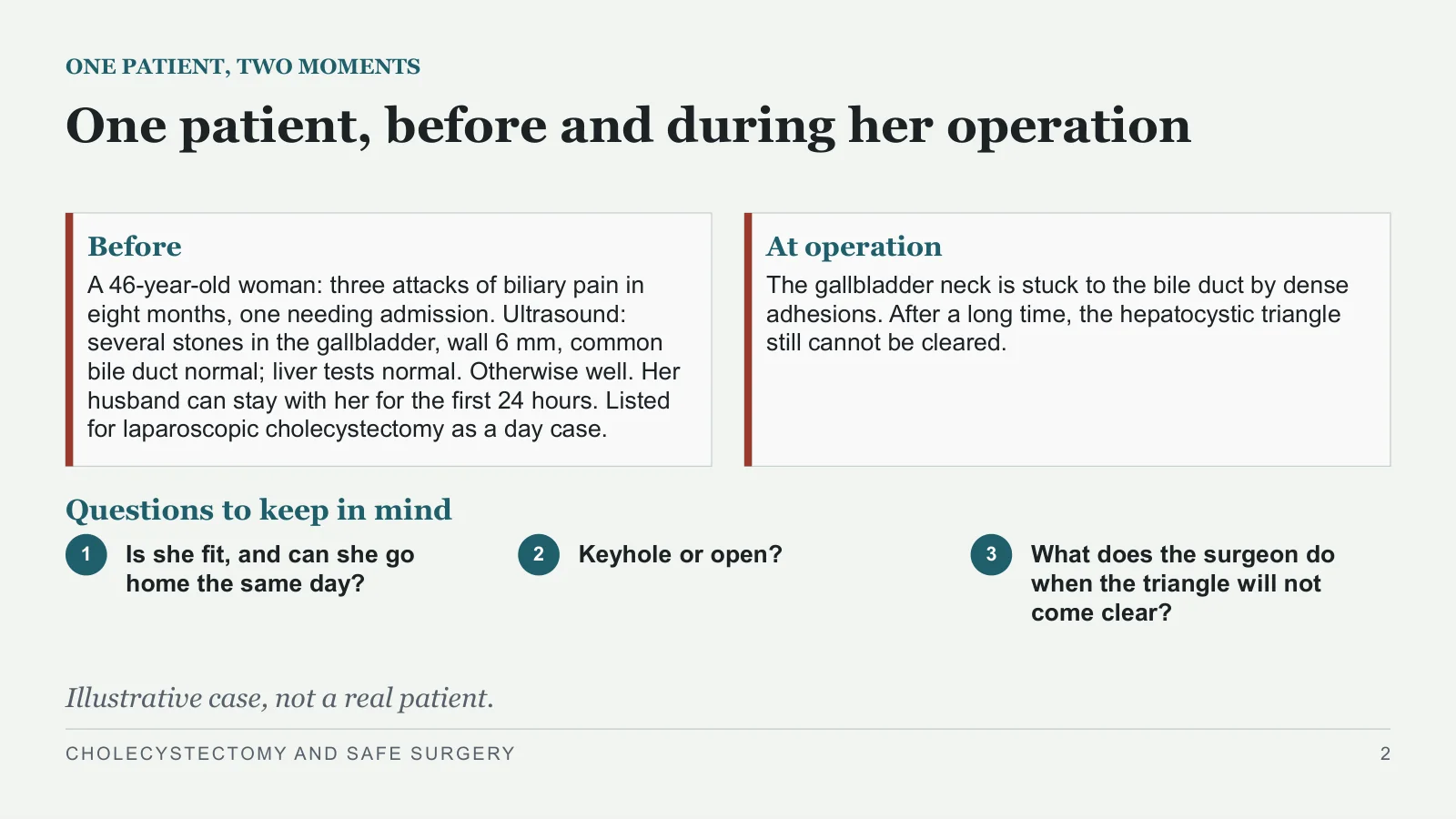
One patient, before and during her operation
ONE PATIENT, TWO MOMENTS
Before
A 46-year-old woman: three attacks of biliary pain in eight months, one needing admission. Ultrasound: several stones in the gallbladder, wall 6 mm, common bile duct normal; liver tests normal. Otherwise well. Her husband can stay with her for the first 24 hours. Listed for laparoscopic cholecystectomy as a day case.
At operation
The gallbladder neck is stuck to the bile duct by dense adhesions. After a long time, the hepatocystic triangle still cannot be cleared.
Questions to keep in mind
1
Is she fit, and can she go home the same day?
2
Keyhole or open?
3
What does the surgeon do when the triangle will not come clear?
Illustrative case, not a real patient.
CHOLECYSTECTOMY AND SAFE SURGERY
2
Who and when
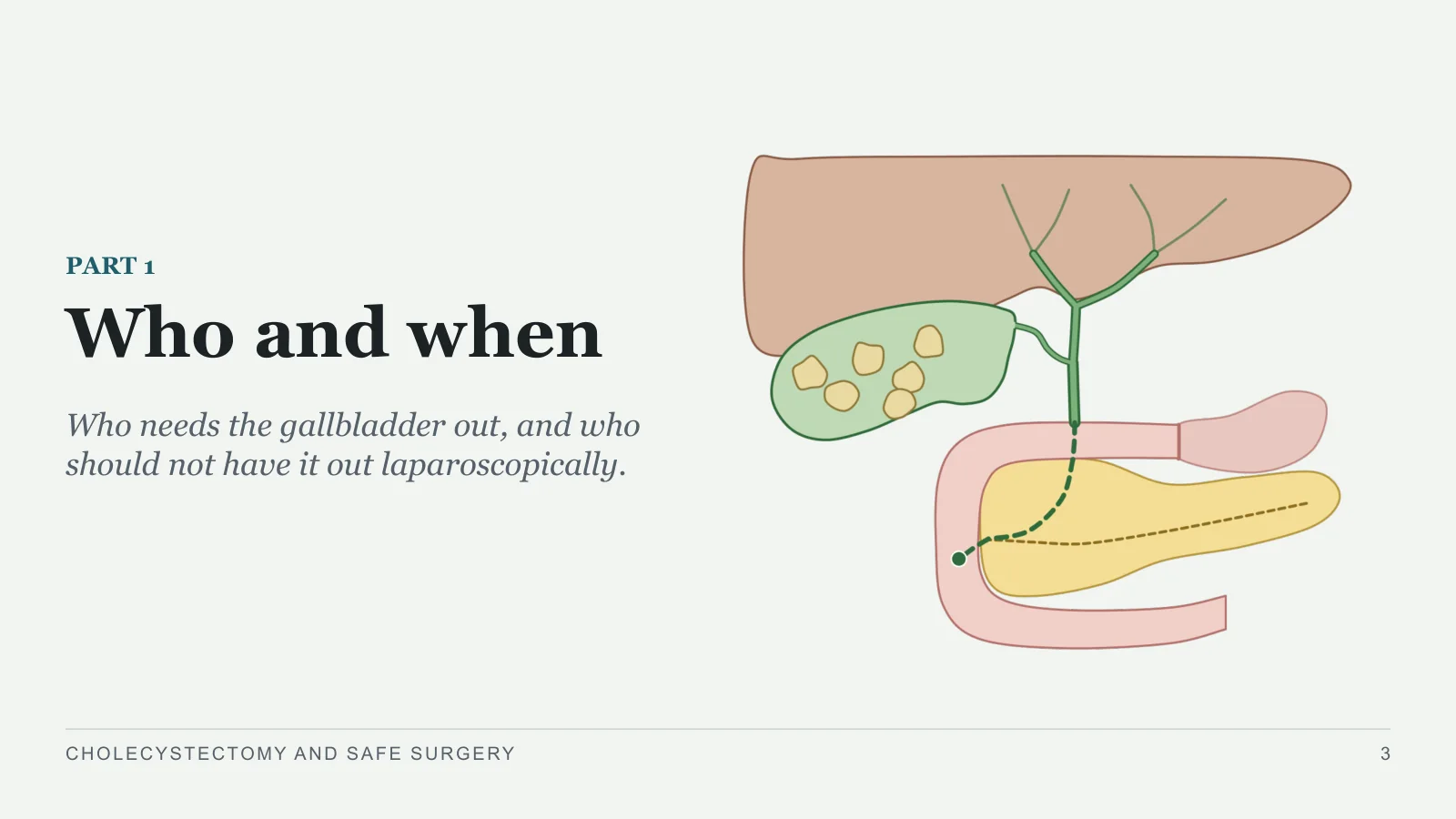
Who and when
PART 1
Who needs the gallbladder out, and who should not have it out laparoscopically.
CHOLECYSTECTOMY AND SAFE SURGERY
3
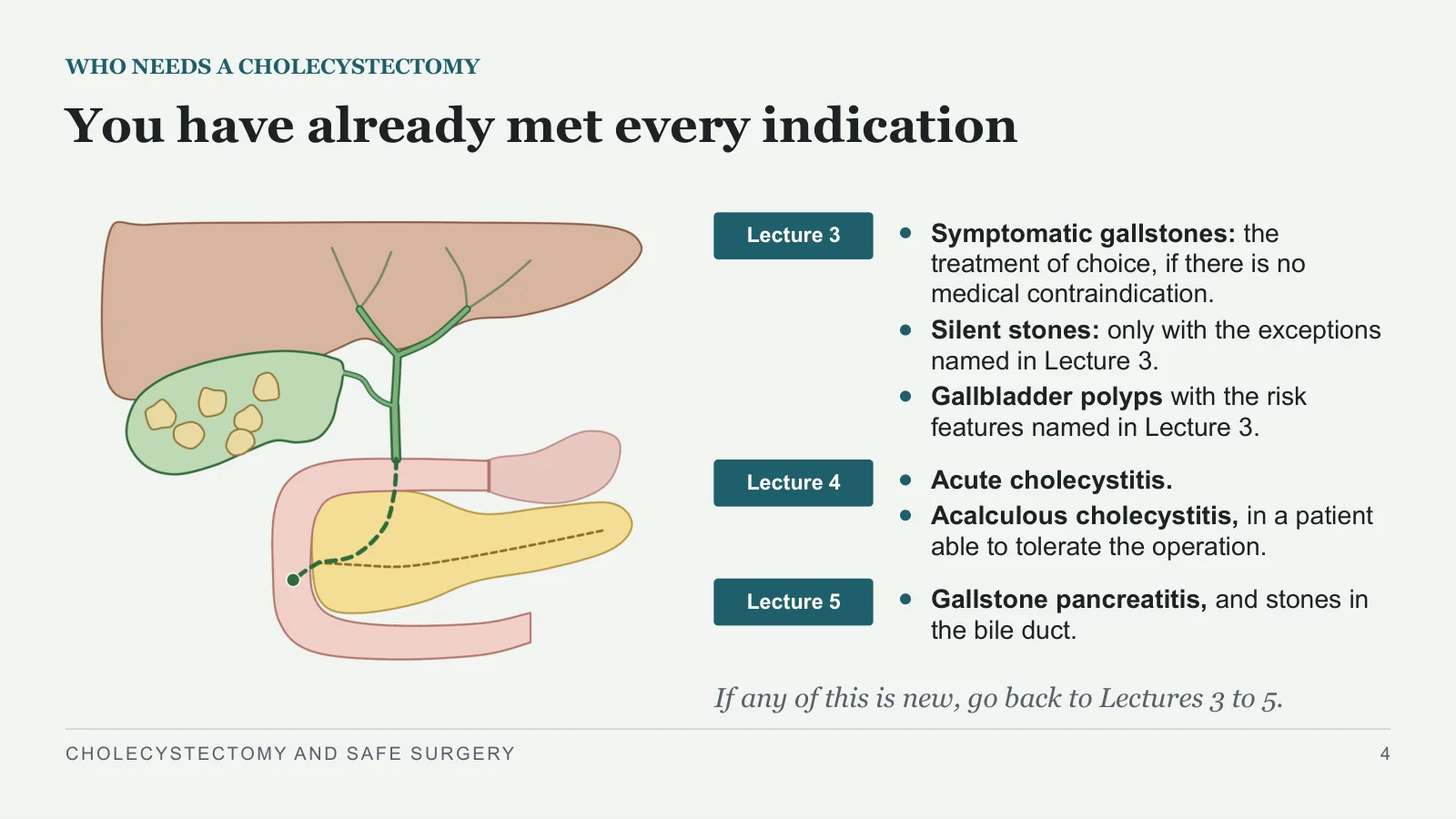
You have already met every indication
WHO NEEDS A CHOLECYSTECTOMY
Lecture 3
Symptomatic gallstones: the treatment of choice, if there is no medical contraindication.
Silent stones: only with the exceptions named in Lecture 3.
Gallbladder polyps with the risk features named in Lecture 3.
Lecture 4
Acute cholecystitis.
Acalculous cholecystitis, in a patient able to tolerate the operation.
Lecture 5
Gallstone pancreatitis, and stones in the bile duct.
If any of this is new, go back to Lectures 3 to 5.
CHOLECYSTECTOMY AND SAFE SURGERY
4
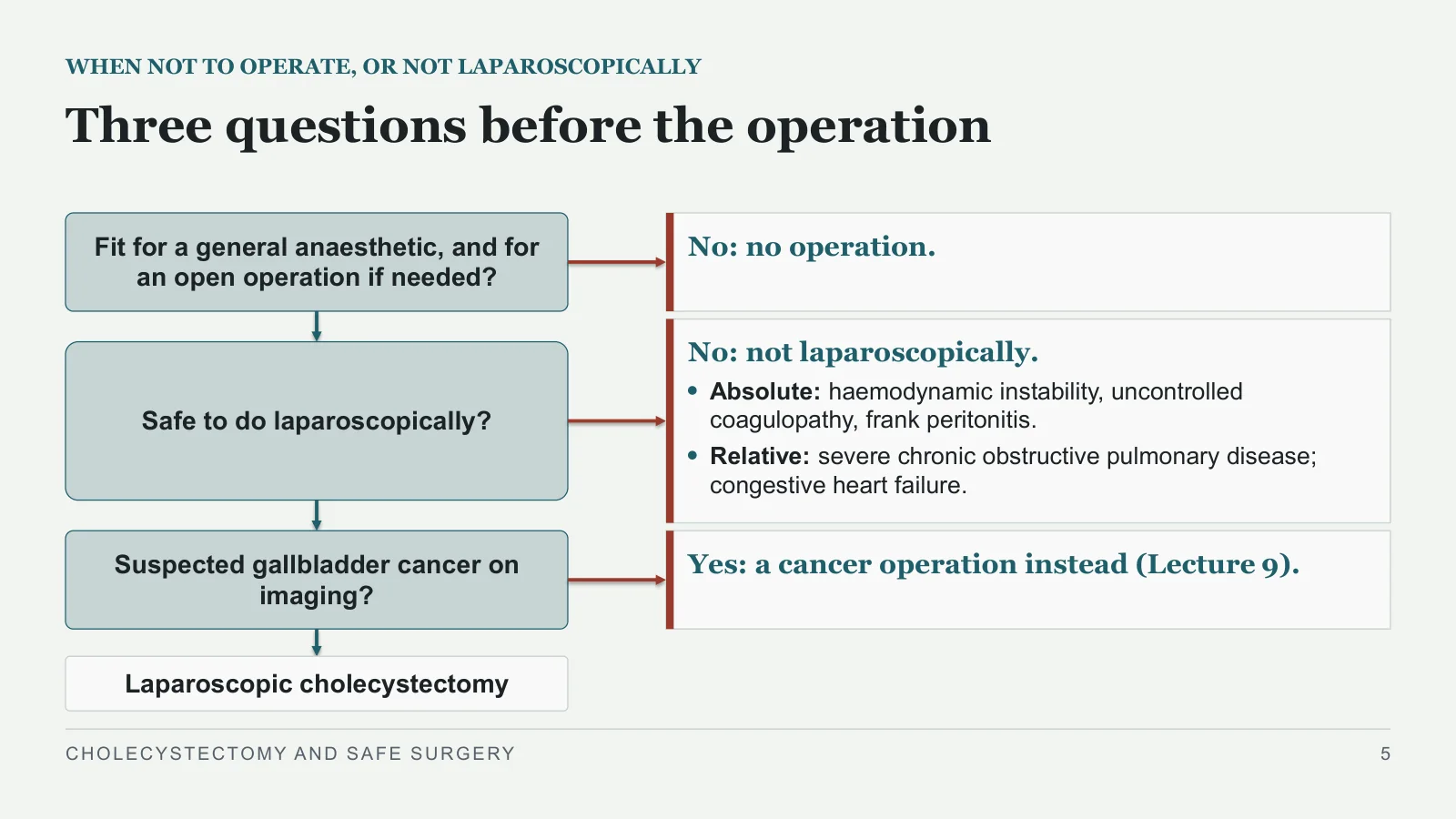
Three questions before the operation
WHEN NOT TO OPERATE, OR NOT LAPAROSCOPICALLY
Fit for a general anaesthetic, and for an open operation if needed?
No: no operation.
Safe to do laparoscopically?
No: not laparoscopically.
Absolute: haemodynamic instability, uncontrolled coagulopathy, frank peritonitis.
Relative: severe chronic obstructive pulmonary disease; congestive heart failure.
Suspected gallbladder cancer on imaging?
Yes: a cancer operation instead (Lecture 9).
Laparoscopic cholecystectomy
CHOLECYSTECTOMY AND SAFE SURGERY
5
Before the operation
Before the operation
PART 2
Fitness, consent, prophylaxis, and whether she can go home the same day.
CHOLECYSTECTOMY AND SAFE SURGERY
6
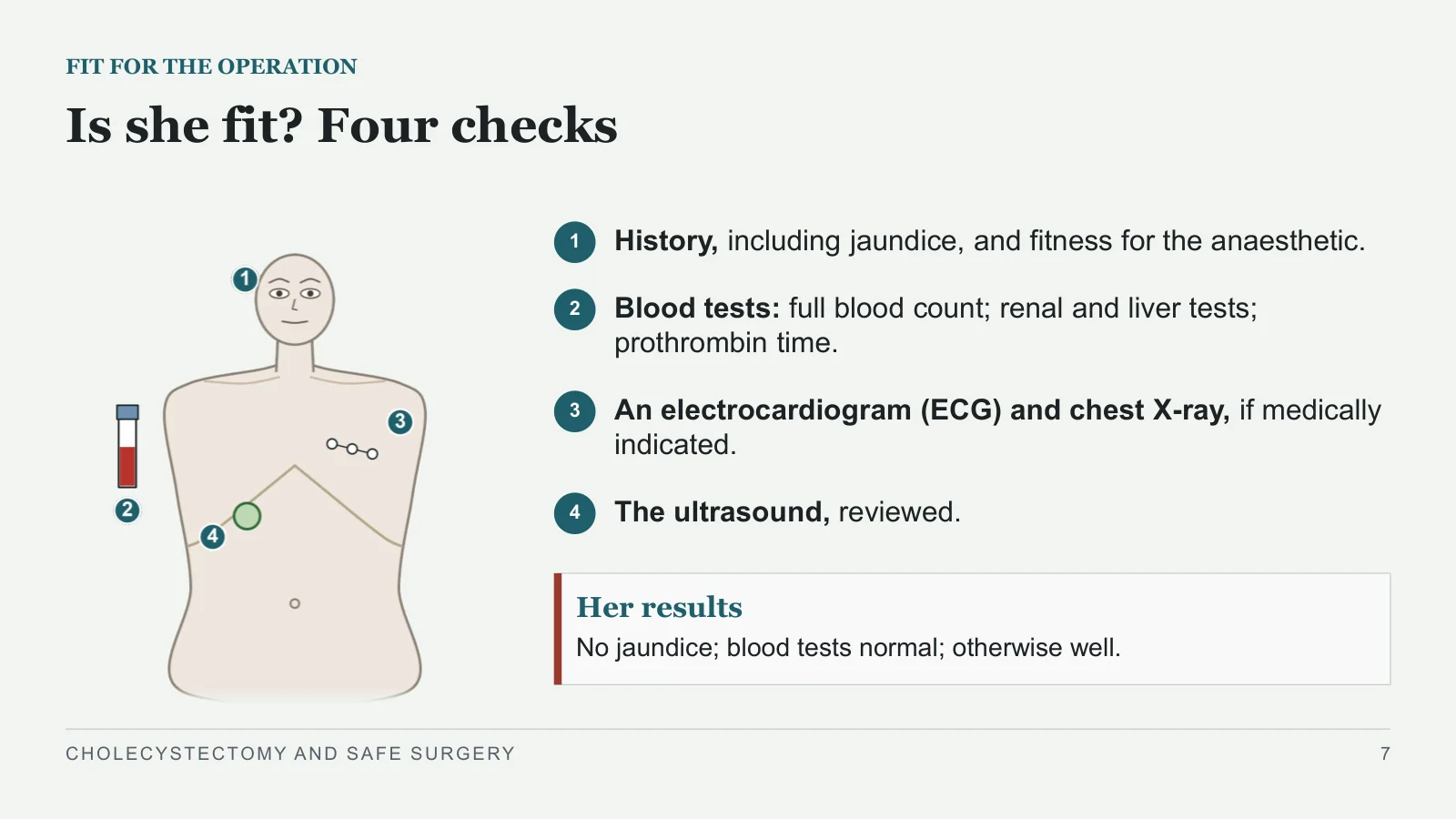
Is she fit? Four checks
FIT FOR THE OPERATION
1
History, including jaundice, and fitness for the anaesthetic.
2
Blood tests: full blood count; renal and liver tests; prothrombin time.
3
An electrocardiogram (ECG) and chest X-ray, if medically indicated.
4
The ultrasound, reviewed.
Her results
No jaundice; blood tests normal; otherwise well.
CHOLECYSTECTOMY AND SAFE SURGERY
7
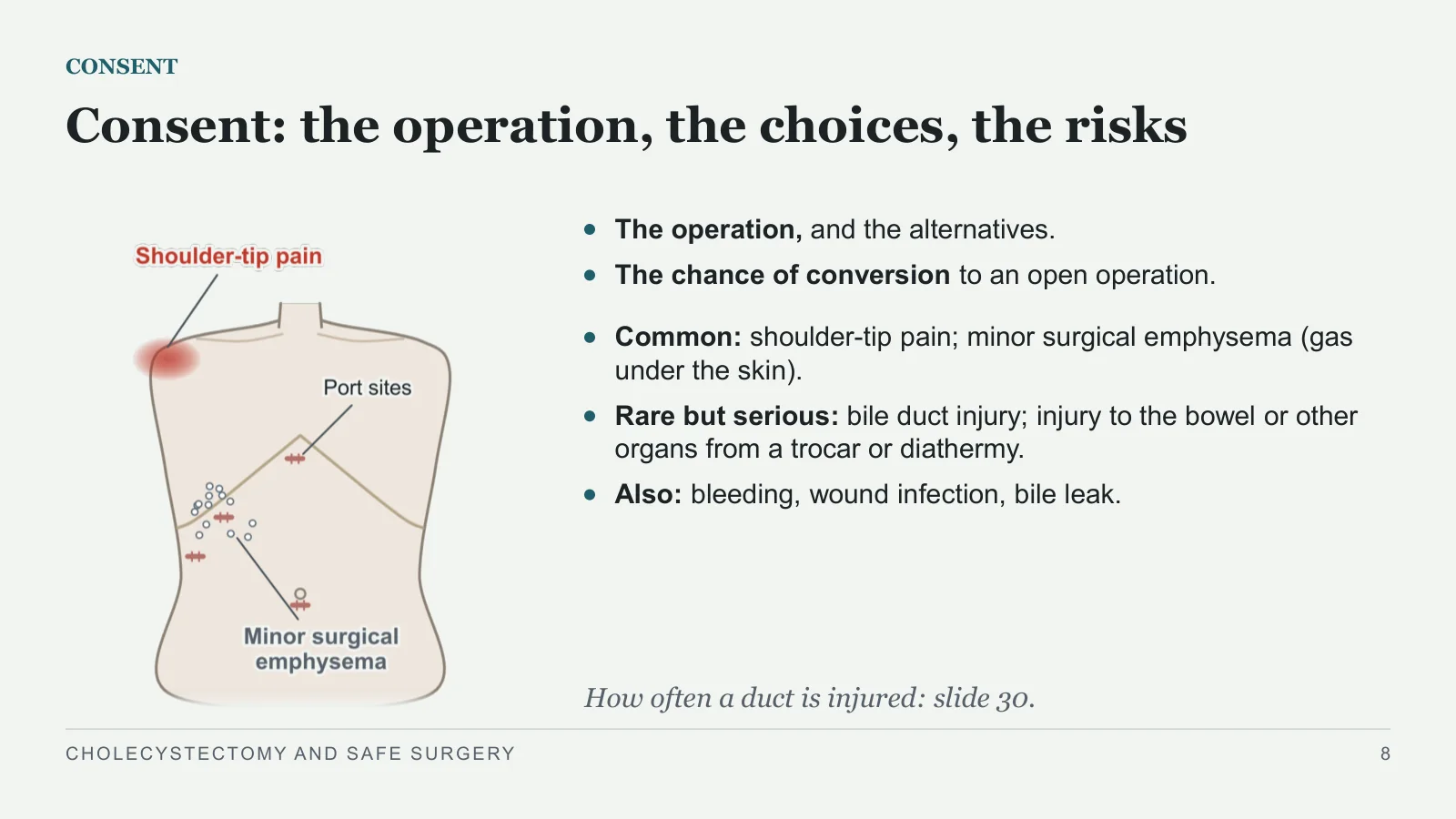
Consent: the operation, the choices, the risks
CONSENT
The operation, and the alternatives.
The chance of conversion to an open operation.
Common: shoulder-tip pain; minor surgical emphysema (gas under the skin).
Rare but serious: bile duct injury; injury to the bowel or other organs from a trocar or diathermy.
Also: bleeding, wound infection, bile leak.
How often a duct is injured: slide 30.
CHOLECYSTECTOMY AND SAFE SURGERY
8
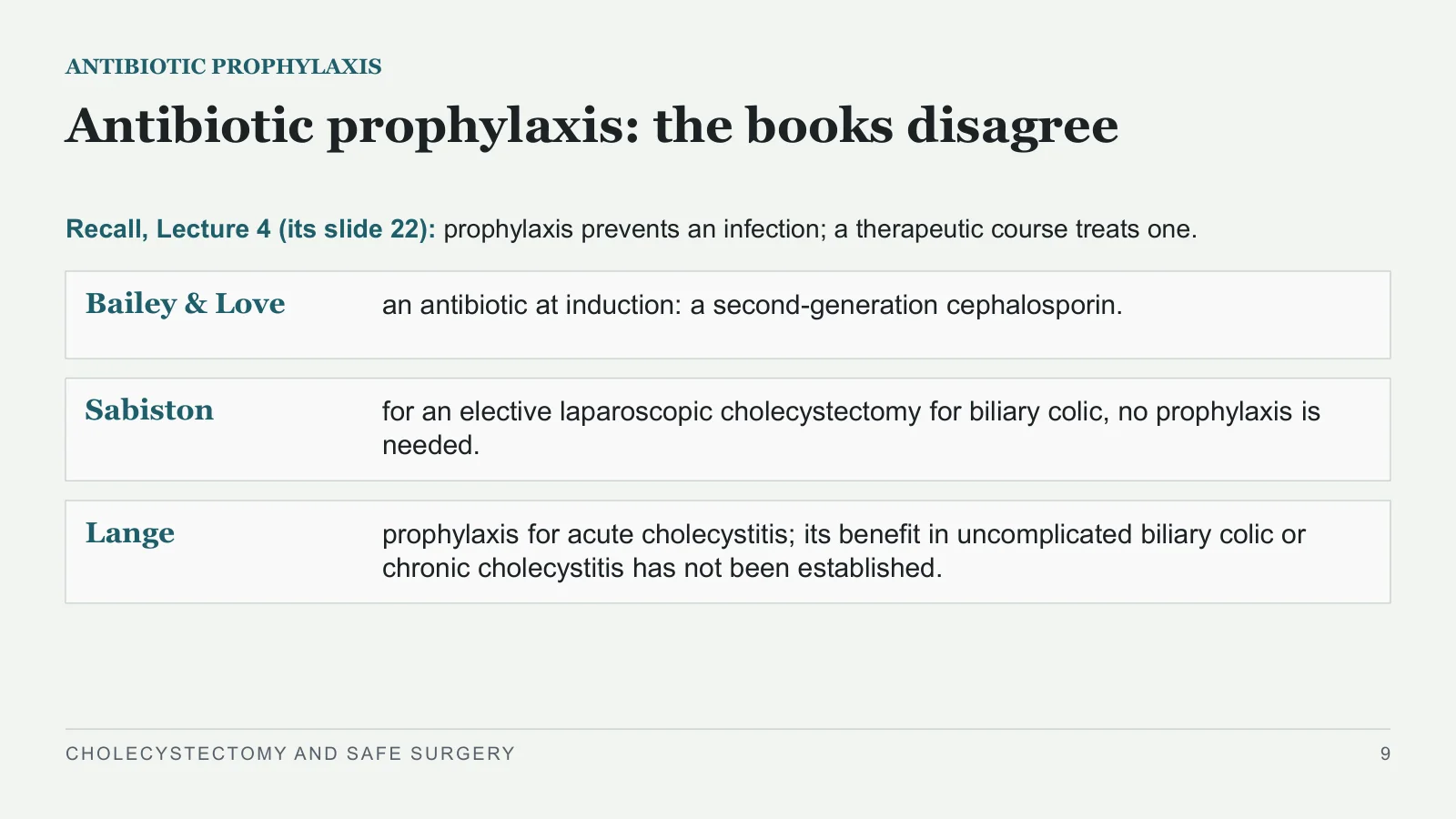
Antibiotic prophylaxis: the books disagree
ANTIBIOTIC PROPHYLAXIS
Recall, Lecture 4 (its slide 22): prophylaxis prevents an infection; a therapeutic course treats one.
Bailey & Love
an antibiotic at induction: a second-generation cephalosporin.
Sabiston
for an elective laparoscopic cholecystectomy for biliary colic, no prophylaxis is needed.
Lange
prophylaxis for acute cholecystitis; its benefit in uncomplicated biliary colic or chronic cholecystitis has not been established.
CHOLECYSTECTOMY AND SAFE SURGERY
9
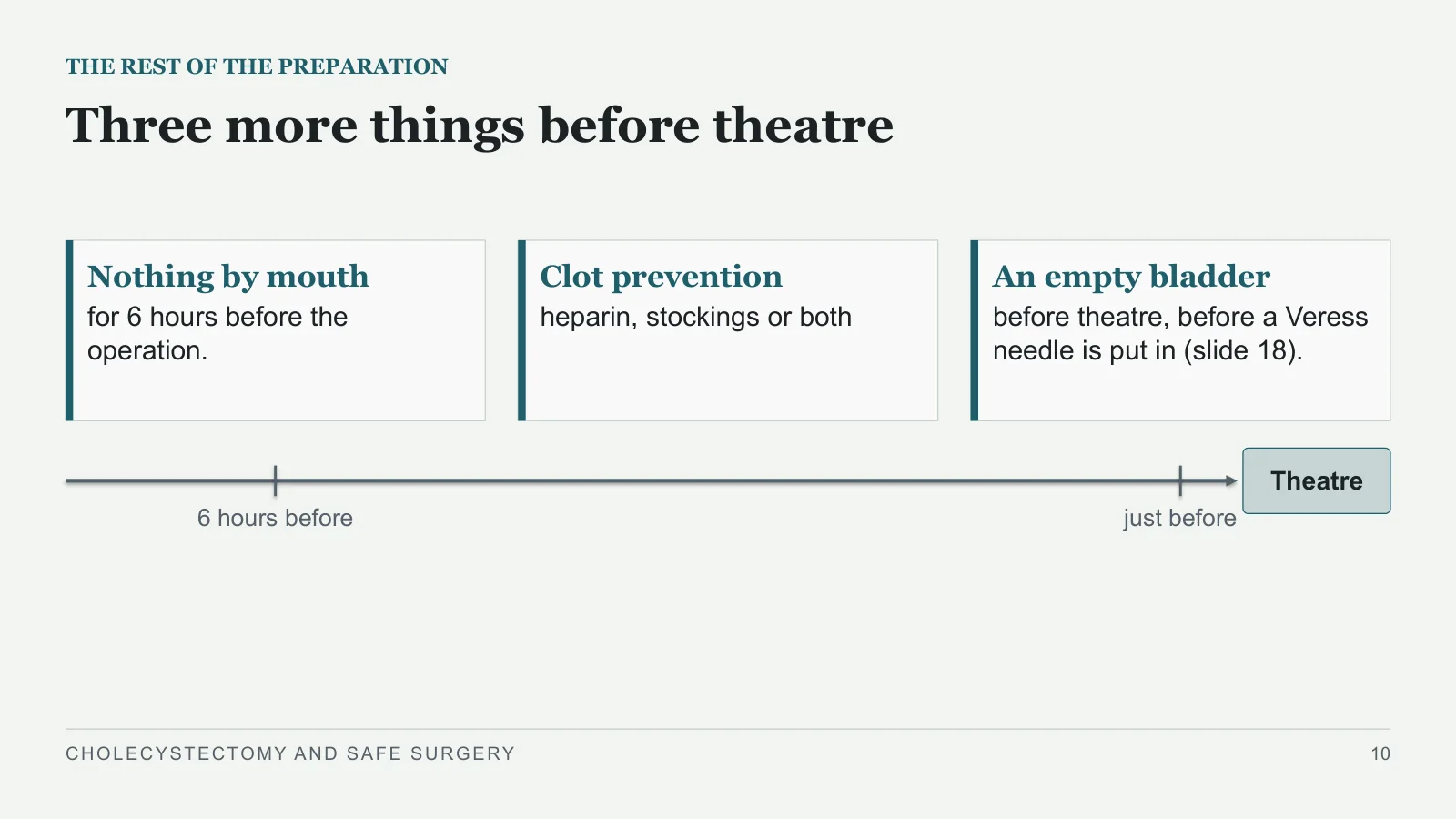
Three more things before theatre
THE REST OF THE PREPARATION
Nothing by mouth
for 6 hours before the operation.
Clot prevention
heparin, stockings or both
An empty bladder
before theatre, before a Veress needle is put in (slide 18).
Theatre
6 hours before
just before
CHOLECYSTECTOMY AND SAFE SURGERY
10
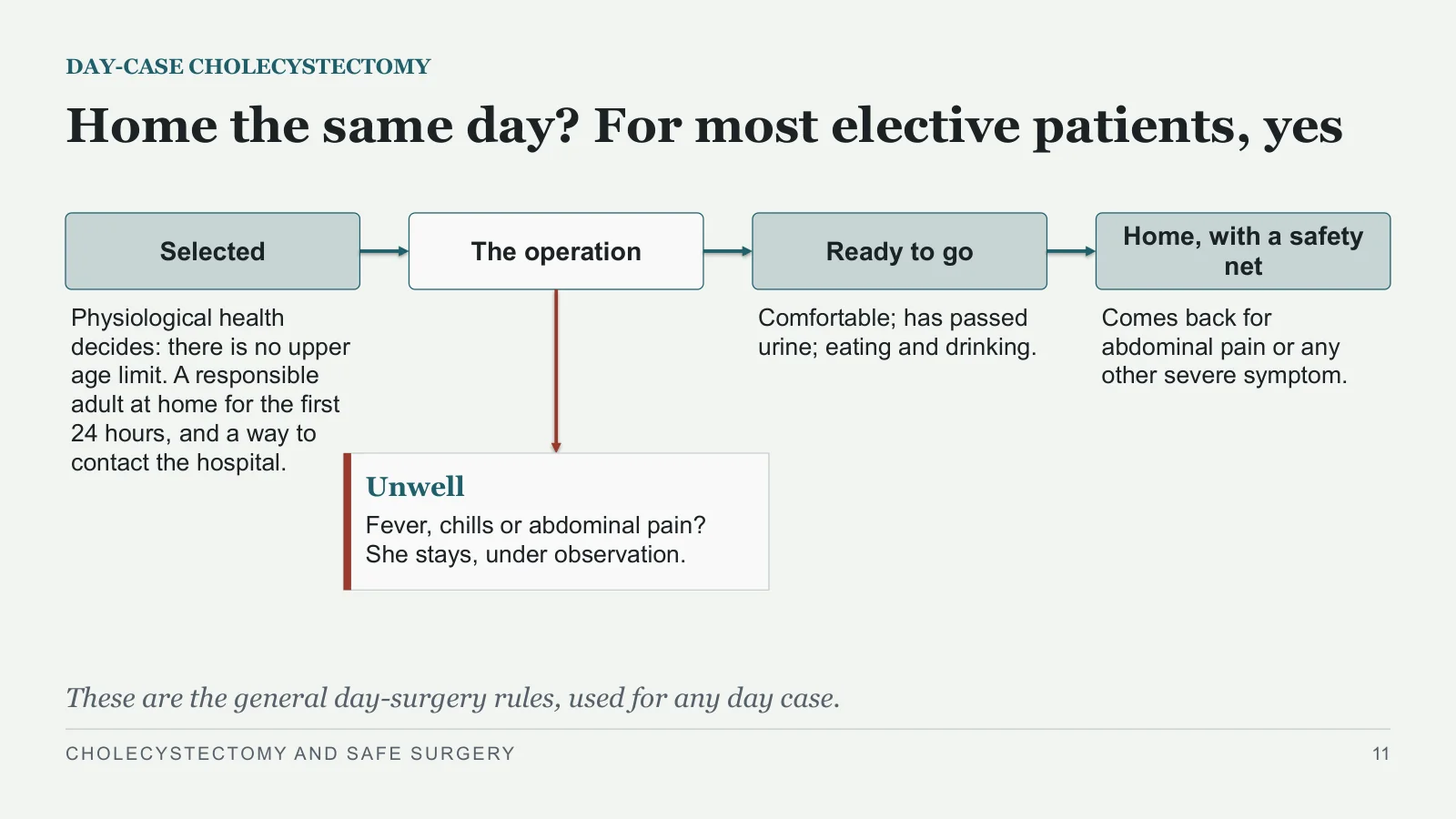
Home the same day? For most elective patients, yes
DAY-CASE CHOLECYSTECTOMY
Selected
Physiological health decides: there is no upper age limit. A responsible adult at home for the first 24 hours, and a way to contact the hospital.
The operation
Ready to go
Comfortable; has passed urine; eating and drinking.
Home, with a safety net
Comes back for abdominal pain or any other severe symptom.
Unwell
Fever, chills or abdominal pain? She stays, under observation.
These are the general day-surgery rules, used for any day case.
CHOLECYSTECTOMY AND SAFE SURGERY
11
Laparoscopic or open
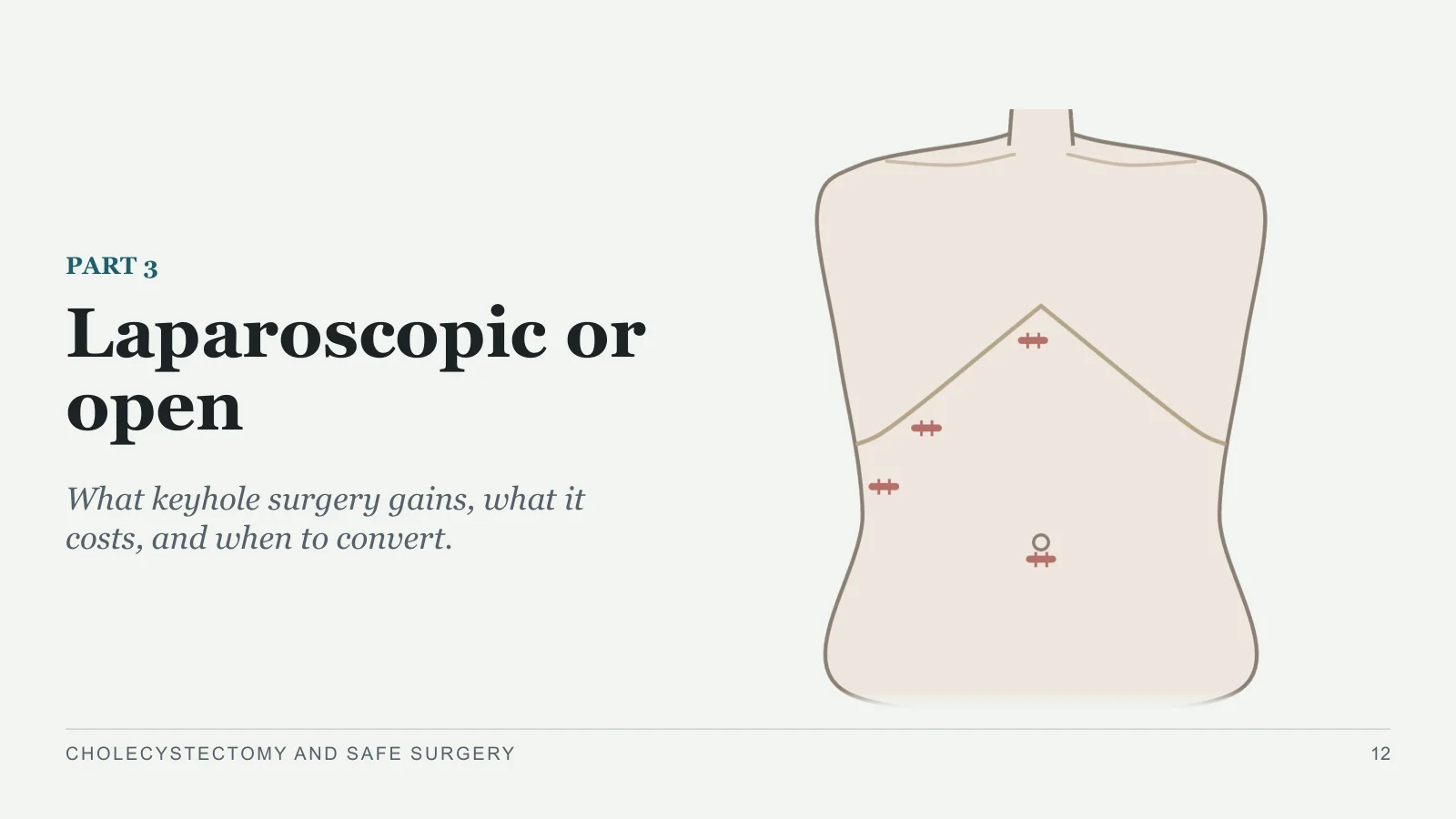
Laparoscopic or open
PART 3
What keyhole surgery gains, what it costs, and when to convert.
CHOLECYSTECTOMY AND SAFE SURGERY
12
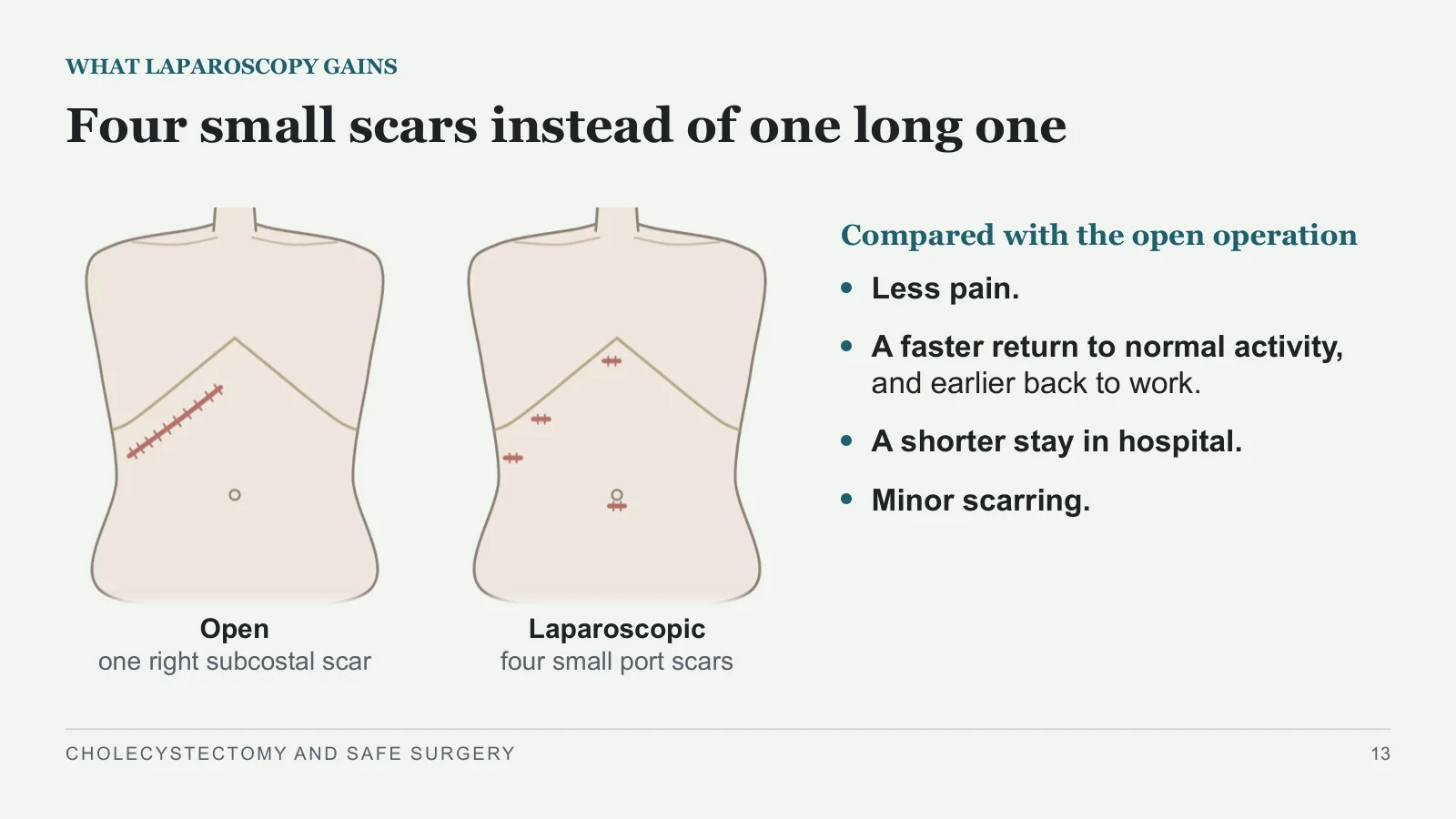
Four small scars instead of one long one
WHAT LAPAROSCOPY GAINS
Open
one right subcostal scar
Laparoscopic
four small port scars
Compared with the open operation
Less pain.
A faster return to normal activity, and earlier back to work.
A shorter stay in hospital.
Minor scarring.
CHOLECYSTECTOMY AND SAFE SURGERY
13
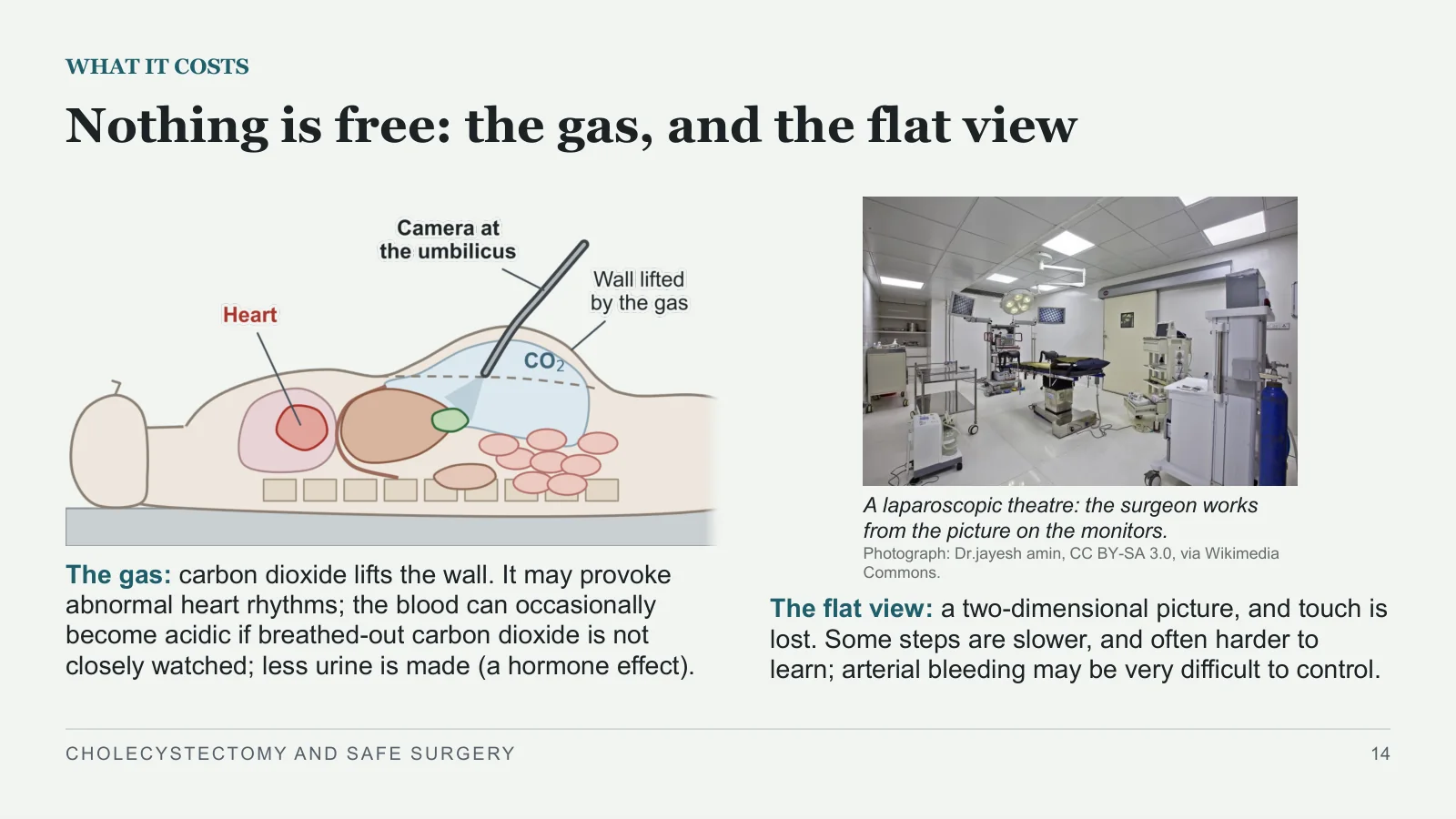
Nothing is free: the gas, and the flat view
WHAT IT COSTS
The gas: carbon dioxide lifts the wall. It may provoke abnormal heart rhythms; the blood can occasionally become acidic if breathed-out carbon dioxide is not closely watched; less urine is made (a hormone effect).
A laparoscopic theatre: the surgeon works from the picture on the monitors.
Photograph: Dr.jayesh amin, CC BY-SA 3.0, via Wikimedia Commons.
The flat view: a two-dimensional picture, and touch is lost. Some steps are slower, and often harder to learn; arterial bleeding may be very difficult to control.
CHOLECYSTECTOMY AND SAFE SURGERY
14
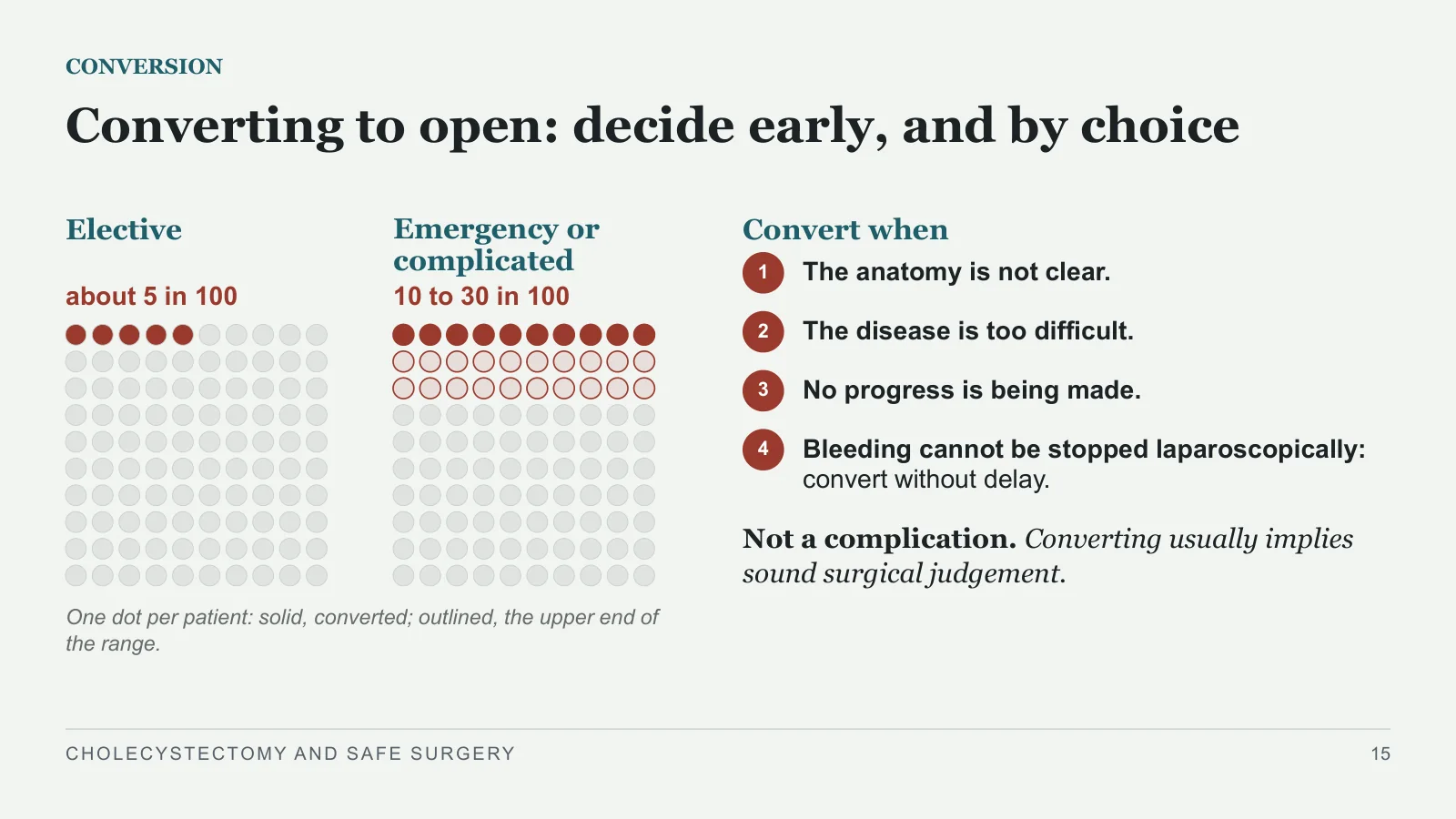
Converting to open: decide early, and by choice
CONVERSION
Elective
about 5 in 100
Emergency or complicated
10 to 30 in 100
One dot per patient: solid, converted; outlined, the upper end of the range.
Convert when
1
The anatomy is not clear.
2
The disease is too difficult.
3
No progress is being made.
4
Bleeding cannot be stopped laparoscopically: convert without delay.
Not a complication. Converting usually implies sound surgical judgement.
CHOLECYSTECTOMY AND SAFE SURGERY
15
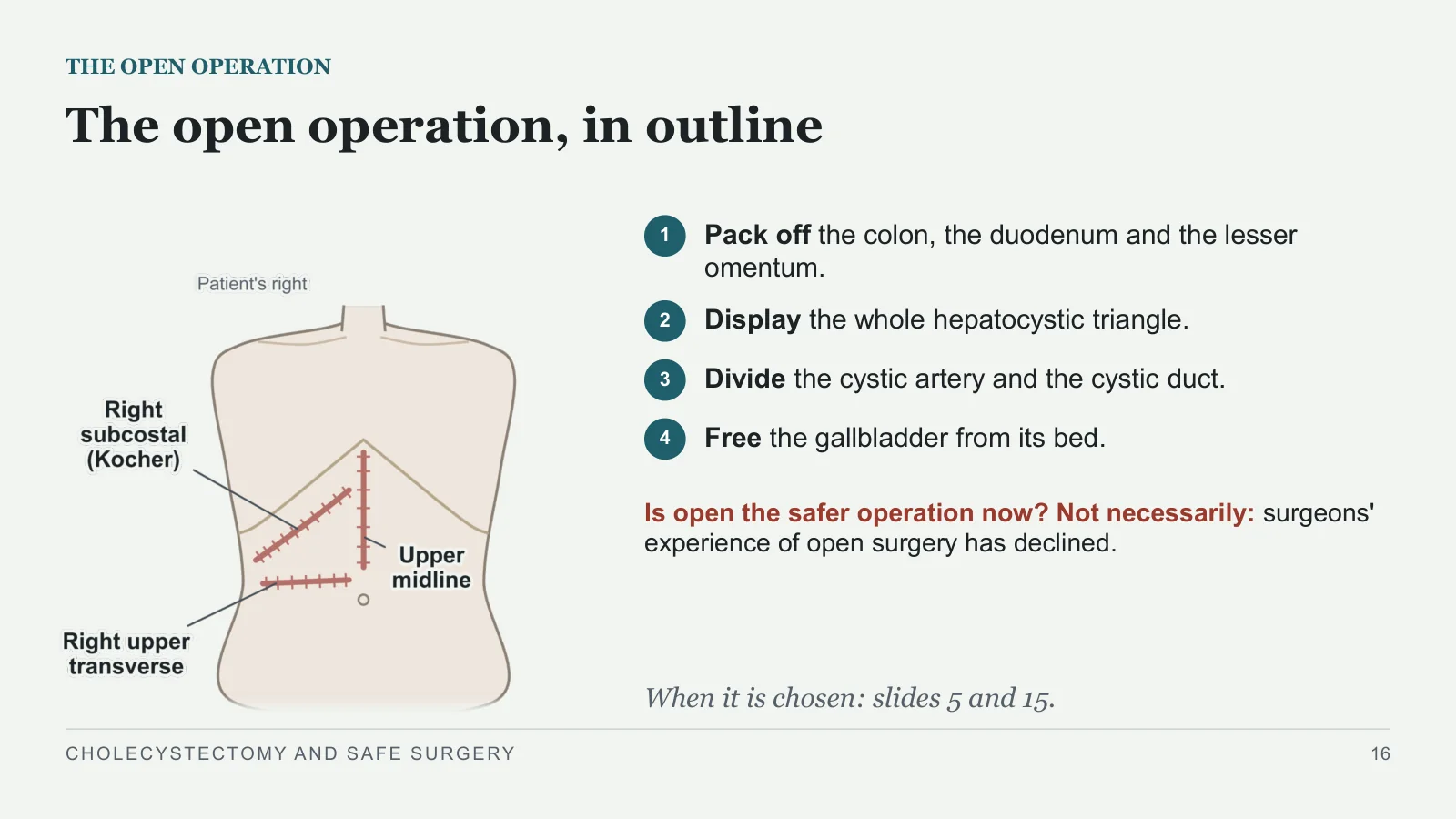
The open operation, in outline
THE OPEN OPERATION
1
Pack off the colon, the duodenum and the lesser omentum.
2
Display the whole hepatocystic triangle.
3
Divide the cystic artery and the cystic duct.
4
Free the gallbladder from its bed.
Is open the safer operation now? Not necessarily: surgeons' experience of open surgery has declined.
When it is chosen: slides 5 and 15.
CHOLECYSTECTOMY AND SAFE SURGERY
16
The operation, step by step
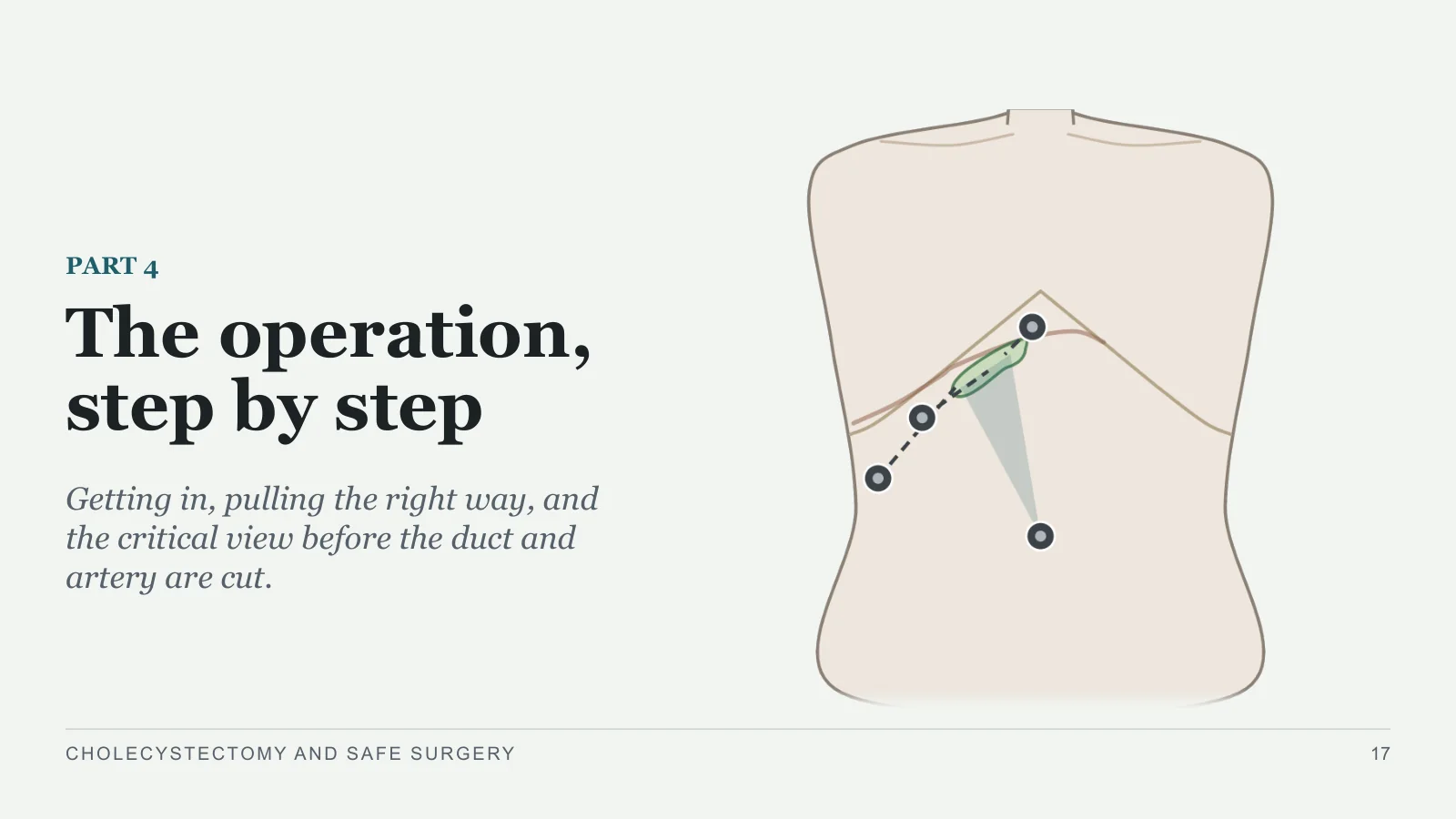
The operation, step by step
PART 4
Getting in, pulling the right way, and the critical view before the duct and artery are cut.
CHOLECYSTECTOMY AND SAFE SURGERY
17
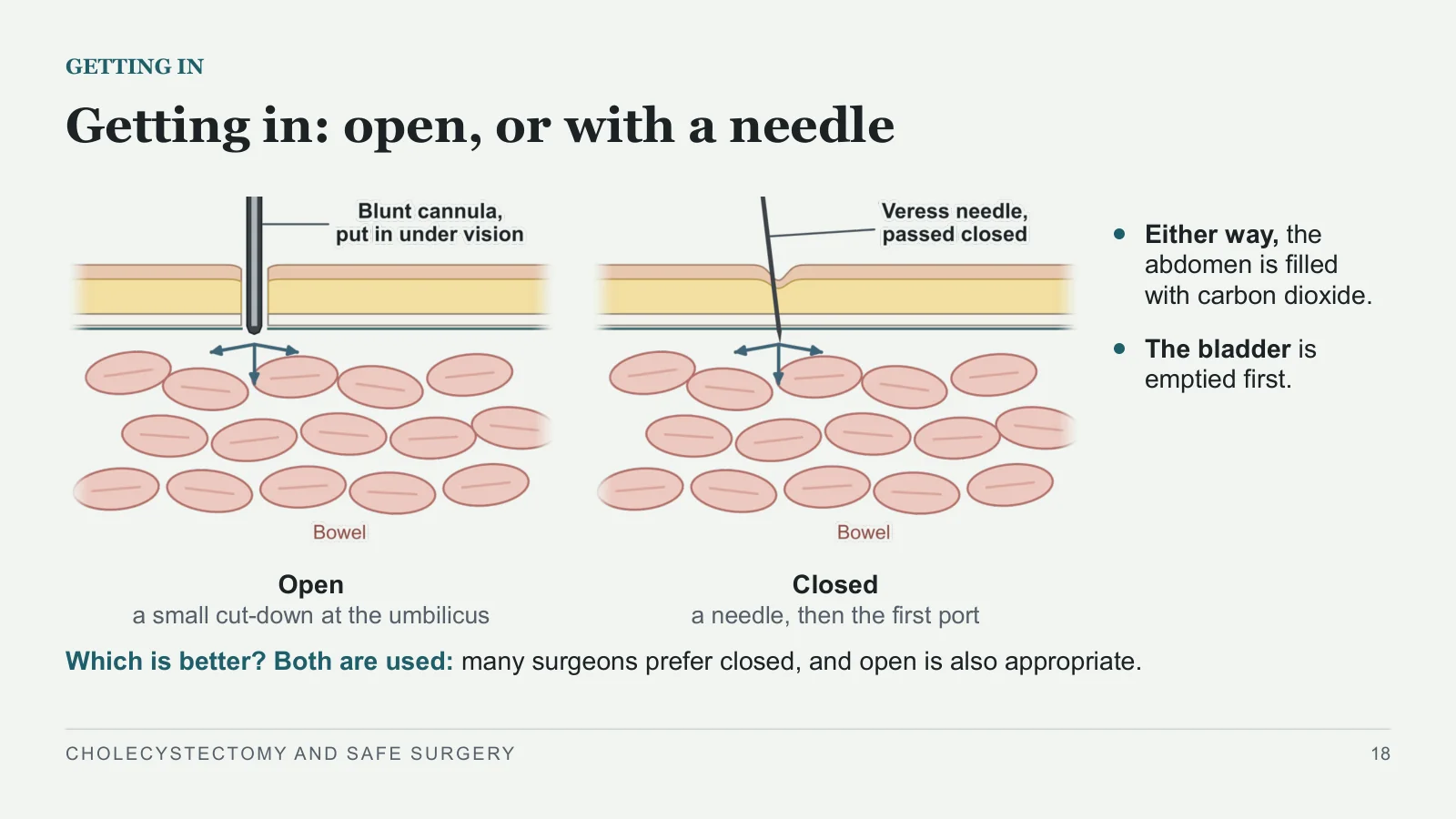
Getting in: open, or with a needle
GETTING IN
Open
a small cut-down at the umbilicus
Closed
a needle, then the first port
Either way, the abdomen is filled with carbon dioxide.
The bladder is emptied first.
Which is better? Both are used: many surgeons prefer closed, and open is also appropriate.
CHOLECYSTECTOMY AND SAFE SURGERY
18
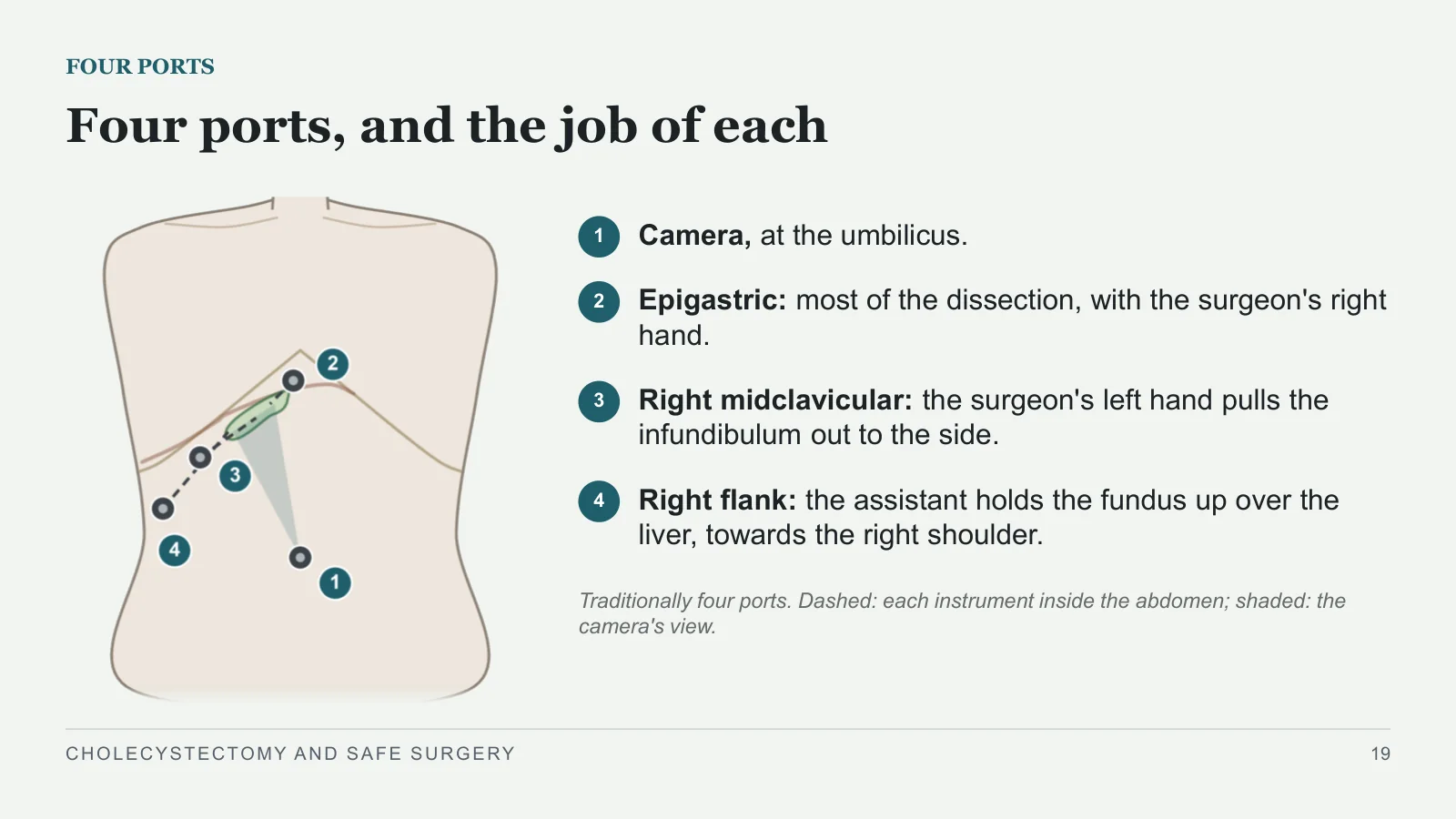
Four ports, and the job of each
FOUR PORTS
1
Camera, at the umbilicus.
2
Epigastric: most of the dissection, with the surgeon's right hand.
3
Right midclavicular: the surgeon's left hand pulls the infundibulum out to the side.
4
Right flank: the assistant holds the fundus up over the liver, towards the right shoulder.
Traditionally four ports. Dashed: each instrument inside the abdomen; shaded: the camera's view.
CHOLECYSTECTOMY AND SAFE SURGERY
19
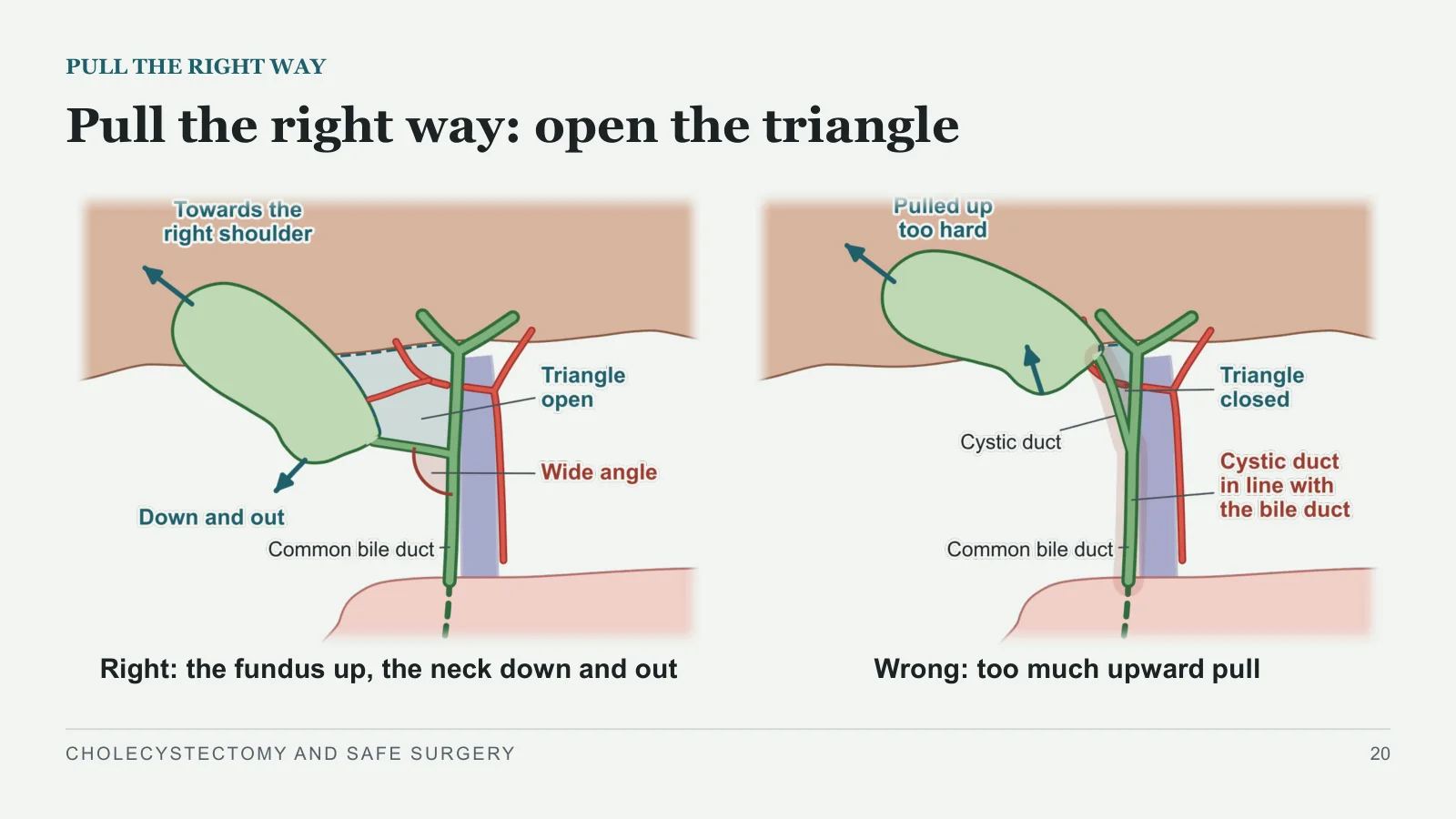
Pull the right way: open the triangle
PULL THE RIGHT WAY
Right: the fundus up, the neck down and out
Wrong: too much upward pull
CHOLECYSTECTOMY AND SAFE SURGERY
20
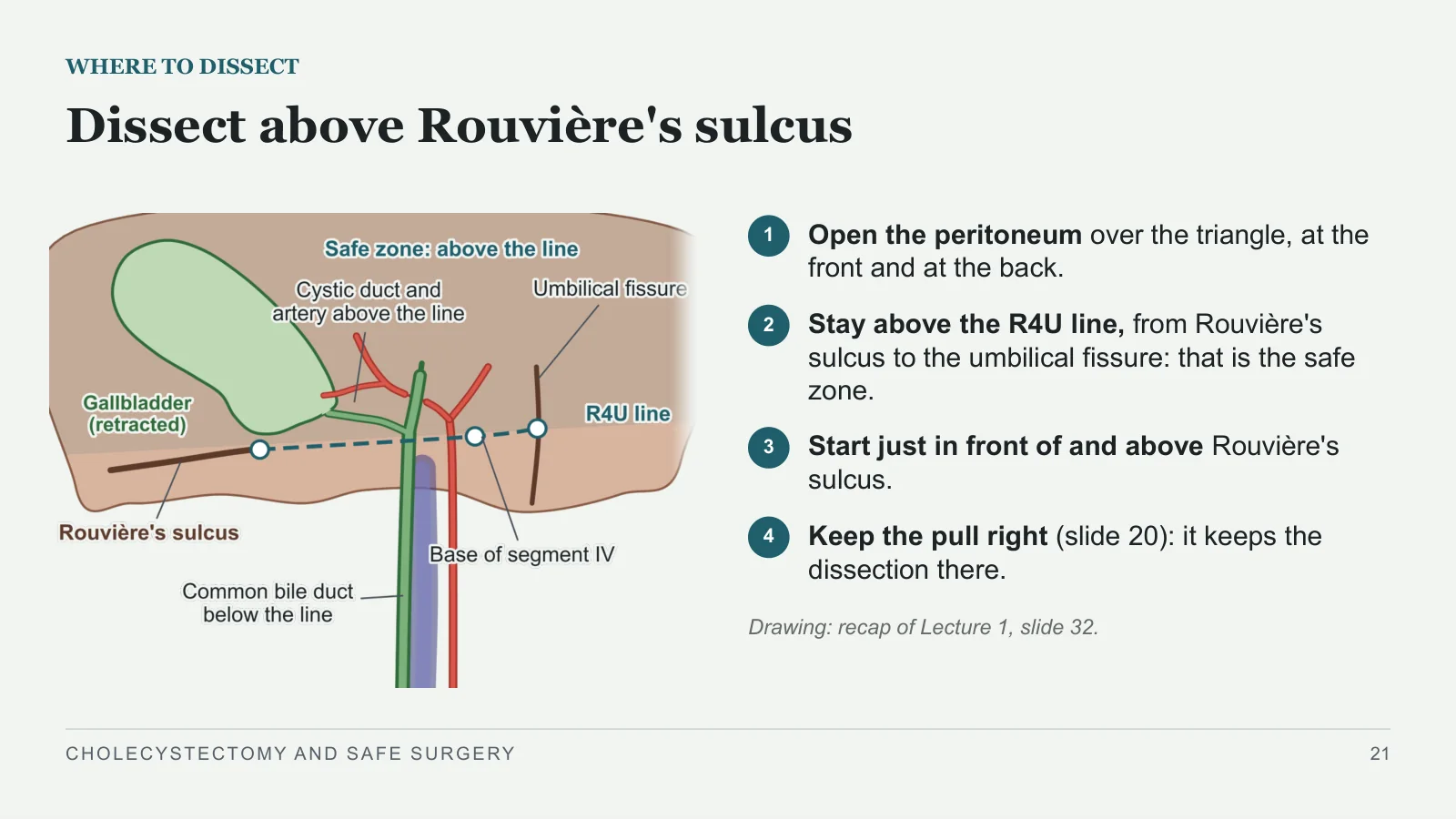
Dissect above Rouvière's sulcus
WHERE TO DISSECT
1
Open the peritoneum over the triangle, at the front and at the back.
2
Stay above the R4U line, from Rouvière's sulcus to the umbilical fissure: that is the safe zone.
3
Start just in front of and above Rouvière's sulcus.
4
Keep the pull right (slide 20): it keeps the dissection there.
Drawing: recap of Lecture 1, slide 32.
CHOLECYSTECTOMY AND SAFE SURGERY
21
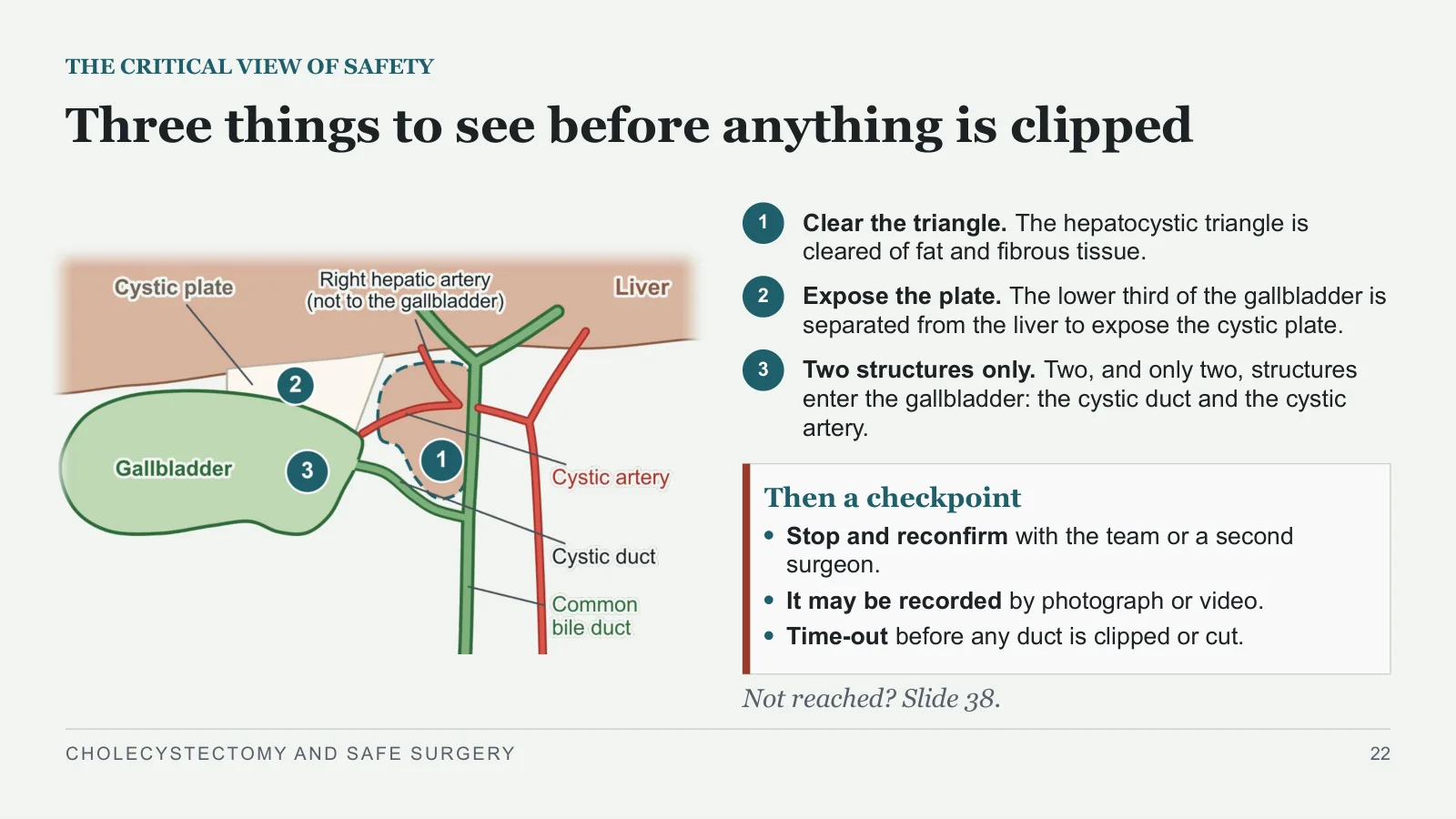
Three things to see before anything is clipped
THE CRITICAL VIEW OF SAFETY
1
Clear the triangle. The hepatocystic triangle is cleared of fat and fibrous tissue.
2
Expose the plate. The lower third of the gallbladder is separated from the liver to expose the cystic plate.
3
Two structures only. Two, and only two, structures enter the gallbladder: the cystic duct and the cystic artery.
Then a checkpoint
Stop and reconfirm with the team or a second surgeon.
It may be recorded by photograph or video.
Time-out before any duct is clipped or cut.
Not reached? Slide 38.
CHOLECYSTECTOMY AND SAFE SURGERY
22
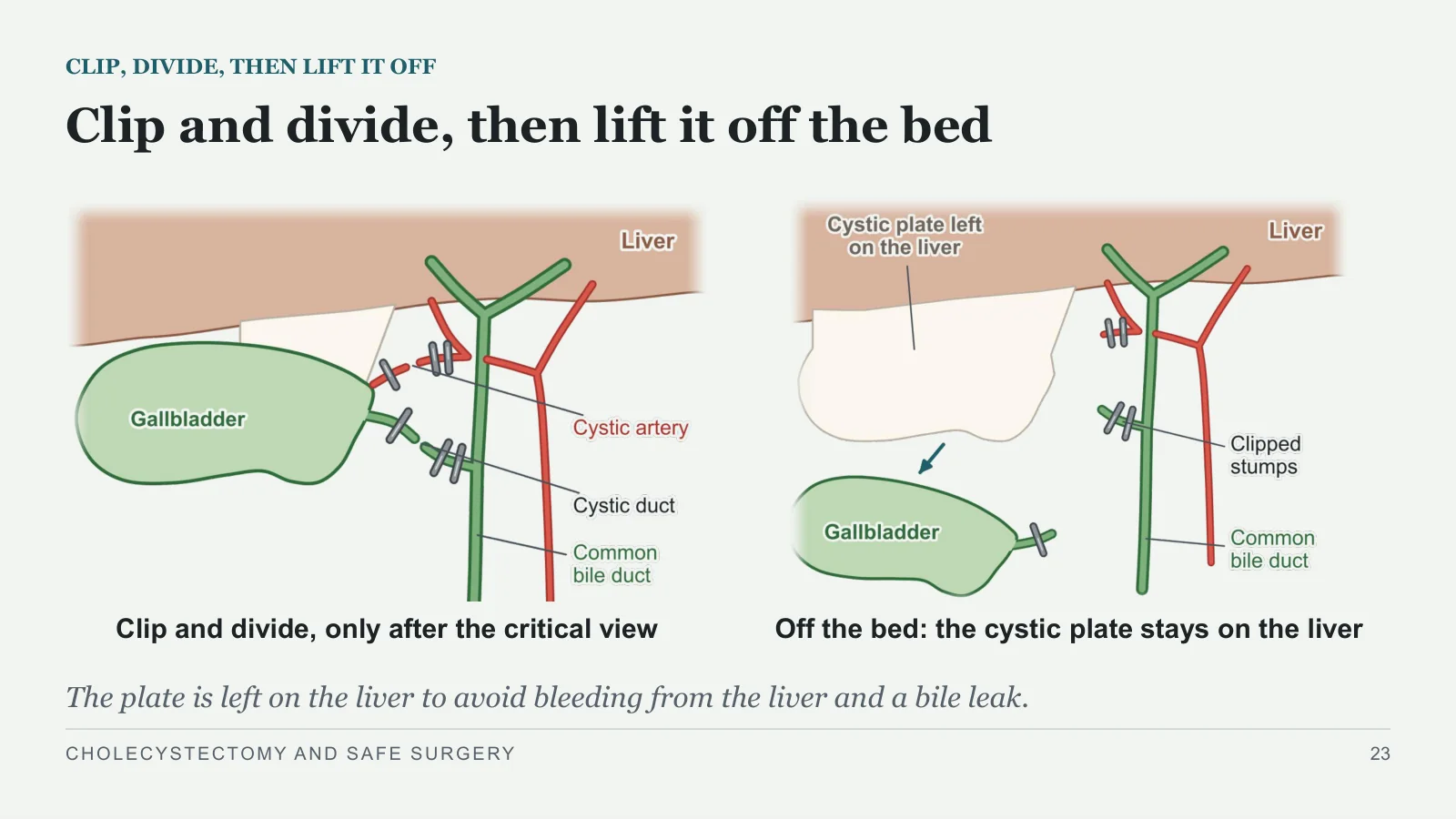
Clip and divide, then lift it off the bed
CLIP, DIVIDE, THEN LIFT IT OFF
Clip and divide, only after the critical view
Off the bed: the cystic plate stays on the liver
The plate is left on the liver to avoid bleeding from the liver and a bile leak.
CHOLECYSTECTOMY AND SAFE SURGERY
23
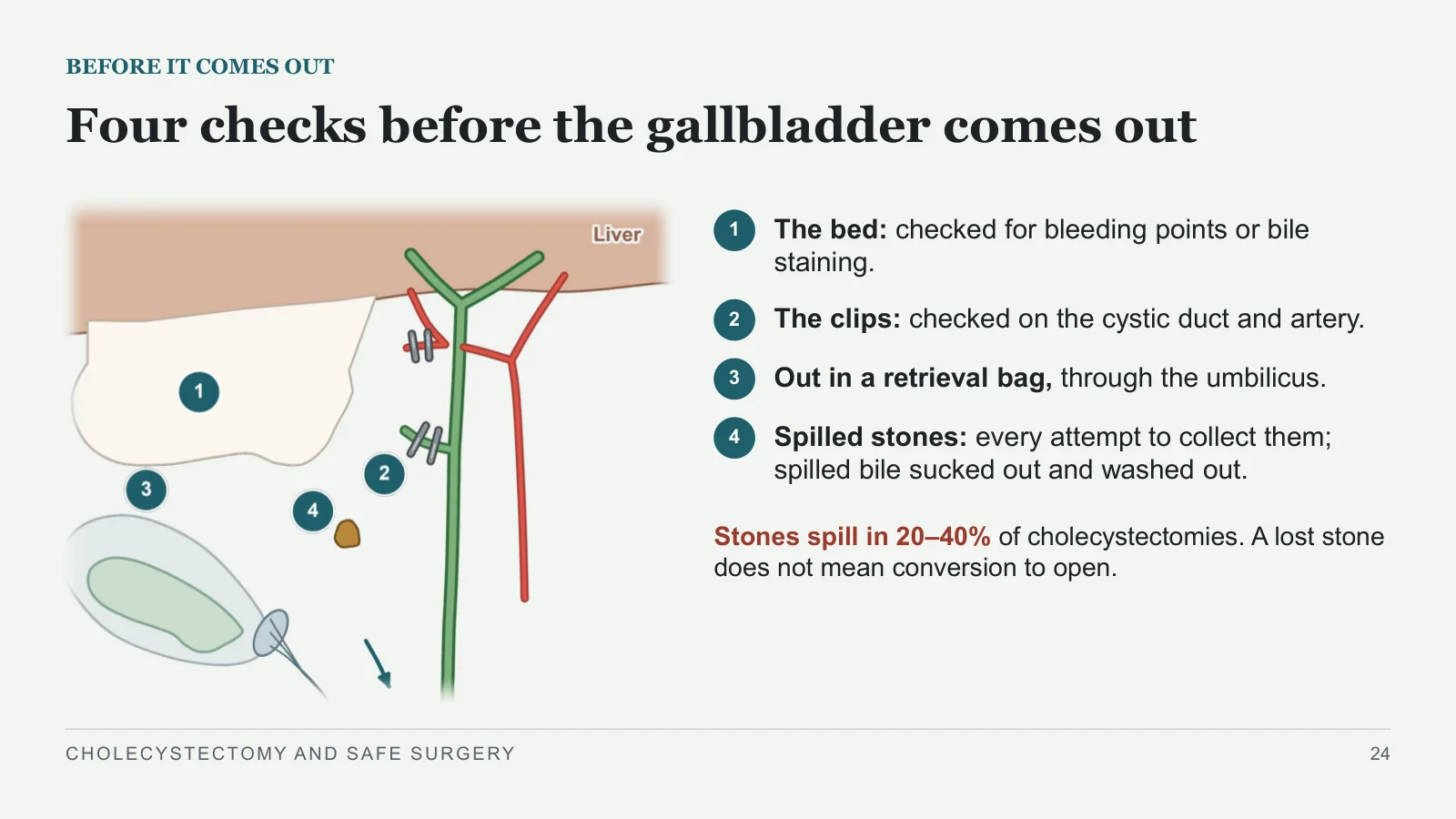
Four checks before the gallbladder comes out
BEFORE IT COMES OUT
1
The bed: checked for bleeding points or bile staining.
2
The clips: checked on the cystic duct and artery.
3
Out in a retrieval bag, through the umbilicus.
4
Spilled stones: every attempt to collect them; spilled bile sucked out and washed out.
Stones spill in 20–40% of cholecystectomies. A lost stone does not mean conversion to open.
CHOLECYSTECTOMY AND SAFE SURGERY
24
Imaging at operation
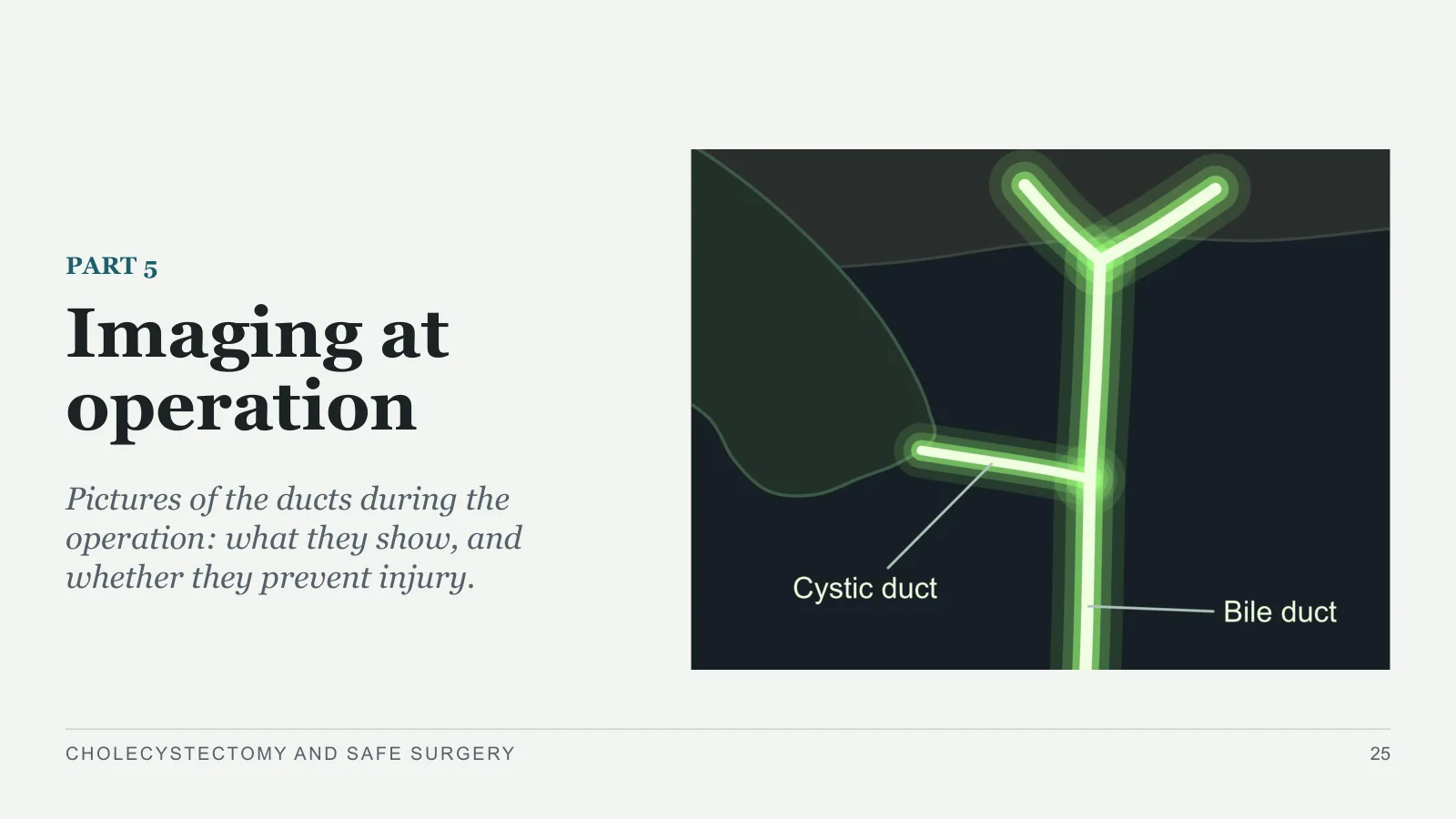
Imaging at operation
PART 5
Pictures of the ducts during the operation: what they show, and whether they prevent injury.
CHOLECYSTECTOMY AND SAFE SURGERY
25
The operative cholangiogram
THE OPERATIVE CHOLANGIOGRAM
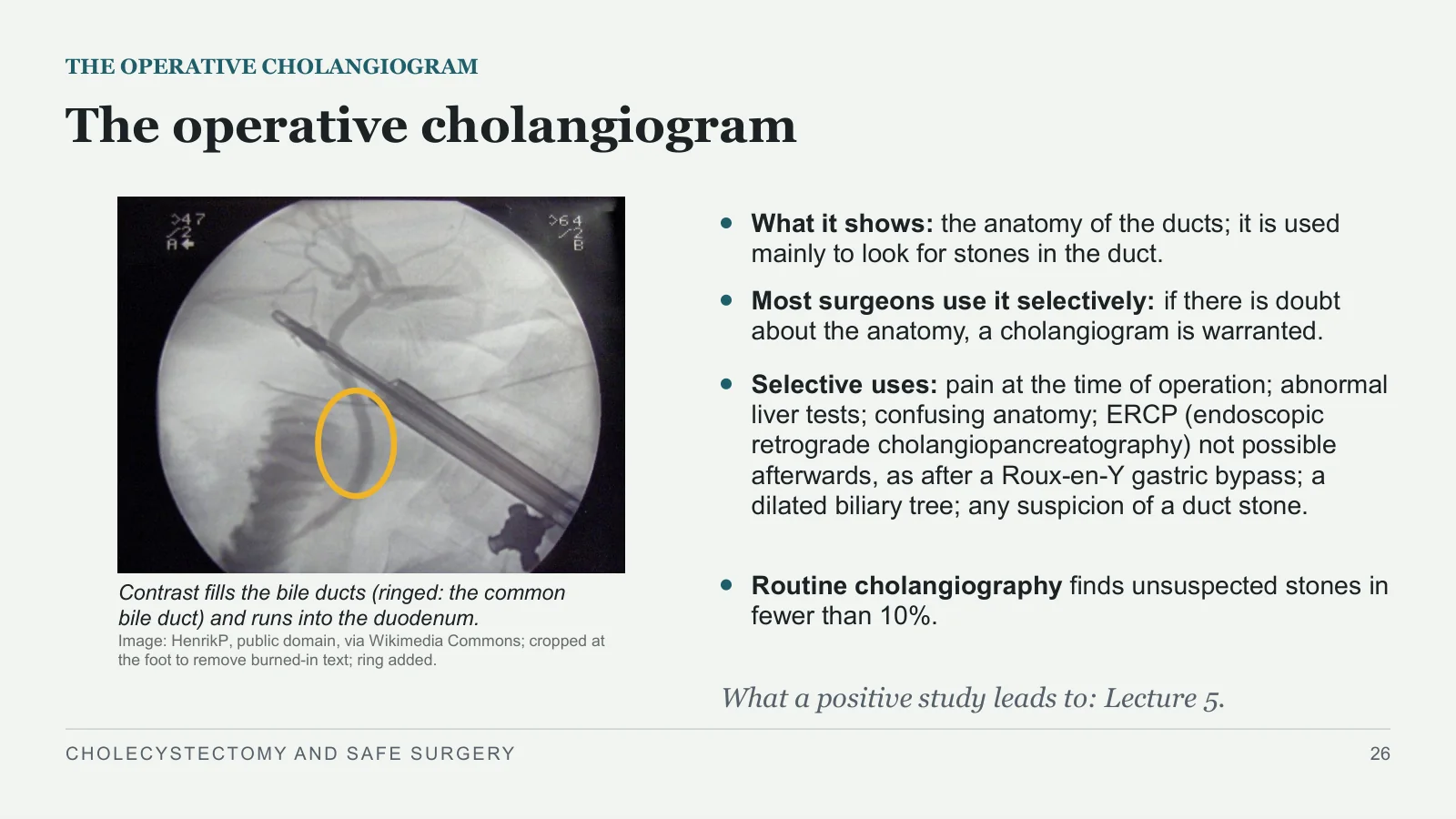
Contrast fills the bile ducts (ringed: the common bile duct) and runs into the duodenum.
Image: HenrikP, public domain, via Wikimedia Commons; cropped at the foot to remove burned-in text; ring added.
What it shows: the anatomy of the ducts; it is used mainly to look for stones in the duct.
Most surgeons use it selectively: if there is doubt about the anatomy, a cholangiogram is warranted.
Selective uses: pain at the time of operation; abnormal liver tests; confusing anatomy; ERCP (endoscopic retrograde cholangiopancreatography) not possible afterwards, as after a Roux-en-Y gastric bypass; a dilated biliary tree; any suspicion of a duct stone.
Routine cholangiography finds unsuspected stones in fewer than 10%.
What a positive study leads to: Lecture 5.
CHOLECYSTECTOMY AND SAFE SURGERY
26
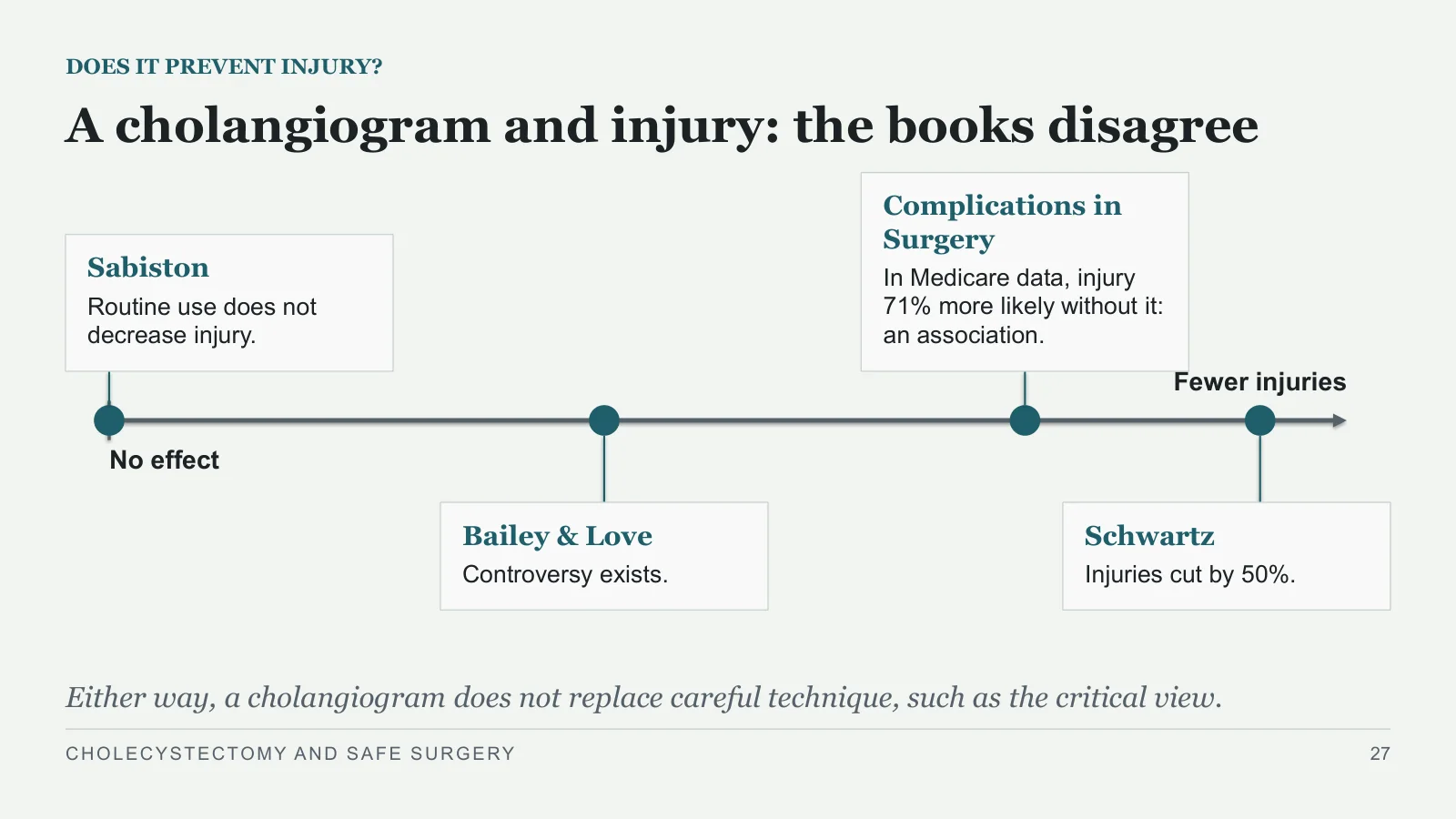
A cholangiogram and injury: the books disagree
DOES IT PREVENT INJURY?
No effect
Fewer injuries
Sabiston
Routine use does not decrease injury.
Bailey & Love
Controversy exists.
Complications in Surgery
In Medicare data, injury 71% more likely without it: an association.
Schwartz
Injuries cut by 50%.
Either way, a cholangiogram does not replace careful technique, such as the critical view.
CHOLECYSTECTOMY AND SAFE SURGERY
27
Fluorescence, and ultrasound at operation
ULTRASOUND AND FLUORESCENCE
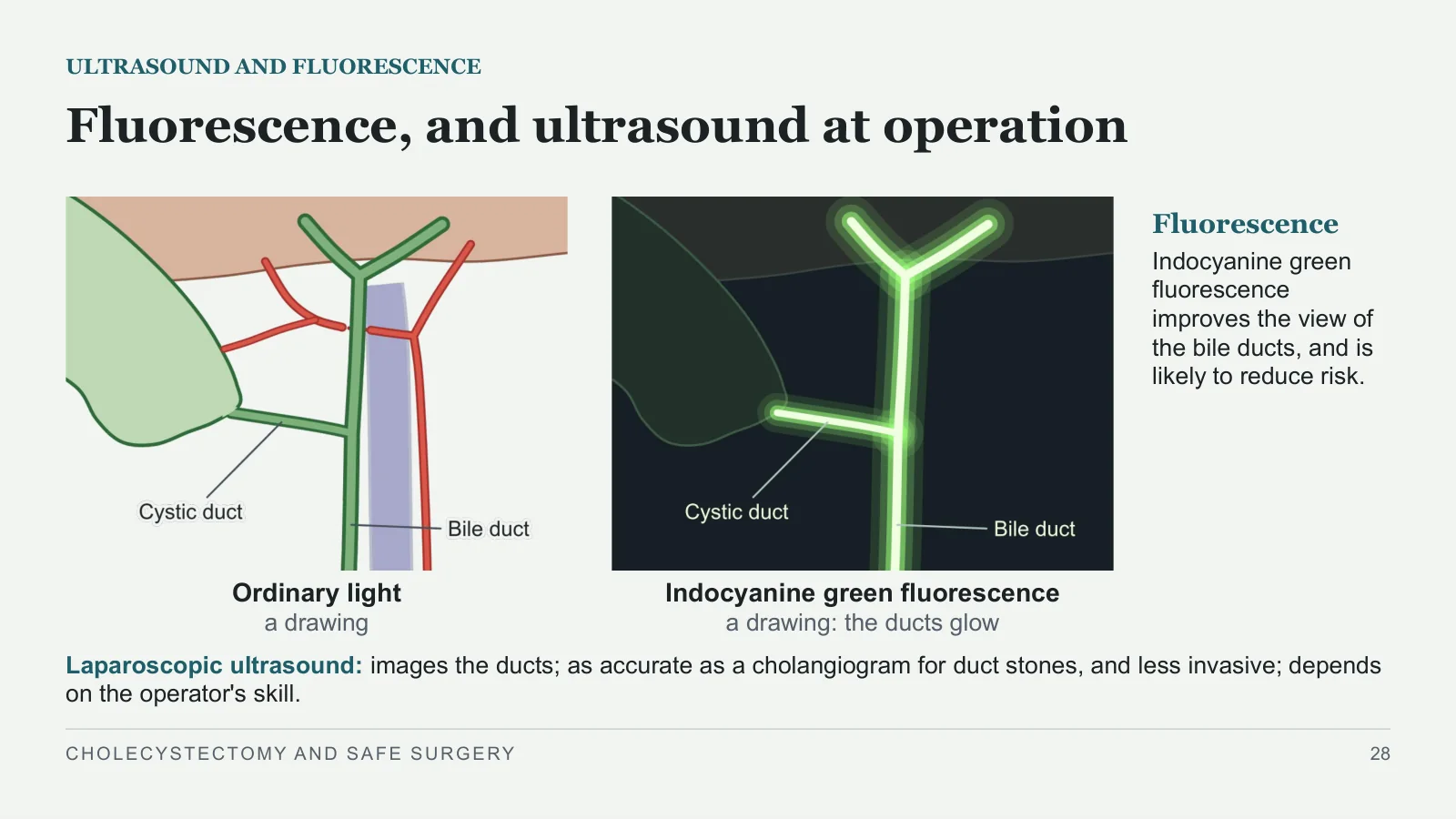
Ordinary light
a drawing
Indocyanine green fluorescence
a drawing: the ducts glow
Fluorescence
Indocyanine green fluorescence improves the view of the bile ducts, and is likely to reduce risk.
Laparoscopic ultrasound: images the ducts; as accurate as a cholangiogram for duct stones, and less invasive; depends on the operator's skill.
CHOLECYSTECTOMY AND SAFE SURGERY
28
Bile duct injury
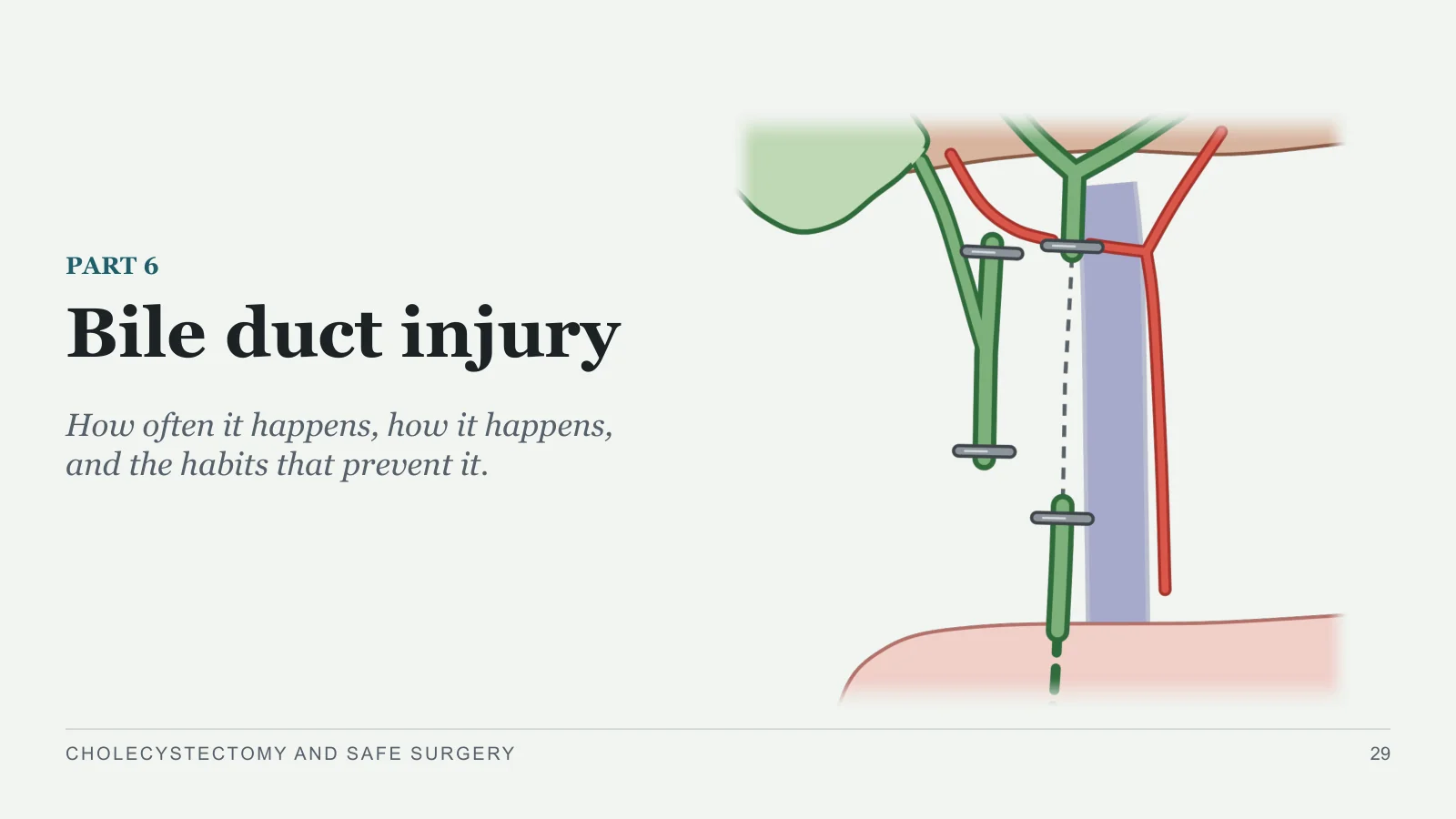
Bile duct injury
PART 6
How often it happens, how it happens, and the habits that prevent it.
CHOLECYSTECTOMY AND SAFE SURGERY
29
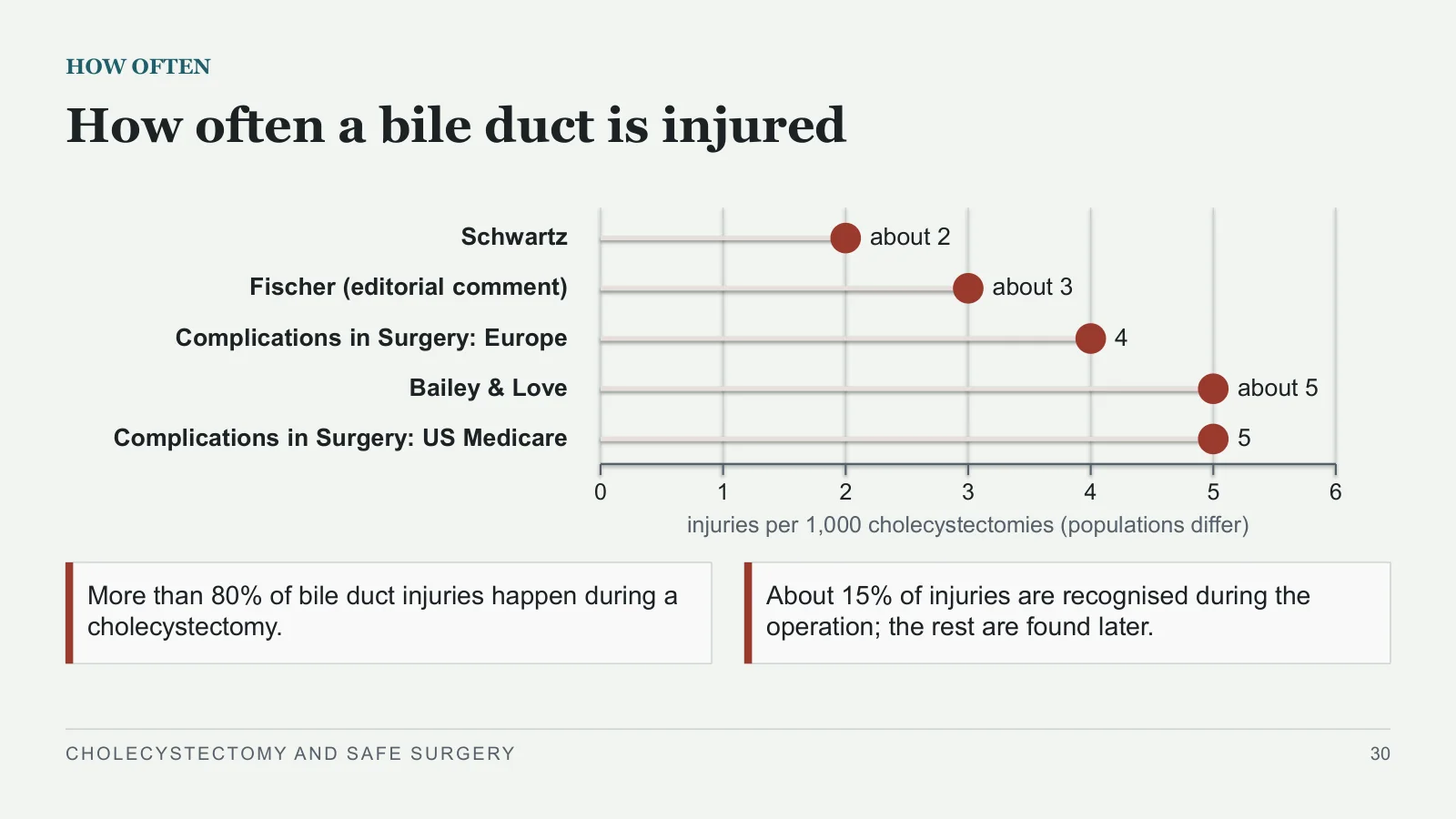
How often a bile duct is injured
HOW OFTEN
Schwartz
about 2
Fischer (editorial comment)
about 3
Complications in Surgery: Europe
4
Bailey & Love
about 5
Complications in Surgery: US Medicare
5
0
1
2
3
4
5
6
injuries per 1,000 cholecystectomies (populations differ)
More than 80% of bile duct injuries happen during a cholecystectomy.
About 15% of injuries are recognised during the operation; the rest are found later.
CHOLECYSTECTOMY AND SAFE SURGERY
30
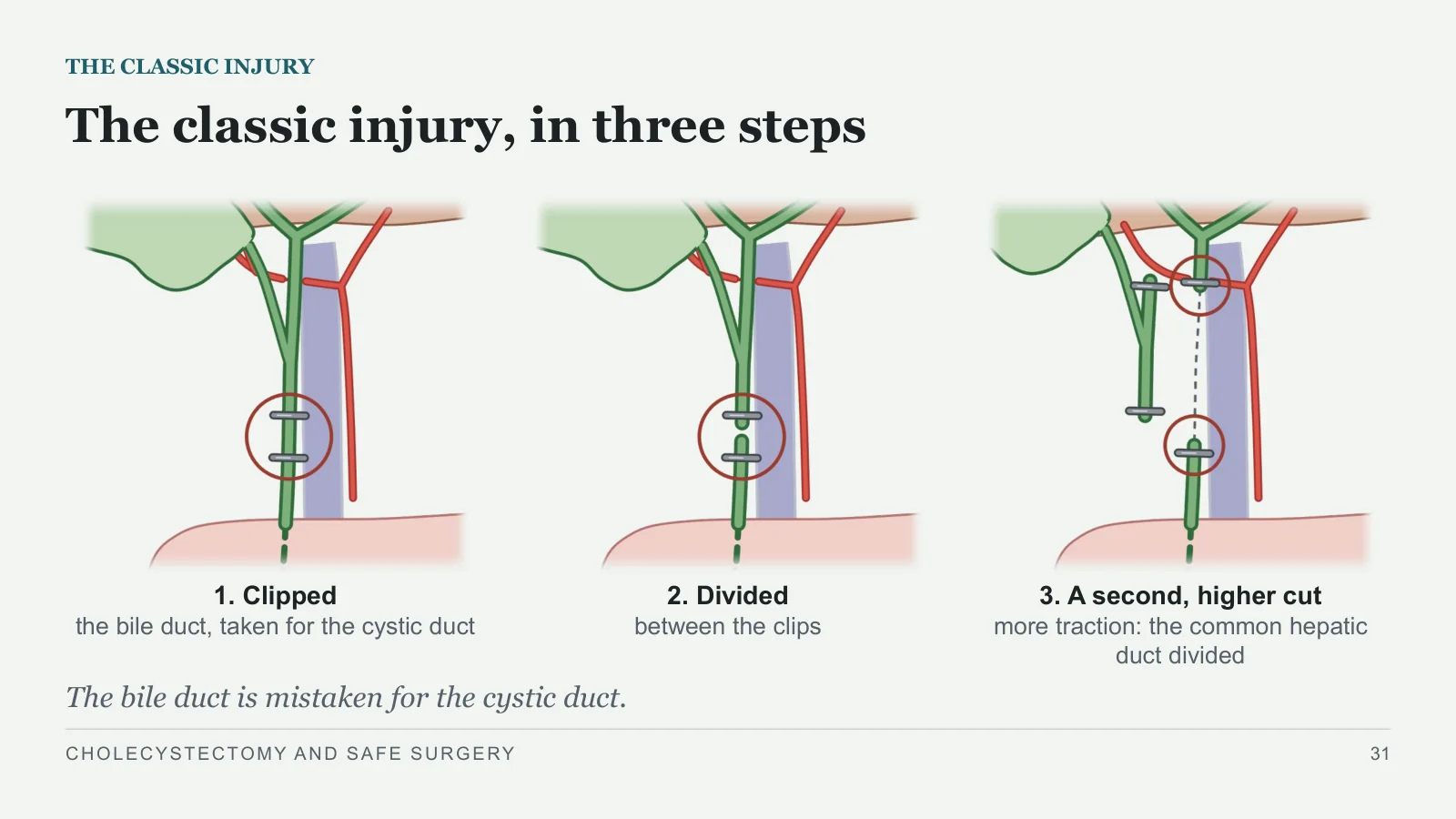
The classic injury, in three steps
THE CLASSIC INJURY
1. Clipped
the bile duct, taken for the cystic duct
2. Divided
between the clips
3. A second, higher cut
more traction: the common hepatic duct divided
The bile duct is mistaken for the cystic duct.
CHOLECYSTECTOMY AND SAFE SURGERY
31
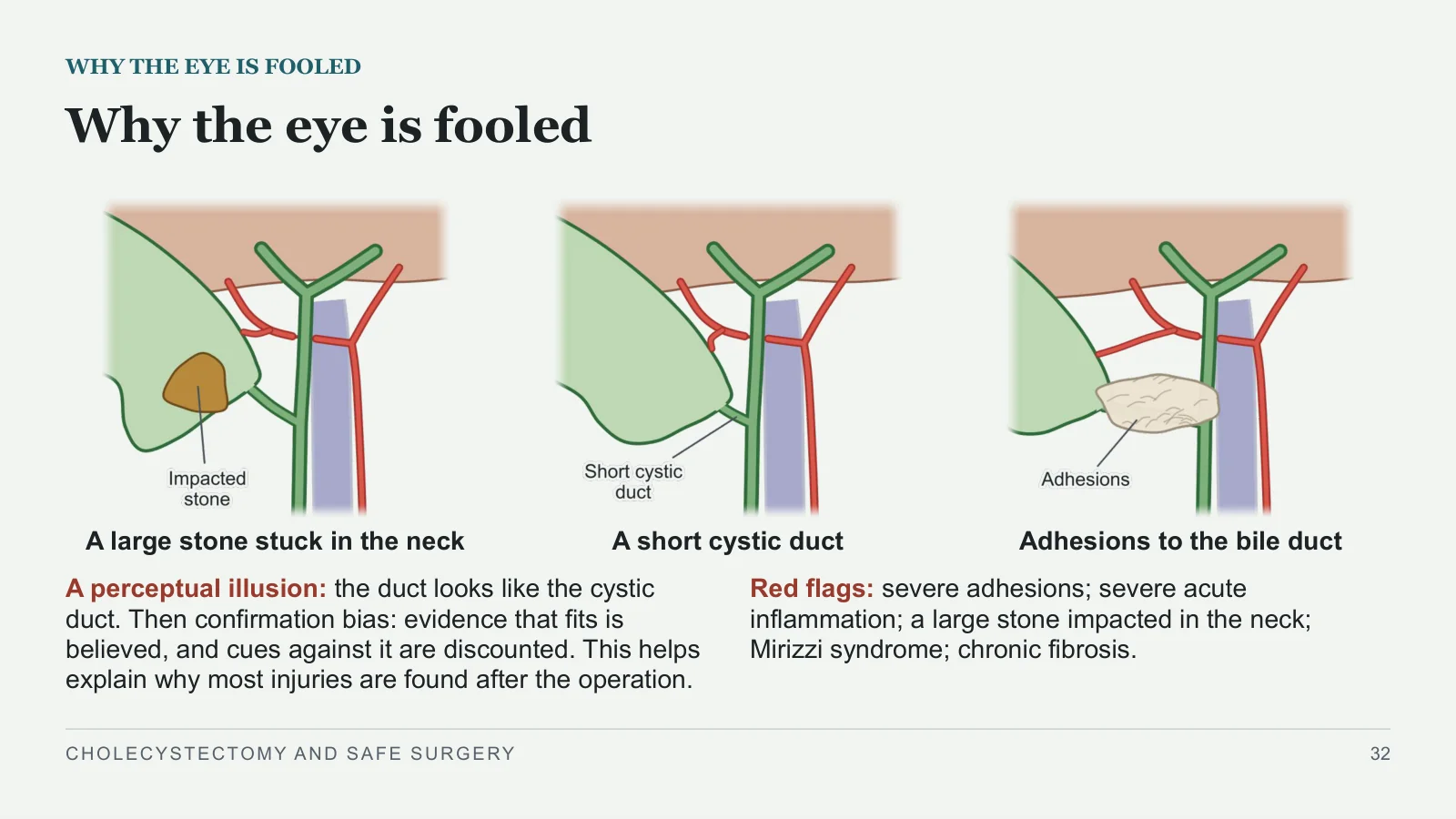
Why the eye is fooled
WHY THE EYE IS FOOLED
A large stone stuck in the neck
A short cystic duct
Adhesions to the bile duct
A perceptual illusion: the duct looks like the cystic duct. Then confirmation bias: evidence that fits is believed, and cues against it are discounted. This helps explain why most injuries are found after the operation.
Red flags: severe adhesions; severe acute inflammation; a large stone impacted in the neck; Mirizzi syndrome; chronic fibrosis.
CHOLECYSTECTOMY AND SAFE SURGERY
32
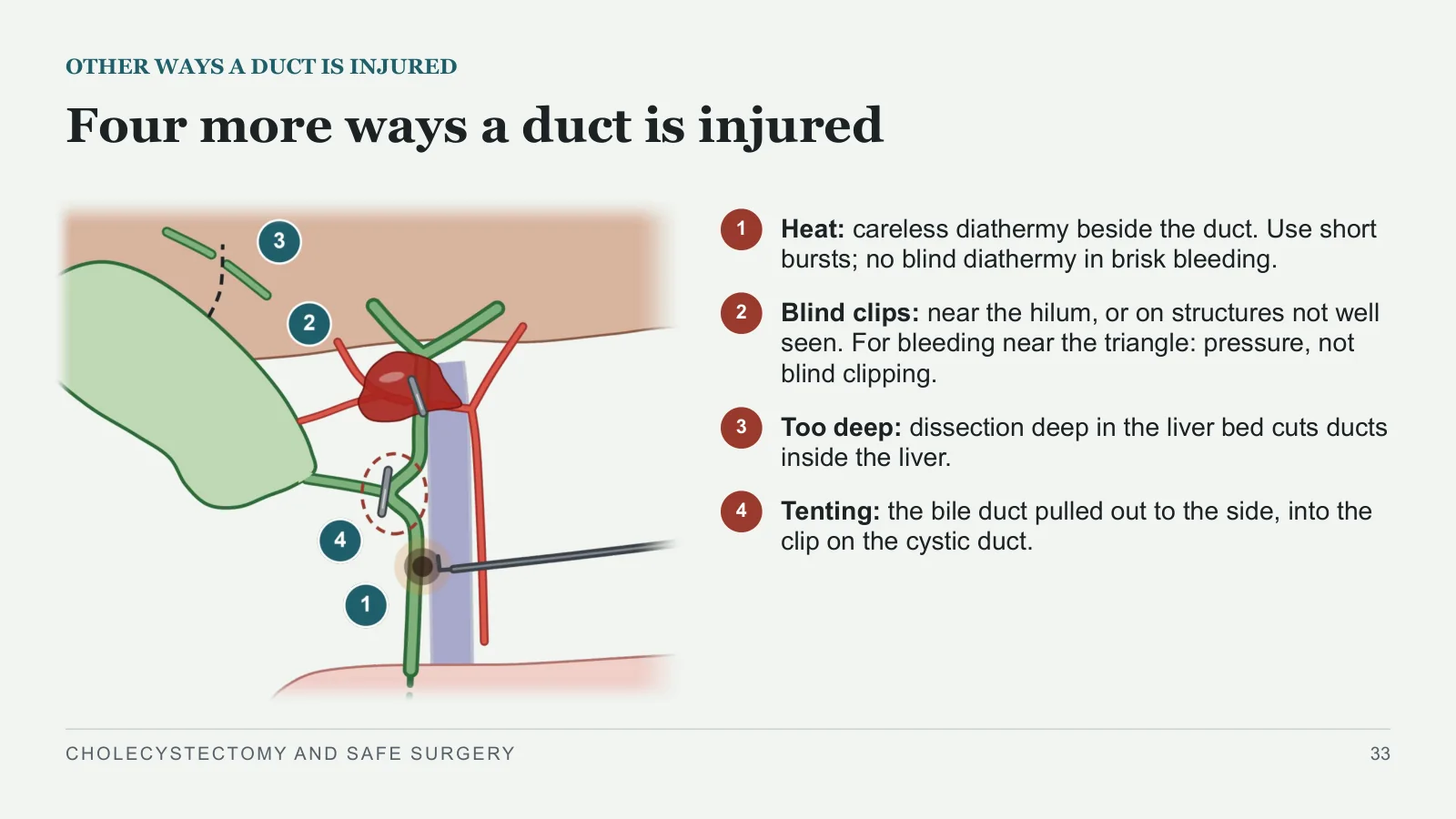
Four more ways a duct is injured
OTHER WAYS A DUCT IS INJURED
1
Heat: careless diathermy beside the duct. Use short bursts; no blind diathermy in brisk bleeding.
2
Blind clips: near the hilum, or on structures not well seen. For bleeding near the triangle: pressure, not blind clipping.
3
Too deep: dissection deep in the liver bed cuts ducts inside the liver.
4
Tenting: the bile duct pulled out to the side, into the clip on the cystic duct.
CHOLECYSTECTOMY AND SAFE SURGERY
33
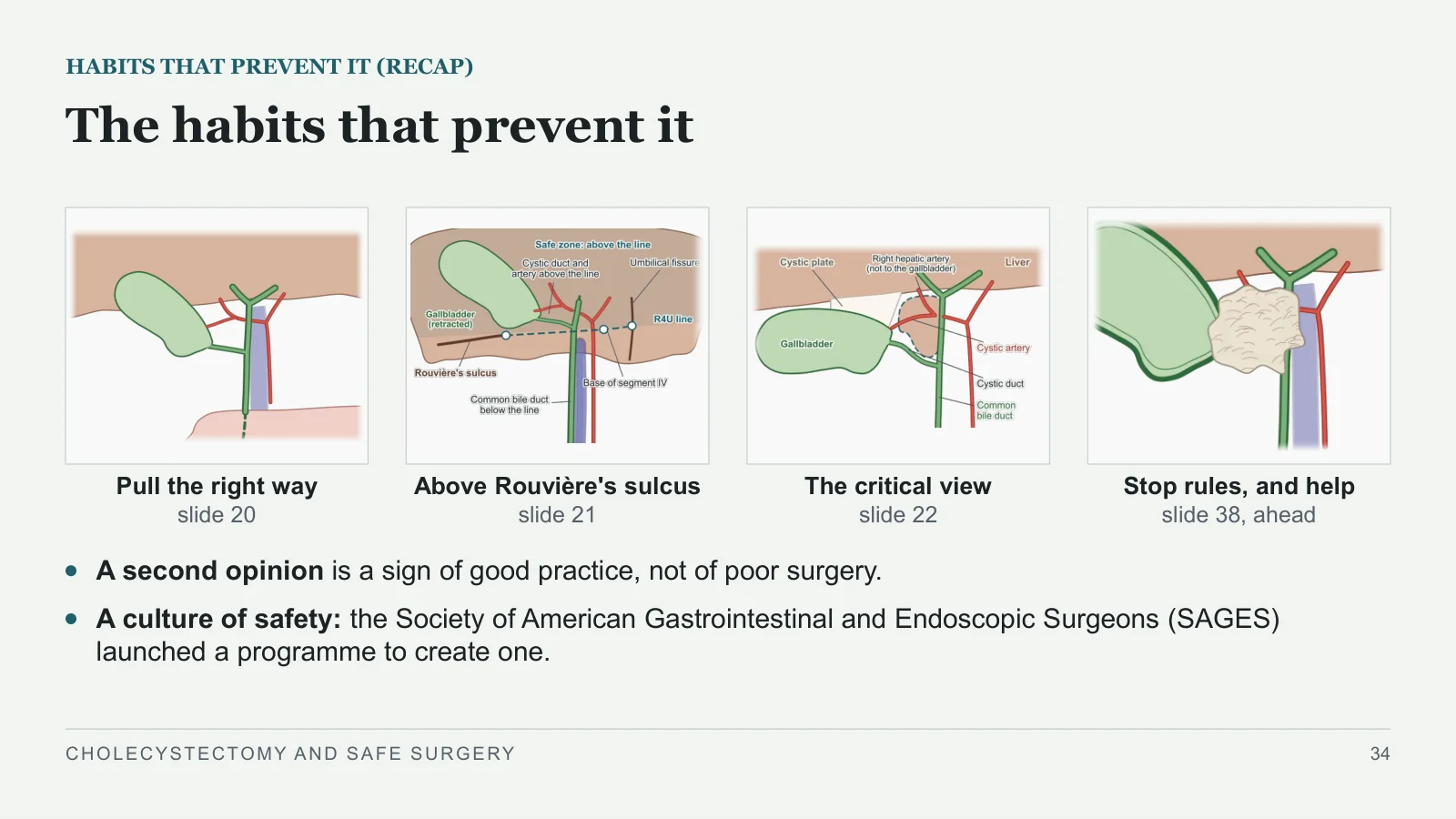
The habits that prevent it
HABITS THAT PREVENT IT (RECAP)
Pull the right way
slide 20
Above Rouvière's sulcus
slide 21
The critical view
slide 22
Stop rules, and help
slide 38, ahead
A second opinion is a sign of good practice, not of poor surgery.
A culture of safety: the Society of American Gastrointestinal and Endoscopic Surgeons (SAGES) launched a programme to create one.
CHOLECYSTECTOMY AND SAFE SURGERY
34
When the anatomy will not come clear
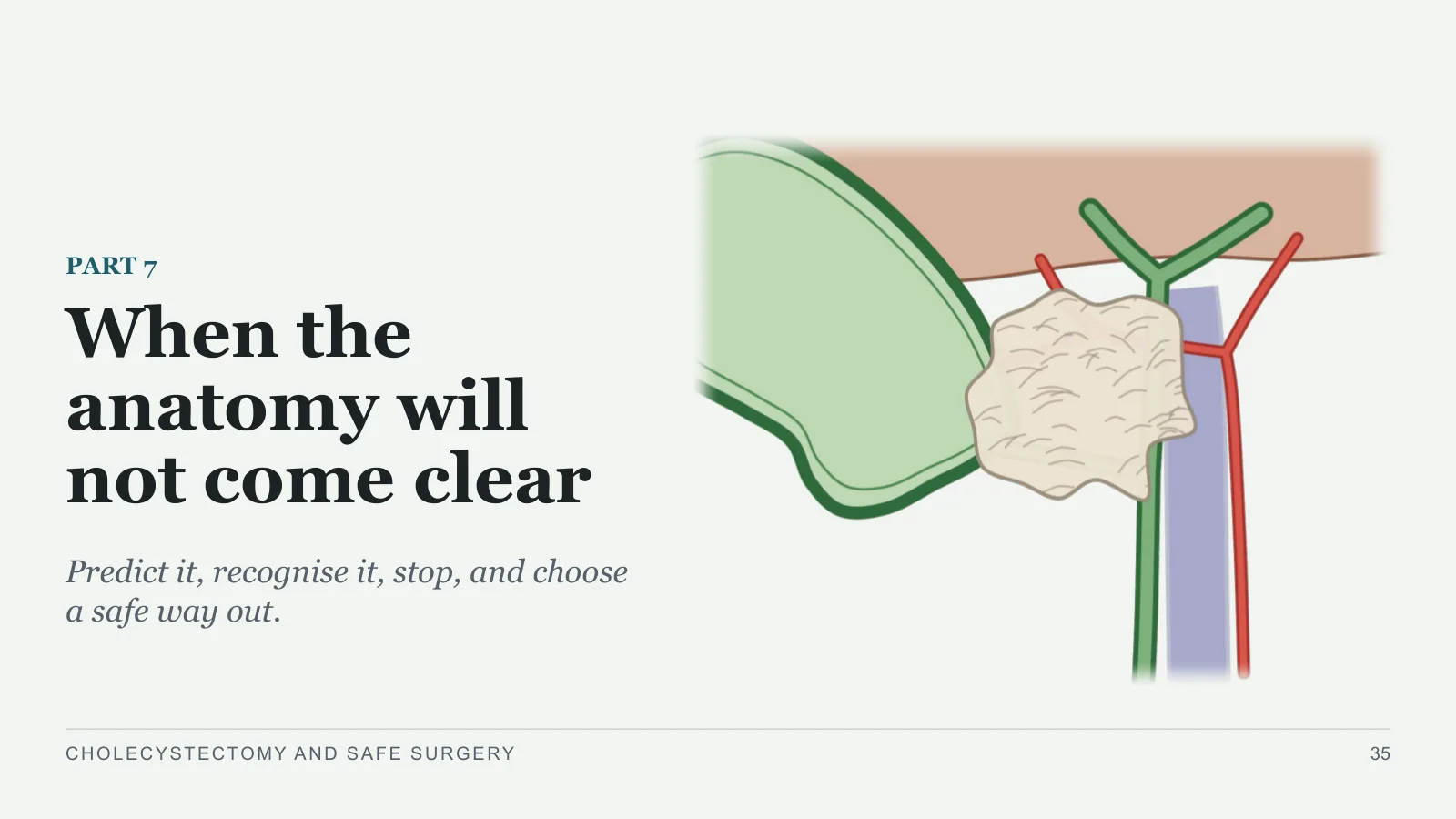
When the anatomy will not come clear
PART 7
Predict it, recognise it, stop, and choose a safe way out.
CHOLECYSTECTOMY AND SAFE SURGERY
35
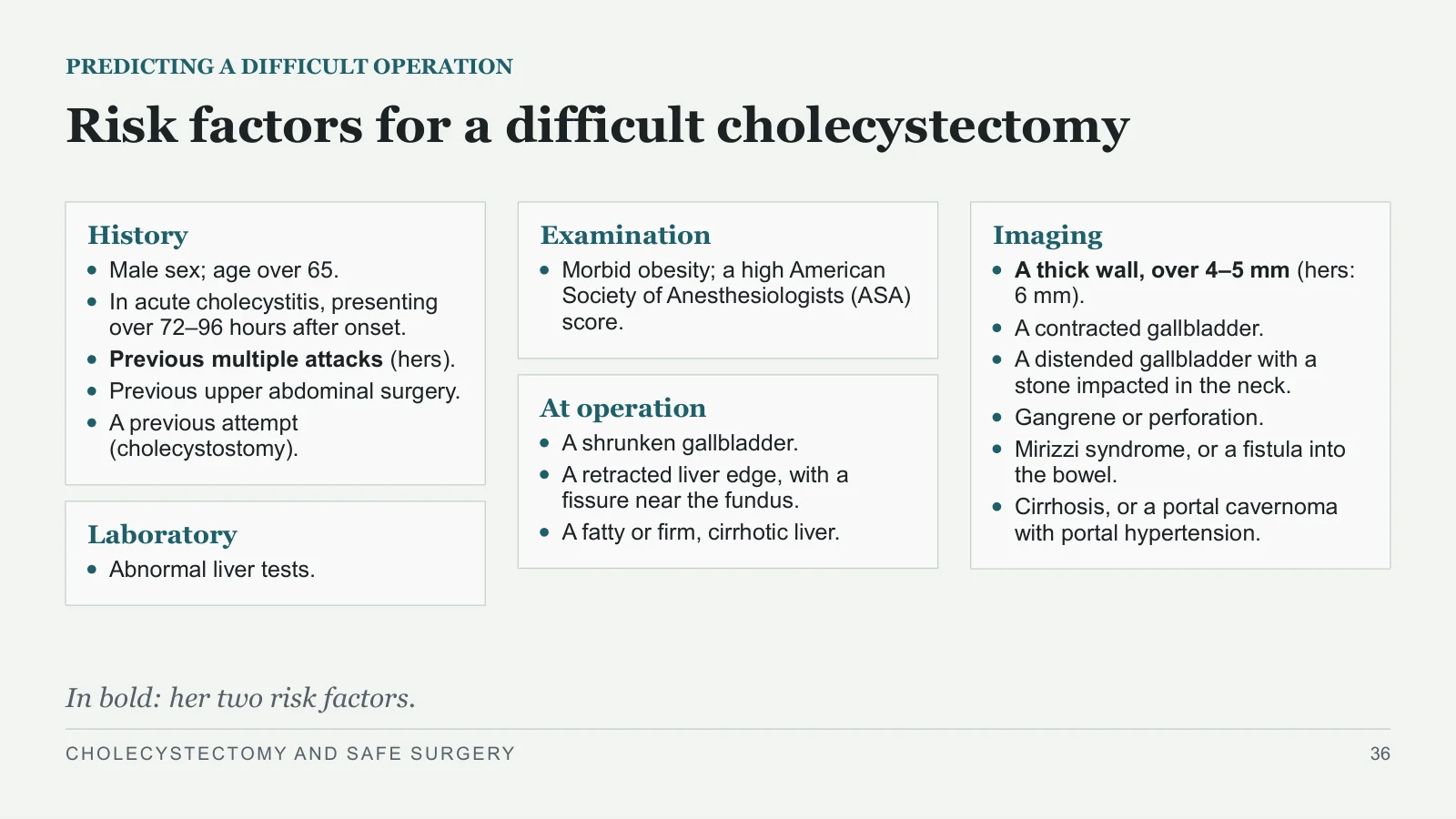
Risk factors for a difficult cholecystectomy
PREDICTING A DIFFICULT OPERATION
History
Male sex; age over 65.
In acute cholecystitis, presenting over 72–96 hours after onset.
Previous multiple attacks (hers).
Previous upper abdominal surgery.
A previous attempt (cholecystostomy).
Laboratory
Abnormal liver tests.
Examination
Morbid obesity; a high American Society of Anesthesiologists (ASA) score.
At operation
A shrunken gallbladder.
A retracted liver edge, with a fissure near the fundus.
A fatty or firm, cirrhotic liver.
Imaging
A thick wall, over 4–5 mm (hers: 6 mm).
A contracted gallbladder.
A distended gallbladder with a stone impacted in the neck.
Gangrene or perforation.
Mirizzi syndrome, or a fistula into the bowel.
Cirrhosis, or a portal cavernoma with portal hypertension.
In bold: her two risk factors.
CHOLECYSTECTOMY AND SAFE SURGERY
36
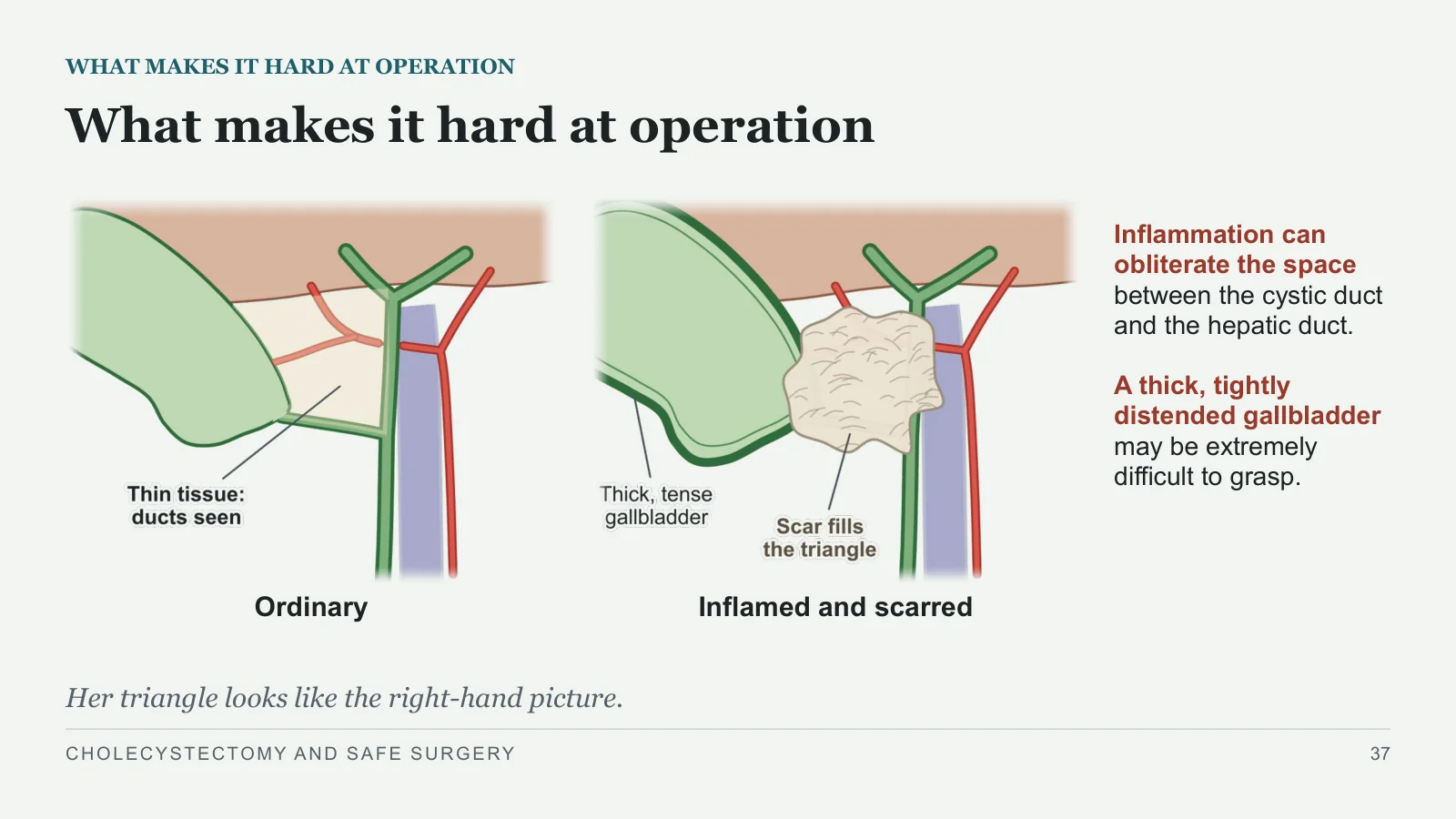
What makes it hard at operation
WHAT MAKES IT HARD AT OPERATION
Ordinary
Inflamed and scarred
Inflammation can obliterate the space between the cystic duct and the hepatic duct.
A thick, tightly distended gallbladder may be extremely difficult to grasp.
Her triangle looks like the right-hand picture.
CHOLECYSTECTOMY AND SAFE SURGERY
37
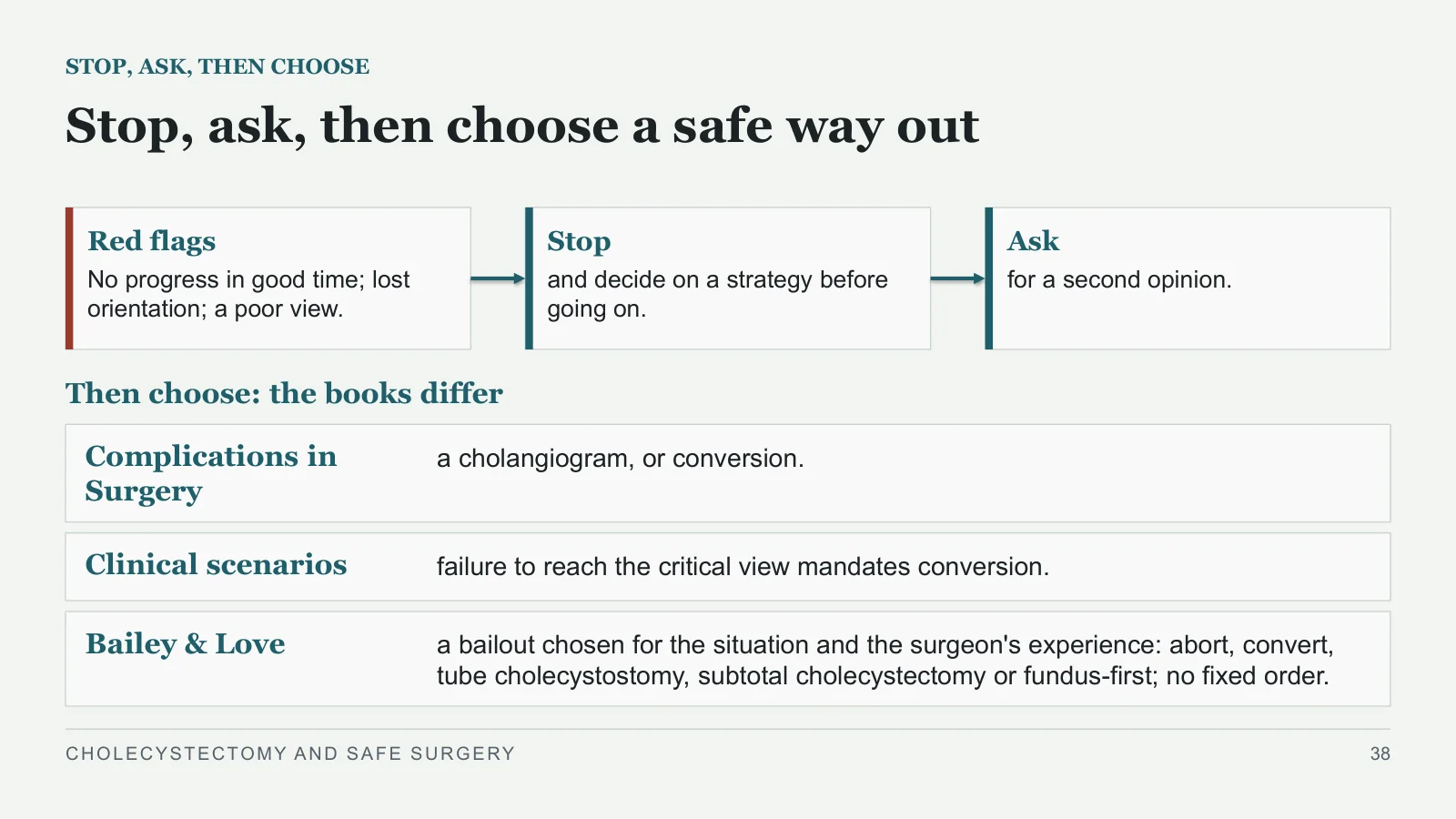
Stop, ask, then choose a safe way out
STOP, ASK, THEN CHOOSE
Red flags
No progress in good time; lost orientation; a poor view.
Stop
and decide on a strategy before going on.
Ask
for a second opinion.
Then choose: the books differ
Complications in Surgery
a cholangiogram, or conversion.
Clinical scenarios
failure to reach the critical view mandates conversion.
Bailey & Love
a bailout chosen for the situation and the surgeon's experience: abort, convert, tube cholecystostomy, subtotal cholecystectomy or fundus-first; no fixed order.
CHOLECYSTECTOMY AND SAFE SURGERY
38
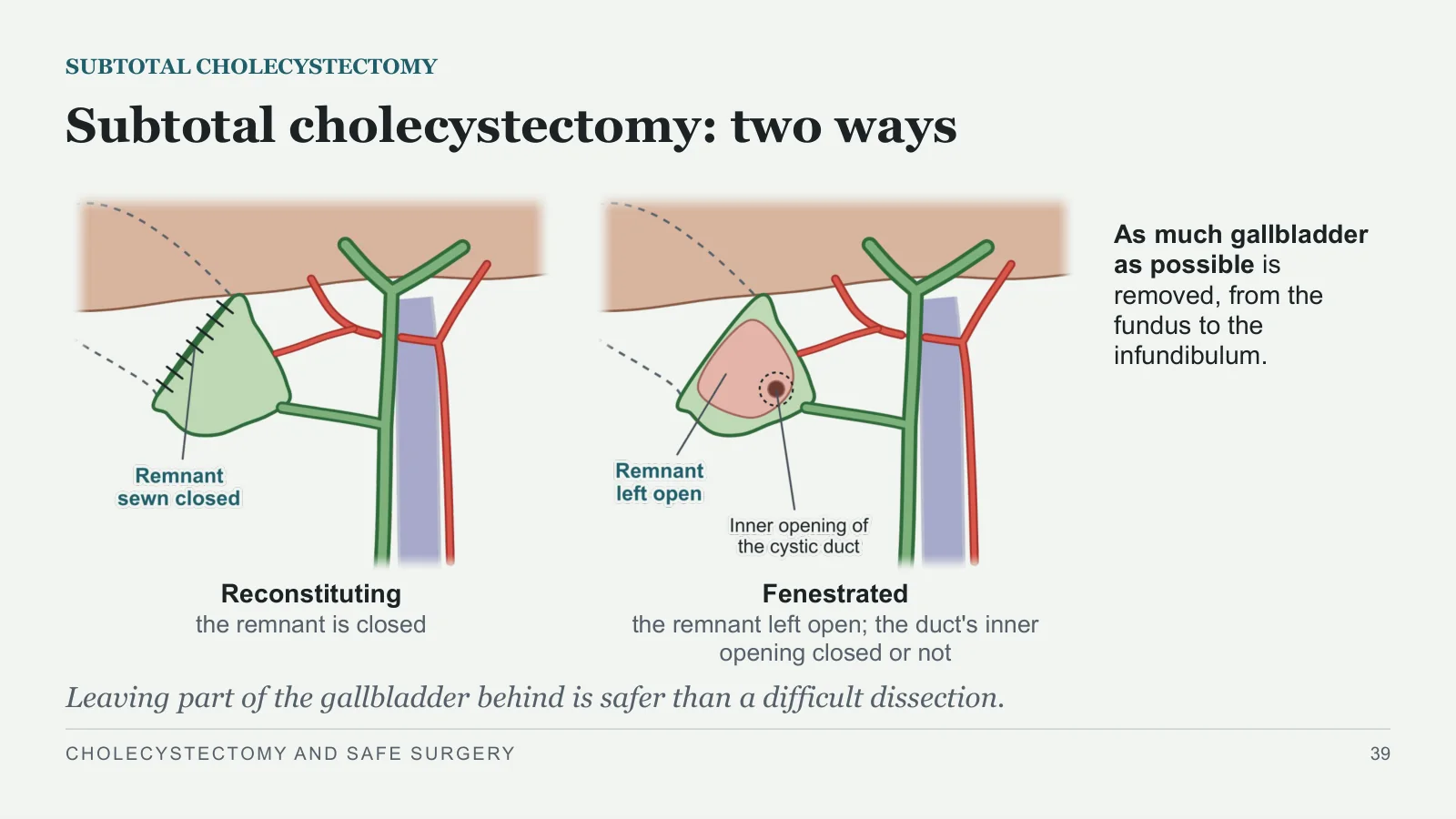
Subtotal cholecystectomy: two ways
SUBTOTAL CHOLECYSTECTOMY
Reconstituting
the remnant is closed
Fenestrated
the remnant left open; the duct's inner opening closed or not
As much gallbladder as possible is removed, from the fundus to the infundibulum.
Leaving part of the gallbladder behind is safer than a difficult dissection.
CHOLECYSTECTOMY AND SAFE SURGERY
39
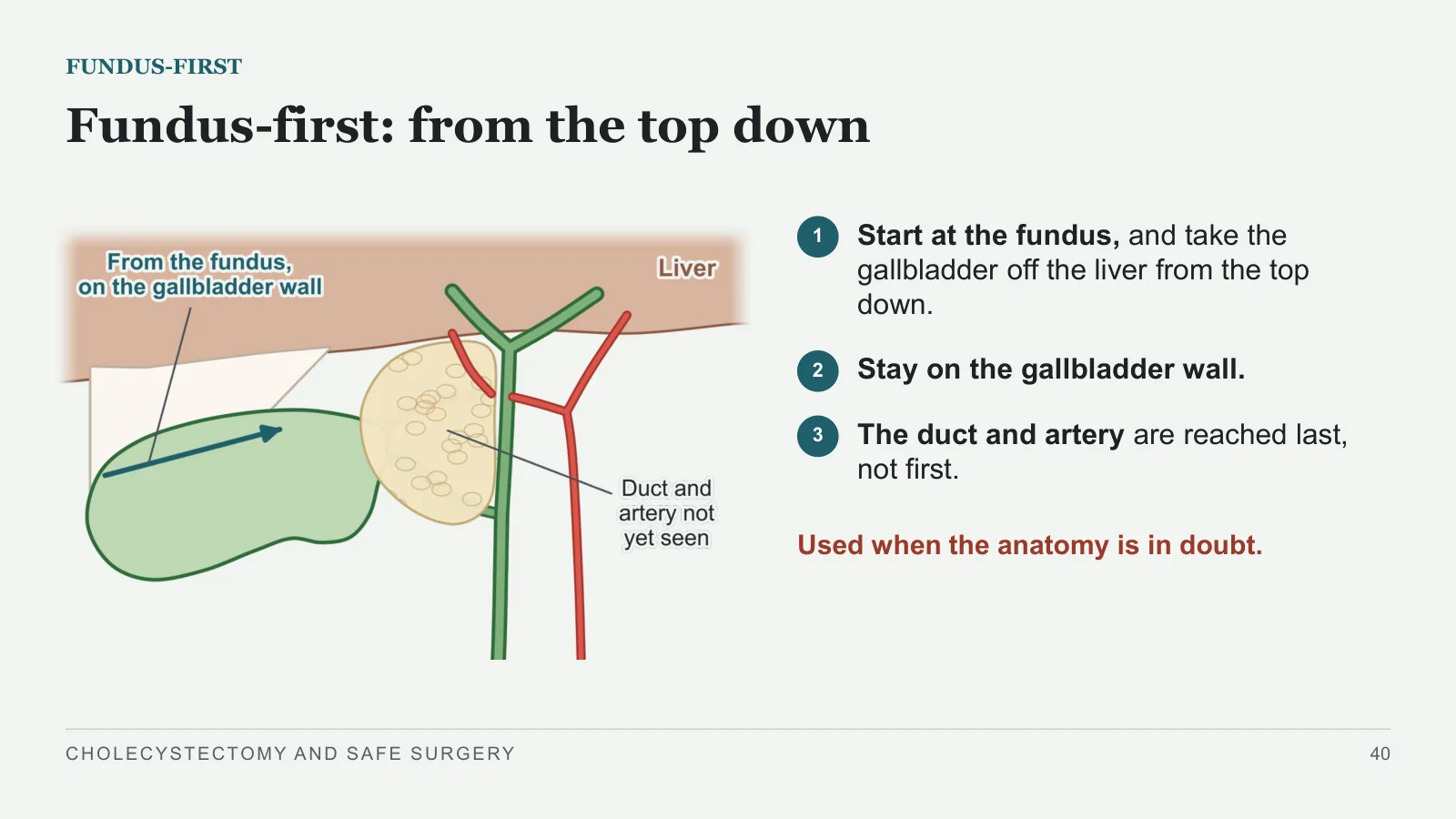
Fundus-first: from the top down
FUNDUS-FIRST
1
Start at the fundus, and take the gallbladder off the liver from the top down.
2
Stay on the gallbladder wall.
3
The duct and artery are reached last, not first.
Used when the anatomy is in doubt.
CHOLECYSTECTOMY AND SAFE SURGERY
40
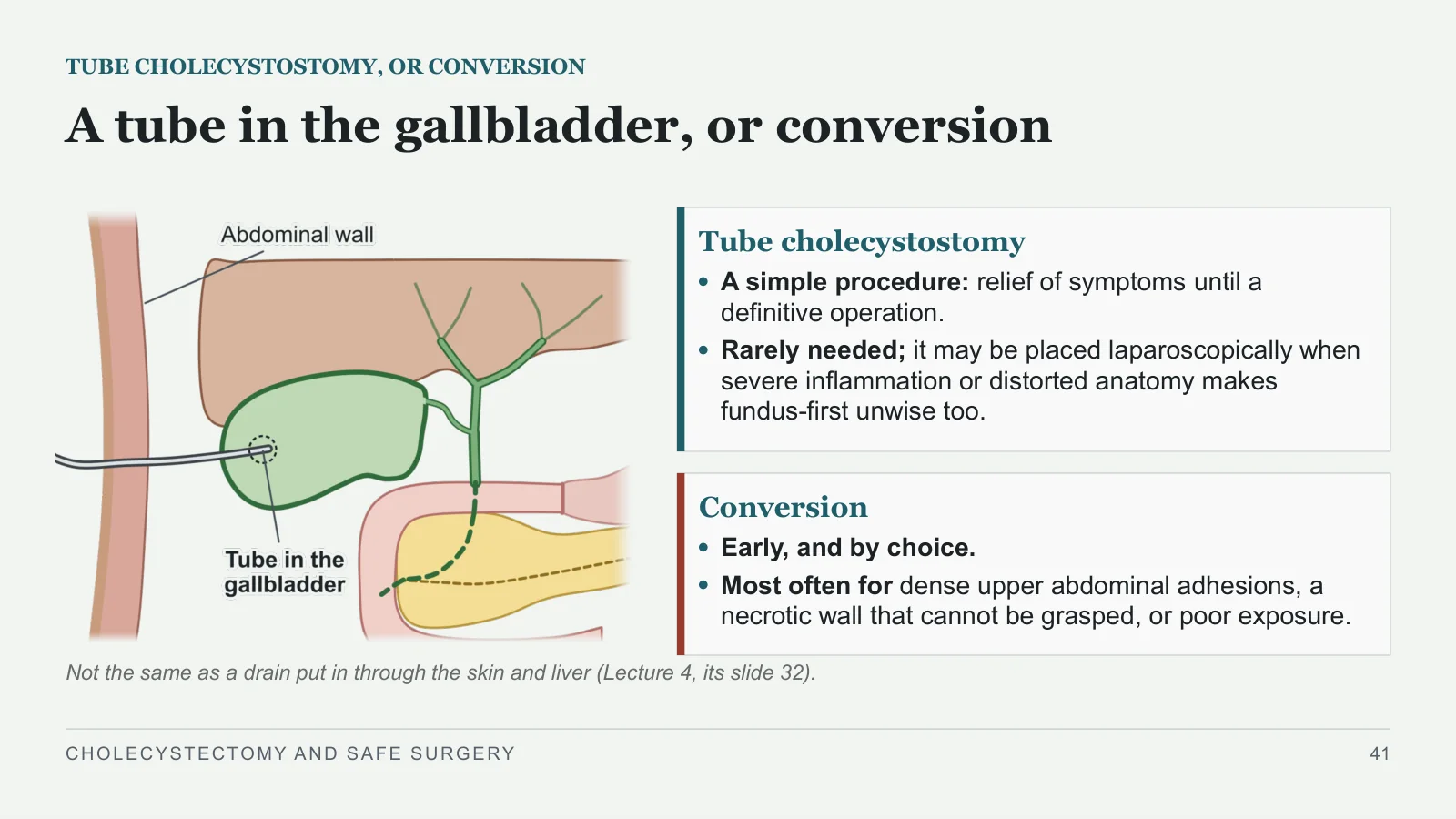
A tube in the gallbladder, or conversion
TUBE CHOLECYSTOSTOMY, OR CONVERSION
Tube cholecystostomy
A simple procedure: relief of symptoms until a definitive operation.
Rarely needed; it may be placed laparoscopically when severe inflammation or distorted anatomy makes fundus-first unwise too.
Conversion
Early, and by choice.
Most often for dense upper abdominal adhesions, a necrotic wall that cannot be grasped, or poor exposure.
Not the same as a drain put in through the skin and liver (Lecture 4, its slide 32).
CHOLECYSTECTOMY AND SAFE SURGERY
41
After the operation
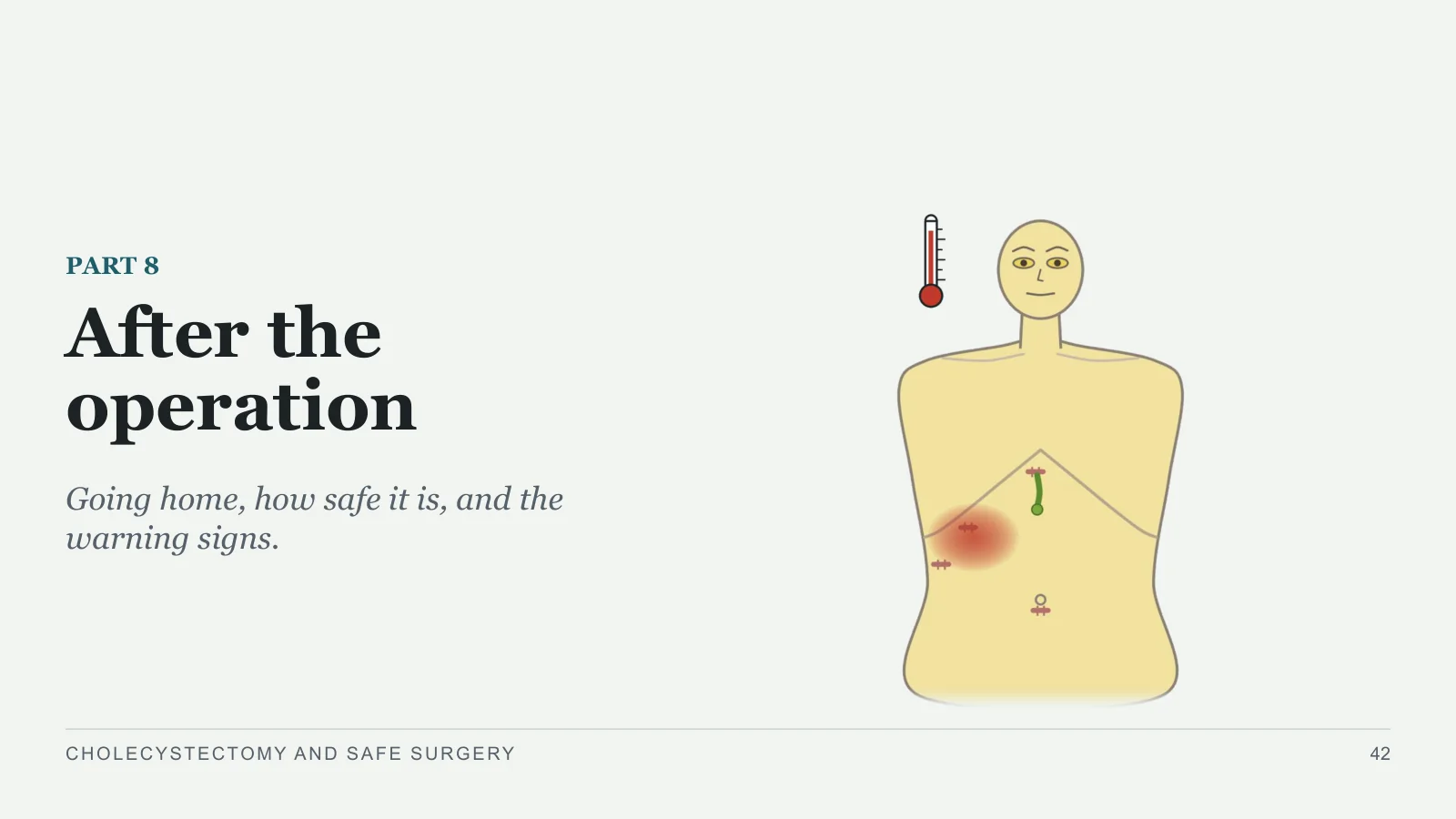
After the operation
PART 8
Going home, how safe it is, and the warning signs.
CHOLECYSTECTOMY AND SAFE SURGERY
42
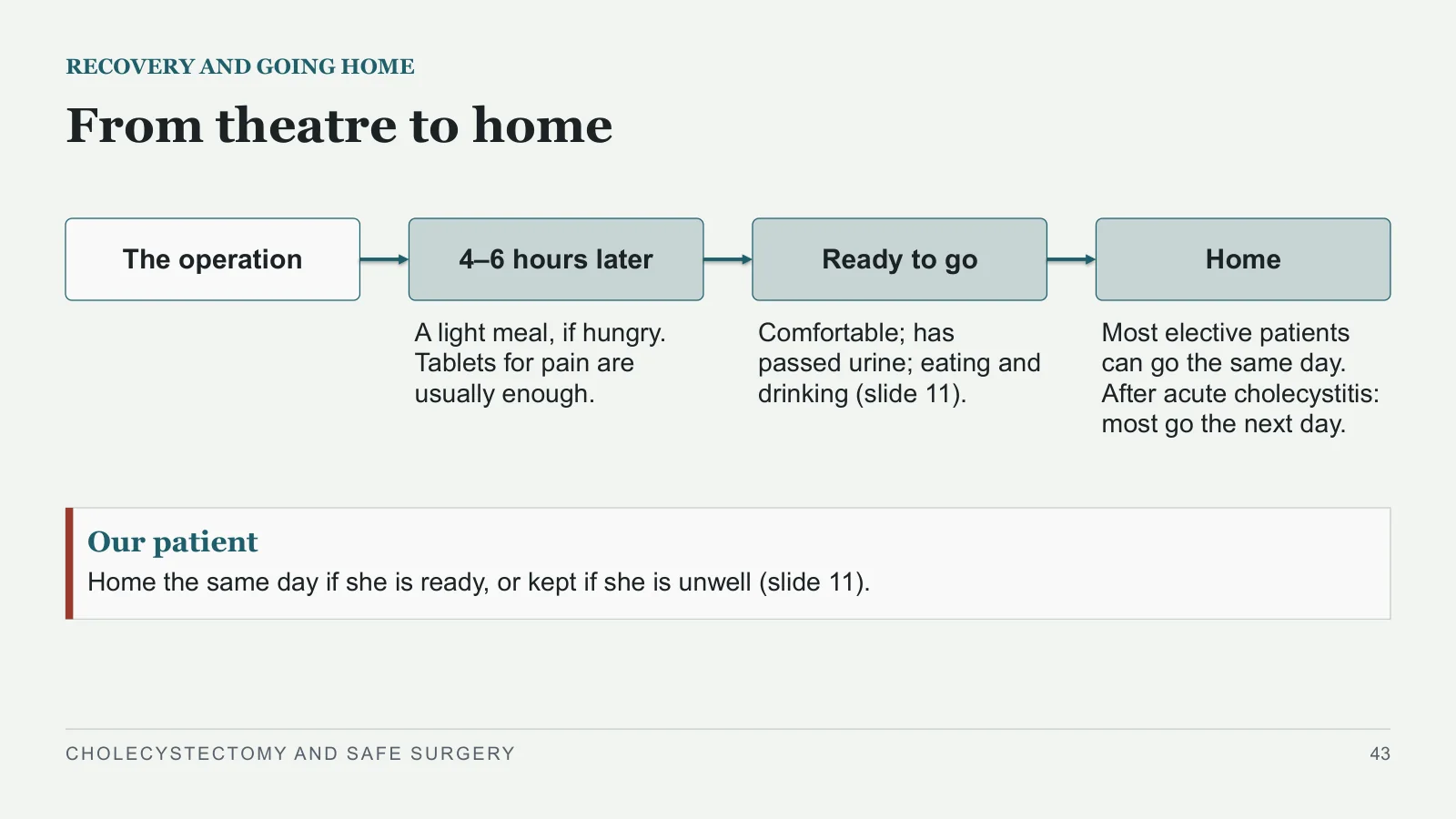
From theatre to home
RECOVERY AND GOING HOME
The operation
4–6 hours later
A light meal, if hungry. Tablets for pain are usually enough.
Ready to go
Comfortable; has passed urine; eating and drinking (slide 11).
Home
Most elective patients can go the same day. After acute cholecystitis: most go the next day.
Our patient
Home the same day if she is ready, or kept if she is unwell (slide 11).
CHOLECYSTECTOMY AND SAFE SURGERY
43
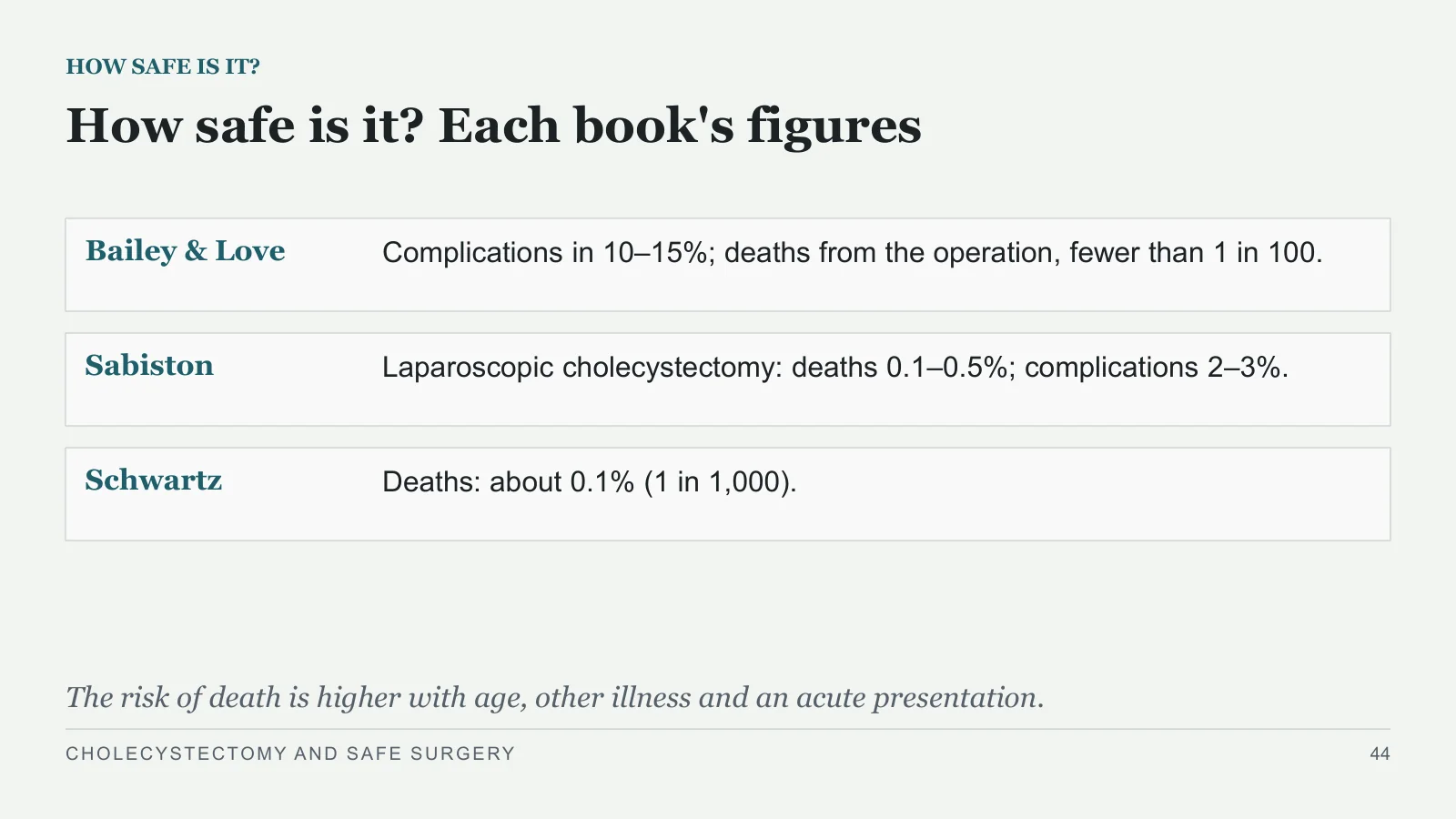
How safe is it? Each book's figures
HOW SAFE IS IT?
Bailey & Love
Complications in 10–15%; deaths from the operation, fewer than 1 in 100.
Sabiston
Laparoscopic cholecystectomy: deaths 0.1–0.5%; complications 2–3%.
Schwartz
Deaths: about 0.1% (1 in 1,000).
The risk of death is higher with age, other illness and an acute presentation.
CHOLECYSTECTOMY AND SAFE SURGERY
44
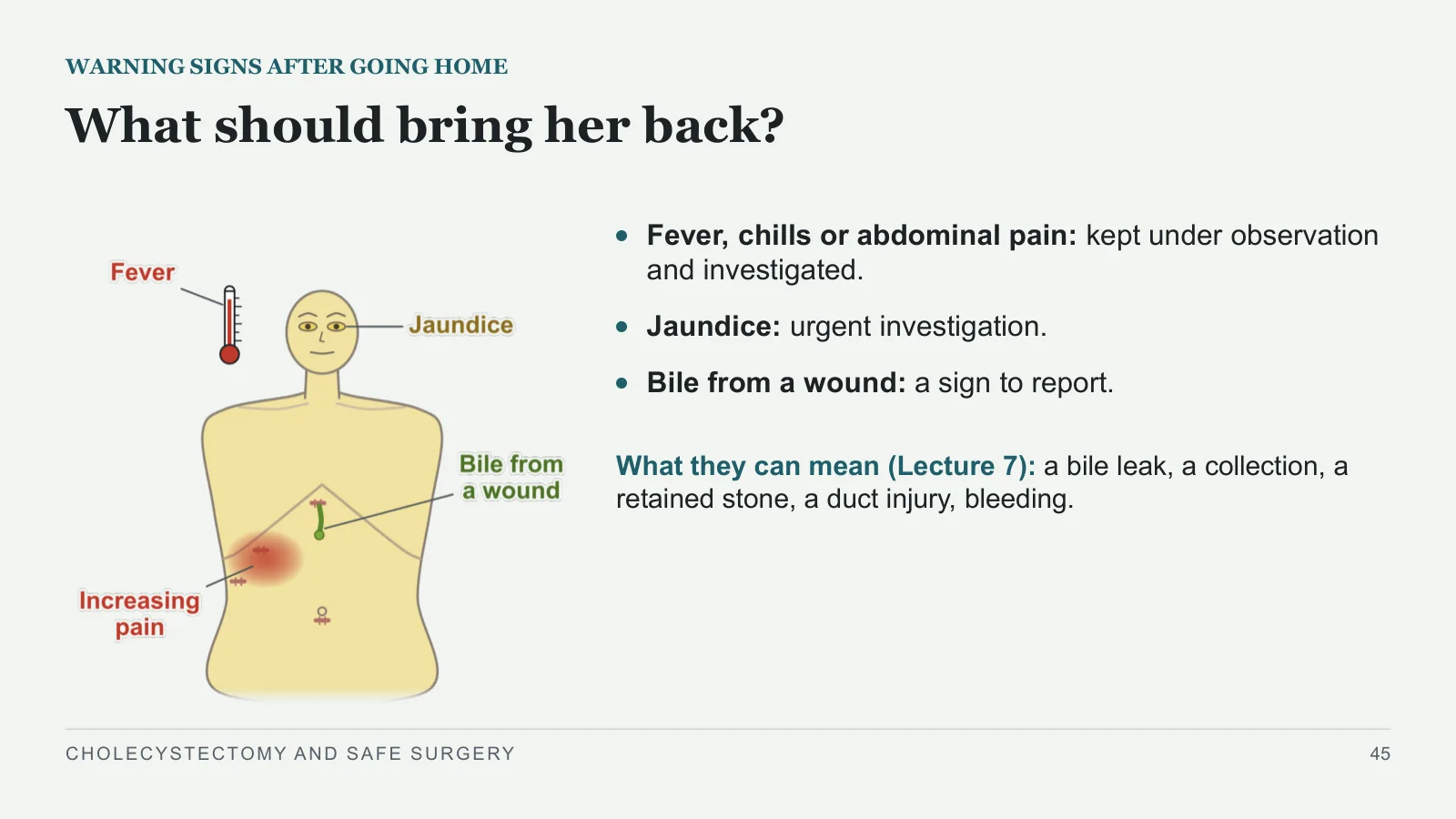
What should bring her back?
WARNING SIGNS AFTER GOING HOME
Fever, chills or abdominal pain: kept under observation and investigated.
Jaundice: urgent investigation.
Bile from a wound: a sign to report.
What they can mean (Lecture 7): a bile leak, a collection, a retained stone, a duct injury, bleeding.
CHOLECYSTECTOMY AND SAFE SURGERY
45
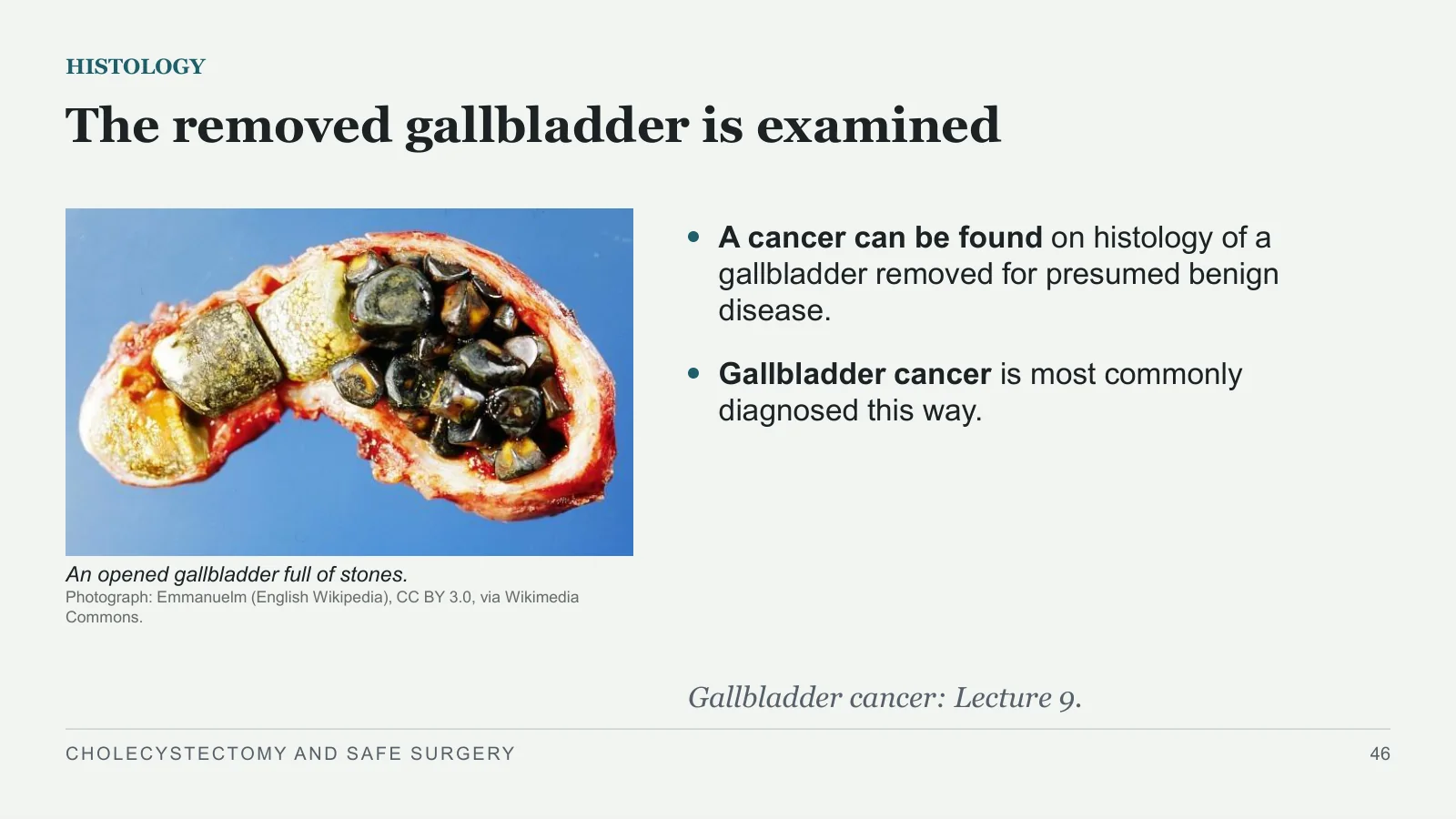
The removed gallbladder is examined
HISTOLOGY
An opened gallbladder full of stones.
Photograph: Emmanuelm (English Wikipedia), CC BY 3.0, via Wikimedia Commons.
A cancer can be found on histology of a gallbladder removed for presumed benign disease.
Gallbladder cancer is most commonly diagnosed this way.
Gallbladder cancer: Lecture 9.
CHOLECYSTECTOMY AND SAFE SURGERY
46
Back to our patient
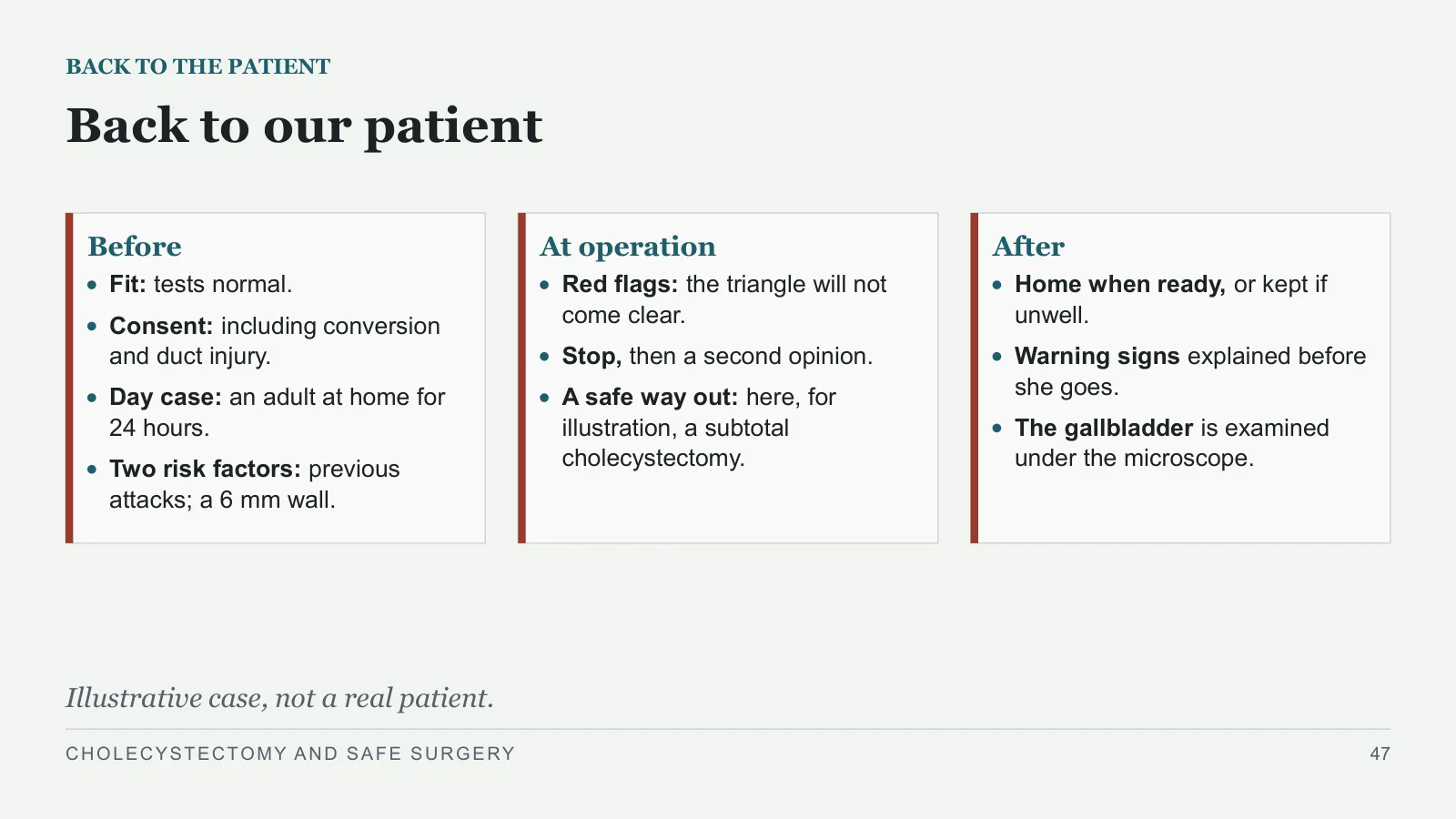
Back to our patient
BACK TO THE PATIENT
Before
Fit: tests normal.
Consent: including conversion and duct injury.
Day case: an adult at home for 24 hours.
Two risk factors: previous attacks; a 6 mm wall.
At operation
Red flags: the triangle will not come clear.
Stop, then a second opinion.
A safe way out: here, for illustration, a subtotal cholecystectomy.
After
Home when ready, or kept if unwell.
Warning signs explained before she goes.
The gallbladder is examined under the microscope.
Illustrative case, not a real patient.
CHOLECYSTECTOMY AND SAFE SURGERY
47
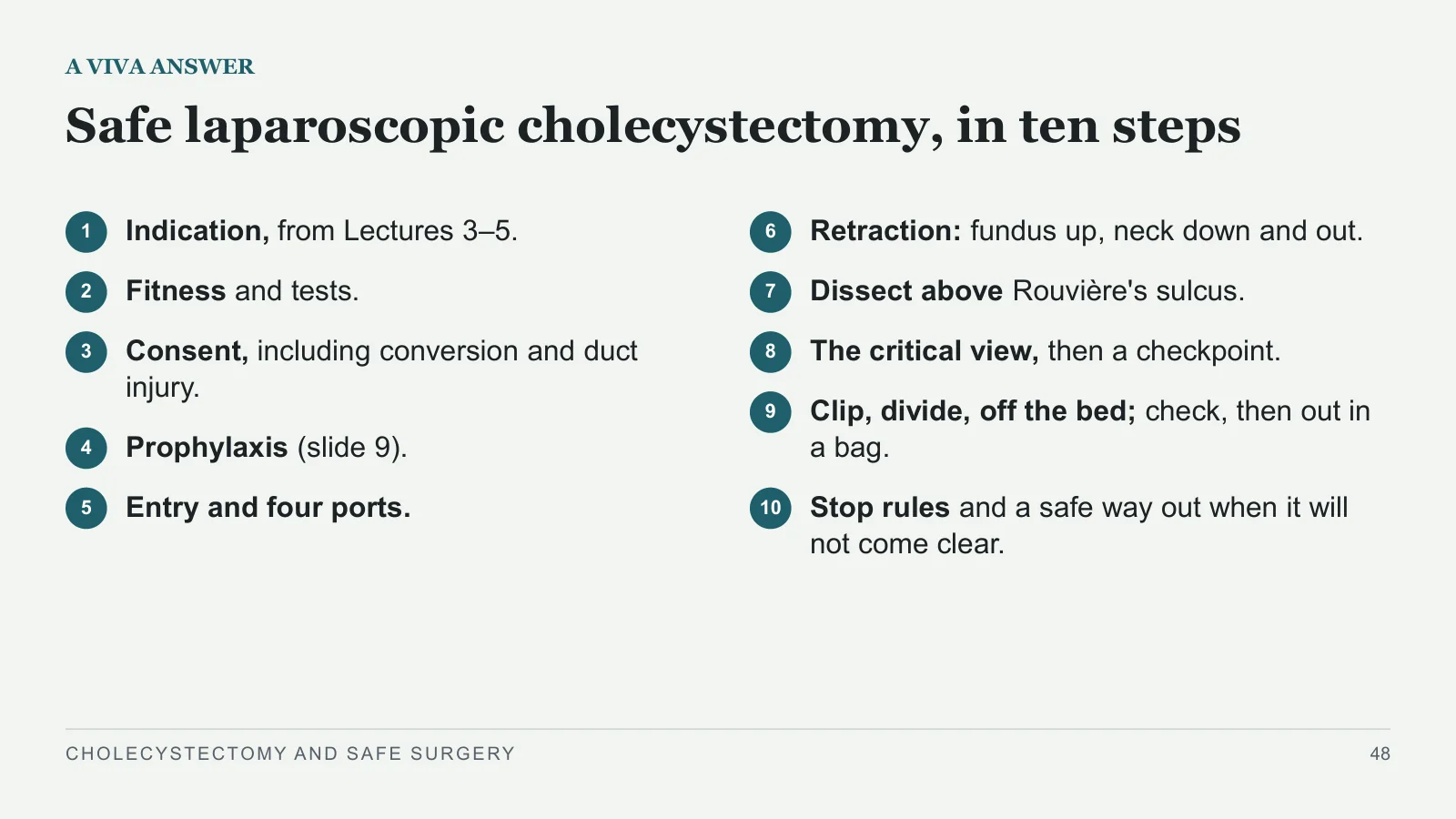
Safe laparoscopic cholecystectomy, in ten steps
A VIVA ANSWER
1
Indication, from Lectures 3–5.
2
Fitness and tests.
3
Consent, including conversion and duct injury.
4
Prophylaxis (slide 9).
5
Entry and four ports.
6
Retraction: fundus up, neck down and out.
7
Dissect above Rouvière's sulcus.
8
The critical view, then a checkpoint.
9
Clip, divide, off the bed; check, then out in a bag.
10
Stop rules and a safe way out when it will not come clear.
CHOLECYSTECTOMY AND SAFE SURGERY
48
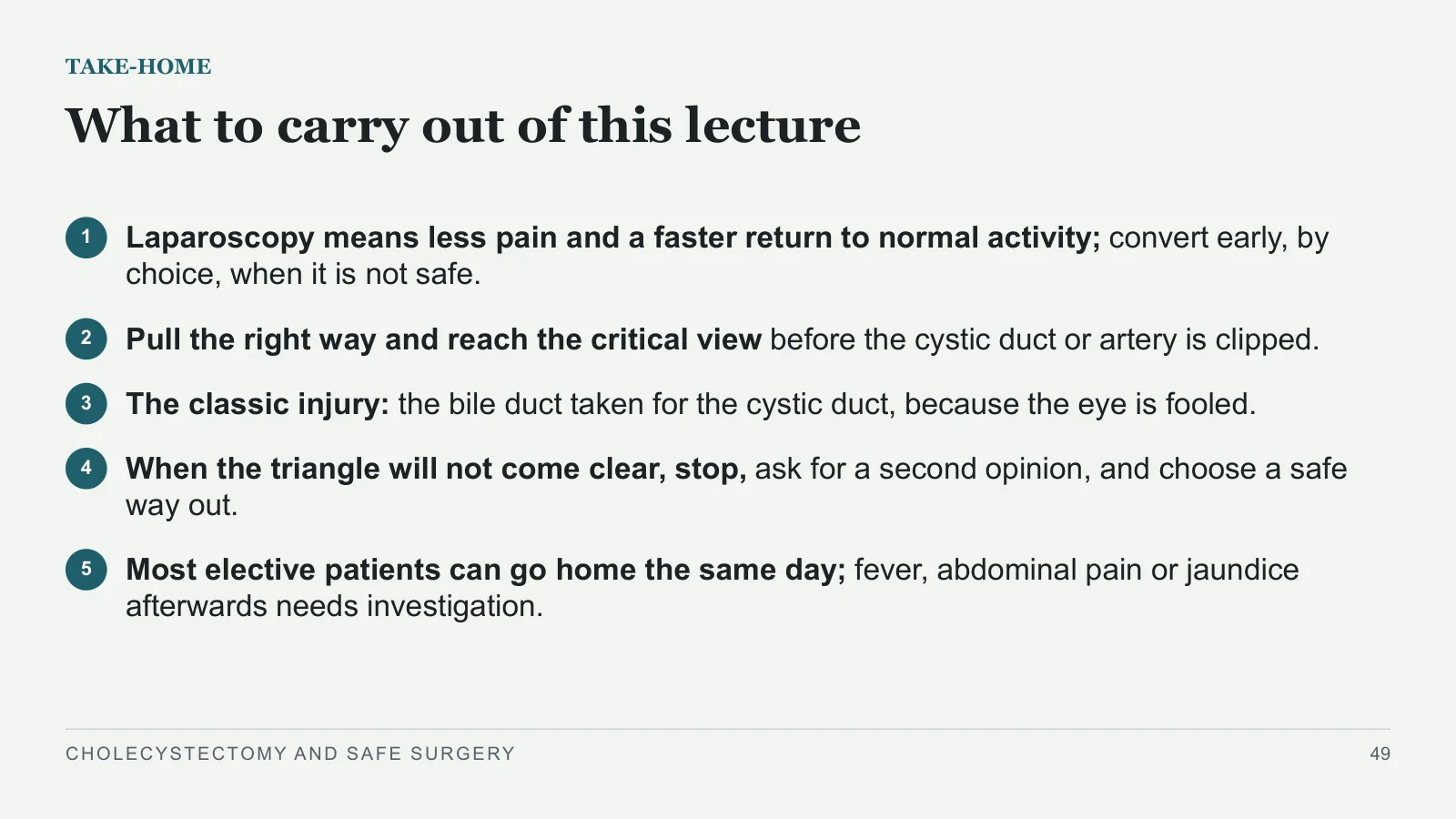
What to carry out of this lecture
TAKE-HOME
1
Laparoscopy means less pain and a faster return to normal activity; convert early, by choice, when it is not safe.
2
Pull the right way and reach the critical view before the cystic duct or artery is clipped.
3
The classic injury: the bile duct taken for the cystic duct, because the eye is fooled.
4
When the triangle will not come clear, stop, ask for a second opinion, and choose a safe way out.
5
Most elective patients can go home the same day; fever, abdominal pain or jaundice afterwards needs investigation.
CHOLECYSTECTOMY AND SAFE SURGERY
49
References
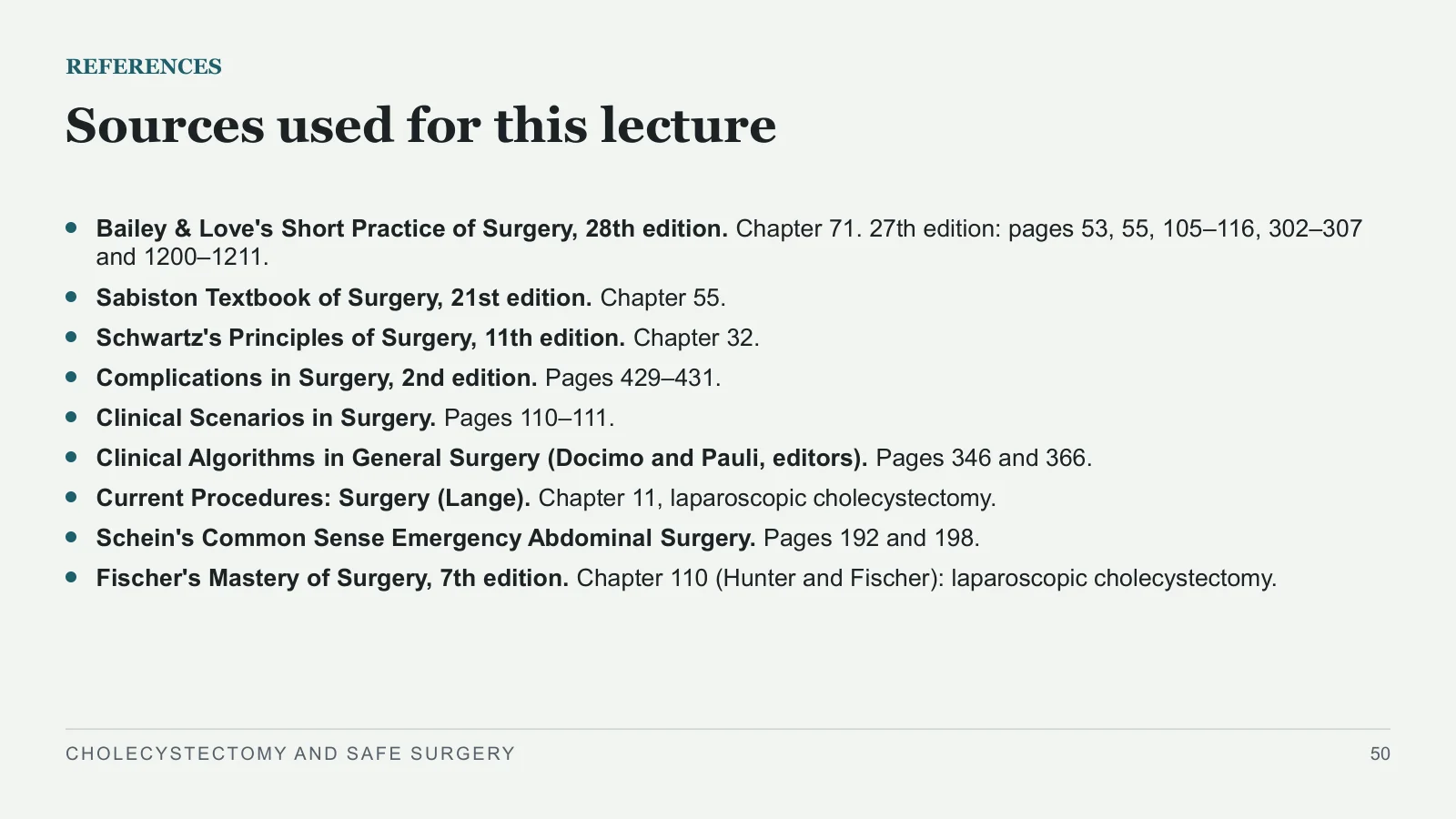
Sources used for this lecture
REFERENCES
Bailey & Love's Short Practice of Surgery, 28th edition. Chapter 71. 27th edition: pages 53, 55, 105–116, 302–307 and 1200–1211.
Sabiston Textbook of Surgery, 21st edition. Chapter 55.
Schwartz's Principles of Surgery, 11th edition. Chapter 32.
Complications in Surgery, 2nd edition. Pages 429–431.
Clinical Scenarios in Surgery. Pages 110–111.
Clinical Algorithms in General Surgery (Docimo and Pauli, editors). Pages 346 and 366.
Current Procedures: Surgery (Lange). Chapter 11, laparoscopic cholecystectomy.
Schein's Common Sense Emergency Abdominal Surgery. Pages 192 and 198.
Fischer's Mastery of Surgery, 7th edition. Chapter 110 (Hunter and Fischer): laparoscopic cholecystectomy.
CHOLECYSTECTOMY AND SAFE SURGERY
50
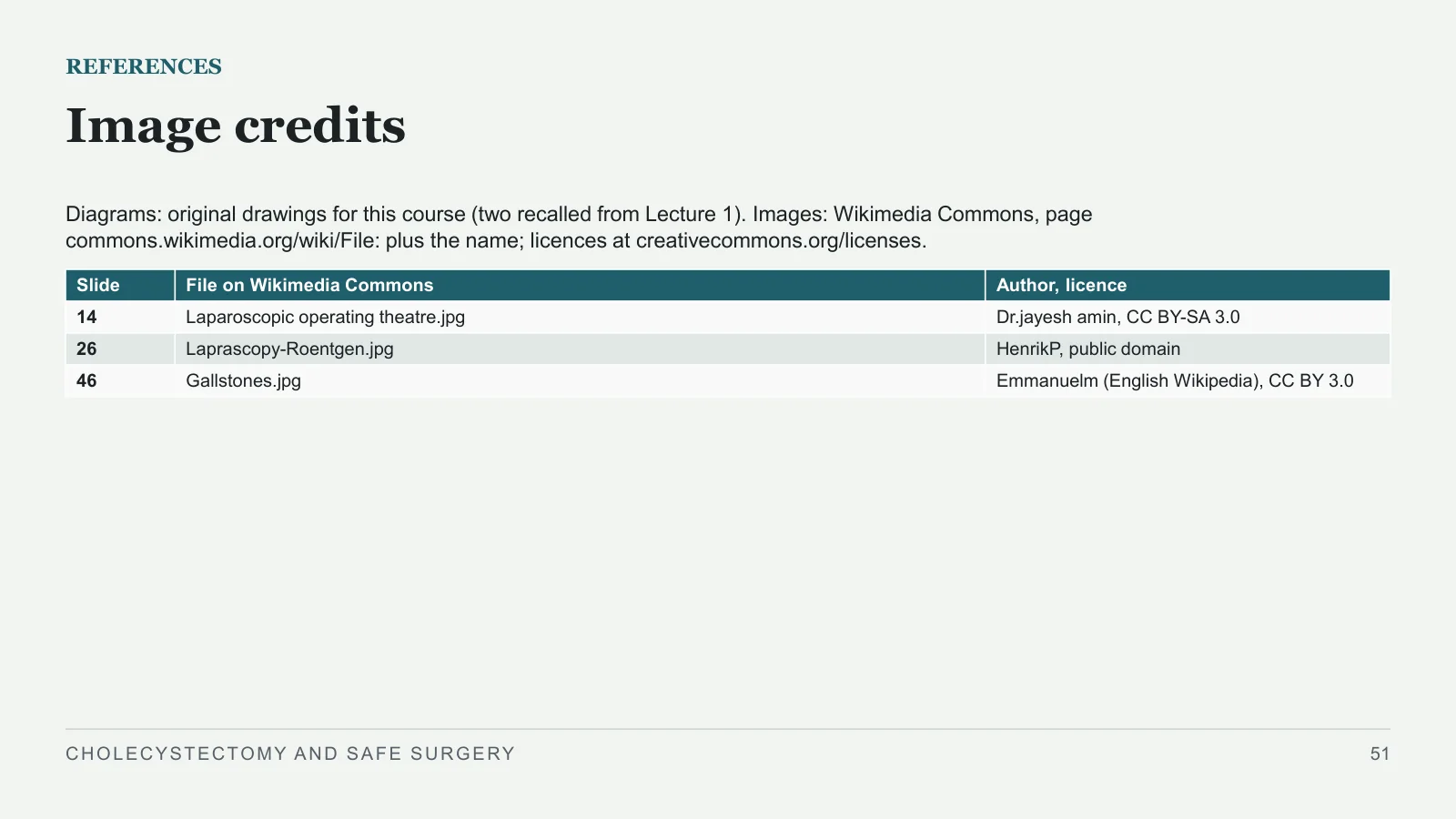
Image credits
REFERENCES
Diagrams: original drawings for this course (two recalled from Lecture 1). Images: Wikimedia Commons, page commons.wikimedia.org/wiki/File: plus the name; licences at creativecommons.org/licenses.
CHOLECYSTECTOMY AND SAFE SURGERY
51
| Slide | File on Wikimedia Commons | Author, licence |
| 14 | Laparoscopic operating theatre.jpg | Dr.jayesh amin, CC BY-SA 3.0 |
| 26 | Laprascopy-Roentgen.jpg | HenrikP, public domain |
| 46 | Gallstones.jpg | Emmanuelm (English Wikipedia), CC BY 3.0 |
Sources and image credits
Original lecture diagrams and source/image credits are preserved from the PowerPoint. Each photograph or scan below links to its source and applicable licence. Changes are described in the slide captions; adapted ShareAlike images retain that licence.
Images
- Slide 14: Laparoscopic operating theatre.jpg · Dr.jayesh amin, CC BY-SA 3.0. Slide caption: Photograph: Dr.jayesh amin, CC BY-SA 3.0, via Wikimedia Commons. Adaptations of this image retain the same Creative Commons ShareAlike licence.
- Licence — Laparoscopic operating theatre.jpg · CC BY-SA 3.0
- Slide 26: Laprascopy-Roentgen.jpg · HenrikP, public domain. Slide caption: Image: HenrikP, public domain, via Wikimedia Commons; cropped at the foot to remove burned-in text; ring added.
- Slide 46: Gallstones.jpg · Emmanuelm (English Wikipedia), CC BY 3.0. Source attribution: Emmanuelm, English Wikipedia. Slide caption: Photograph: Emmanuelm (English Wikipedia), CC BY 3.0, via Wikimedia Commons.
- Licence — Gallstones.jpg · CC BY 3.0


Sources
- [1] REFERENCES
- [2] Sources used for this lecture
- [3] Bailey & Love's Short Practice of Surgery, 28th edition. Chapter 71. 27th edition: pages 53, 55, 105–116, 302–307 and 1200–1211.
- [4] Sabiston Textbook of Surgery, 21st edition. Chapter 55.
- [5] Schwartz's Principles of Surgery, 11th edition. Chapter 32.
- [6] Complications in Surgery, 2nd edition. Pages 429–431.
- [7] Clinical Scenarios in Surgery. Pages 110–111.
- [8] Clinical Algorithms in General Surgery (Docimo and Pauli, editors). Pages 346 and 366.
- [9] Current Procedures: Surgery (Lange). Chapter 11, laparoscopic cholecystectomy.
- [10] Schein's Common Sense Emergency Abdominal Surgery. Pages 192 and 198.
- [11] Fischer's Mastery of Surgery, 7th edition. Chapter 110 (Hunter and Fischer): laparoscopic cholecystectomy.