Colorectal · Ileocaecal disease · 15 slides
Ileocaecal disease: TB, Crohn’s or malignancy?
A talk at PUNJ SURG 2026, Ludhiana, where I served on the Scientific and Registration Committee: tissue first, the ATT trial last, and the operation follows the diagnosis.
About the downloads
PowerPoint without speaker notes. SHA-256 checksums verify the downloaded files.
Contents · 7 parts
What is it?
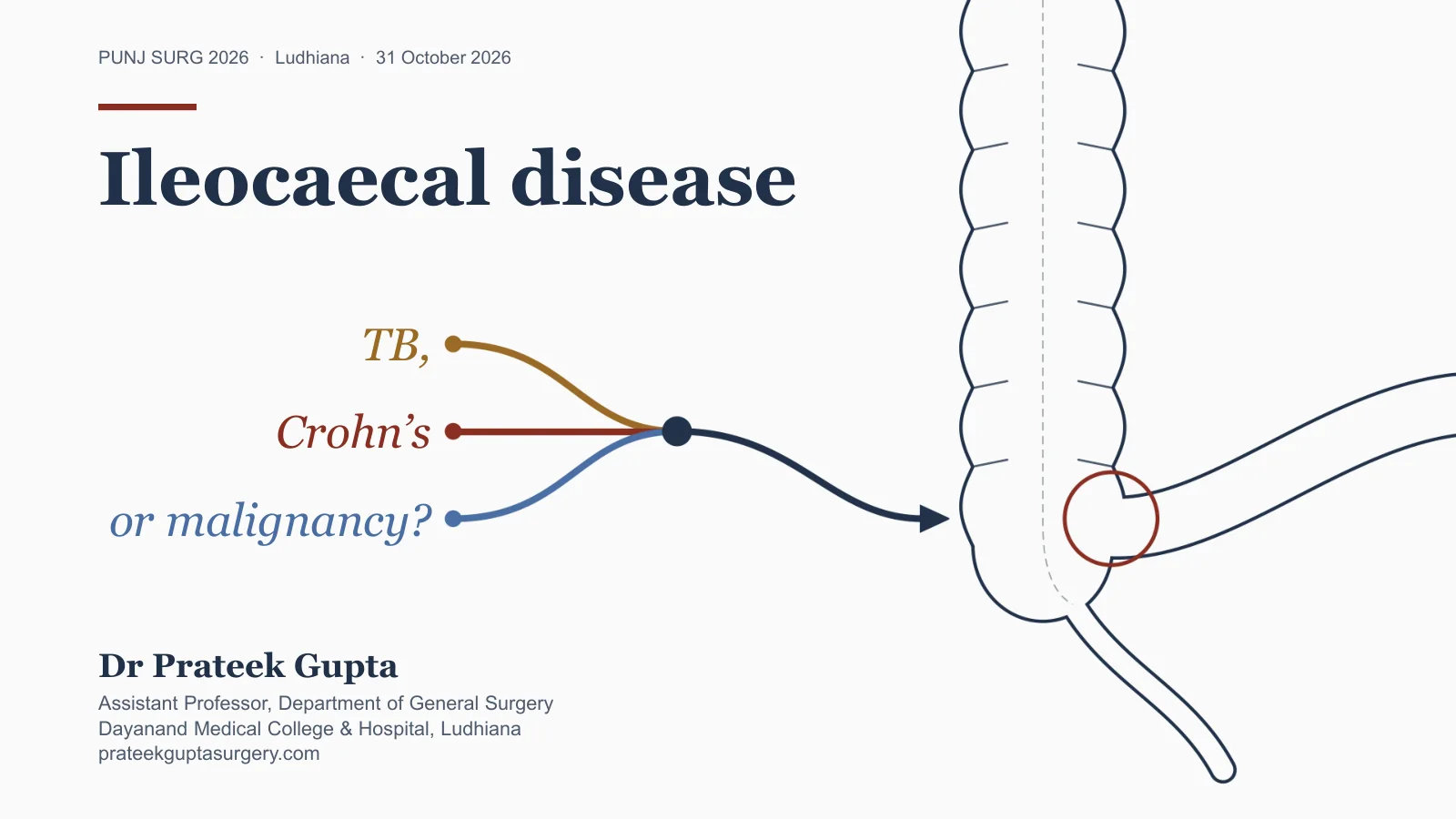
Ileocaecal disease: TB, Crohn’s or malignancy?
PUNJ SURG 2026 · Ludhiana · 31 October 2026
Ileocaecal disease
TB,
Crohn’s
or malignancy?
Dr Prateek Gupta Assistant Professor, Department of General Surgery Dayanand Medical College & Hospital, Ludhiana prateekguptasurgery.com
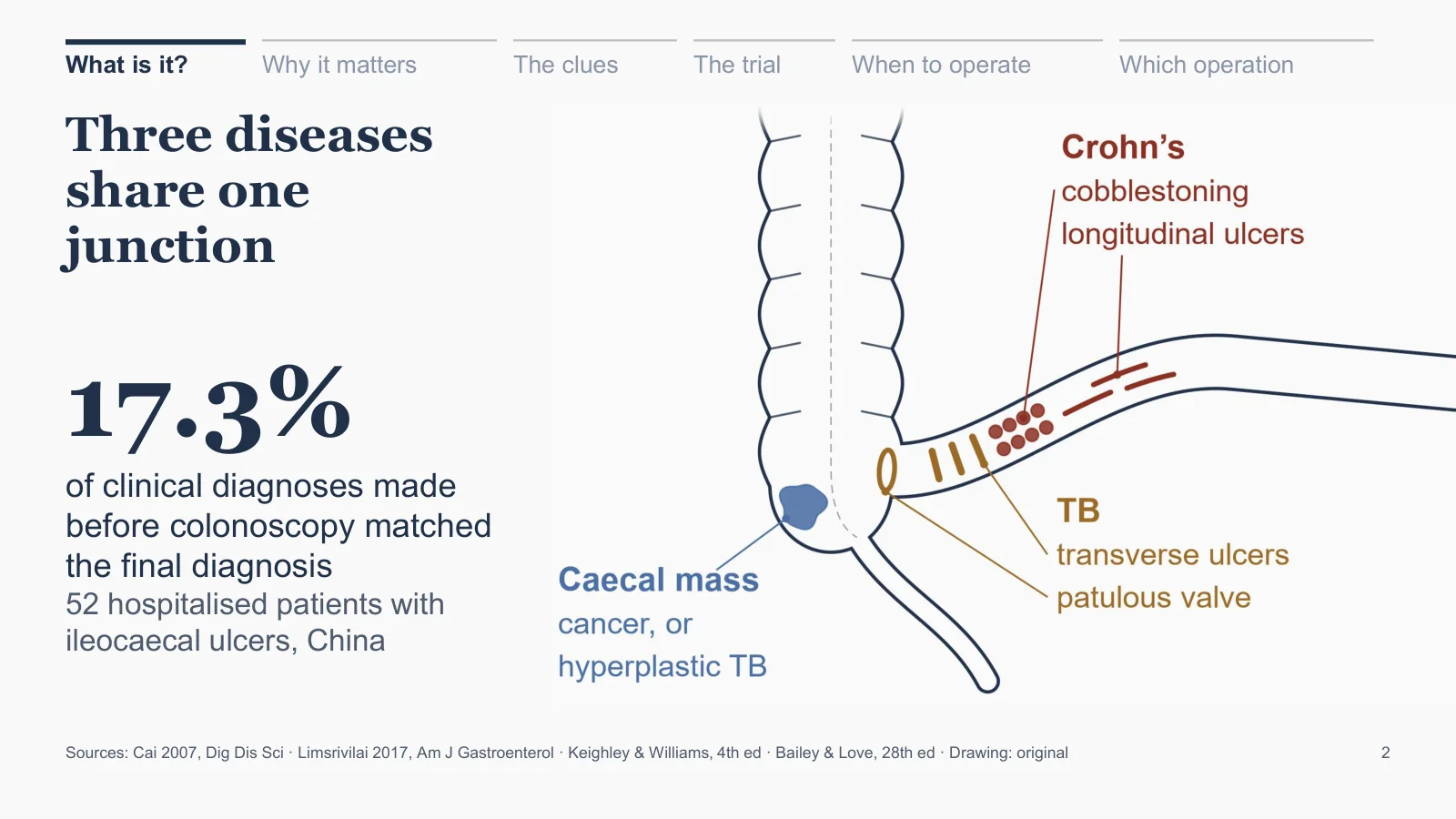
17.3%
What is it?
Why it matters
The clues
The trial
When to operate
Which operation
Sources: Cai 2007, Dig Dis Sci · Limsrivilai 2017, Am J Gastroenterol · Keighley & Williams, 4th ed · Bailey & Love, 28th ed · Drawing: original
2
Three diseases share one junction
of clinical diagnoses made before colonoscopy matched the final diagnosis
52 hospitalised patients with ileocaecal ulcers, China
Why it matters
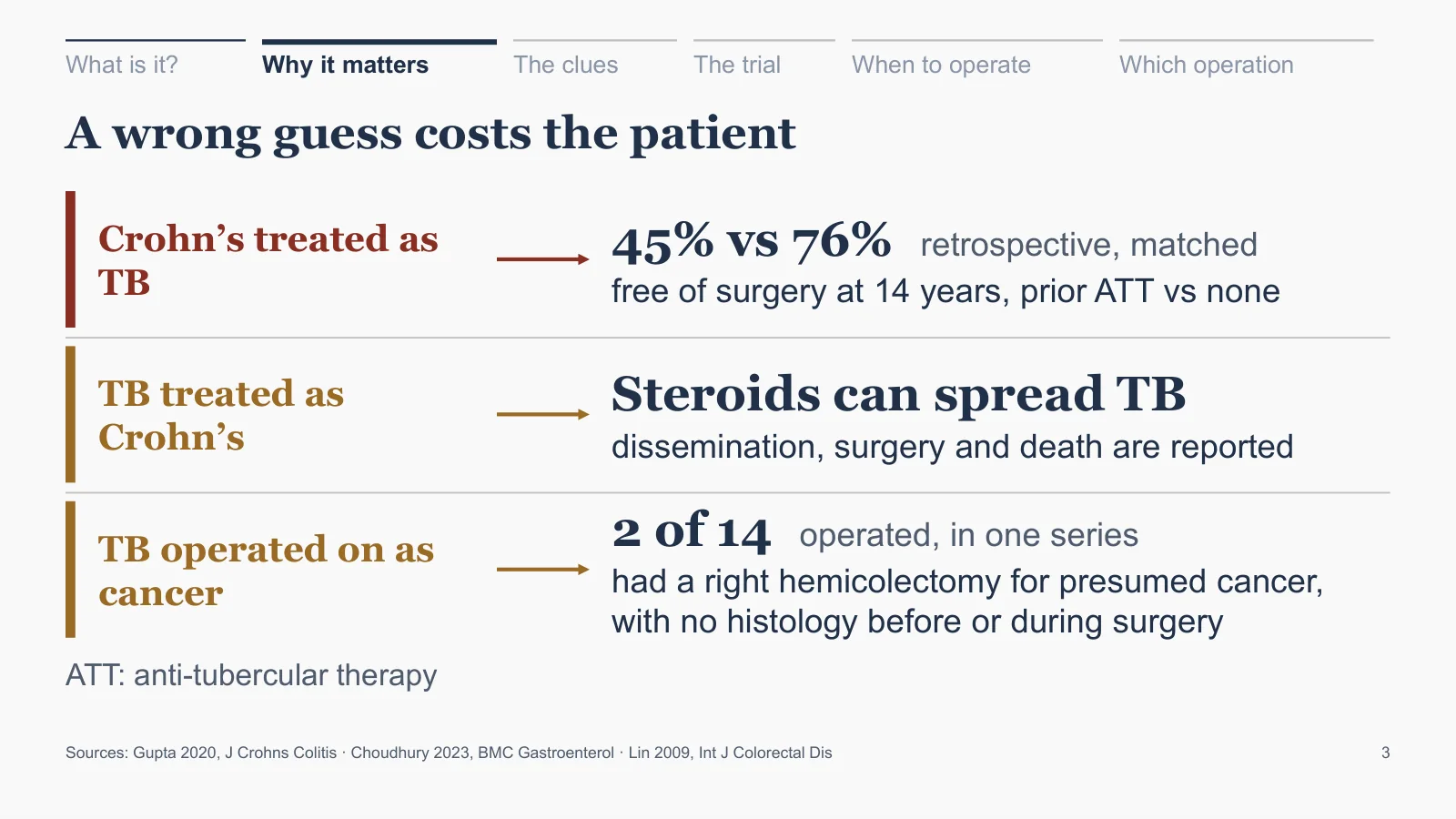
45% vs 76% retrospective, matched free of surgery at 14 years, prior ATT vs none
What is it?
Why it matters
The clues
The trial
When to operate
Which operation
A wrong guess costs the patient
Sources: Gupta 2020, J Crohns Colitis · Choudhury 2023, BMC Gastroenterol · Lin 2009, Int J Colorectal Dis
3
Crohn’s treated as TB
TB treated as Crohn’s
Steroids can spread TB dissemination, surgery and death are reported
TB operated on as cancer
2 of 14 operated, in one series had a right hemicolectomy for presumed cancer, with no histology before or during surgery
ATT: anti-tubercular therapy
The clues
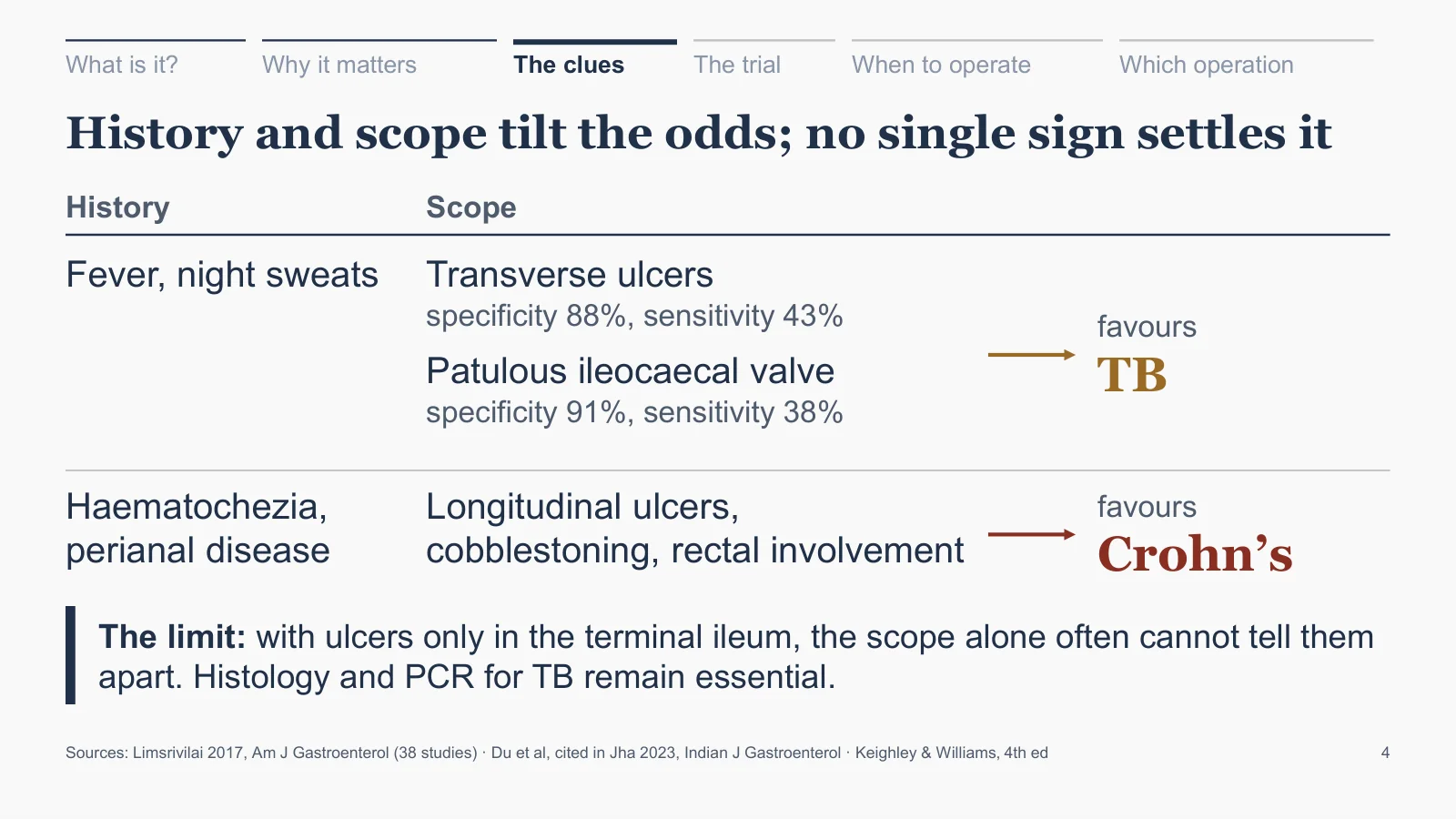
favours TB
What is it?
Why it matters
The clues
The trial
When to operate
Which operation
History and scope tilt the odds; no single sign settles it
Sources: Limsrivilai 2017, Am J Gastroenterol (38 studies) · Du et al, cited in Jha 2023, Indian J Gastroenterol · Keighley & Williams, 4th ed
4
History
Scope
Fever, night sweats
Transverse ulcers specificity 88%, sensitivity 43% Patulous ileocaecal valve specificity 91%, sensitivity 38%
Haematochezia, perianal disease
Longitudinal ulcers, cobblestoning, rectal involvement
favours Crohn’s
The limit: with ulcers only in the terminal ileum, the scope alone often cannot tell them apart. Histology and PCR for TB remain essential.
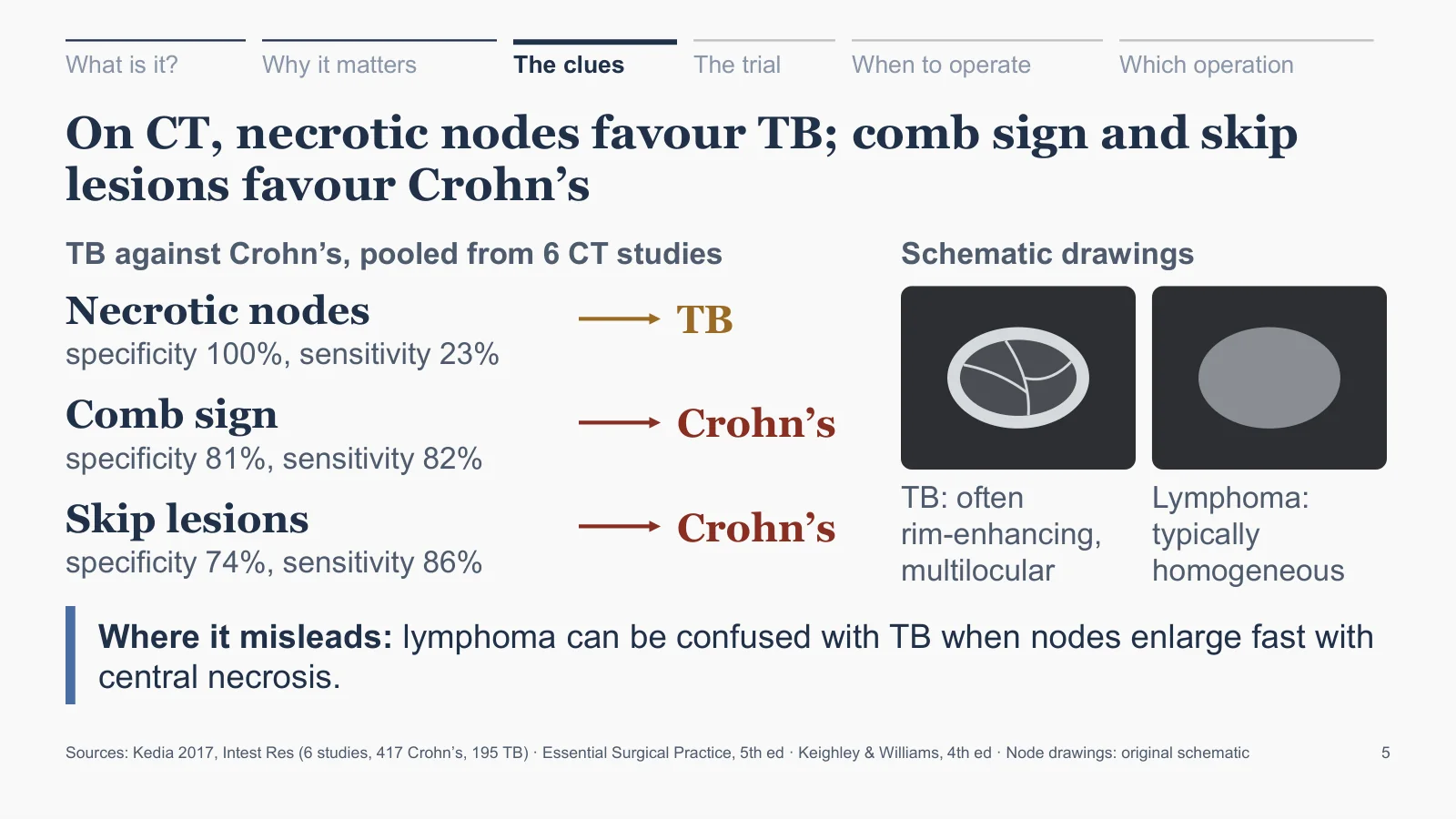
On CT, necrotic nodes favour TB; comb sign and skip lesions favour Crohn’s
What is it?
Why it matters
The clues
The trial
When to operate
Which operation
Sources: Kedia 2017, Intest Res (6 studies, 417 Crohn’s, 195 TB) · Essential Surgical Practice, 5th ed · Keighley & Williams, 4th ed · Node drawings: original schematic
5
TB against Crohn’s, pooled from 6 CT studies
Schematic drawings
Necrotic nodes specificity 100%, sensitivity 23%
TB
Comb sign specificity 81%, sensitivity 82%
Crohn’s
Skip lesions specificity 74%, sensitivity 86%
Crohn’s
TB: often rim-enhancing, multilocular
Lymphoma: typically homogeneous
Where it misleads: lymphoma can be confused with TB when nodes enlarge fast with central necrosis.
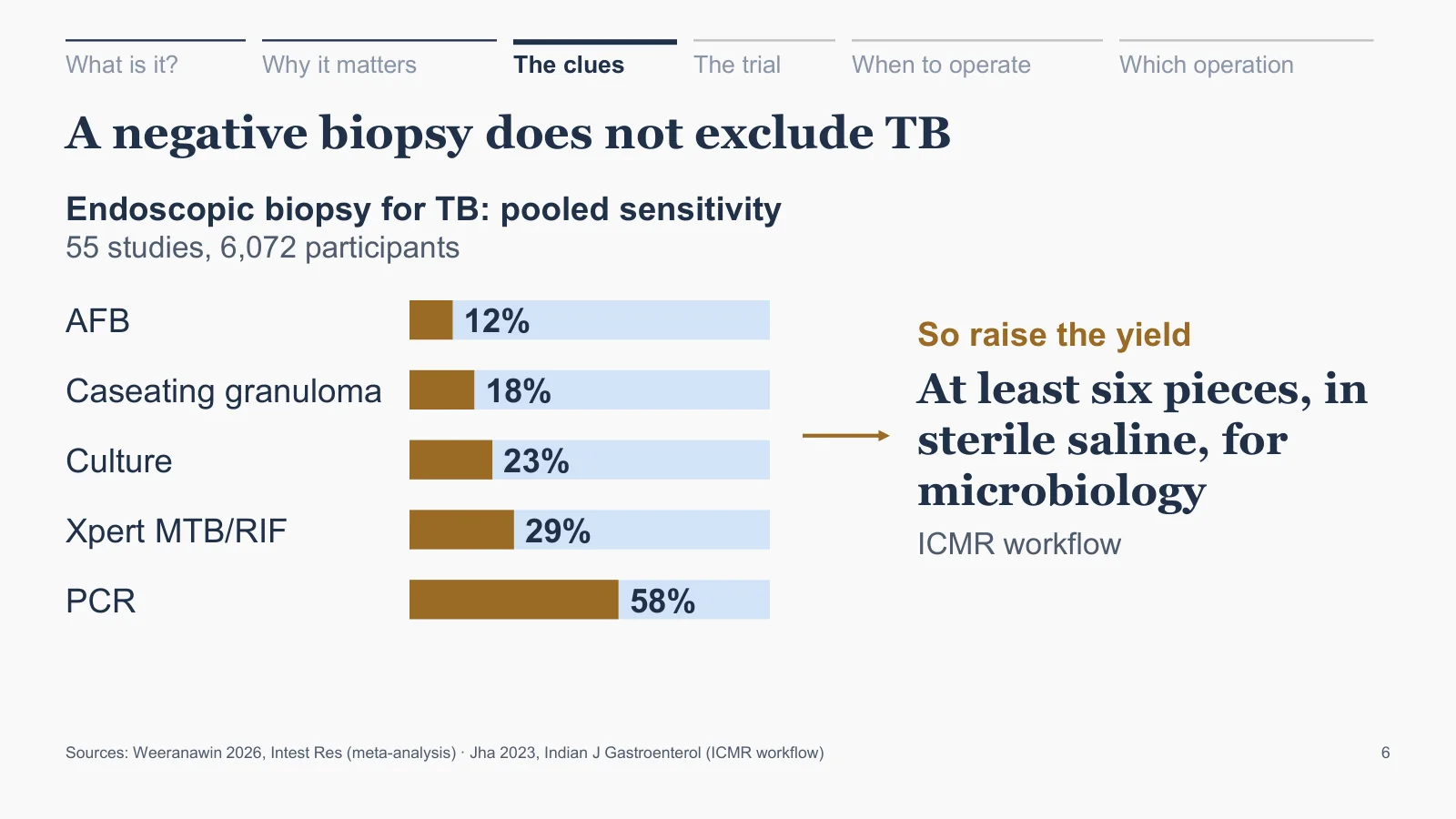
A negative biopsy does not exclude TB
What is it?
Why it matters
The clues
The trial
When to operate
Which operation
Sources: Weeranawin 2026, Intest Res (meta-analysis) · Jha 2023, Indian J Gastroenterol (ICMR workflow)
6
Endoscopic biopsy for TB: pooled sensitivity 55 studies, 6,072 participants
AFB
12%
Caseating granuloma
18%
Culture
23%
Xpert MTB/RIF
29%
PCR
58%
So raise the yield At least six pieces, in sterile saline, for microbiology ICMR workflow
The trial
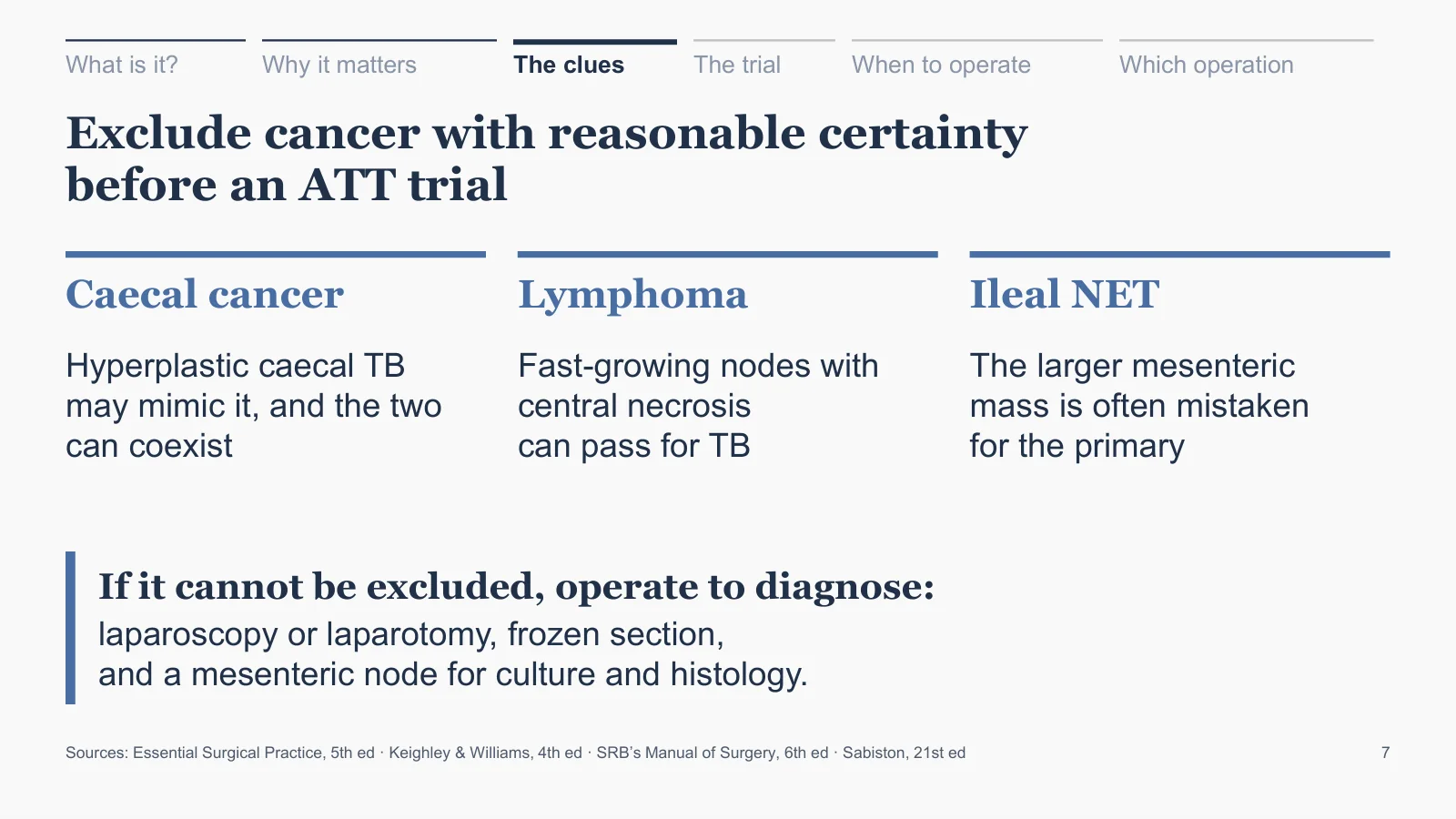
Exclude cancer with reasonable certainty before an ATT trial
What is it?
Why it matters
The clues
The trial
When to operate
Which operation
Sources: Essential Surgical Practice, 5th ed · Keighley & Williams, 4th ed · SRB’s Manual of Surgery, 6th ed · Sabiston, 21st ed
7
Caecal cancer
Hyperplastic caecal TB may mimic it, and the two can coexist
Lymphoma
Fast-growing nodes with central necrosis can pass for TB
Ileal NET
The larger mesenteric mass is often mistaken for the primary
If it cannot be excluded, operate to diagnose: laparoscopy or laparotomy, frozen section, and a mesenteric node for culture and histology.
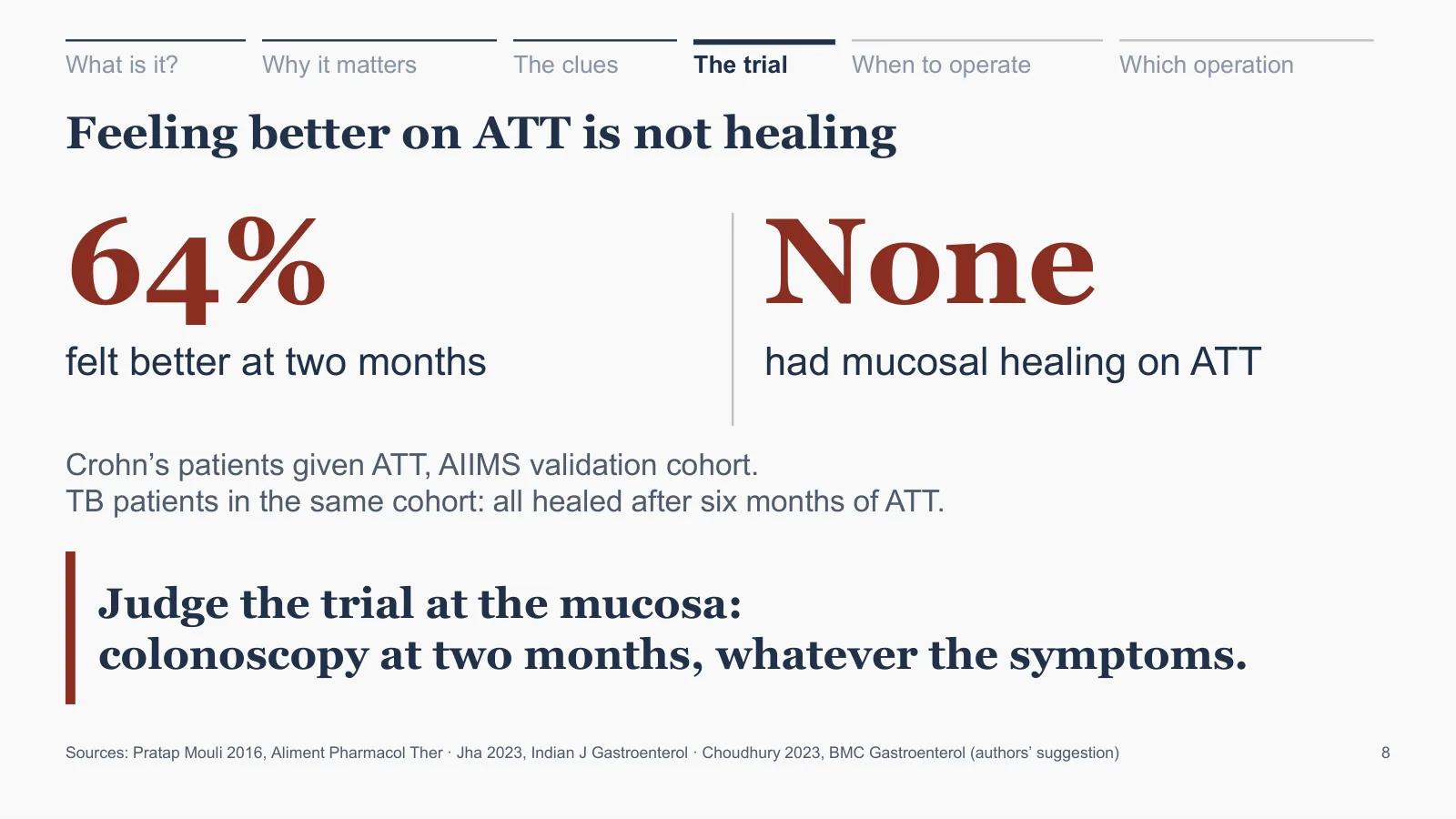
64%
What is it?
Why it matters
The clues
The trial
When to operate
Which operation
Feeling better on ATT is not healing
Sources: Pratap Mouli 2016, Aliment Pharmacol Ther · Jha 2023, Indian J Gastroenterol · Choudhury 2023, BMC Gastroenterol (authors’ suggestion)
8
felt better at two months
None
had mucosal healing on ATT
Crohn’s patients given ATT, AIIMS validation cohort. TB patients in the same cohort: all healed after six months of ATT.
Judge the trial at the mucosa: colonoscopy at two months, whatever the symptoms.
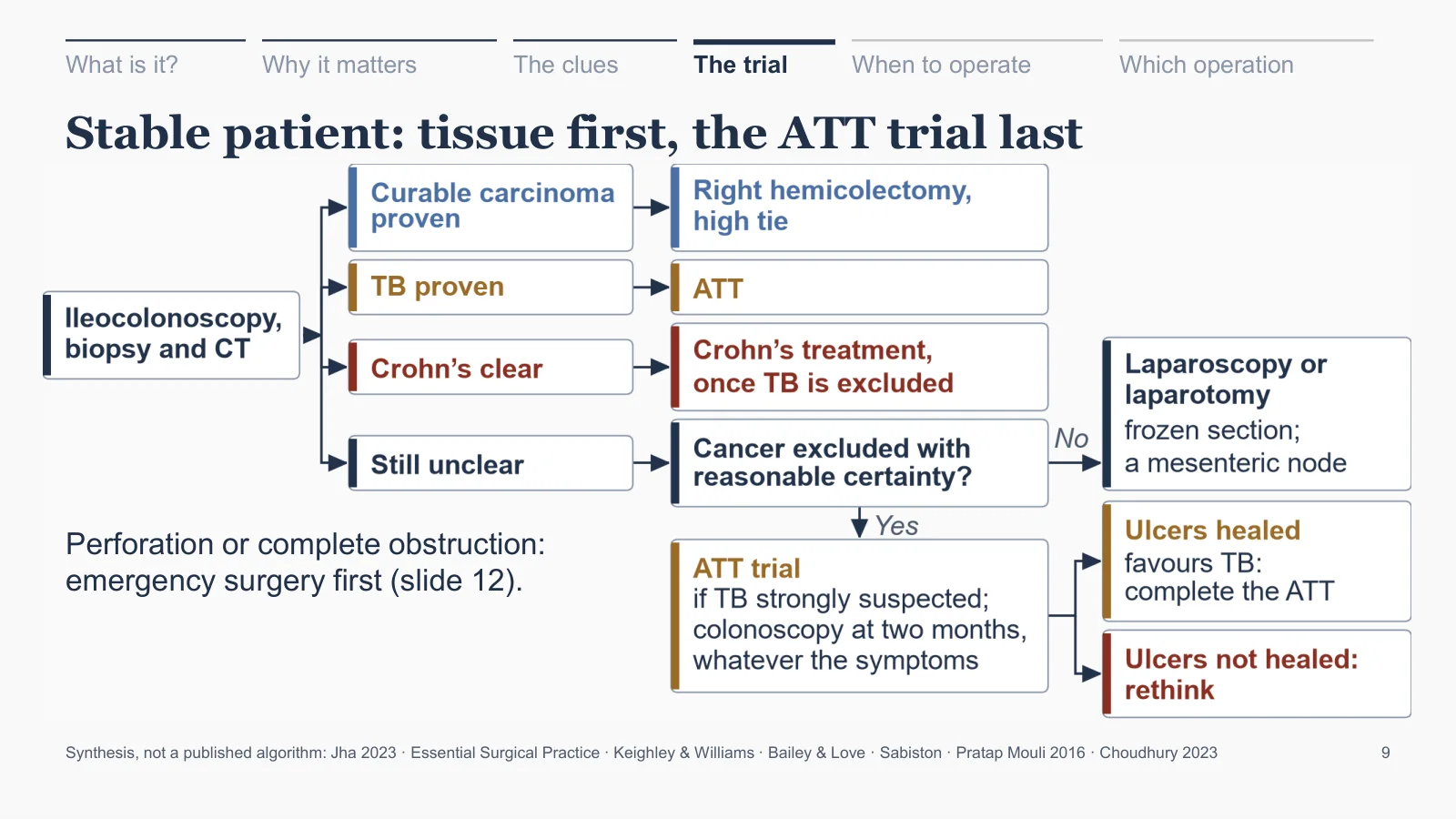
Stable patient: tissue first, the ATT trial last
What is it?
Why it matters
The clues
The trial
When to operate
Which operation
Synthesis, not a published algorithm: Jha 2023 · Essential Surgical Practice · Keighley & Williams · Bailey & Love · Sabiston · Pratap Mouli 2016 · Choudhury 2023
9
Perforation or complete obstruction: emergency surgery first (slide 12).
When to operate
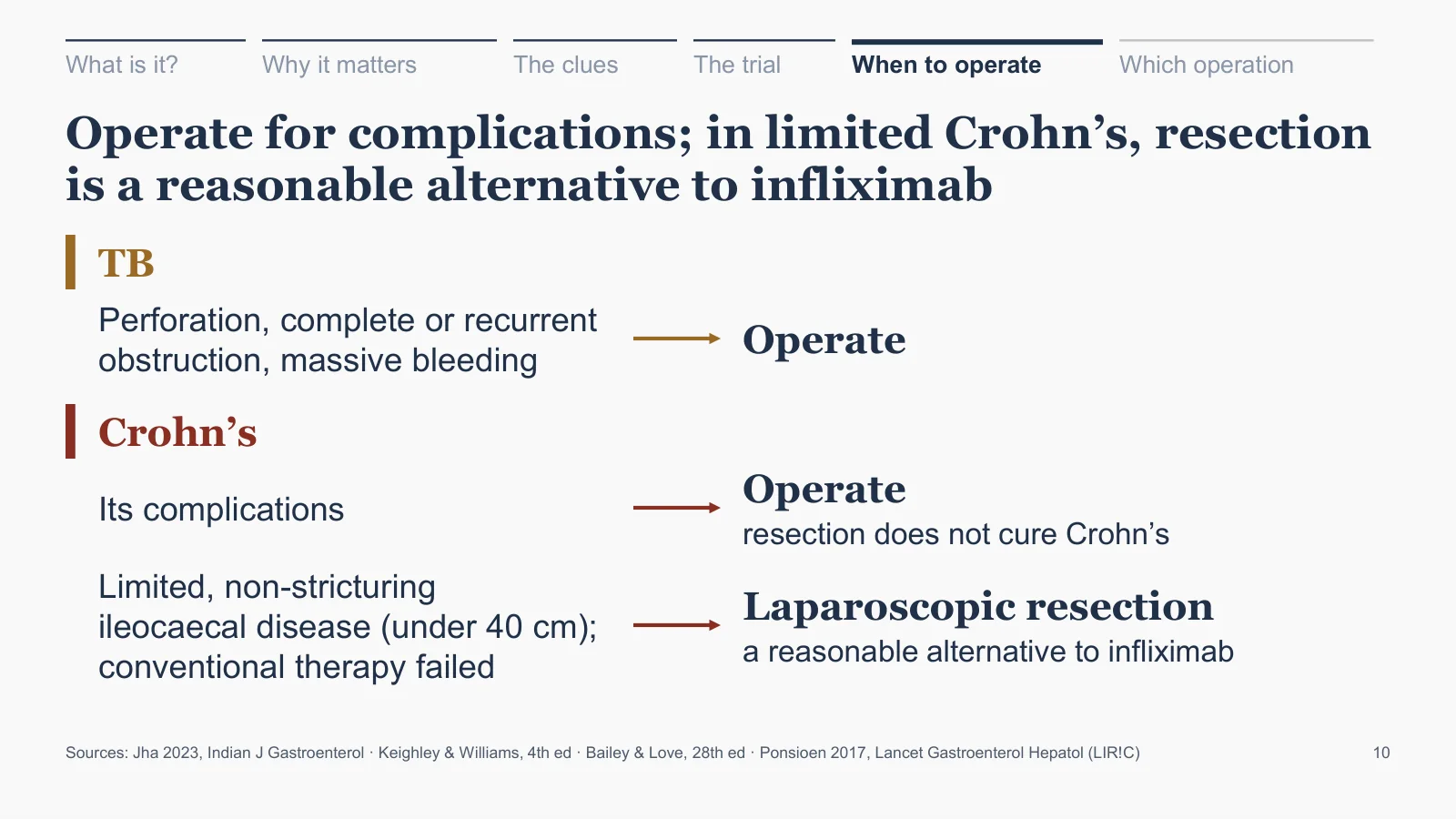
Operate for complications; in limited Crohn’s, resection is a reasonable alternative to infliximab
What is it?
Why it matters
The clues
The trial
When to operate
Which operation
Sources: Jha 2023, Indian J Gastroenterol · Keighley & Williams, 4th ed · Bailey & Love, 28th ed · Ponsioen 2017, Lancet Gastroenterol Hepatol (LIR!C)
10
TB
Perforation, complete or recurrent obstruction, massive bleeding
Operate
Crohn’s
Its complications
Operate resection does not cure Crohn’s
Limited, non-stricturing ileocaecal disease (under 40 cm); conventional therapy failed
Laparoscopic resection a reasonable alternative to infliximab
Which operation
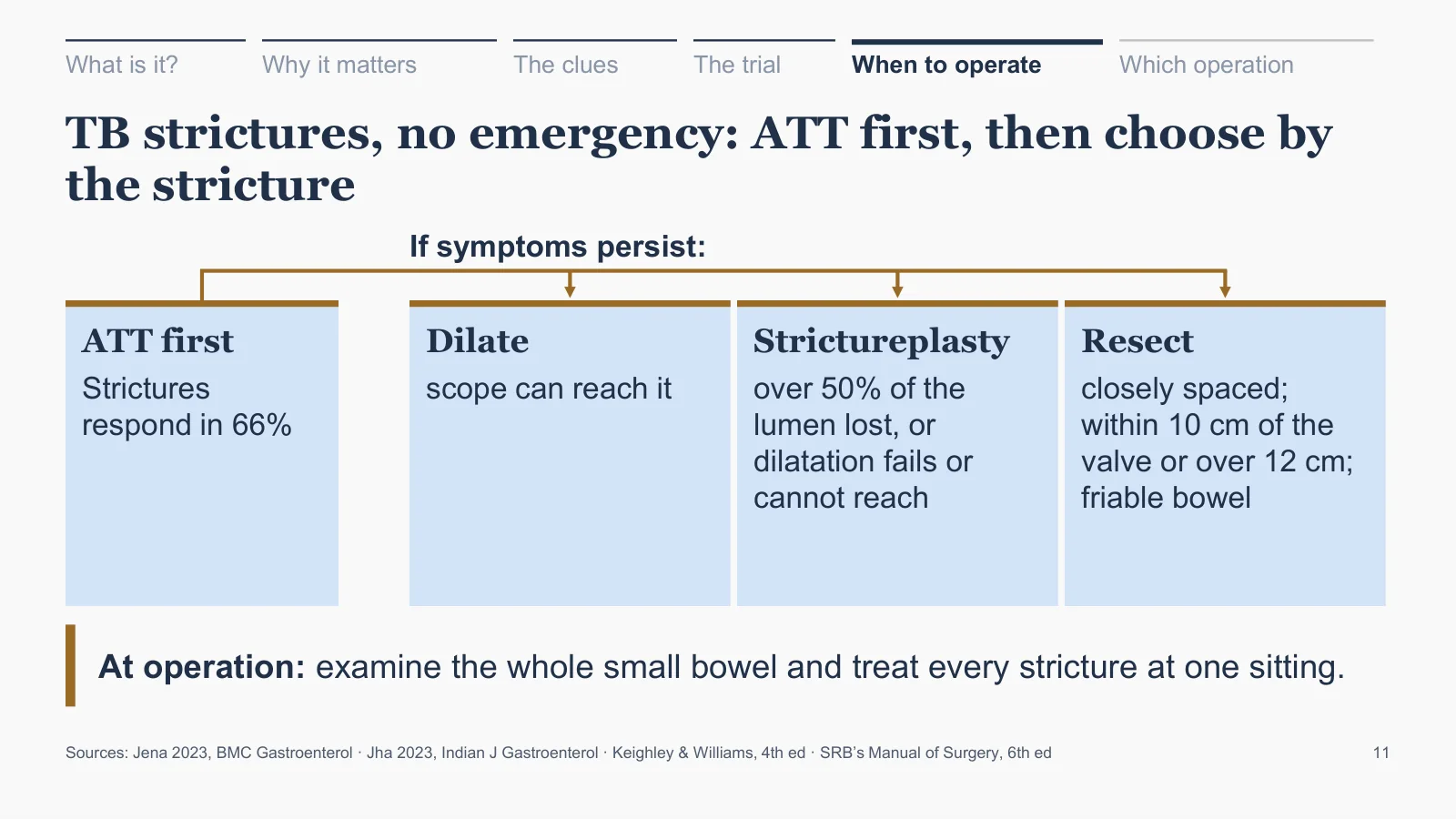
TB strictures, no emergency: ATT first, then choose by the stricture
What is it?
Why it matters
The clues
The trial
When to operate
Which operation
Sources: Jena 2023, BMC Gastroenterol · Jha 2023, Indian J Gastroenterol · Keighley & Williams, 4th ed · SRB’s Manual of Surgery, 6th ed
11
ATT first Strictures respond in 66%
If symptoms persist:
Dilate scope can reach it
Strictureplasty over 50% of the lumen lost, or dilatation fails or cannot reach
Resect closely spaced; within 10 cm of the valve or over 12 cm; friable bowel
At operation: examine the whole small bowel and treat every stricture at one sitting.
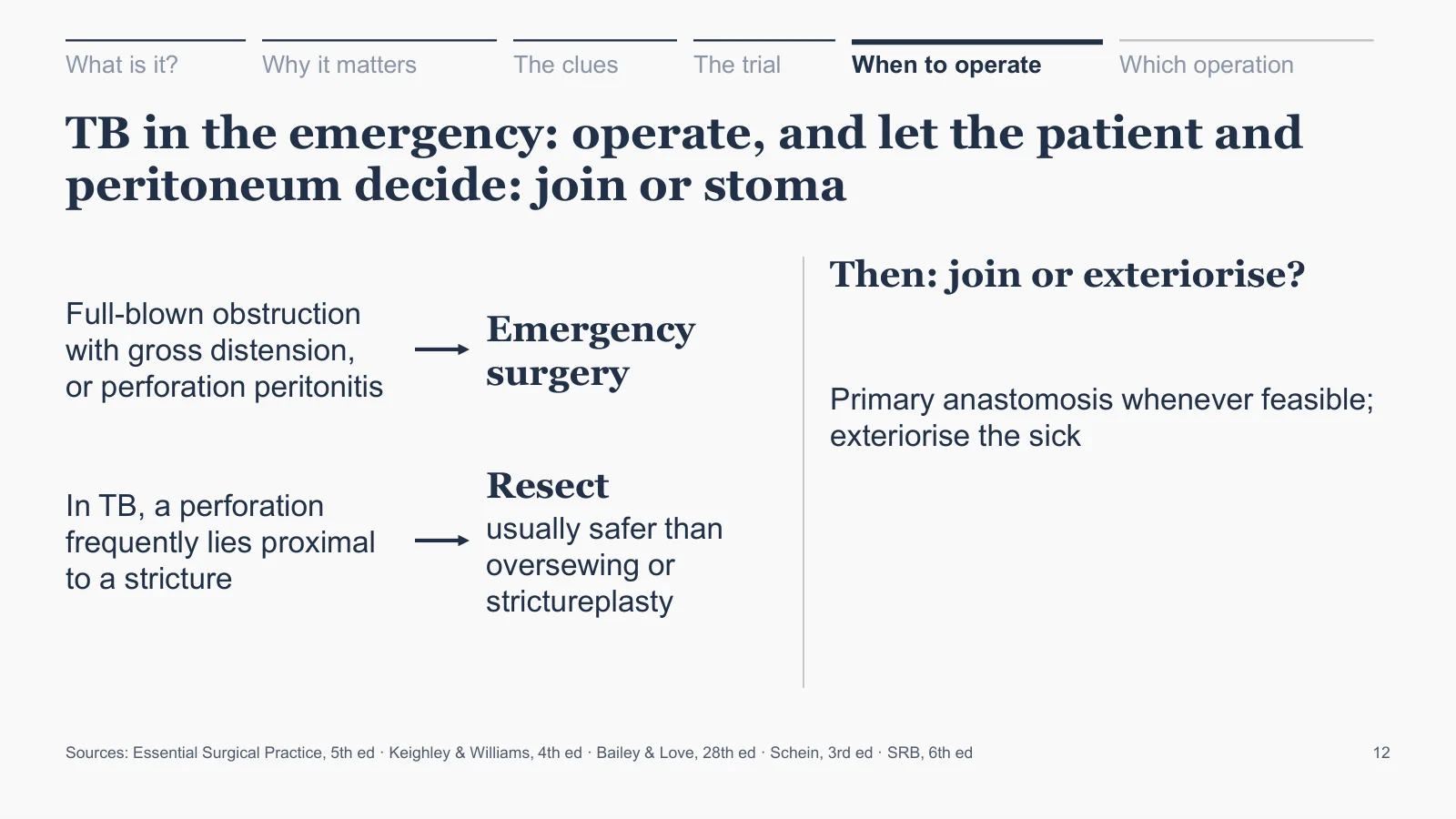
TB in the emergency: operate, and let the patient and peritoneum decide: join or stoma
What is it?
Why it matters
The clues
The trial
When to operate
Which operation
Sources: Essential Surgical Practice, 5th ed · Keighley & Williams, 4th ed · Bailey & Love, 28th ed · Schein, 3rd ed · SRB, 6th ed
12
Full-blown obstruction with gross distension, or perforation peritonitis
Emergency surgery
In TB, a perforation frequently lies proximal to a stricture
Resect usually safer than oversewing or strictureplasty
Then: join or exteriorise? Primary anastomosis whenever feasible; exteriorise the sick
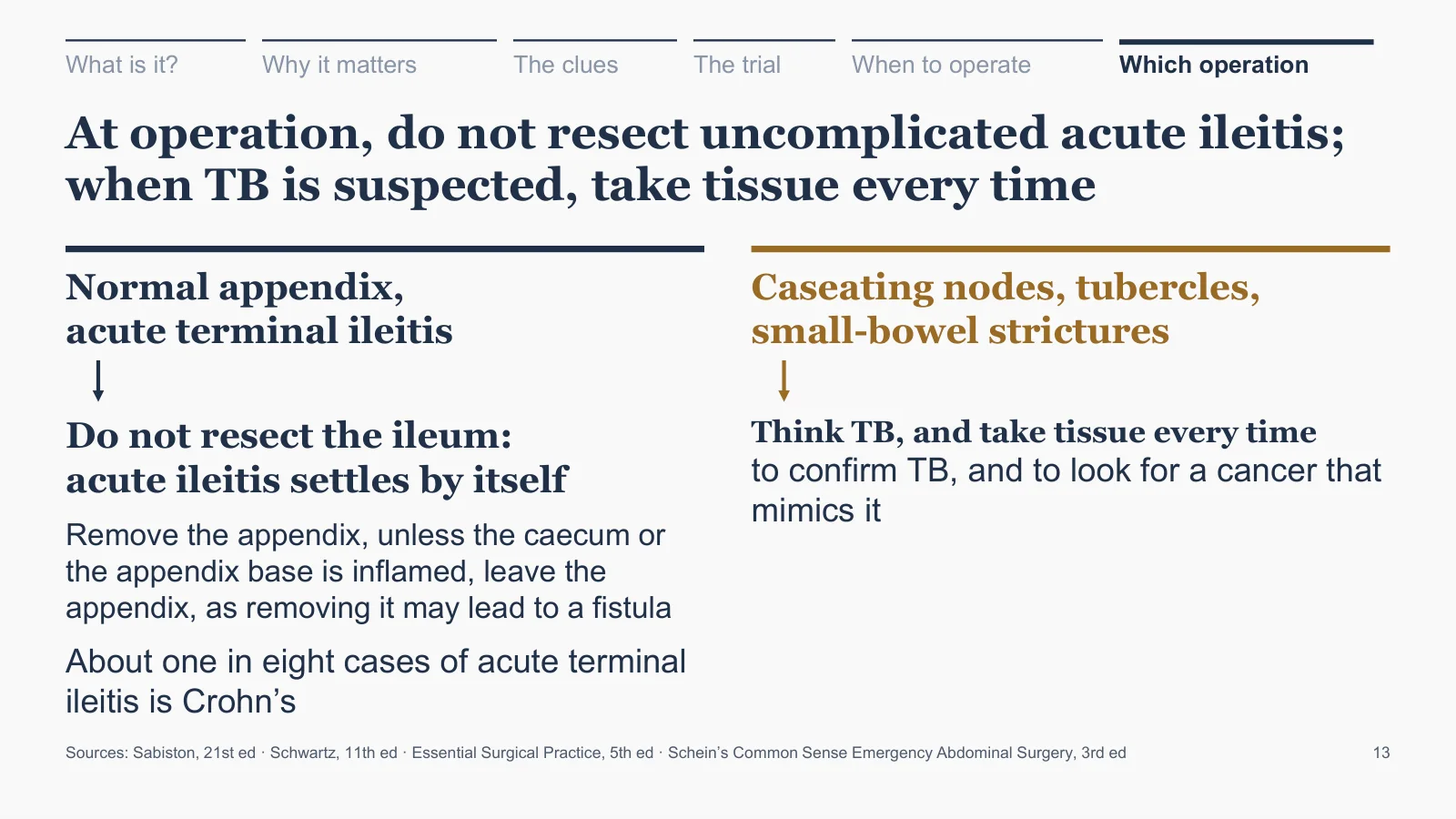
At operation, do not resect uncomplicated acute ileitis; when TB is suspected, take tissue every time
What is it?
Why it matters
The clues
The trial
When to operate
Which operation
Sources: Sabiston, 21st ed · Schwartz, 11th ed · Essential Surgical Practice, 5th ed · Schein’s Common Sense Emergency Abdominal Surgery, 3rd ed
13
Normal appendix, acute terminal ileitis
Do not resect the ileum: acute ileitis settles by itself Remove the appendix, unless the caecum or the appendix base is inflamed, leave the appendix, as removing it may lead to a fistula About one in eight cases of acute terminal ileitis is Crohn’s
Caseating nodes, tubercles, small-bowel strictures
Think TB, and take tissue every time to confirm TB, and to look for a cancer that mimics it
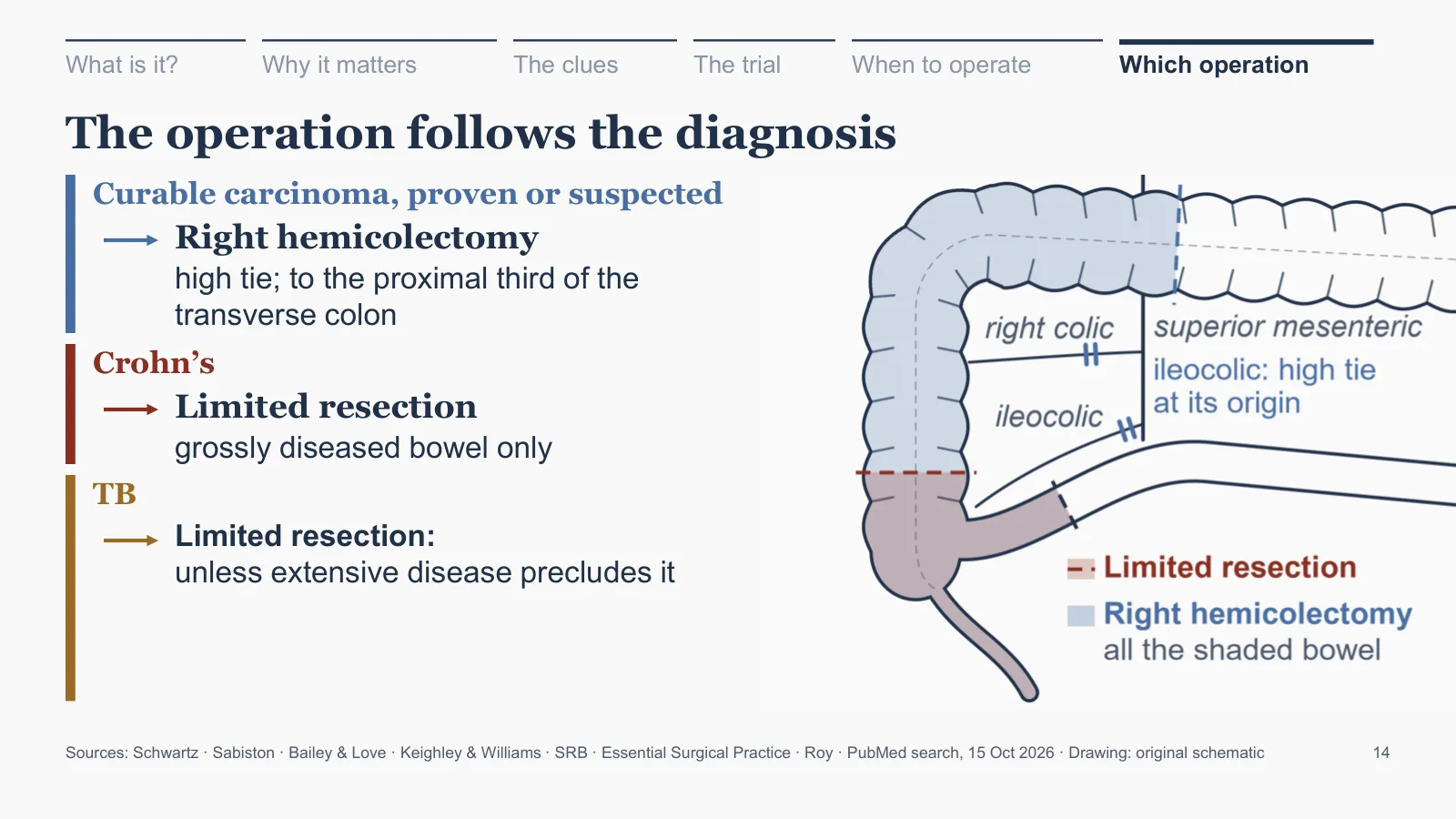
The operation follows the diagnosis
What is it?
Why it matters
The clues
The trial
When to operate
Which operation
Sources: Schwartz · Sabiston · Bailey & Love · Keighley & Williams · SRB · Essential Surgical Practice · Roy · PubMed search, 15 Oct 2026 · Drawing: original schematic
14
Curable carcinoma, proven or suspected
Right hemicolectomy high tie; to the proximal third of the transverse colon
Crohn’s
Limited resection grossly diseased bowel only
TB
Limited resection: unless extensive disease precludes it
Take-home
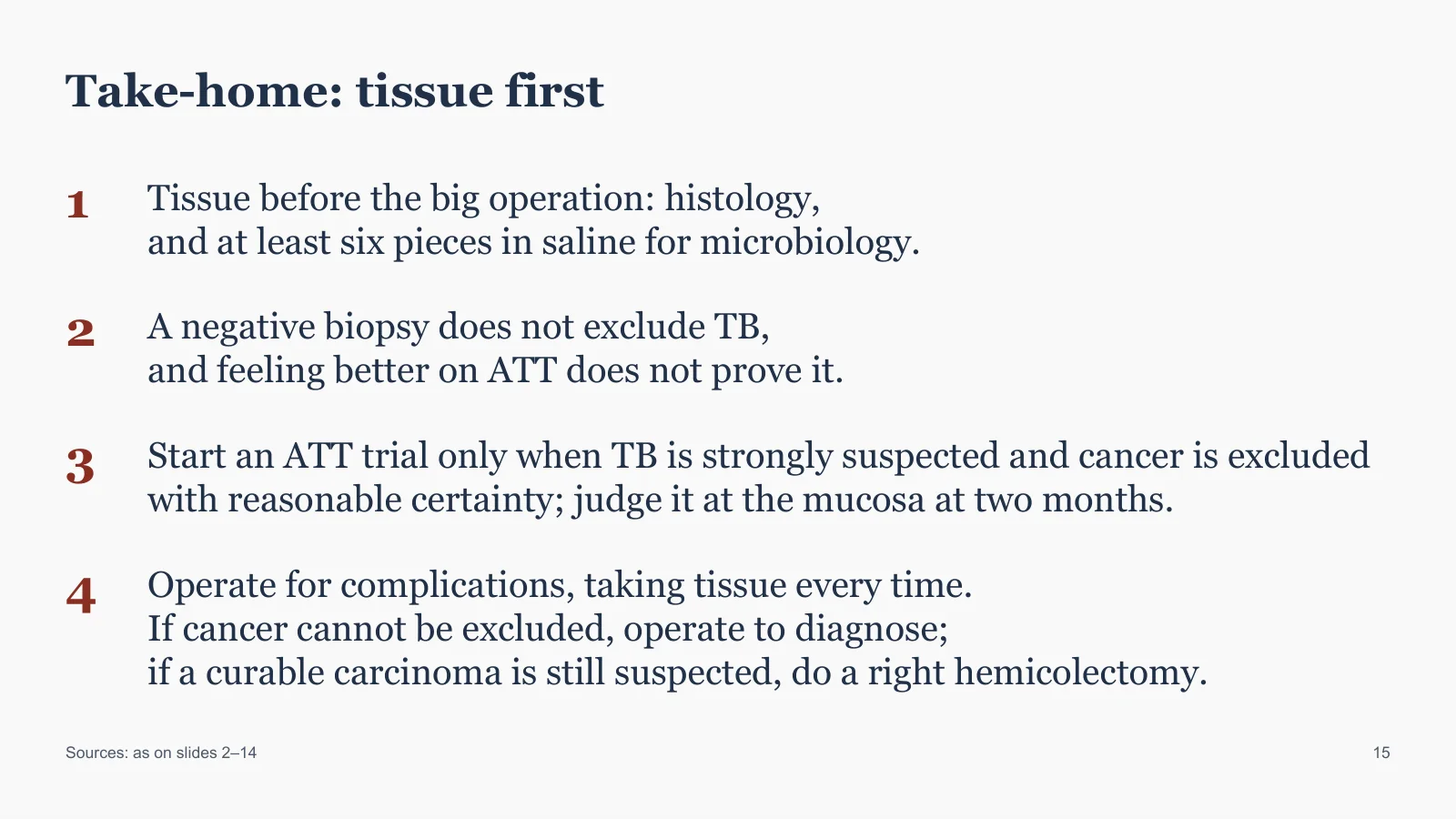
Take-home: tissue first
Sources: as on slides 2–14
15
1
Tissue before the big operation: histology, and at least six pieces in saline for microbiology.
2
A negative biopsy does not exclude TB, and feeling better on ATT does not prove it.
3
Start an ATT trial only when TB is strongly suspected and cancer is excluded with reasonable certainty; judge it at the mucosa at two months.
4
Operate for complications, taking tissue every time. If cancer cannot be excluded, operate to diagnose; if a curable carcinoma is still suspected, do a right hemicolectomy.
Sources and image credits
Every figure and clip was drawn for this talk. Sources are cited on each slide, as listed below.
Sources
- [1] Sources: Cai 2007, Dig Dis Sci · Limsrivilai 2017, Am J Gastroenterol · Keighley & Williams, 4th ed · Bailey & Love, 28th ed · Drawing: original
- [2] Sources: Gupta 2020, J Crohns Colitis · Choudhury 2023, BMC Gastroenterol · Lin 2009, Int J Colorectal Dis
- [3] Sources: Limsrivilai 2017, Am J Gastroenterol (38 studies) · Du et al, cited in Jha 2023, Indian J Gastroenterol · Keighley & Williams, 4th ed
- [4] Sources: Kedia 2017, Intest Res (6 studies, 417 Crohn’s, 195 TB) · Essential Surgical Practice, 5th ed · Keighley & Williams, 4th ed · Node drawings: original schematic
- [5] Sources: Weeranawin 2026, Intest Res (meta-analysis) · Jha 2023, Indian J Gastroenterol (ICMR workflow)
- [6] Sources: Essential Surgical Practice, 5th ed · Keighley & Williams, 4th ed · SRB’s Manual of Surgery, 6th ed · Sabiston, 21st ed
- [7] Sources: Pratap Mouli 2016, Aliment Pharmacol Ther · Jha 2023, Indian J Gastroenterol · Choudhury 2023, BMC Gastroenterol (authors’ suggestion)
- [8] Synthesis, not a published algorithm: Jha 2023 · Essential Surgical Practice · Keighley & Williams · Bailey & Love · Sabiston · Pratap Mouli 2016 · Choudhury 2023
- [9] Sources: Jha 2023, Indian J Gastroenterol · Keighley & Williams, 4th ed · Bailey & Love, 28th ed · Ponsioen 2017, Lancet Gastroenterol Hepatol (LIR!C)
- [10] Sources: Jena 2023, BMC Gastroenterol · Jha 2023, Indian J Gastroenterol · Keighley & Williams, 4th ed · SRB’s Manual of Surgery, 6th ed
- [11] Sources: Essential Surgical Practice, 5th ed · Keighley & Williams, 4th ed · Bailey & Love, 28th ed · Schein, 3rd ed · SRB, 6th ed
- [12] Sources: Sabiston, 21st ed · Schwartz, 11th ed · Essential Surgical Practice, 5th ed · Schein’s Common Sense Emergency Abdominal Surgery, 3rd ed
- [13] Sources: Schwartz · Sabiston · Bailey & Love · Keighley & Williams · SRB · Essential Surgical Practice · Roy · PubMed search, 15 Oct 2026 · Drawing: original schematic
- [14] Sources: as on slides 2–14