Hepatobiliary surgery · Lecture 8
Non-stone biliary obstruction · 55 slides
Biliary obstruction beyond stones.
Start with three patients and follow the level and cause of obstruction, from benign strictures to congenital disease and parasites.
About the downloads
PowerPoint without speaker notes. SHA-256 checksums verify the downloaded files.
Contents · 10 parts
Opening cases
Biliary obstruction beyond stones
HEPATOBILIARY SURGERY · LECTURE 8
Biliary obstruction beyond stones
Dr Prateek Gupta
Assistant Professor, Department of General Surgery Dayanand Medical College & Hospital, Ludhiana prateekguptasurgery.com
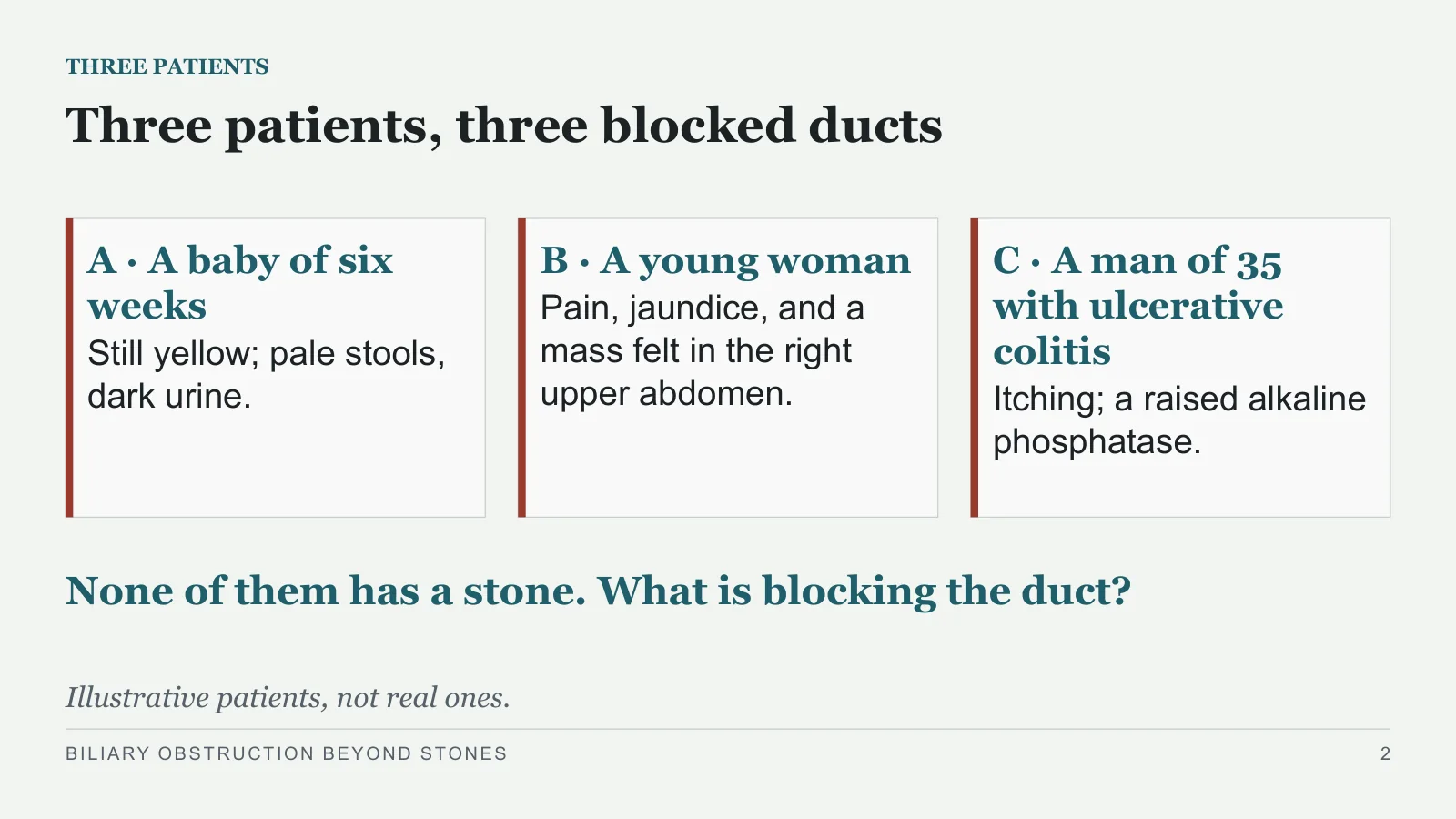
Three patients, three blocked ducts
THREE PATIENTS
A · A baby of six weeks
Still yellow; pale stools, dark urine.
B · A young woman
Pain, jaundice, and a mass felt in the right upper abdomen.
C · A man of 35 with ulcerative colitis
Itching; a raised alkaline phosphatase.
None of them has a stone. What is blocking the duct?
Illustrative patients, not real ones.
BILIARY OBSTRUCTION BEYOND STONES
2
Where, and what
Where, and what
PART 1
BILIARY OBSTRUCTION BEYOND STONES
3
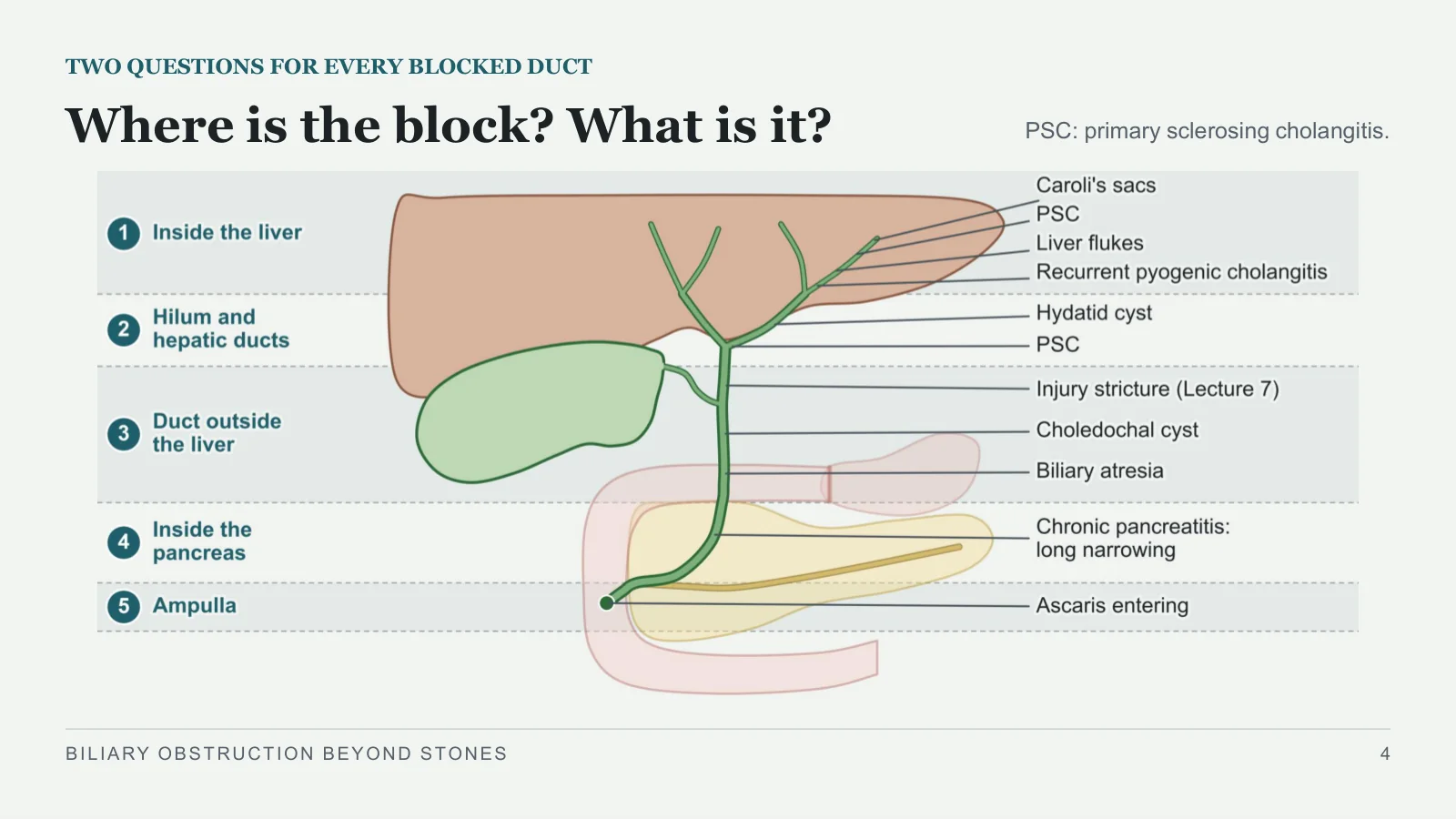
Where is the block? What is it?
TWO QUESTIONS FOR EVERY BLOCKED DUCT
PSC: primary sclerosing cholangitis.
BILIARY OBSTRUCTION BEYOND STONES
4
Benign strictures
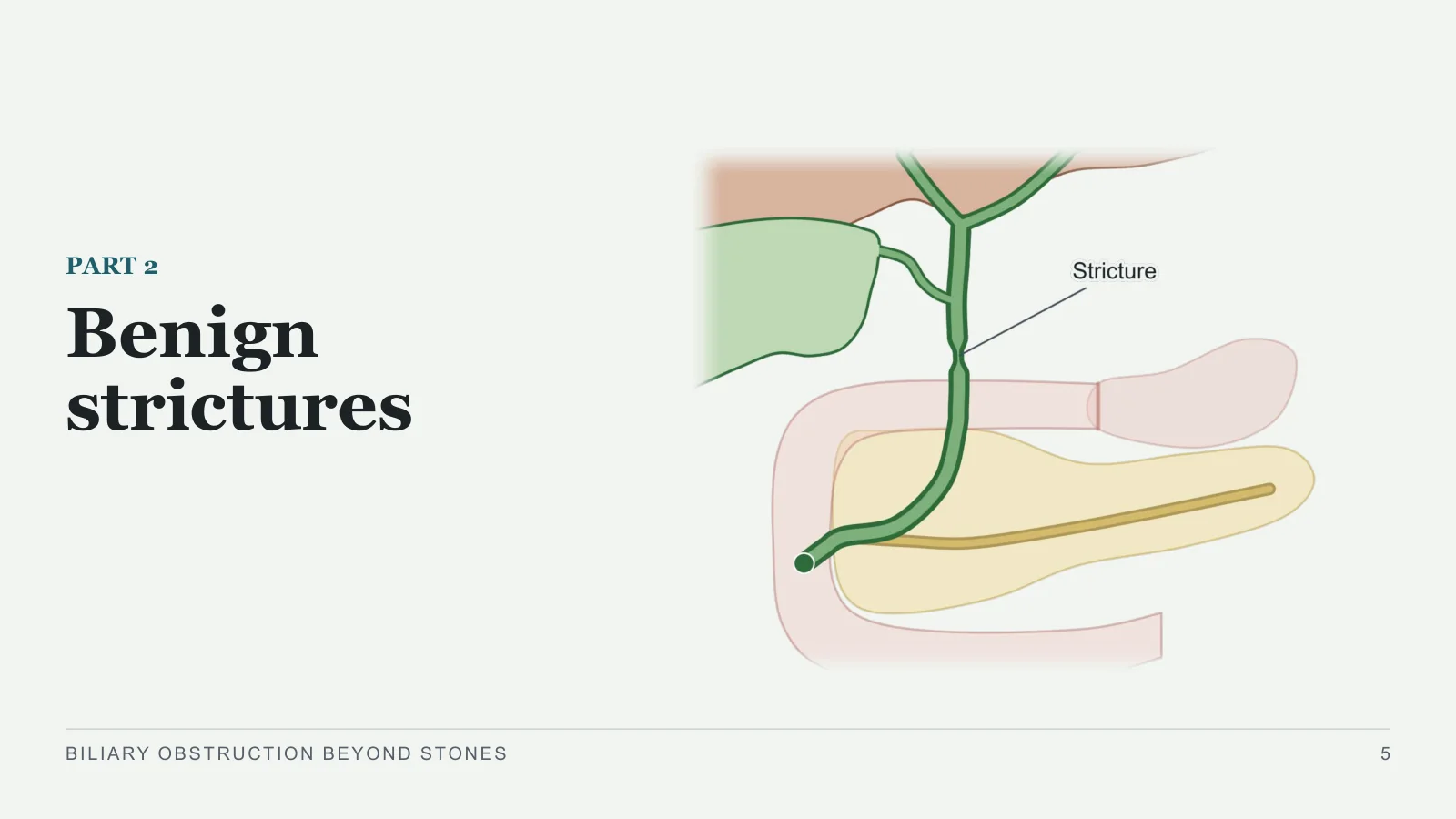
Benign strictures
PART 2
BILIARY OBSTRUCTION BEYOND STONES
5
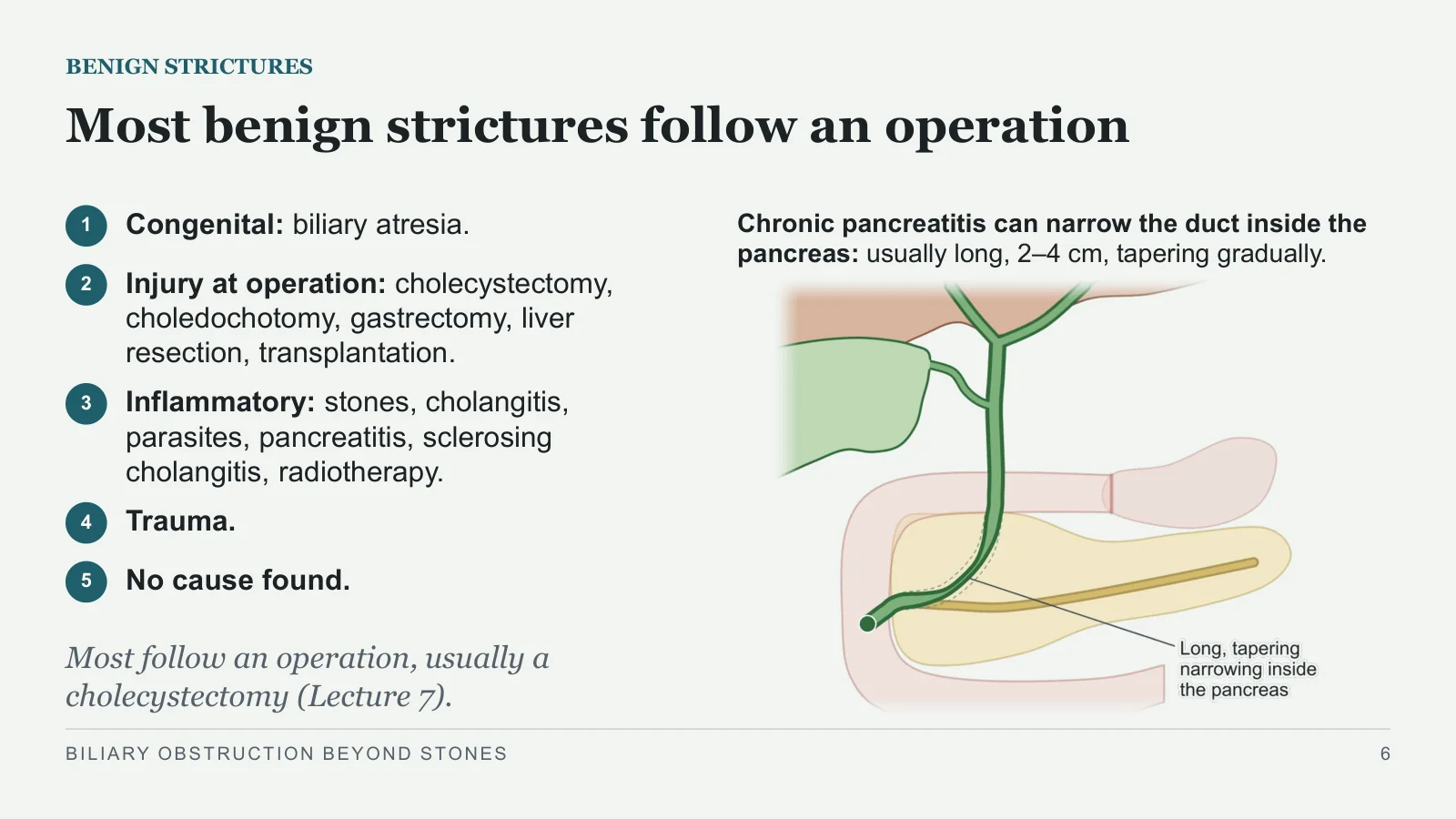
Most benign strictures follow an operation
BENIGN STRICTURES
1
Congenital: biliary atresia.
2
Injury at operation: cholecystectomy, choledochotomy, gastrectomy, liver resection, transplantation.
3
Inflammatory: stones, cholangitis, parasites, pancreatitis, sclerosing cholangitis, radiotherapy.
4
Trauma.
5
No cause found.
Most follow an operation, usually a cholecystectomy (Lecture 7).
Chronic pancreatitis can narrow the duct inside the pancreas: usually long, 2–4 cm, tapering gradually.
BILIARY OBSTRUCTION BEYOND STONES
6
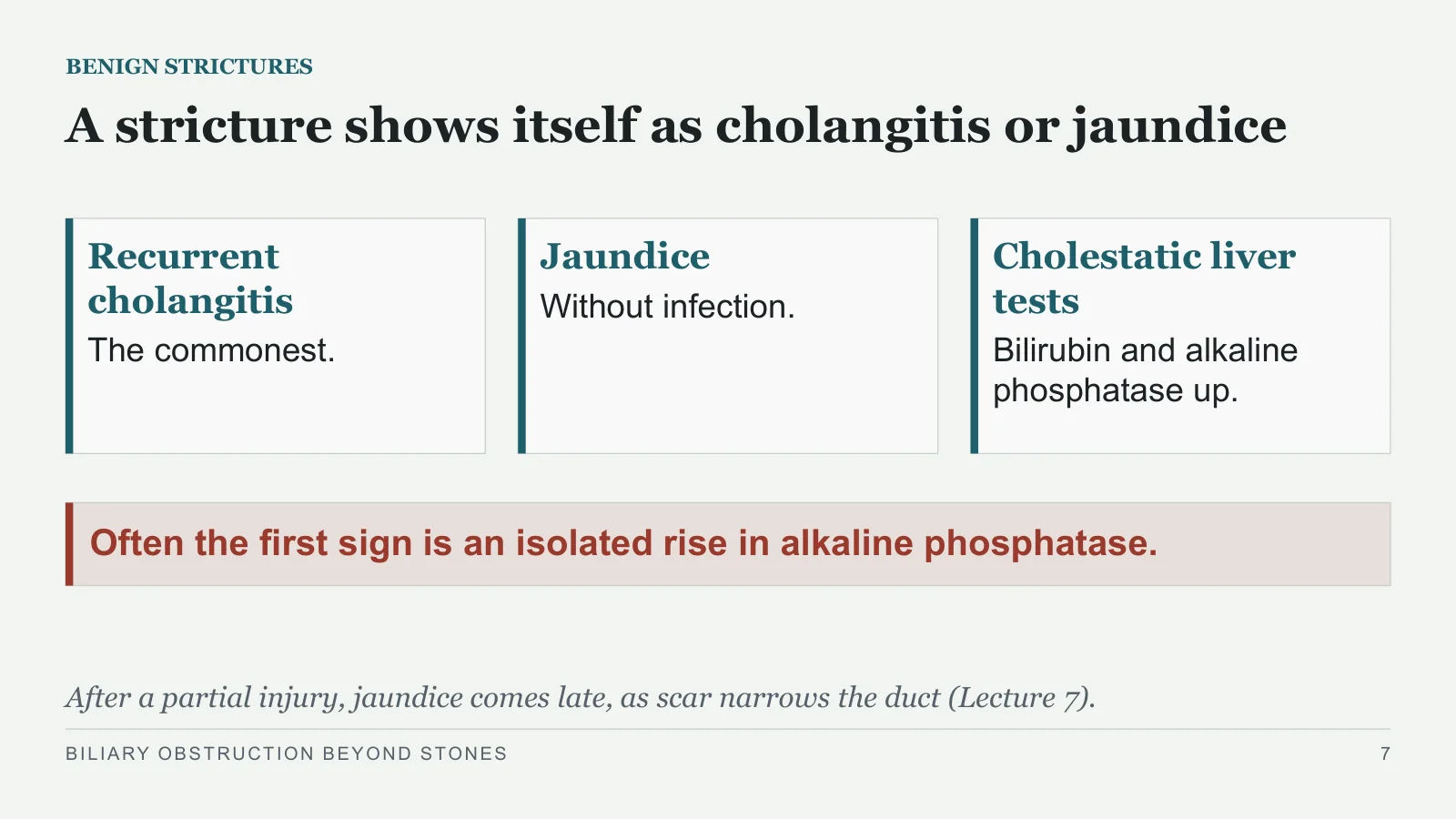
A stricture shows itself as cholangitis or jaundice
BENIGN STRICTURES
Recurrent cholangitis
The commonest.
Jaundice
Without infection.
Cholestatic liver tests
Bilirubin and alkaline phosphatase up.
Often the first sign is an isolated rise in alkaline phosphatase.
After a partial injury, jaundice comes late, as scar narrows the duct (Lecture 7).
BILIARY OBSTRUCTION BEYOND STONES
7
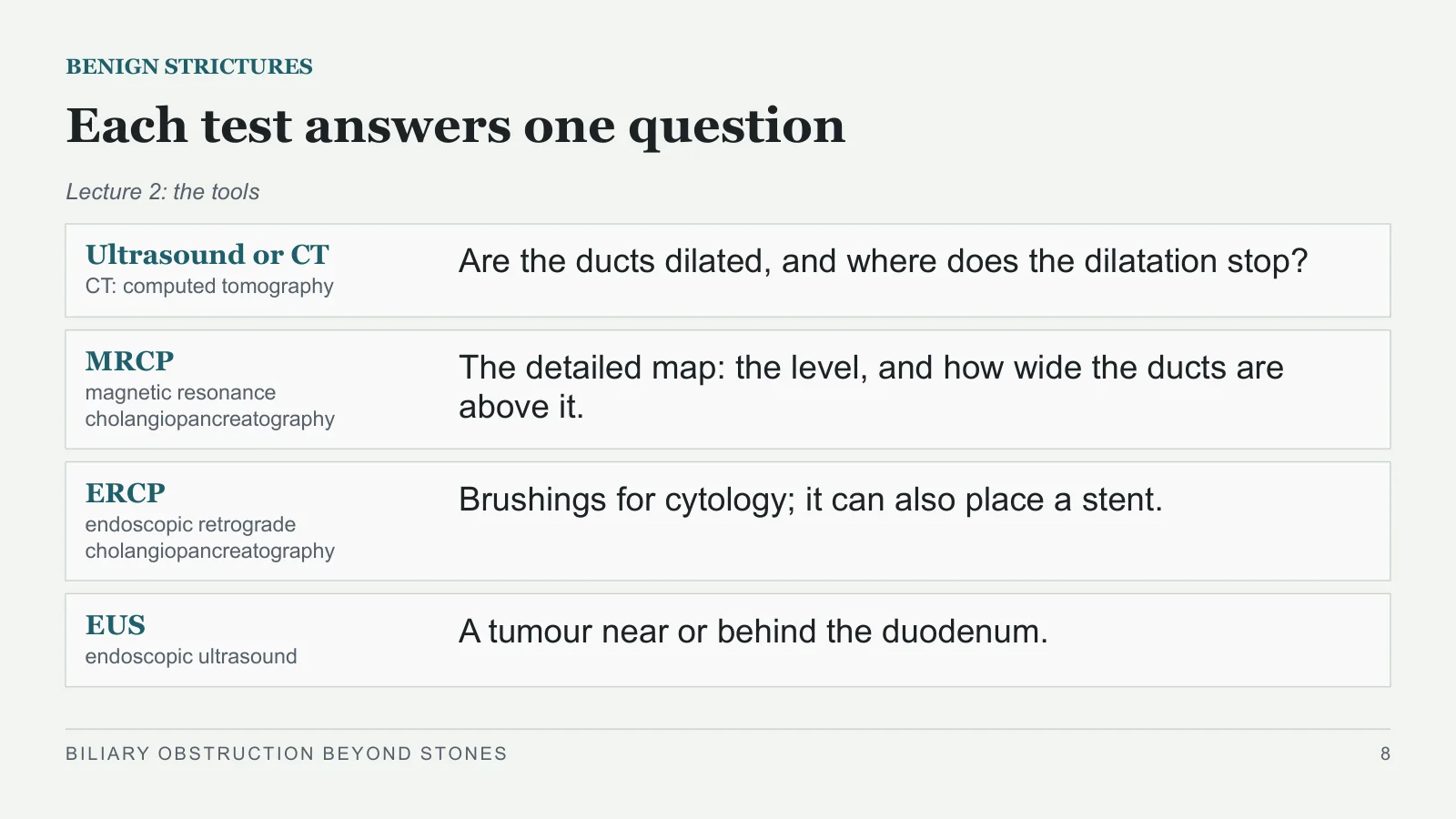
Each test answers one question
BENIGN STRICTURES
Lecture 2: the tools
Ultrasound or CT
CT: computed tomography
Are the ducts dilated, and where does the dilatation stop?
MRCP
magnetic resonance cholangiopancreatography
The detailed map: the level, and how wide the ducts are above it.
ERCP
endoscopic retrograde cholangiopancreatography
Brushings for cytology; it can also place a stent.
EUS
endoscopic ultrasound
A tumour near or behind the duodenum.
BILIARY OBSTRUCTION BEYOND STONES
8
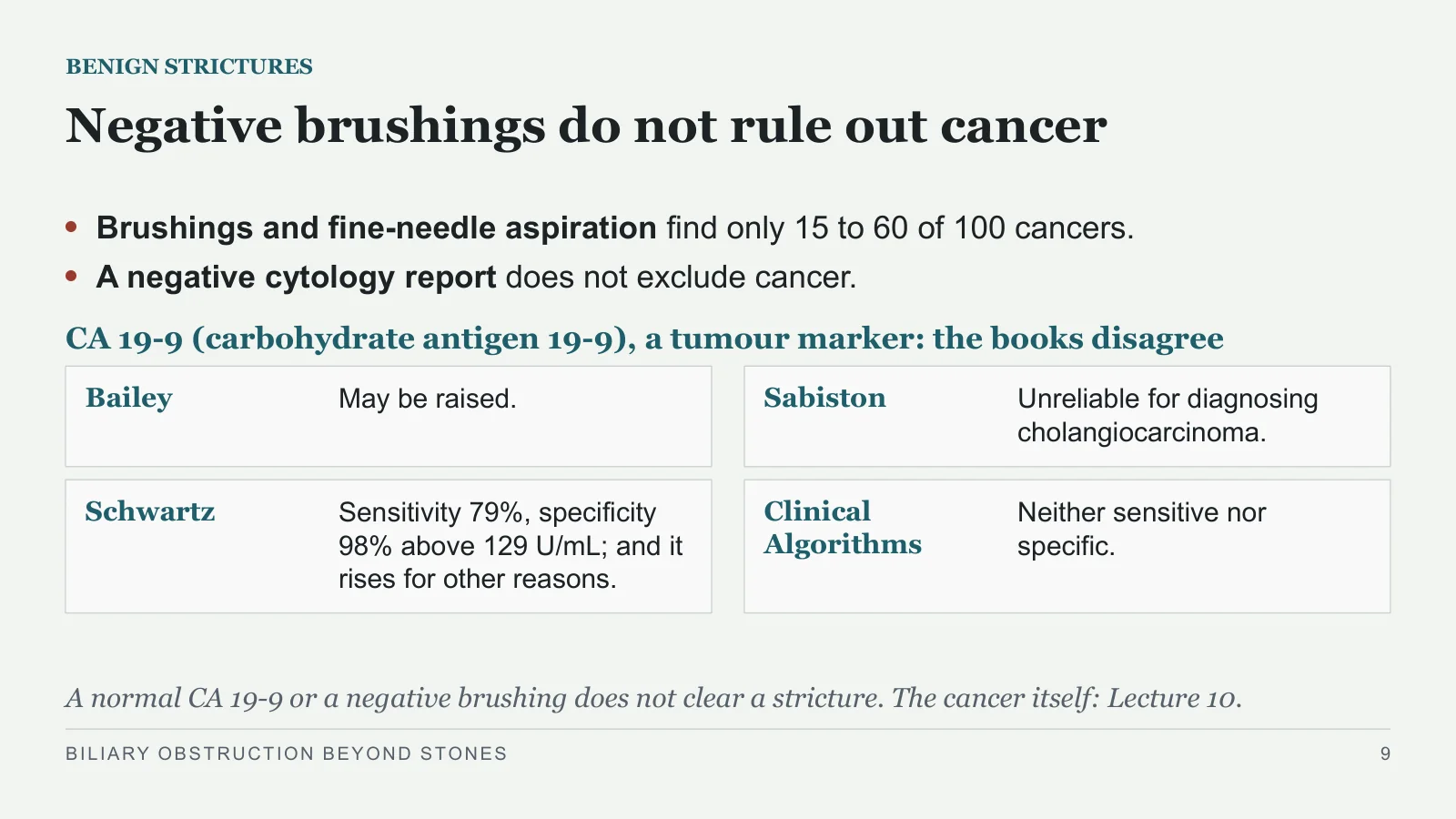
Negative brushings do not rule out cancer
BENIGN STRICTURES
Brushings and fine-needle aspiration find only 15 to 60 of 100 cancers.
A negative cytology report does not exclude cancer.
CA 19-9 (carbohydrate antigen 19-9), a tumour marker: the books disagree
Bailey
May be raised.
Sabiston
Unreliable for diagnosing cholangiocarcinoma.
Schwartz
Sensitivity 79%, specificity 98% above 129 U/mL; and it rises for other reasons.
Clinical Algorithms
Neither sensitive nor specific.
A normal CA 19-9 or a negative brushing does not clear a stricture. The cancer itself: Lecture 10.
BILIARY OBSTRUCTION BEYOND STONES
9
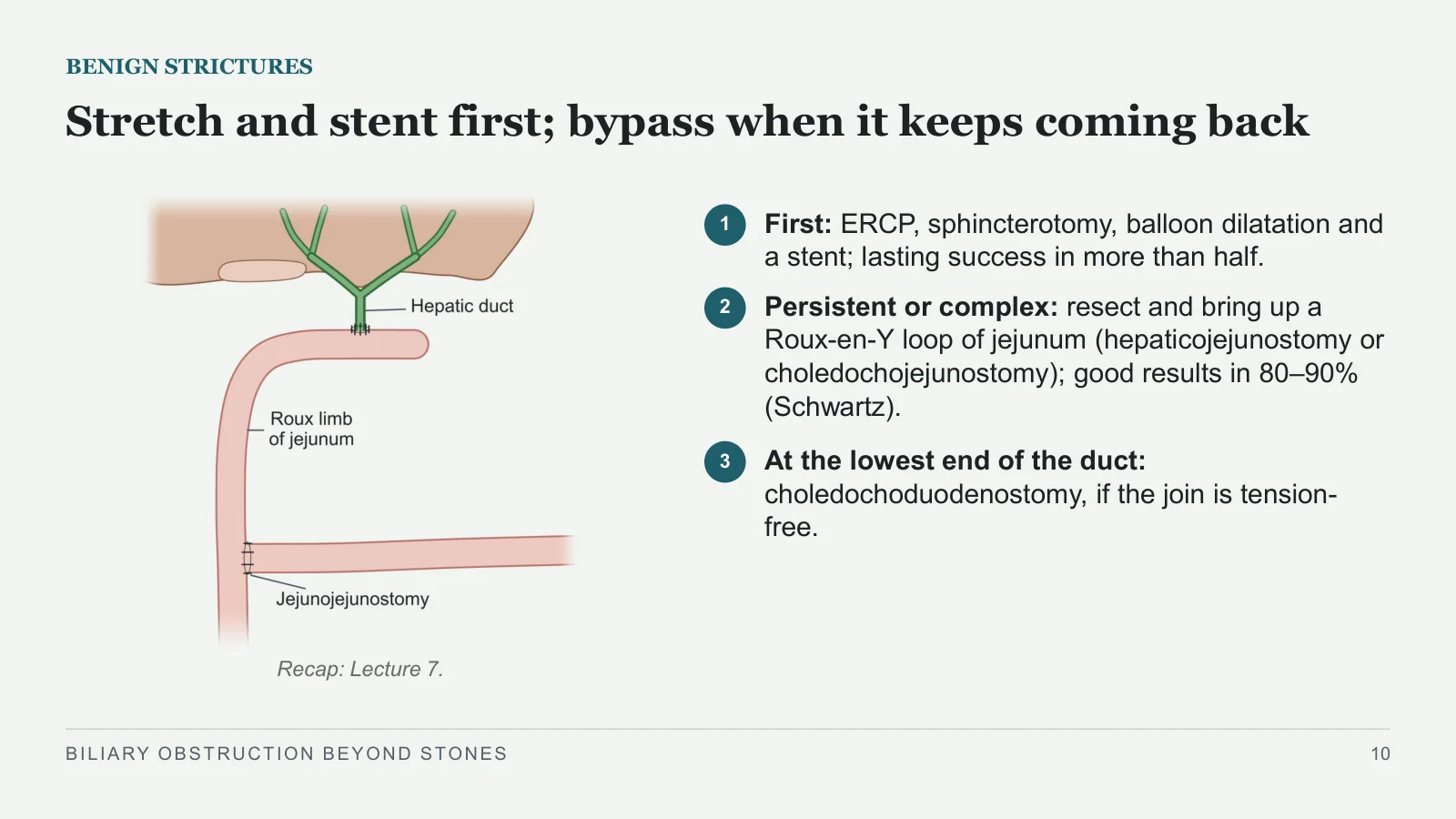
Stretch and stent first; bypass when it keeps coming back
BENIGN STRICTURES
1
First: ERCP, sphincterotomy, balloon dilatation and a stent; lasting success in more than half.
2
Persistent or complex: resect and bring up a Roux-en-Y loop of jejunum (hepaticojejunostomy or choledochojejunostomy); good results in 80–90% (Schwartz).
Recap: Lecture 7.
3
At the lowest end of the duct: choledochoduodenostomy, if the join is tension-free.
BILIARY OBSTRUCTION BEYOND STONES
10
Choledochal cyst
Choledochal cyst
PART 3
BILIARY OBSTRUCTION BEYOND STONES
11
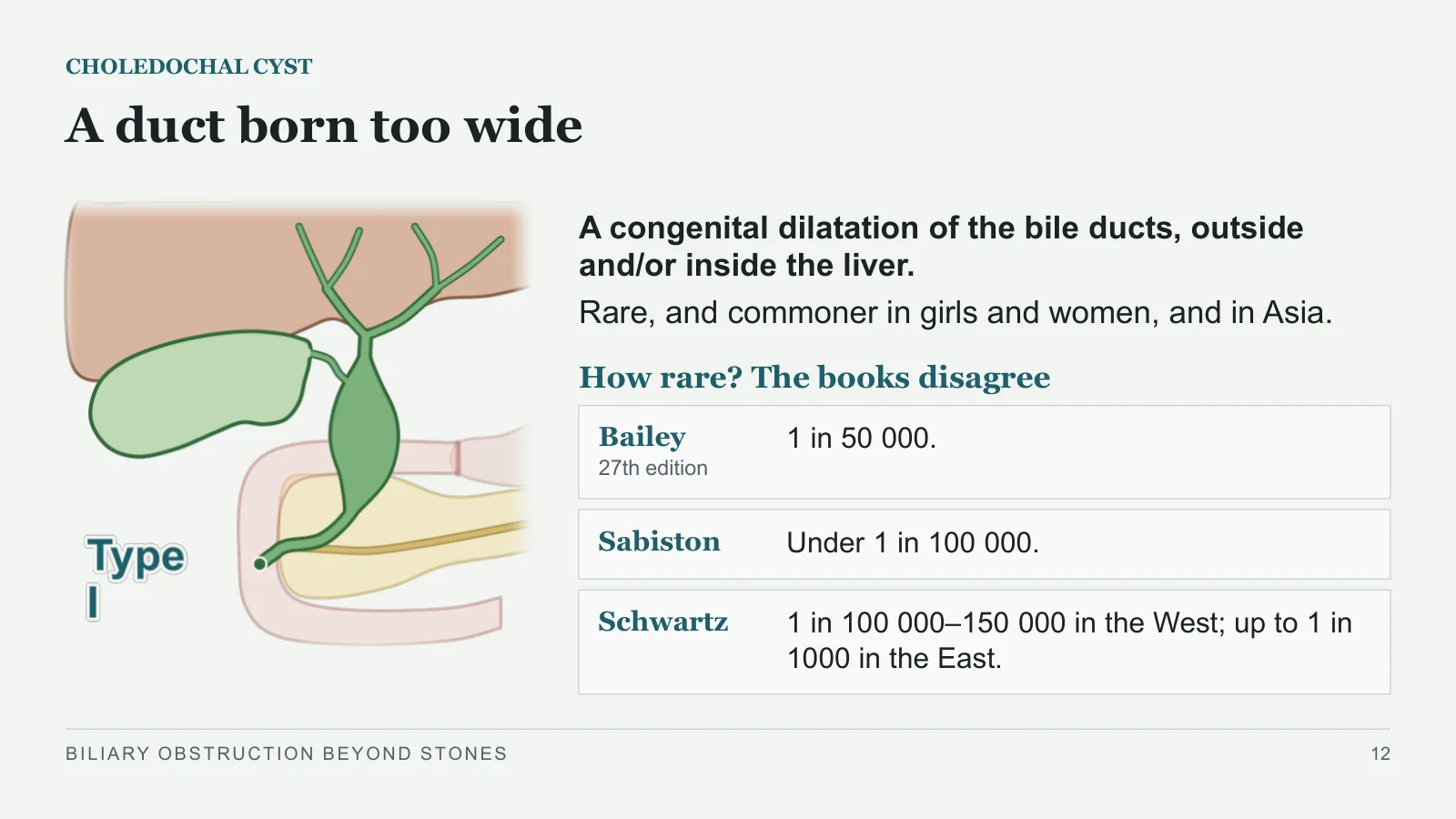
A duct born too wide
CHOLEDOCHAL CYST
A congenital dilatation of the bile ducts, outside and/or inside the liver.
Rare, and commoner in girls and women, and in Asia.
How rare? The books disagree
Bailey
27th edition
1 in 50 000.
Sabiston
Under 1 in 100 000.
Schwartz
1 in 100 000–150 000 in the West; up to 1 in 1000 in the East.
BILIARY OBSTRUCTION BEYOND STONES
12
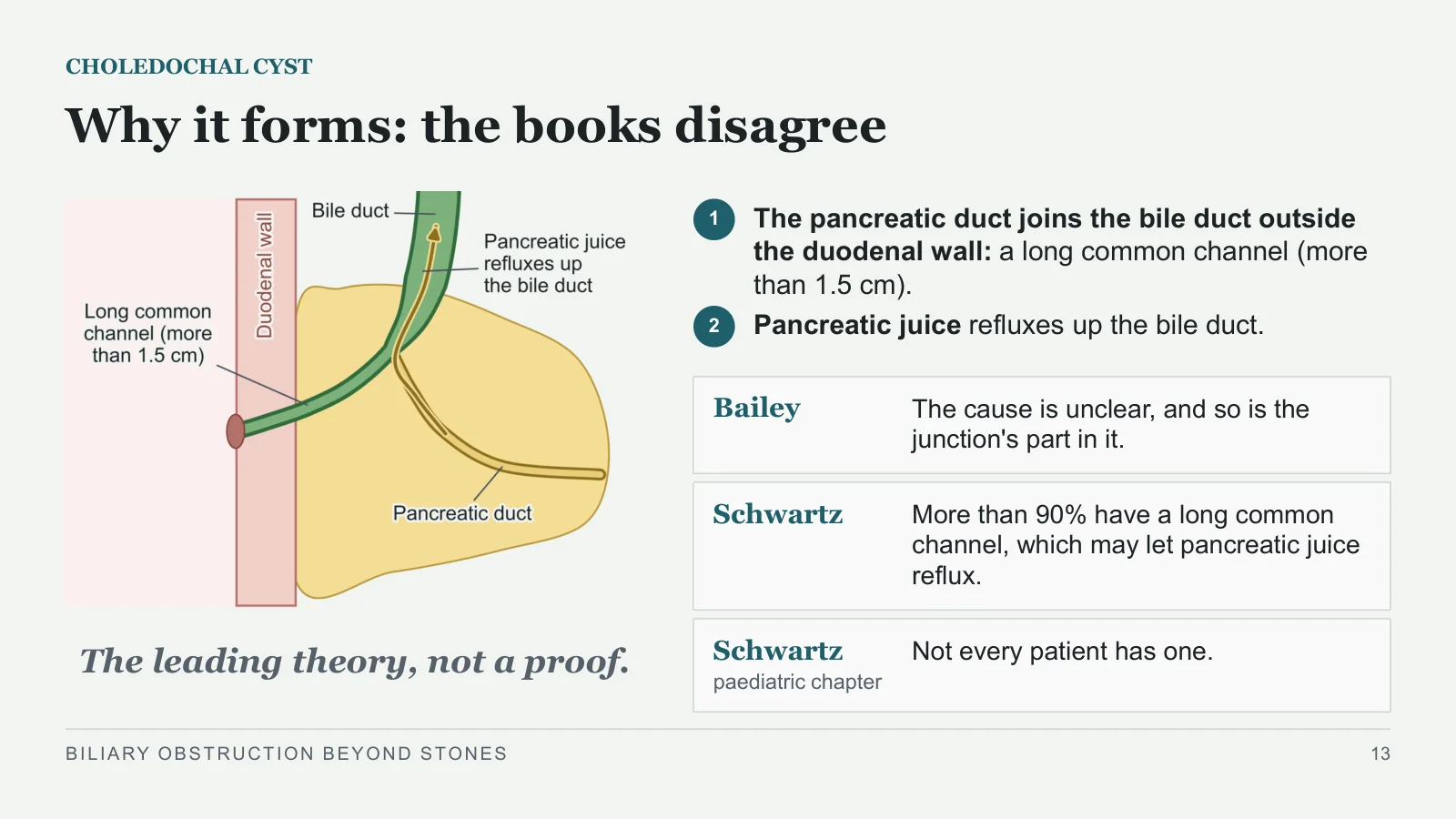
Why it forms: the books disagree
CHOLEDOCHAL CYST
1
The pancreatic duct joins the bile duct outside the duodenal wall: a long common channel (more than 1.5 cm).
2
Pancreatic juice refluxes up the bile duct.
Bailey
The cause is unclear, and so is the junction's part in it.
Schwartz
More than 90% have a long common channel, which may let pancreatic juice reflux.
Schwartz
paediatric chapter
Not every patient has one.
The leading theory, not a proof.
BILIARY OBSTRUCTION BEYOND STONES
13
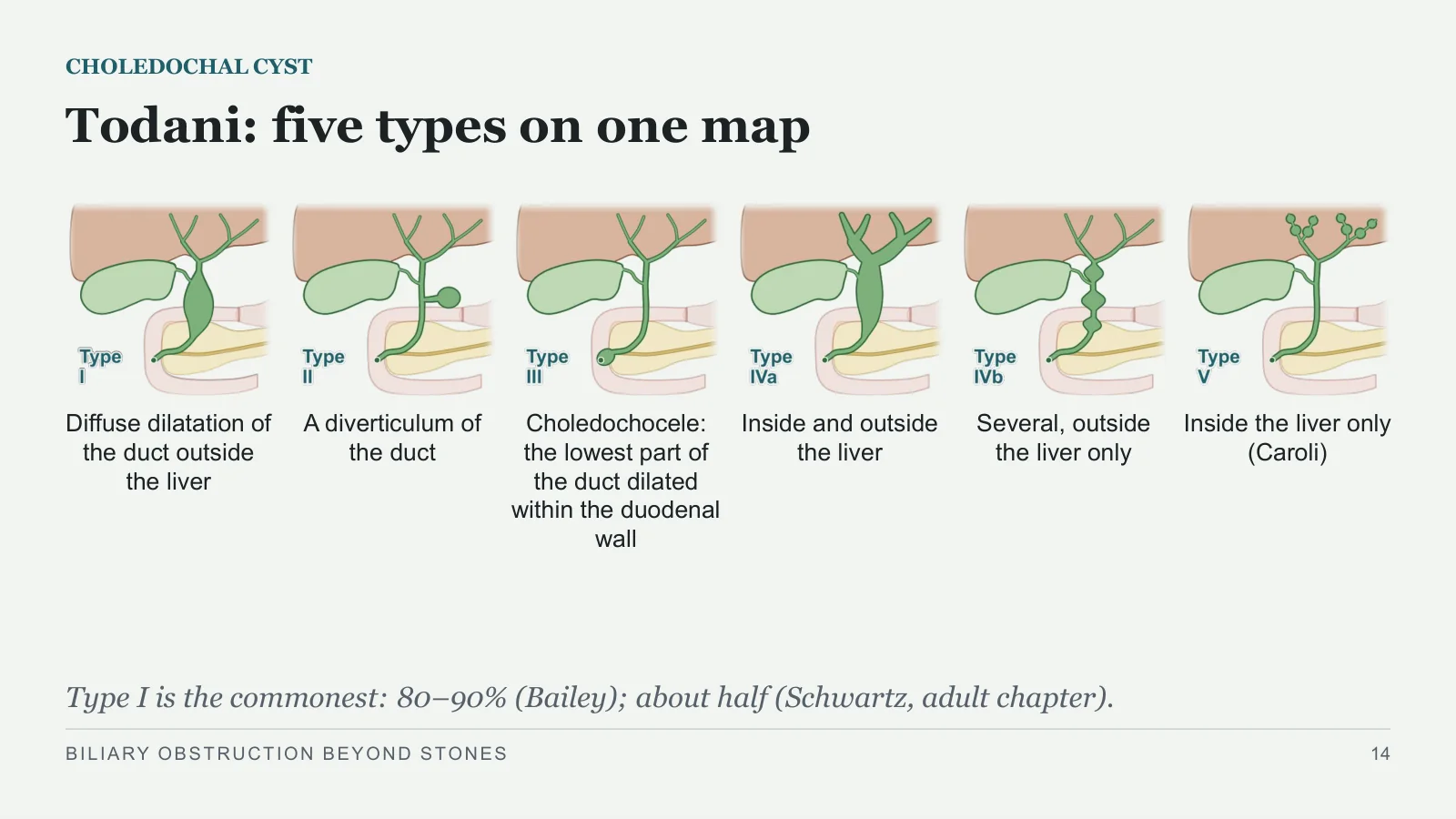
Todani: five types on one map
CHOLEDOCHAL CYST
Diffuse dilatation of the duct outside the liver
A diverticulum of the duct
Choledochocele: the lowest part of the duct dilated within the duodenal wall
Inside and outside the liver
Several, outside the liver only
Inside the liver only (Caroli)
Type I is the commonest: 80–90% (Bailey); about half (Schwartz, adult chapter).
BILIARY OBSTRUCTION BEYOND STONES
14
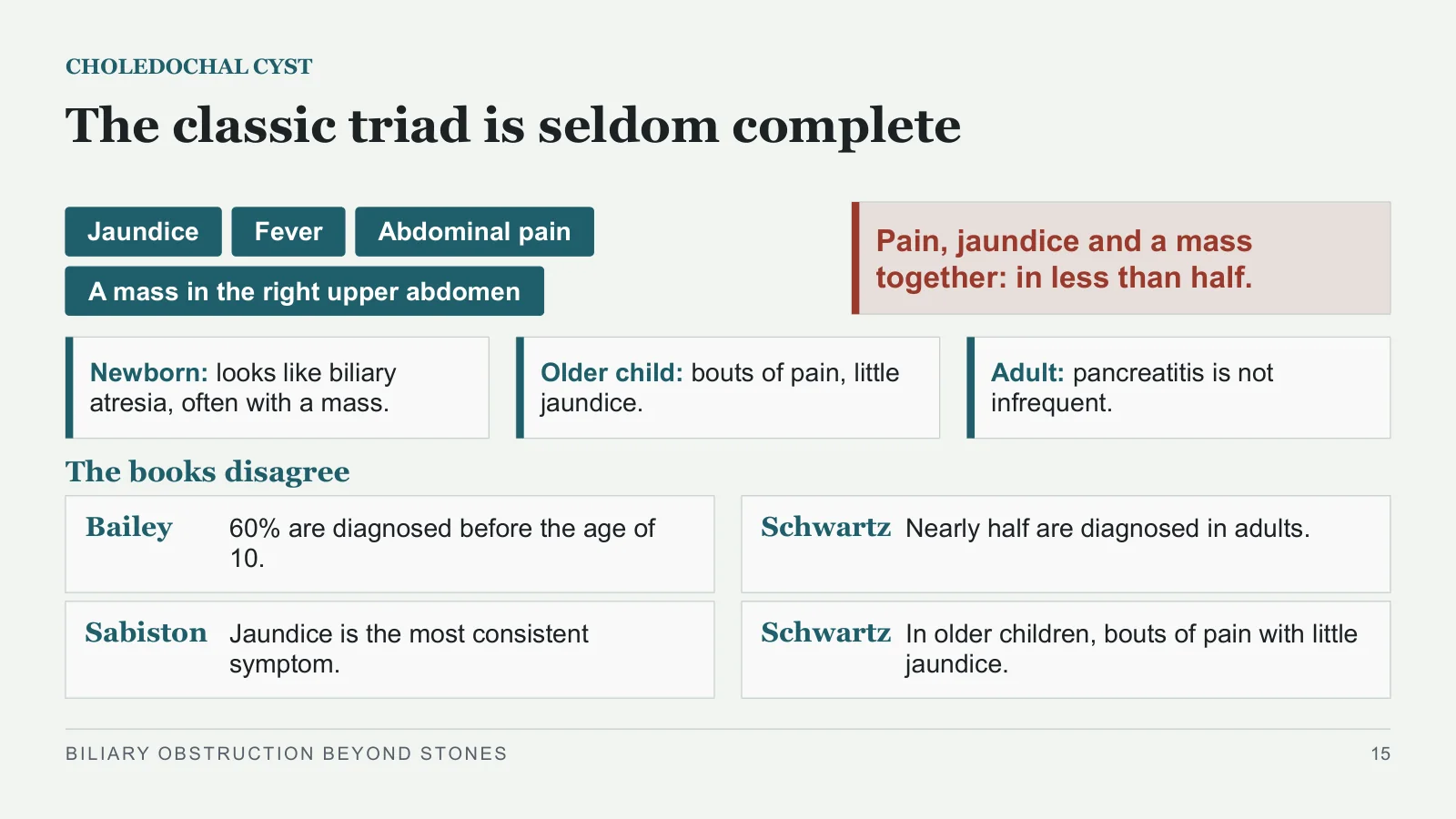
The classic triad is seldom complete
CHOLEDOCHAL CYST
Jaundice
Fever
Abdominal pain
A mass in the right upper abdomen
Pain, jaundice and a mass together: in less than half.
Newborn: looks like biliary atresia, often with a mass.
Older child: bouts of pain, little jaundice.
Adult: pancreatitis is not infrequent.
The books disagree
Bailey
60% are diagnosed before the age of 10.
Schwartz
Nearly half are diagnosed in adults.
Sabiston
Jaundice is the most consistent symptom.
Schwartz
In older children, bouts of pain with little jaundice.
BILIARY OBSTRUCTION BEYOND STONES
15
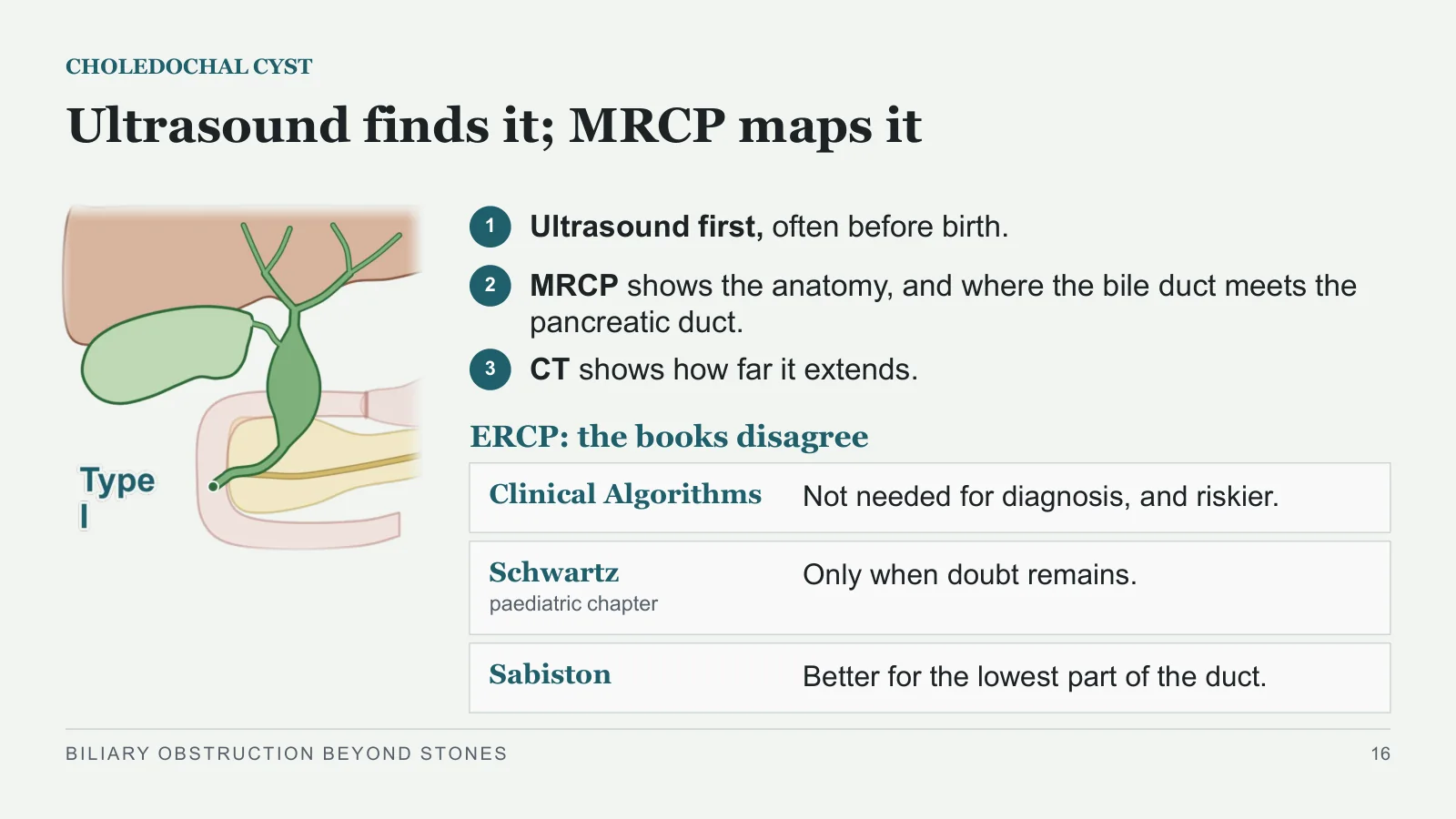
Ultrasound finds it; MRCP maps it
CHOLEDOCHAL CYST
1
Ultrasound first, often before birth.
2
MRCP shows the anatomy, and where the bile duct meets the pancreatic duct.
3
CT shows how far it extends.
ERCP: the books disagree
Clinical Algorithms
Not needed for diagnosis, and riskier.
Schwartz
paediatric chapter
Only when doubt remains.
Sabiston
Better for the lowest part of the duct.
BILIARY OBSTRUCTION BEYOND STONES
16
Why it must come out
CHOLEDOCHAL CYST
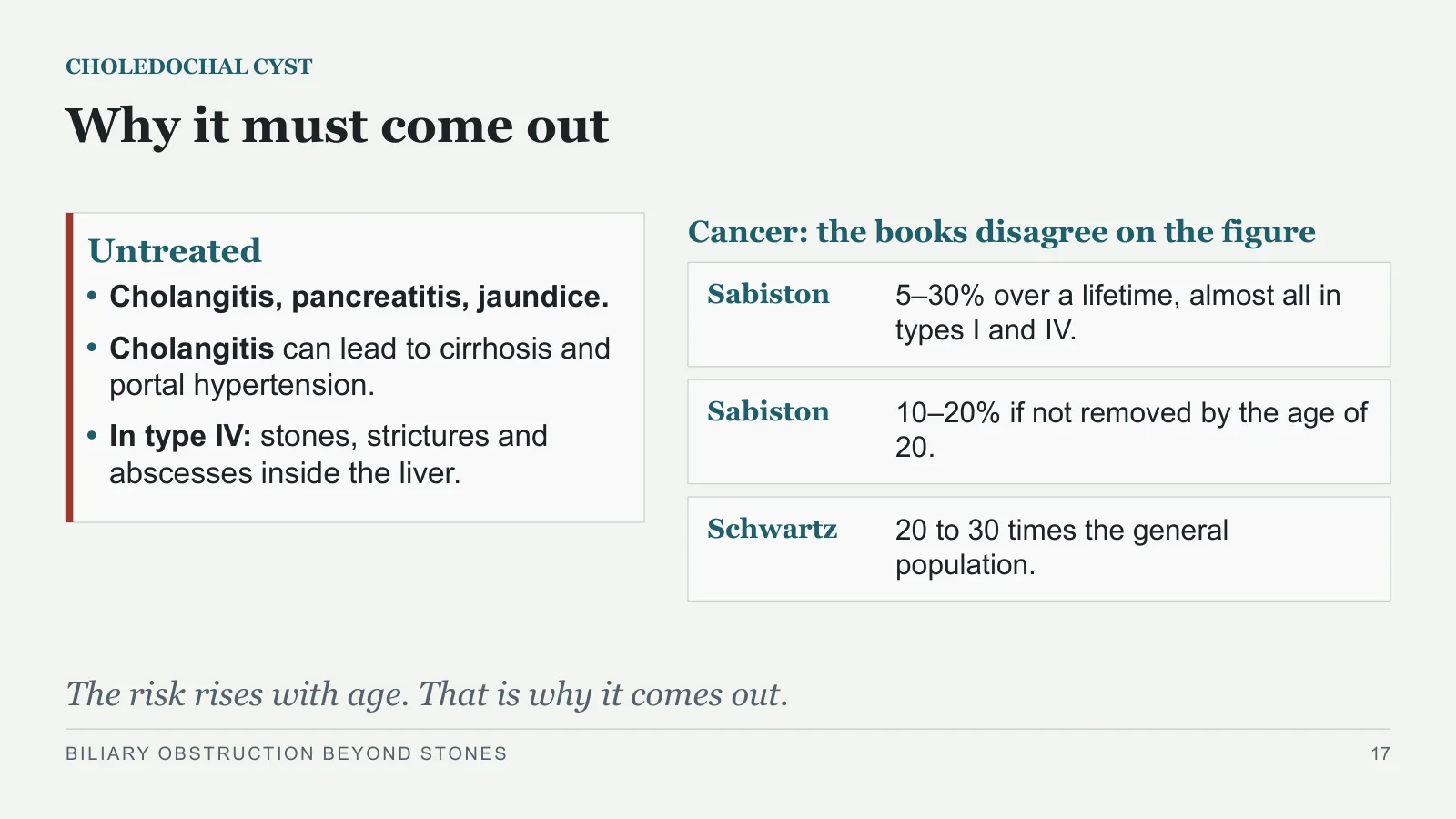
Untreated
Cholangitis, pancreatitis, jaundice.
Cholangitis can lead to cirrhosis and portal hypertension.
In type IV: stones, strictures and abscesses inside the liver.
Cancer: the books disagree on the figure
Sabiston
5–30% over a lifetime, almost all in types I and IV.
Sabiston
10–20% if not removed by the age of 20.
Schwartz
20 to 30 times the general population.
The risk rises with age. That is why it comes out.
BILIARY OBSTRUCTION BEYOND STONES
17
Take it out, then bring up a Roux loop
CHOLEDOCHAL CYST
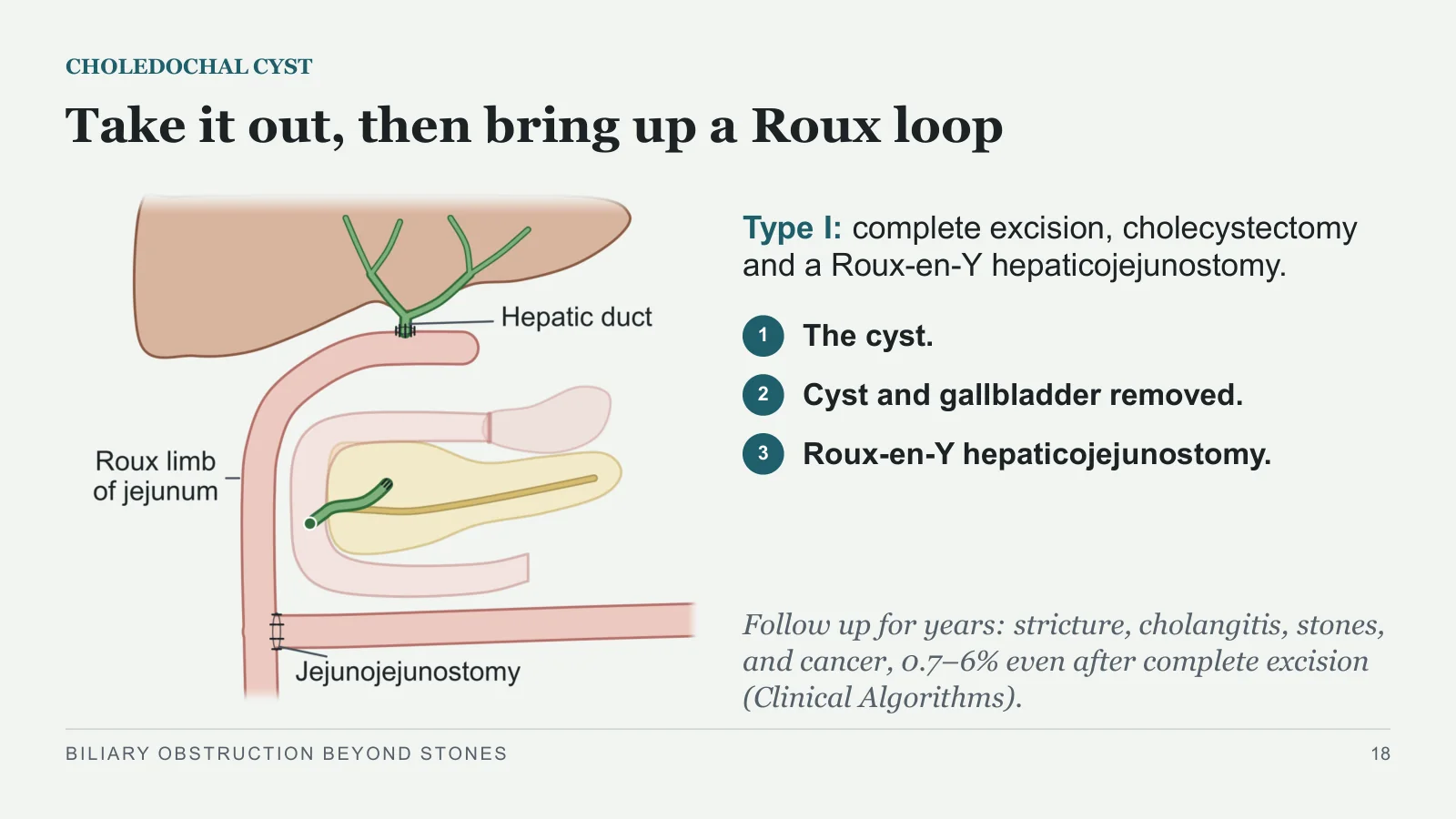
Type I: complete excision, cholecystectomy and a Roux-en-Y hepaticojejunostomy.
1
The cyst.
2
Cyst and gallbladder removed.
3
Roux-en-Y hepaticojejunostomy.
Follow up for years: stricture, cholangitis, stones, and cancer, 0.7–6% even after complete excision (Clinical Algorithms).
BILIARY OBSTRUCTION BEYOND STONES
18
Draining it into bowel is not done
CHOLEDOCHAL CYST
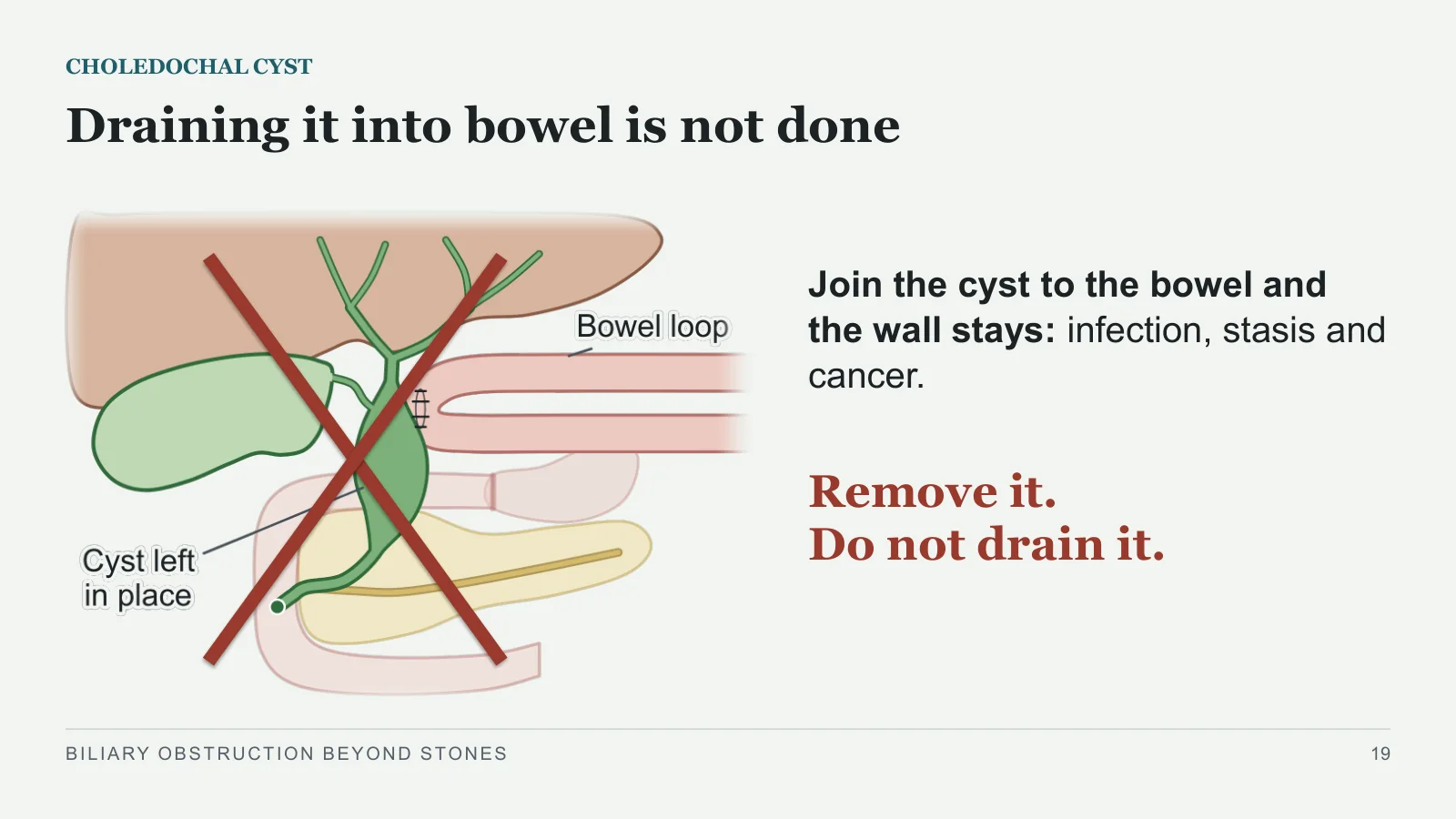
Join the cyst to the bowel and the wall stays: infection, stasis and cancer.
Remove it. Do not drain it.
BILIARY OBSTRUCTION BEYOND STONES
19
Each type, its own operation
CHOLEDOCHAL CYST
BILIARY OBSTRUCTION BEYOND STONES
20
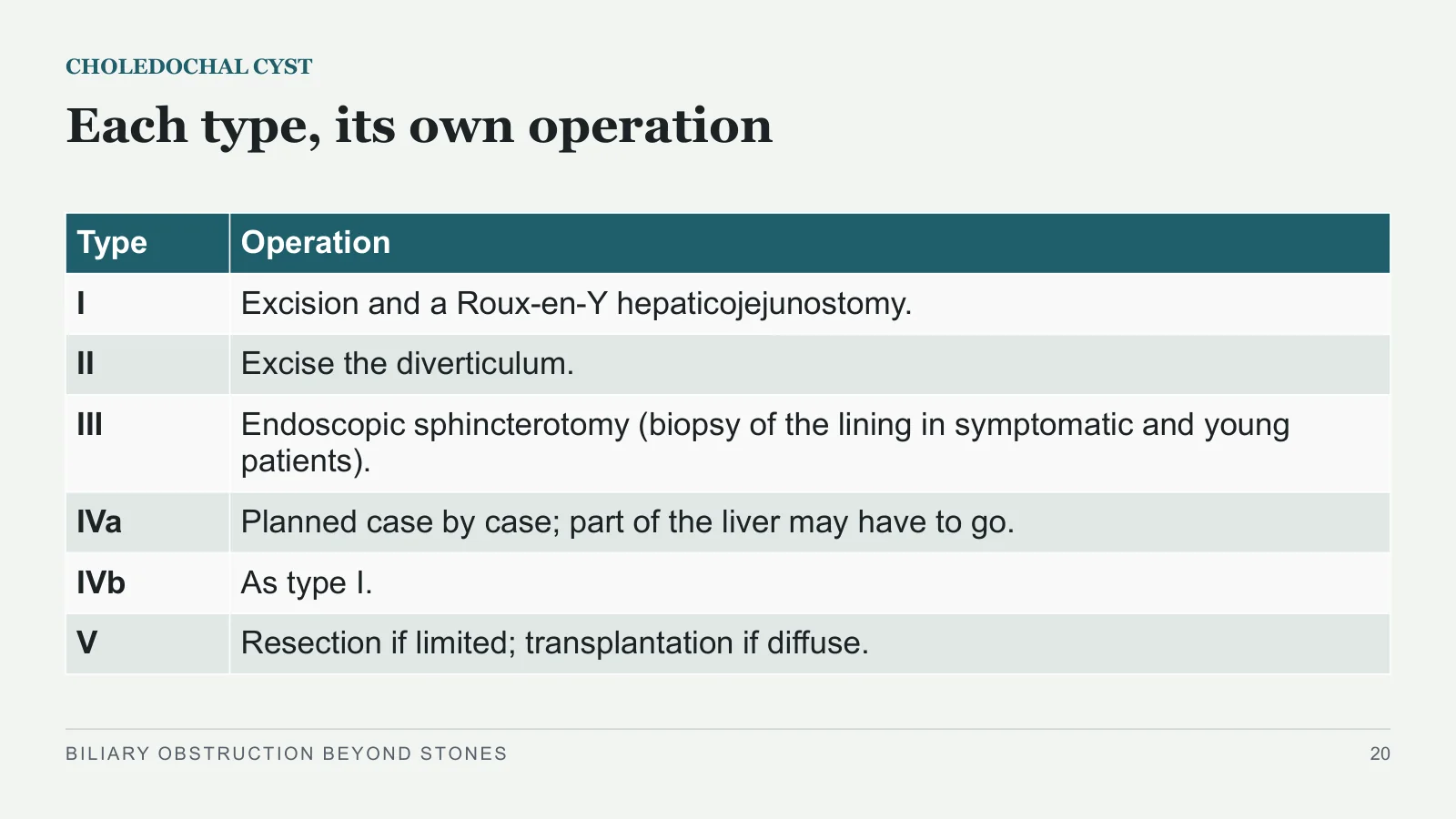
| Type | Operation |
| I | Excision and a Roux-en-Y hepaticojejunostomy. |
| II | Excise the diverticulum. |
| III | Endoscopic sphincterotomy (biopsy of the lining in symptomatic and young patients). |
| IVa | Planned case by case; part of the liver may have to go. |
| IVb | As type I. |
| V | Resection if limited; transplantation if diffuse. |
Caroli disease
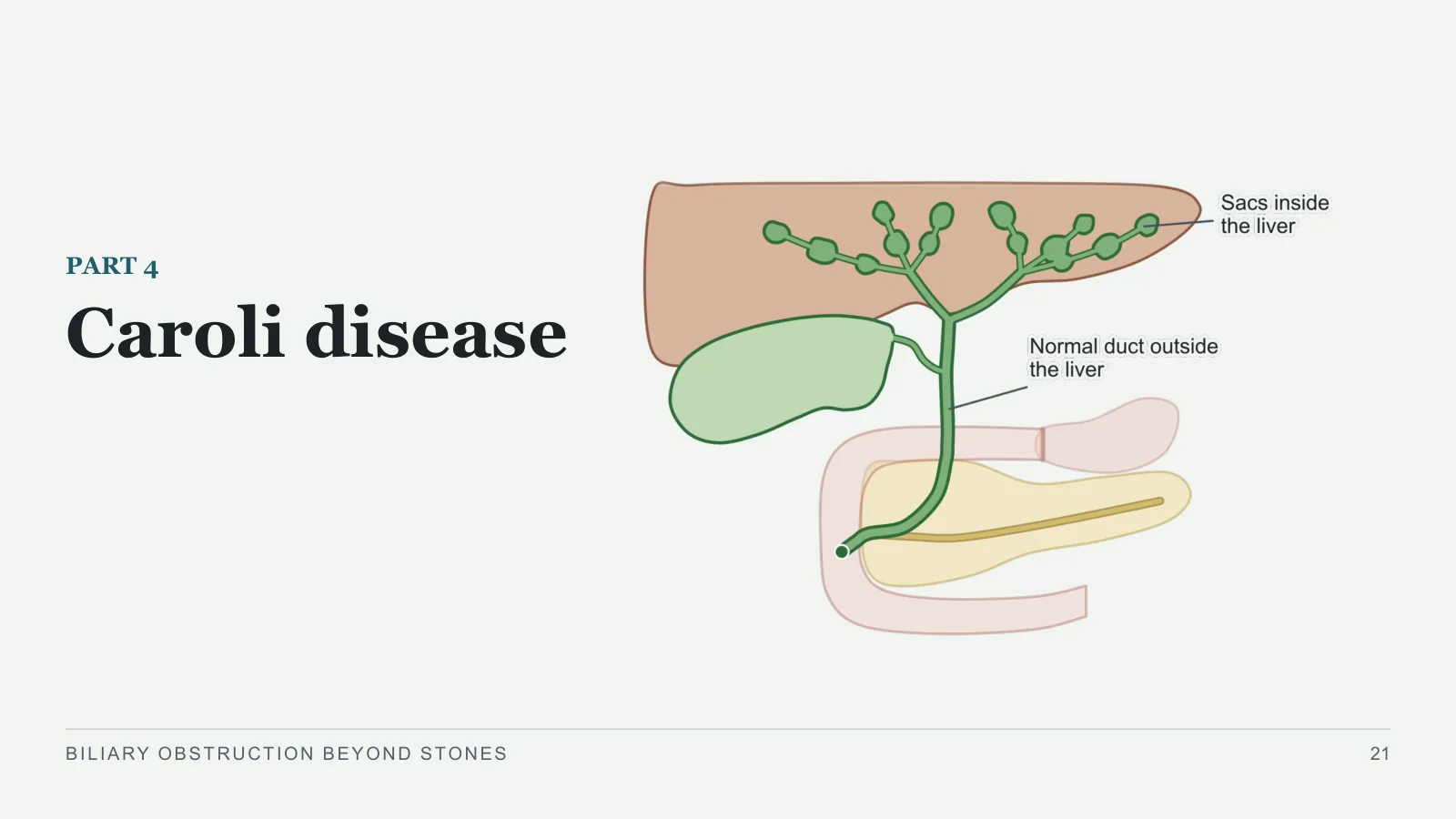
Caroli disease
PART 4
BILIARY OBSTRUCTION BEYOND STONES
21
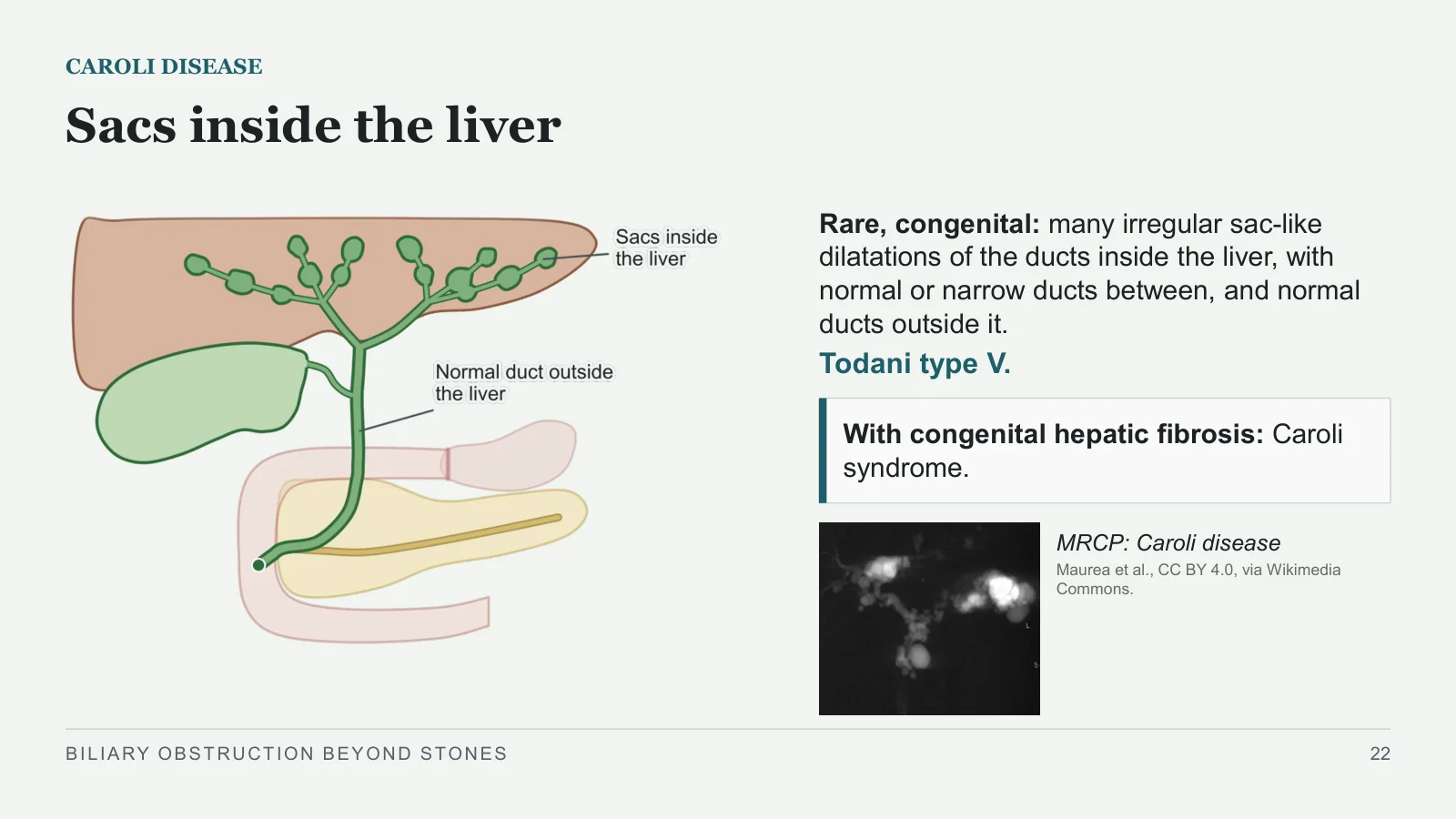
Sacs inside the liver
CAROLI DISEASE
Rare, congenital: many irregular sac-like dilatations of the ducts inside the liver, with normal or narrow ducts between, and normal ducts outside it.
Todani type V.
With congenital hepatic fibrosis: Caroli syndrome.
MRCP: Caroli disease
Maurea et al., CC BY 4.0, via Wikimedia Commons.
BILIARY OBSTRUCTION BEYOND STONES
22
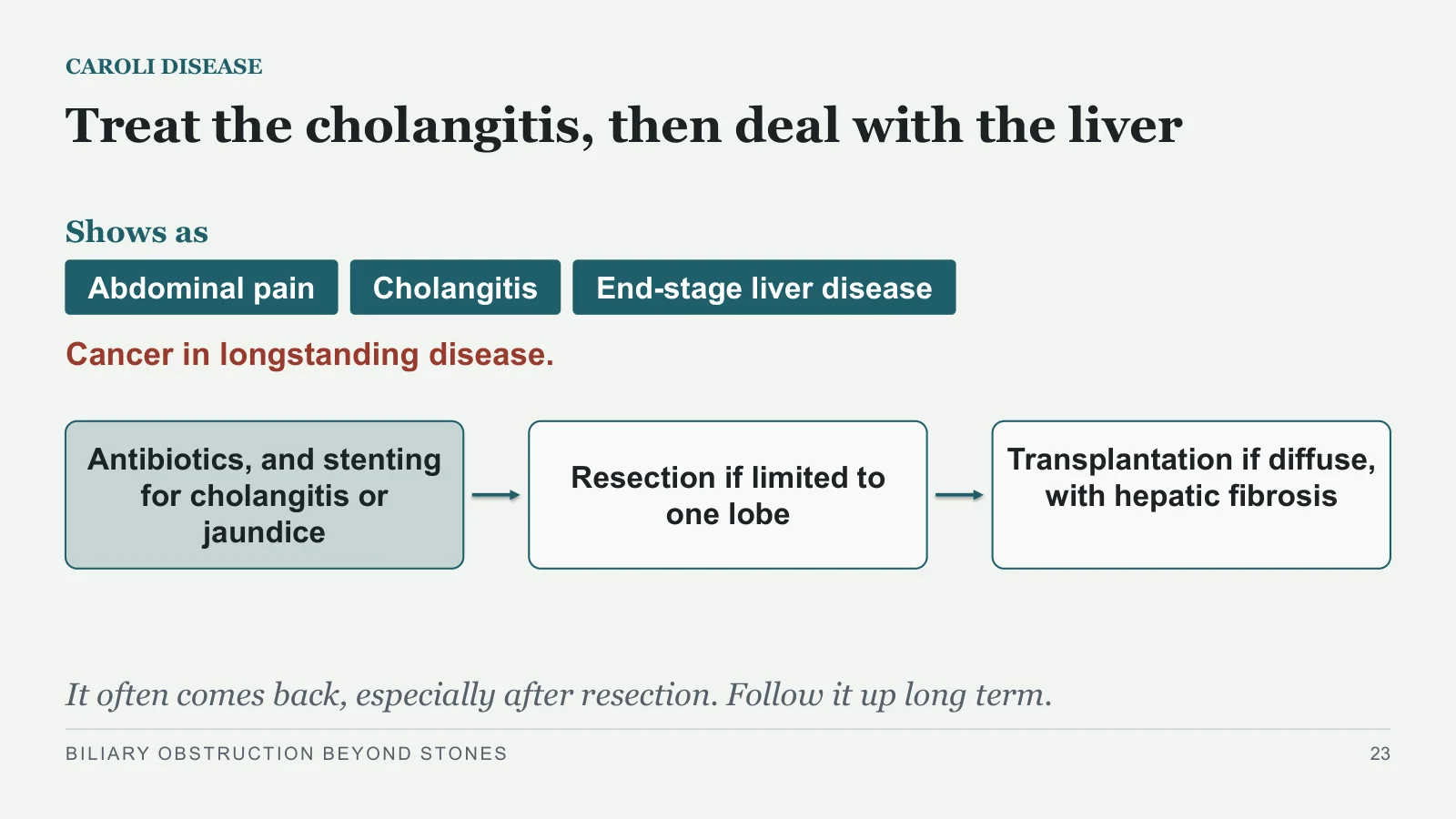
Treat the cholangitis, then deal with the liver
CAROLI DISEASE
Shows as
Abdominal pain
Cholangitis
End-stage liver disease
Cancer in longstanding disease.
Antibiotics, and stenting for cholangitis or jaundice
Resection if limited to one lobe
Transplantation if diffuse, with hepatic fibrosis
It often comes back, especially after resection. Follow it up long term.
BILIARY OBSTRUCTION BEYOND STONES
23
Biliary atresia
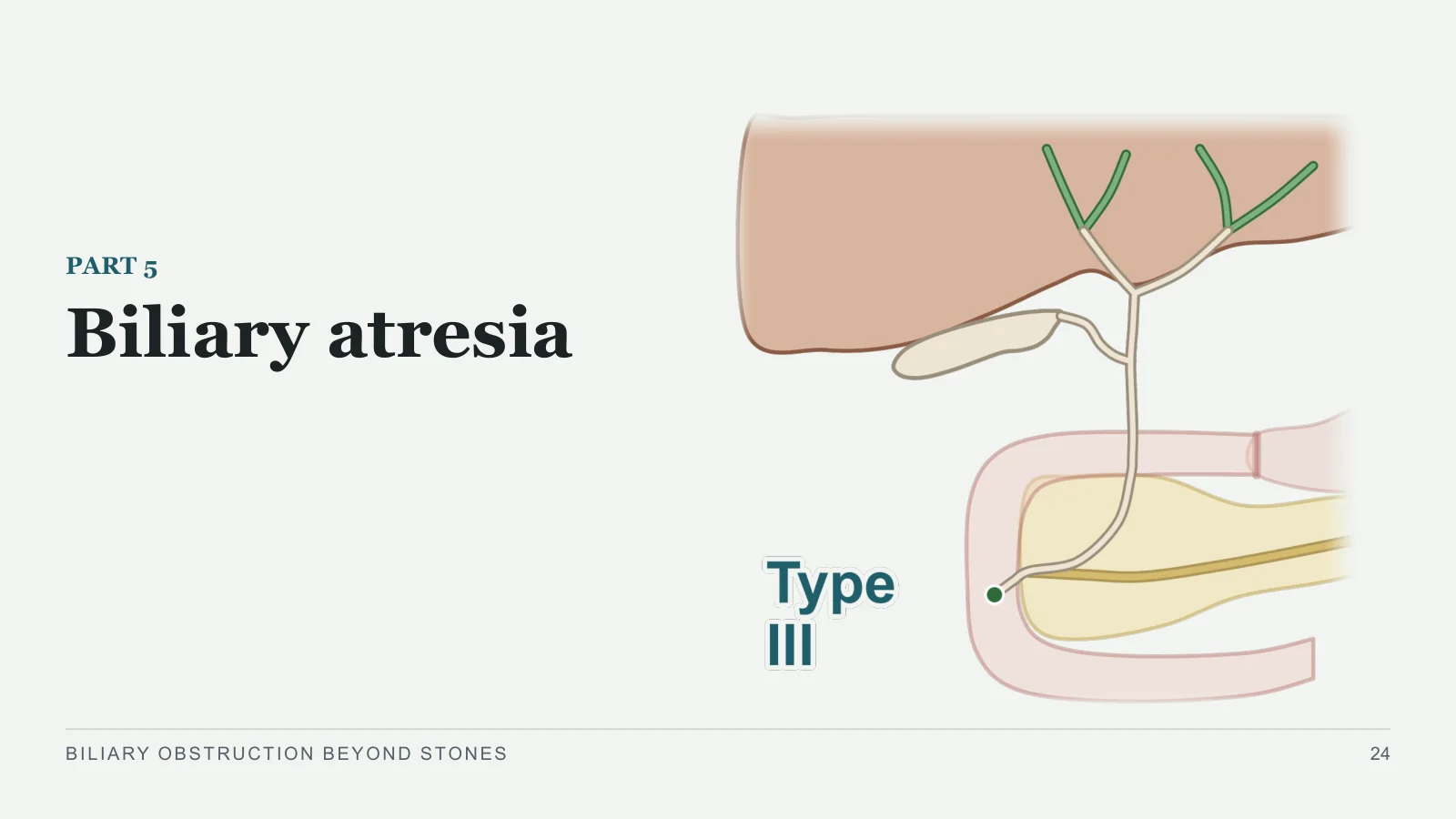
Biliary atresia
PART 5
BILIARY OBSTRUCTION BEYOND STONES
24
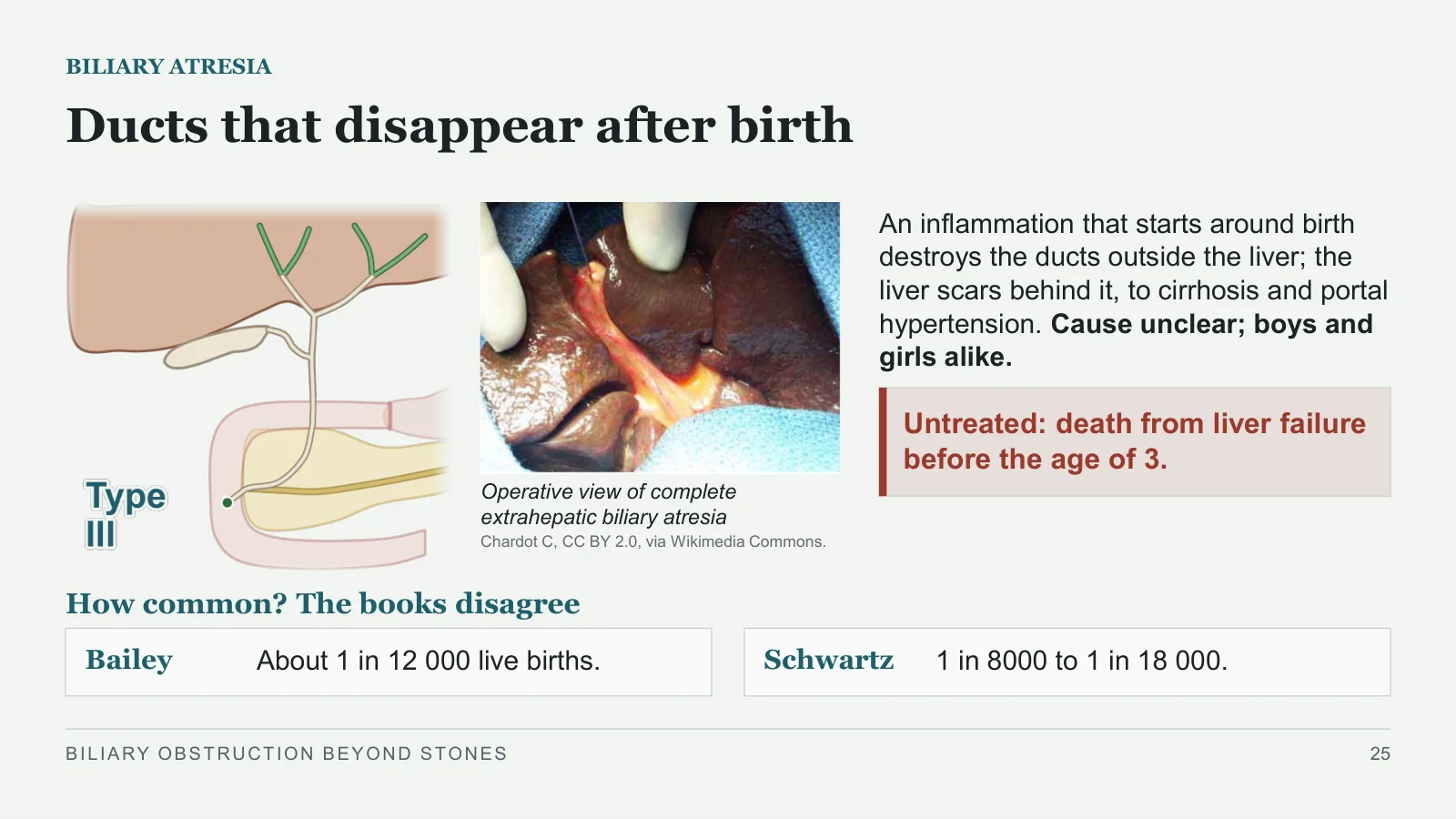
Ducts that disappear after birth
BILIARY ATRESIA
Operative view of complete extrahepatic biliary atresia
Chardot C, CC BY 2.0, via Wikimedia Commons.
An inflammation that starts around birth destroys the ducts outside the liver; the liver scars behind it, to cirrhosis and portal hypertension. Cause unclear; boys and girls alike.
Untreated: death from liver failure before the age of 3.
How common? The books disagree
Bailey
About 1 in 12 000 live births.
Schwartz
1 in 8000 to 1 in 18 000.
BILIARY OBSTRUCTION BEYOND STONES
25
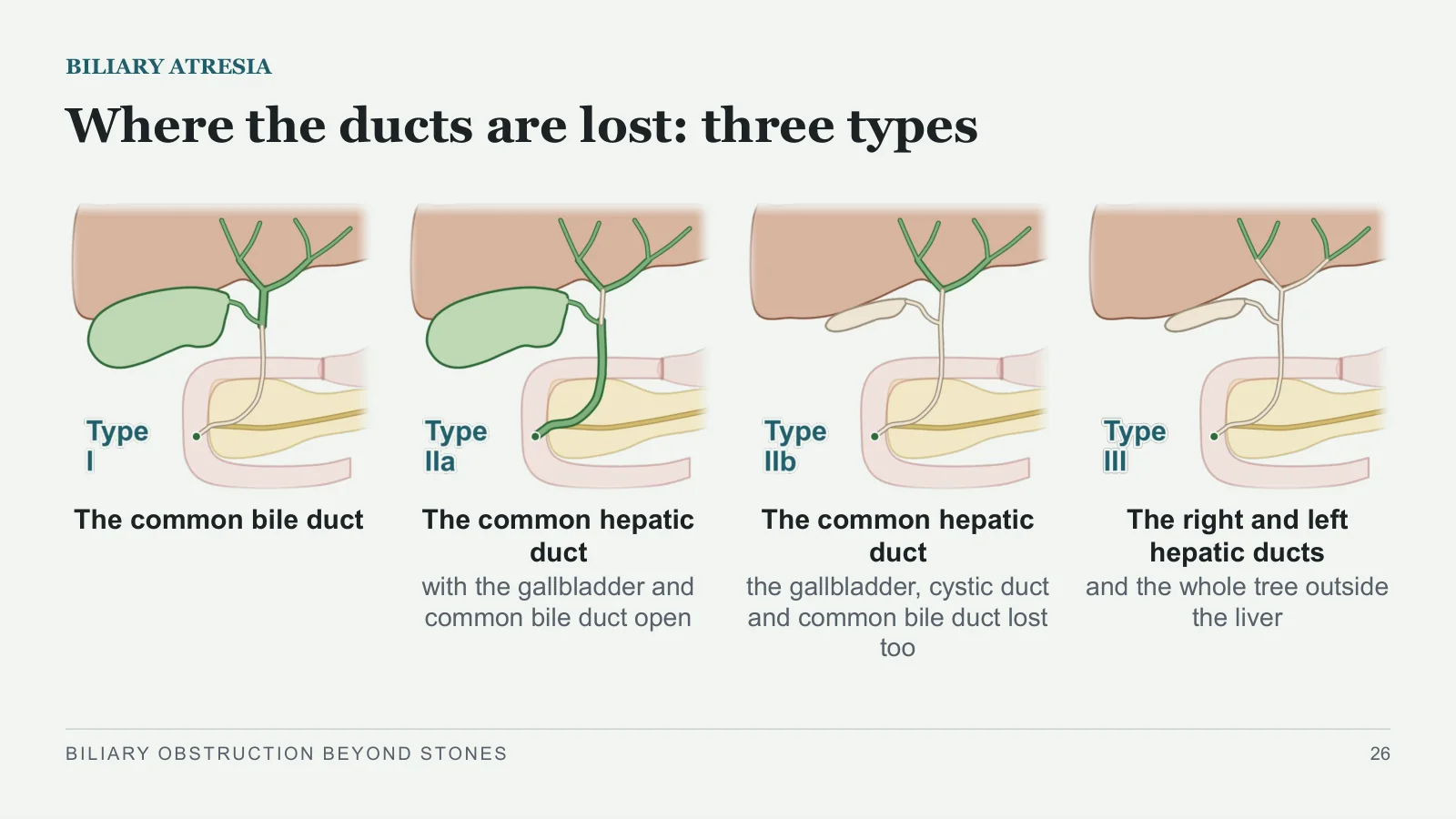
Where the ducts are lost: three types
BILIARY ATRESIA
The common bile duct
The common hepatic duct
with the gallbladder and common bile duct open
The common hepatic duct
the gallbladder, cystic duct and common bile duct lost too
The right and left hepatic ducts
and the whole tree outside the liver
BILIARY OBSTRUCTION BEYOND STONES
26
The yellow baby who stays yellow
BILIARY ATRESIA
About one in three is yellow at birth; all are by the end of week one, and it deepens.
Jaundice beyond 2 weeks is not normal: think of atresia.
Pale stools
Dark urine
Other malformations: the books differ
Bailey
27th edition
About 20%.
Schwartz
About 25%.
Often with polysplenia, a preduodenal portal vein, vena cava anomalies.
BILIARY OBSTRUCTION BEYOND STONES
27
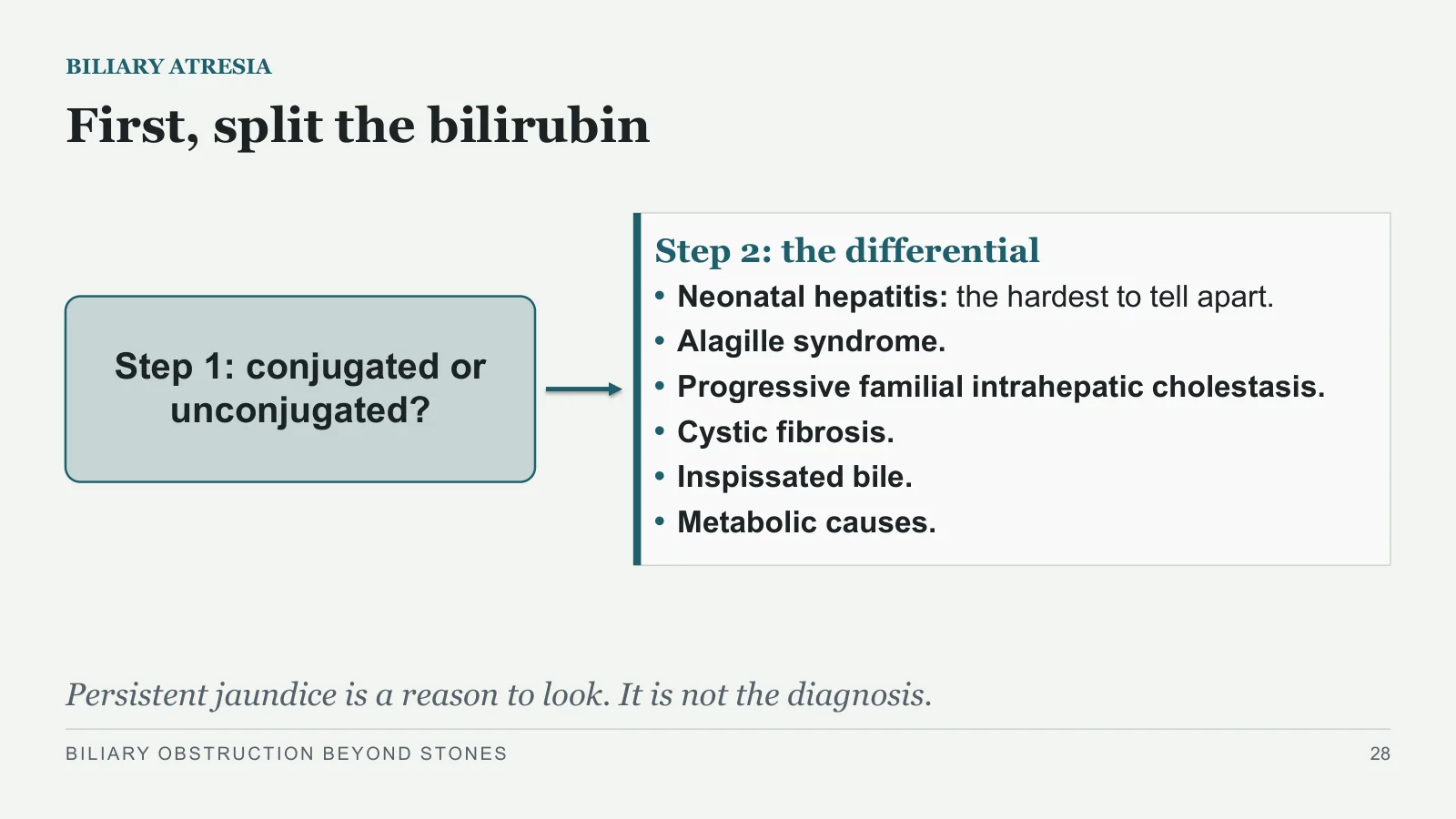
First, split the bilirubin
BILIARY ATRESIA
Step 2: the differential
Neonatal hepatitis: the hardest to tell apart.
Alagille syndrome.
Progressive familial intrahepatic cholestasis.
Cystic fibrosis.
Inspissated bile.
Metabolic causes.
Step 1: conjugated or unconjugated?
Persistent jaundice is a reason to look. It is not the diagnosis.
BILIARY OBSTRUCTION BEYOND STONES
28
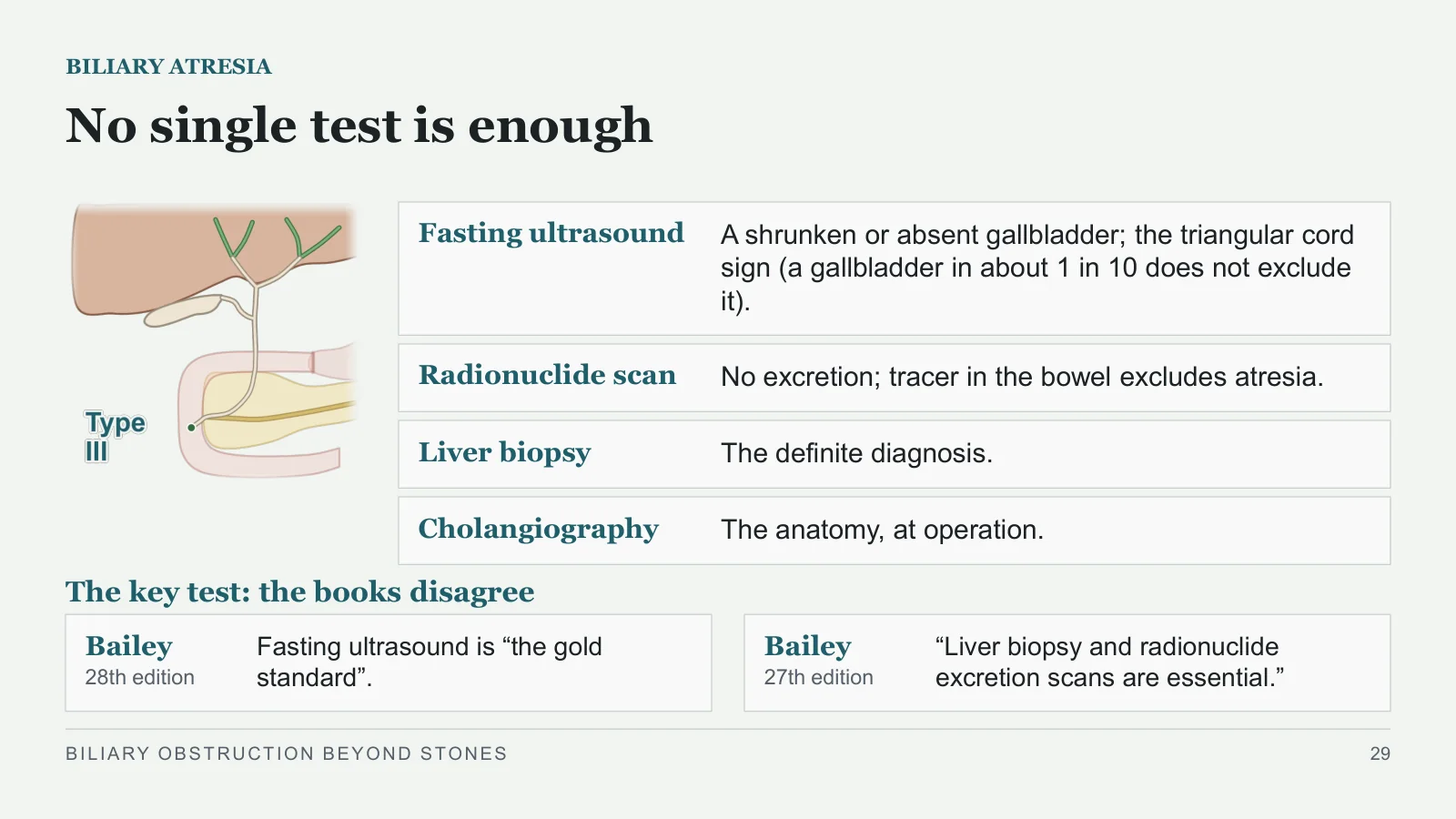
No single test is enough
BILIARY ATRESIA
Fasting ultrasound
A shrunken or absent gallbladder; the triangular cord sign (a gallbladder in about 1 in 10 does not exclude it).
Radionuclide scan
No excretion; tracer in the bowel excludes atresia.
Liver biopsy
The definite diagnosis.
Cholangiography
The anatomy, at operation.
The key test: the books disagree
Bailey
28th edition
Fasting ultrasound is “the gold standard”.
Bailey
27th edition
“Liver biopsy and radionuclide excretion scans are essential.”
BILIARY OBSTRUCTION BEYOND STONES
29
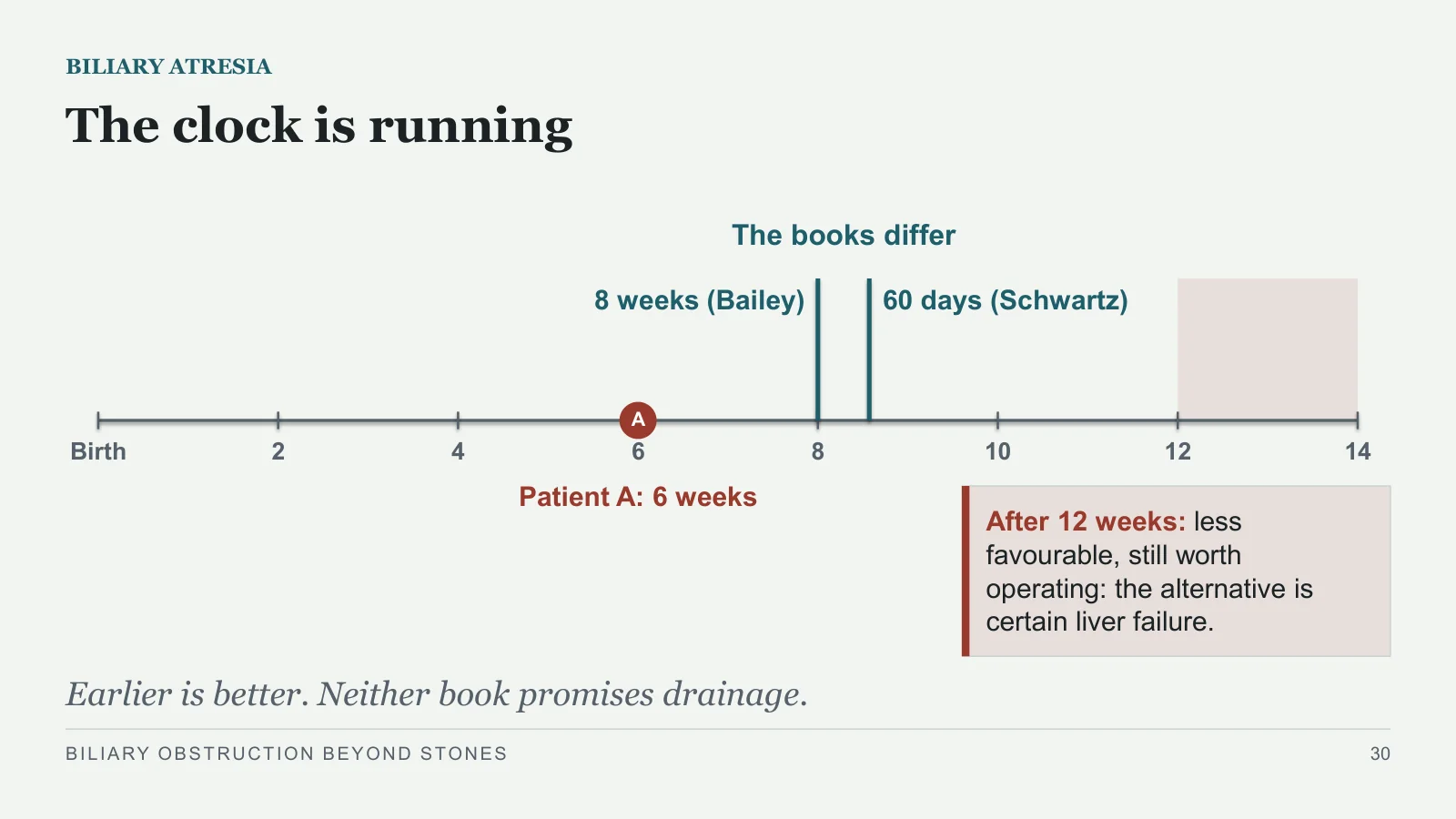
The clock is running
BILIARY ATRESIA
Birth
2
4
6
8
10
12
14
8 weeks (Bailey)
60 days (Schwartz)
The books differ
A
Patient A: 6 weeks
After 12 weeks: less favourable, still worth operating: the alternative is certain liver failure.
Earlier is better. Neither book promises drainage.
BILIARY OBSTRUCTION BEYOND STONES
30
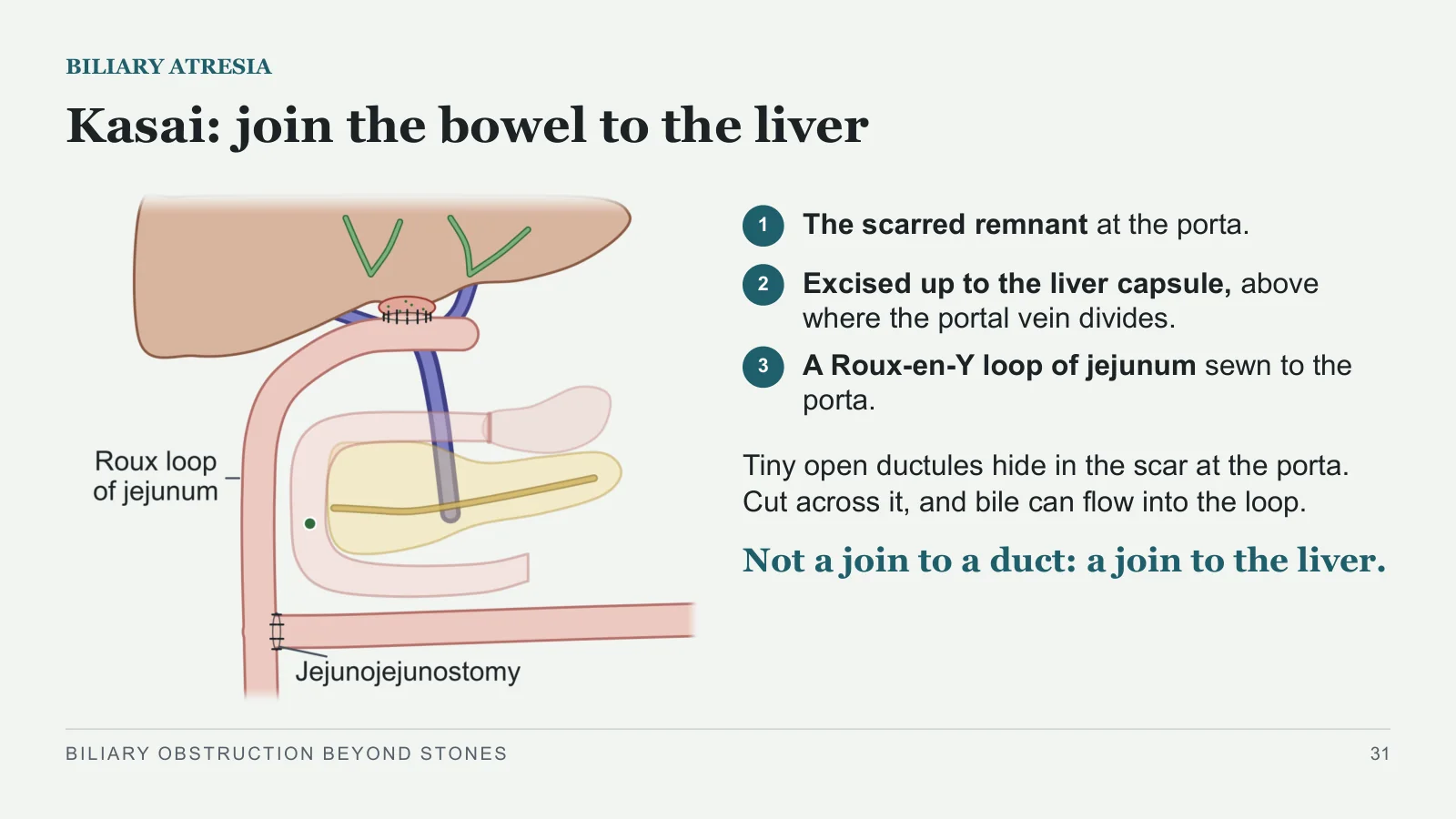
Kasai: join the bowel to the liver
BILIARY ATRESIA
1
The scarred remnant at the porta.
2
Excised up to the liver capsule, above where the portal vein divides.
3
A Roux-en-Y loop of jejunum sewn to the porta.
Tiny open ductules hide in the scar at the porta. Cut across it, and bile can flow into the loop.
Not a join to a duct: a join to the liver.
BILIARY OBSTRUCTION BEYOND STONES
31
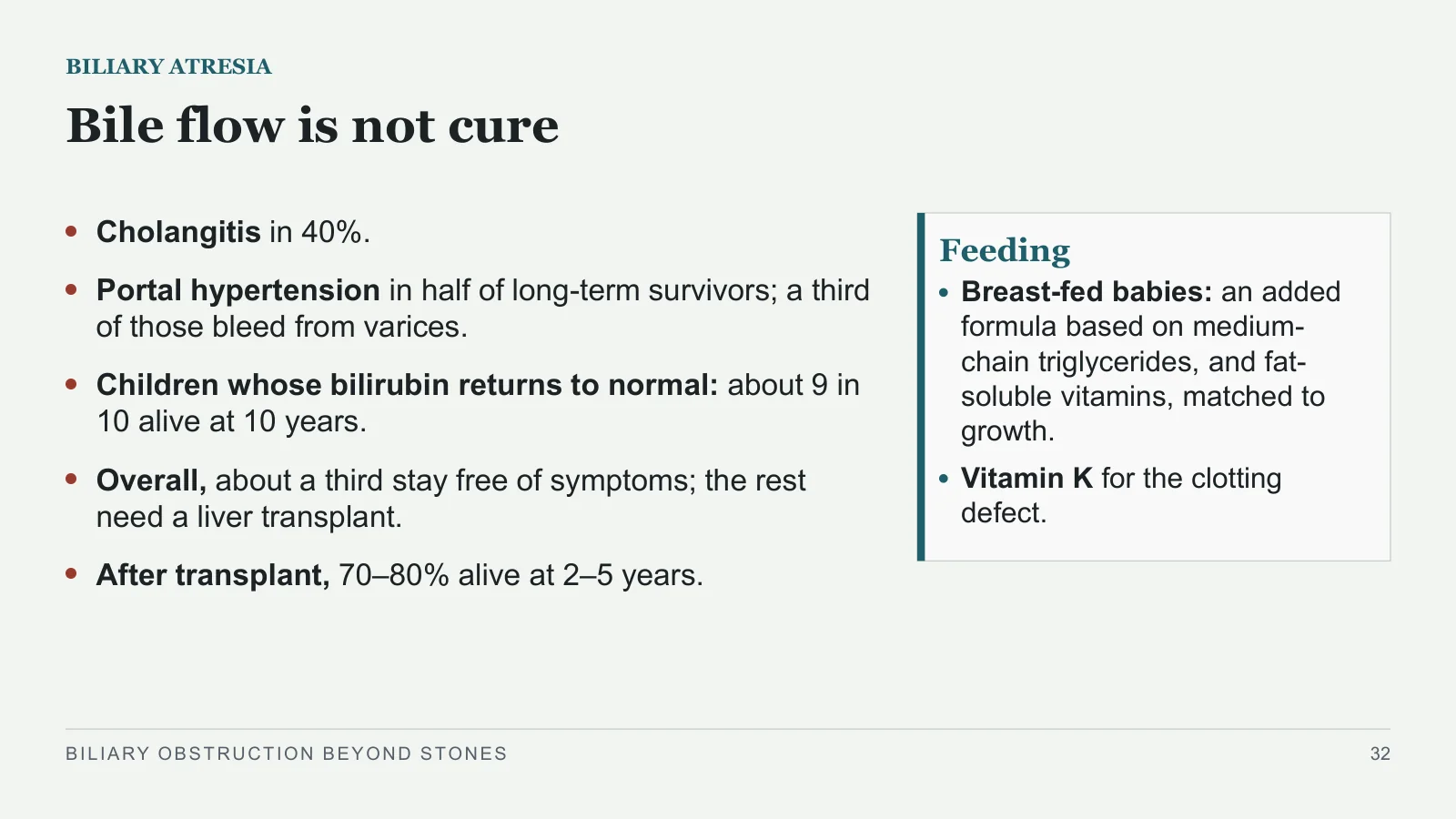
Bile flow is not cure
BILIARY ATRESIA
Cholangitis in 40%.
Portal hypertension in half of long-term survivors; a third of those bleed from varices.
Children whose bilirubin returns to normal: about 9 in 10 alive at 10 years.
Overall, about a third stay free of symptoms; the rest need a liver transplant.
After transplant, 70–80% alive at 2–5 years.
Feeding
Breast-fed babies: an added formula based on medium-chain triglycerides, and fat-soluble vitamins, matched to growth.
Vitamin K for the clotting defect.
BILIARY OBSTRUCTION BEYOND STONES
32
Primary sclerosing cholangitis
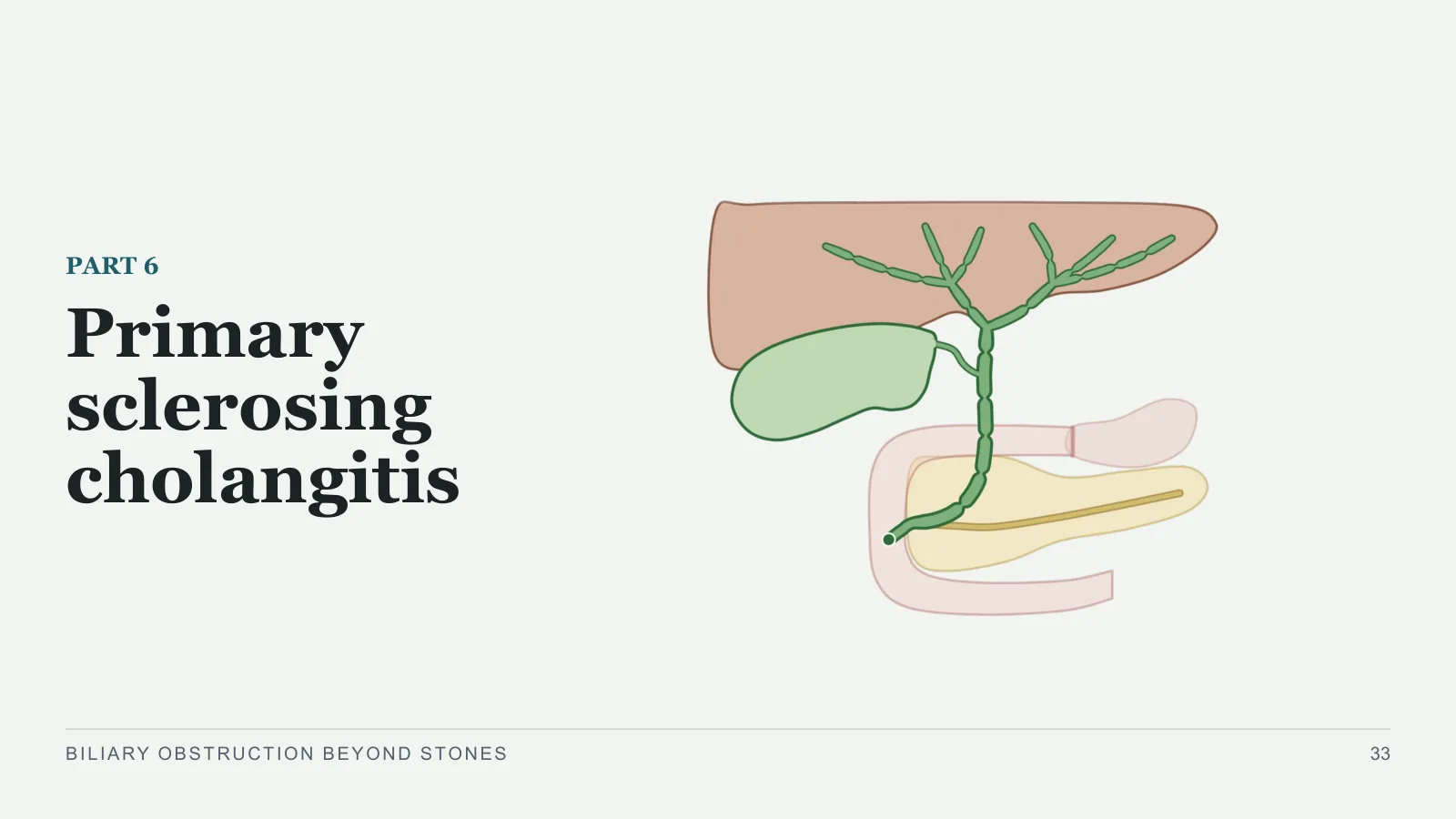
Primary sclerosing cholangitis
PART 6
BILIARY OBSTRUCTION BEYOND STONES
33
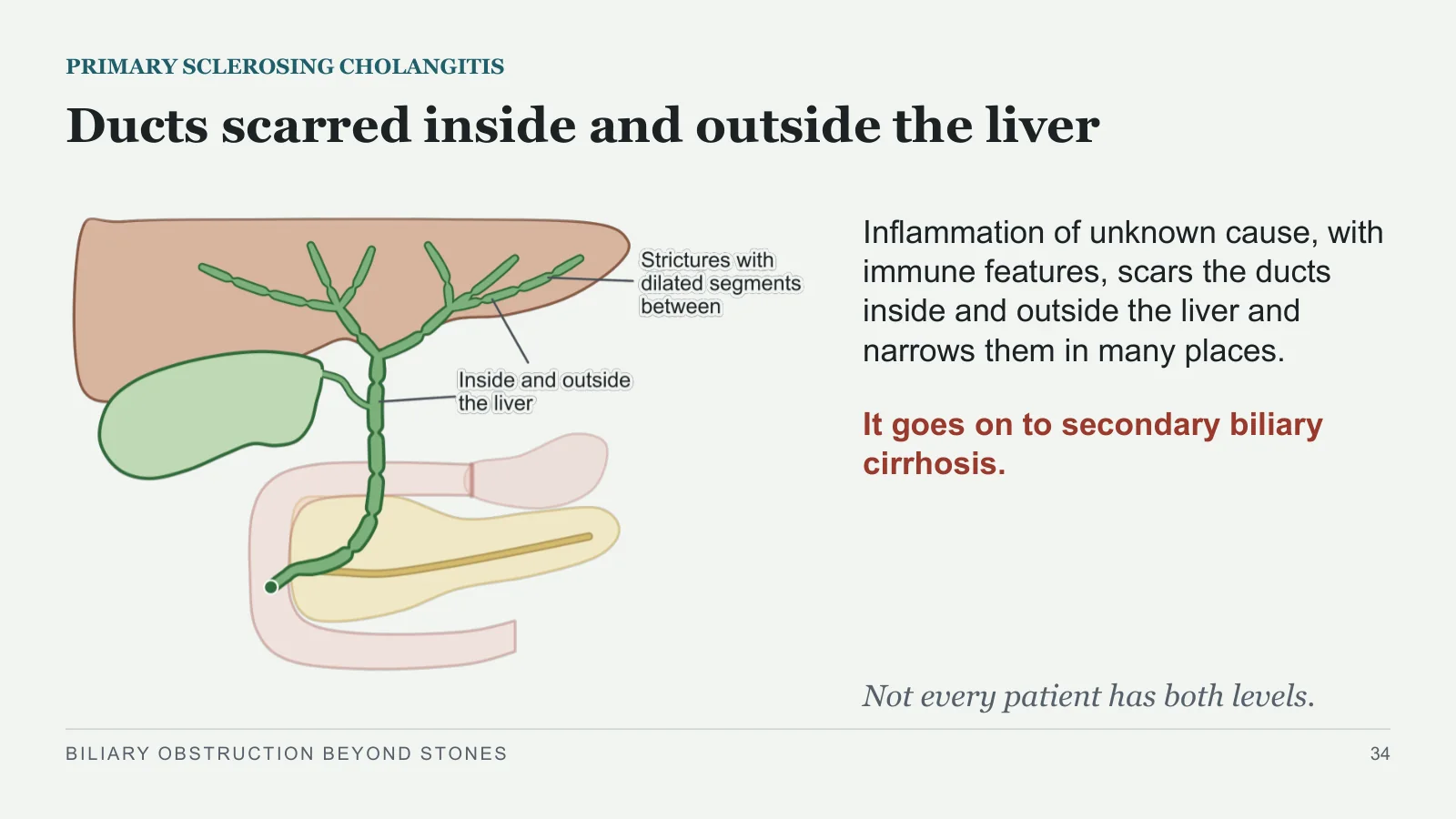
Ducts scarred inside and outside the liver
PRIMARY SCLEROSING CHOLANGITIS
Inflammation of unknown cause, with immune features, scars the ducts inside and outside the liver and narrows them in many places.
It goes on to secondary biliary cirrhosis.
Not every patient has both levels.
BILIARY OBSTRUCTION BEYOND STONES
34
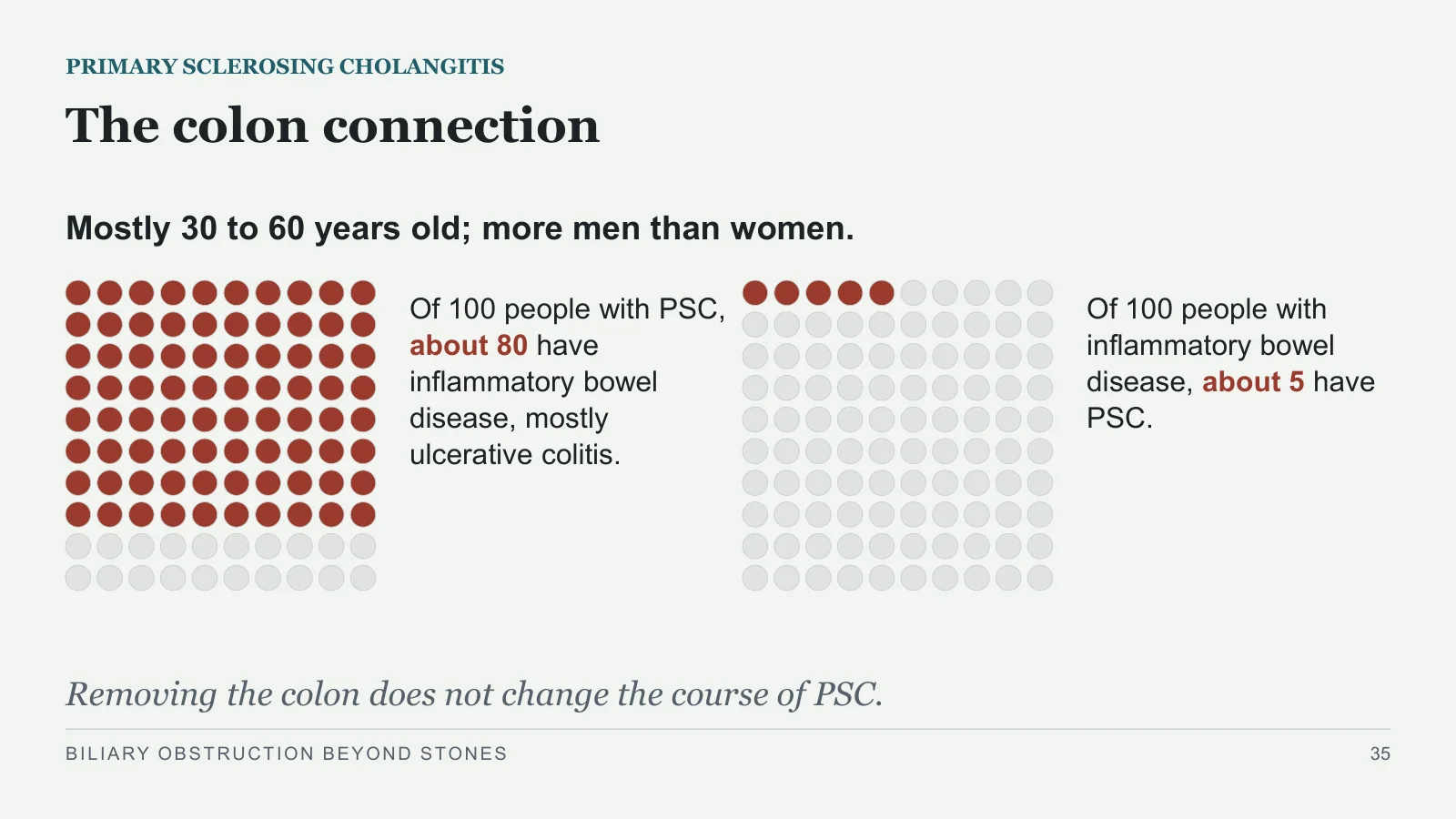
The colon connection
PRIMARY SCLEROSING CHOLANGITIS
Mostly 30 to 60 years old; more men than women.
Of 100 people with PSC, about 80 have inflammatory bowel disease, mostly ulcerative colitis.
Of 100 people with inflammatory bowel disease, about 5 have PSC.
Removing the colon does not change the course of PSC.
BILIARY OBSTRUCTION BEYOND STONES
35
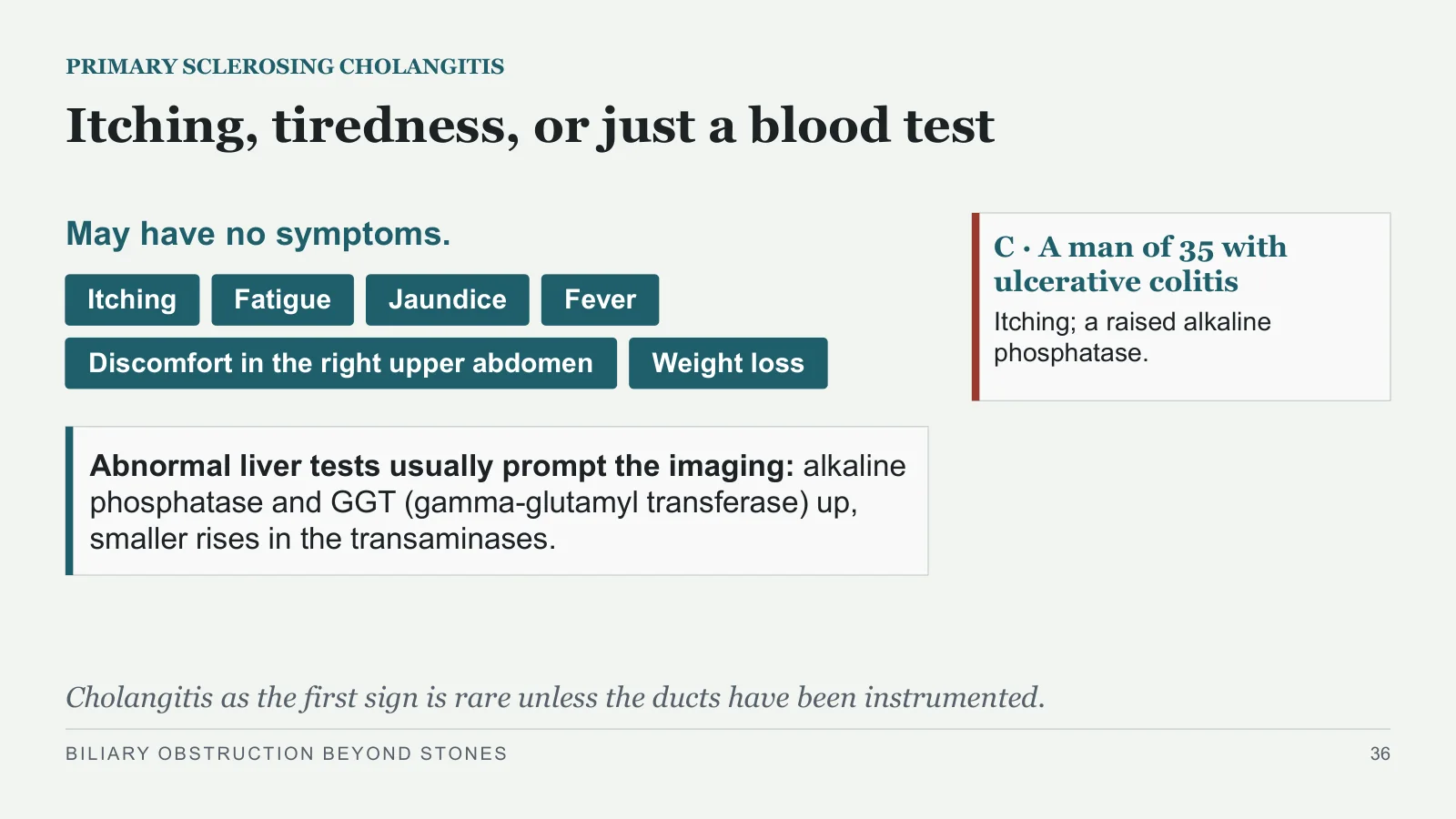
Itching, tiredness, or just a blood test
PRIMARY SCLEROSING CHOLANGITIS
May have no symptoms.
Itching
Fatigue
Jaundice
Fever
Discomfort in the right upper abdomen
Weight loss
Abnormal liver tests usually prompt the imaging: alkaline phosphatase and GGT (gamma-glutamyl transferase) up, smaller rises in the transaminases.
C · A man of 35 with ulcerative colitis
Itching; a raised alkaline phosphatase.
Cholangitis as the first sign is rare unless the ducts have been instrumented.
BILIARY OBSTRUCTION BEYOND STONES
36
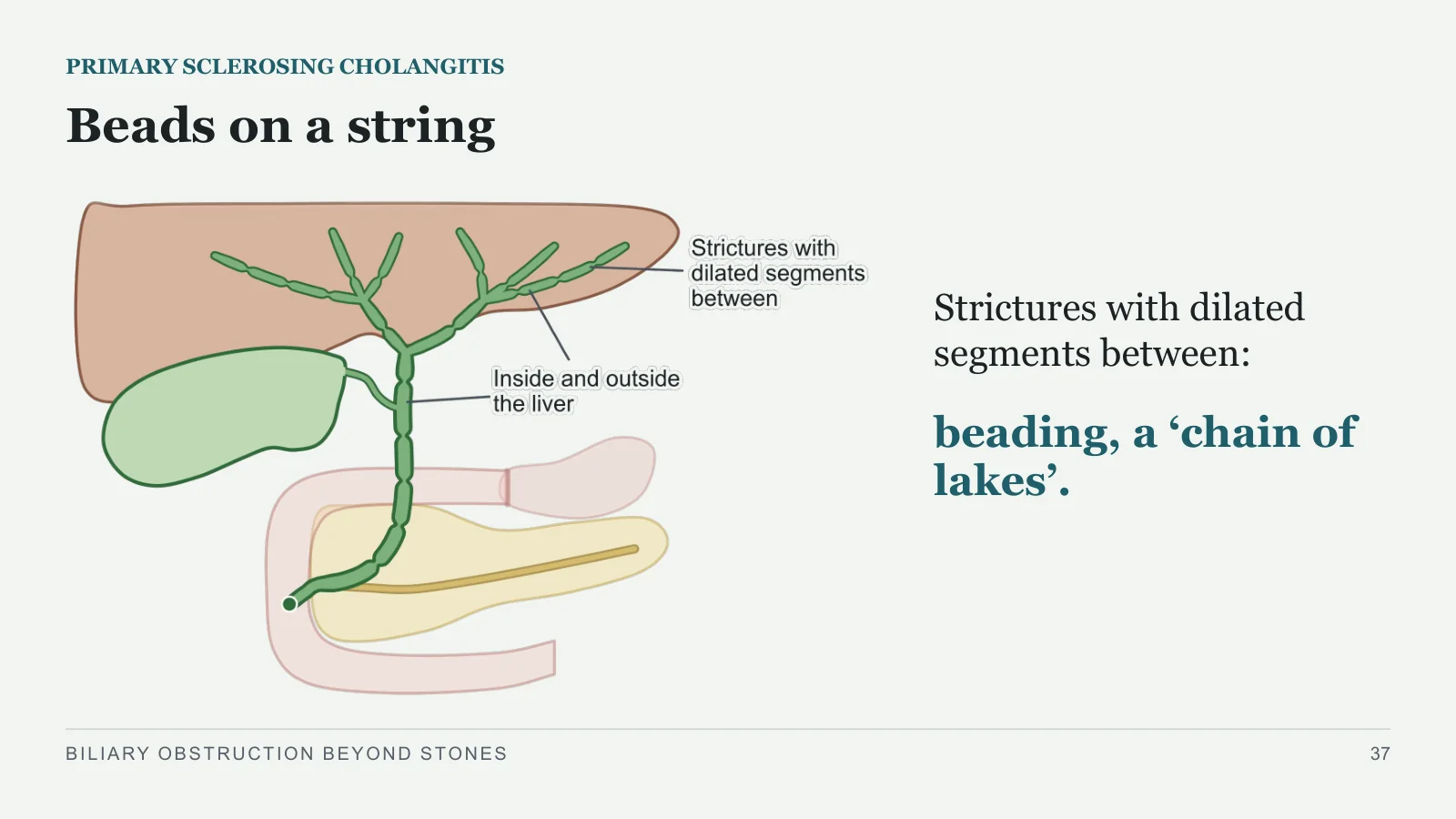
Beads on a string
PRIMARY SCLEROSING CHOLANGITIS
Strictures with dilated segments between:
beading, a ‘chain of lakes’.
BILIARY OBSTRUCTION BEYOND STONES
37
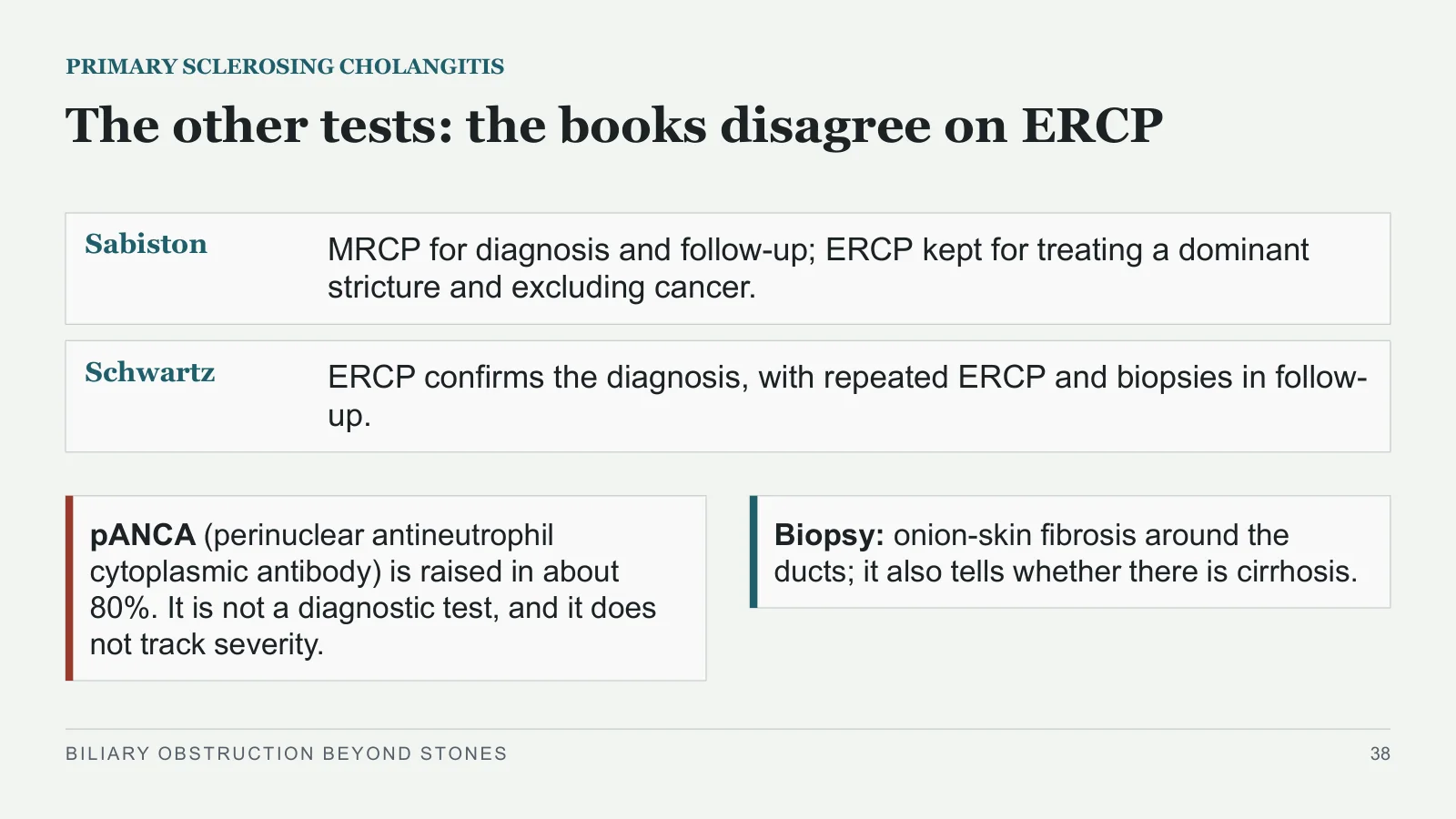
The other tests: the books disagree on ERCP
PRIMARY SCLEROSING CHOLANGITIS
Sabiston
MRCP for diagnosis and follow-up; ERCP kept for treating a dominant stricture and excluding cancer.
Schwartz
ERCP confirms the diagnosis, with repeated ERCP and biopsies in follow-up.
pANCA (perinuclear antineutrophil cytoplasmic antibody) is raised in about 80%. It is not a diagnostic test, and it does not track severity.
Biopsy: onion-skin fibrosis around the ducts; it also tells whether there is cirrhosis.
BILIARY OBSTRUCTION BEYOND STONES
38
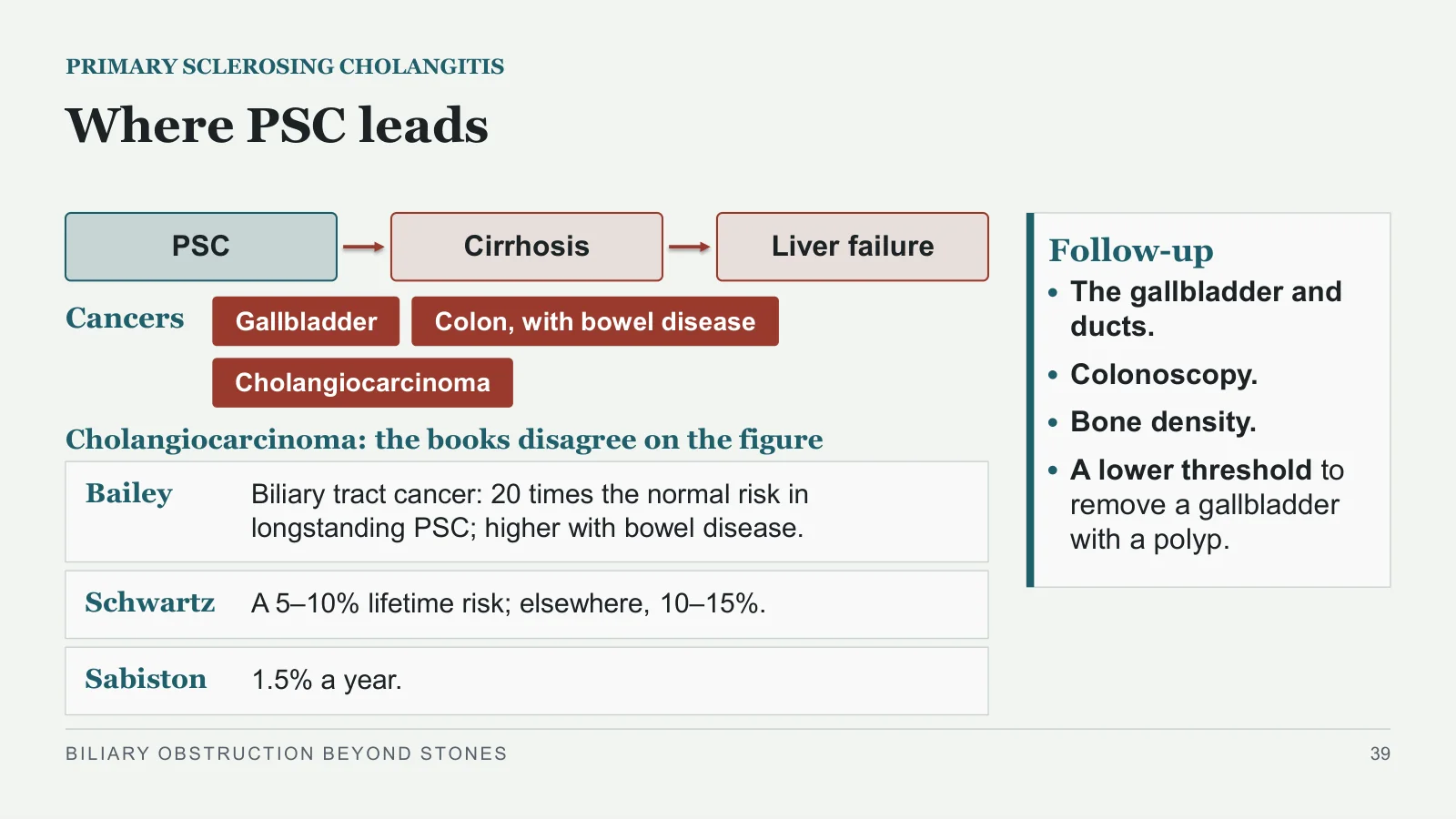
Where PSC leads
PRIMARY SCLEROSING CHOLANGITIS
PSC
Cirrhosis
Liver failure
Cancers
Gallbladder
Colon, with bowel disease
Cholangiocarcinoma
Cholangiocarcinoma: the books disagree on the figure
Bailey
Biliary tract cancer: 20 times the normal risk in longstanding PSC; higher with bowel disease.
Schwartz
A 5–10% lifetime risk; elsewhere, 10–15%.
Sabiston
1.5% a year.
Follow-up
The gallbladder and ducts.
Colonoscopy.
Bone density.
A lower threshold to remove a gallbladder with a polyp.
BILIARY OBSTRUCTION BEYOND STONES
39
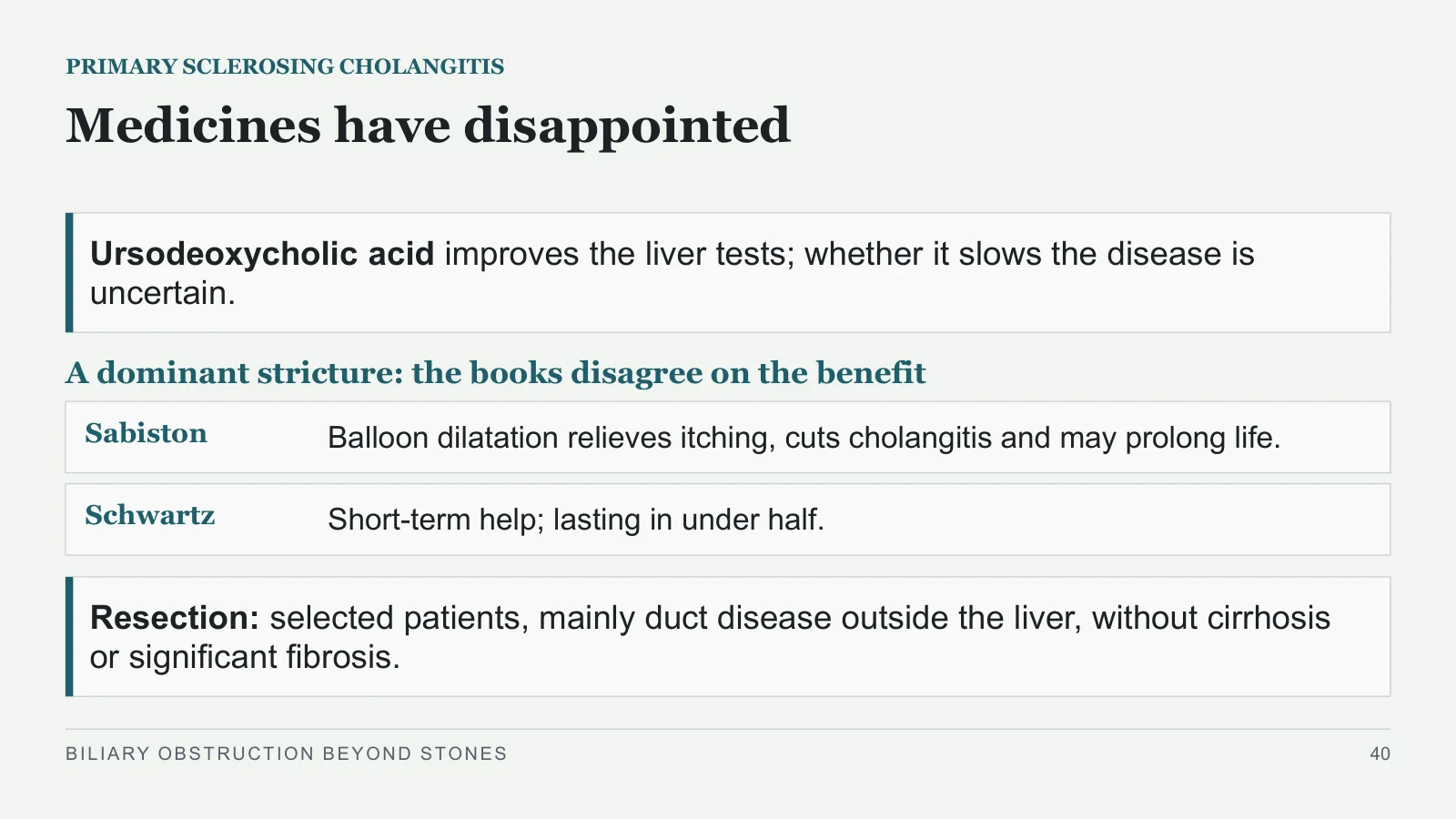
Medicines have disappointed
PRIMARY SCLEROSING CHOLANGITIS
Ursodeoxycholic acid improves the liver tests; whether it slows the disease is uncertain.
A dominant stricture: the books disagree on the benefit
Sabiston
Balloon dilatation relieves itching, cuts cholangitis and may prolong life.
Schwartz
Short-term help; lasting in under half.
Resection: selected patients, mainly duct disease outside the liver, without cirrhosis or significant fibrosis.
BILIARY OBSTRUCTION BEYOND STONES
40
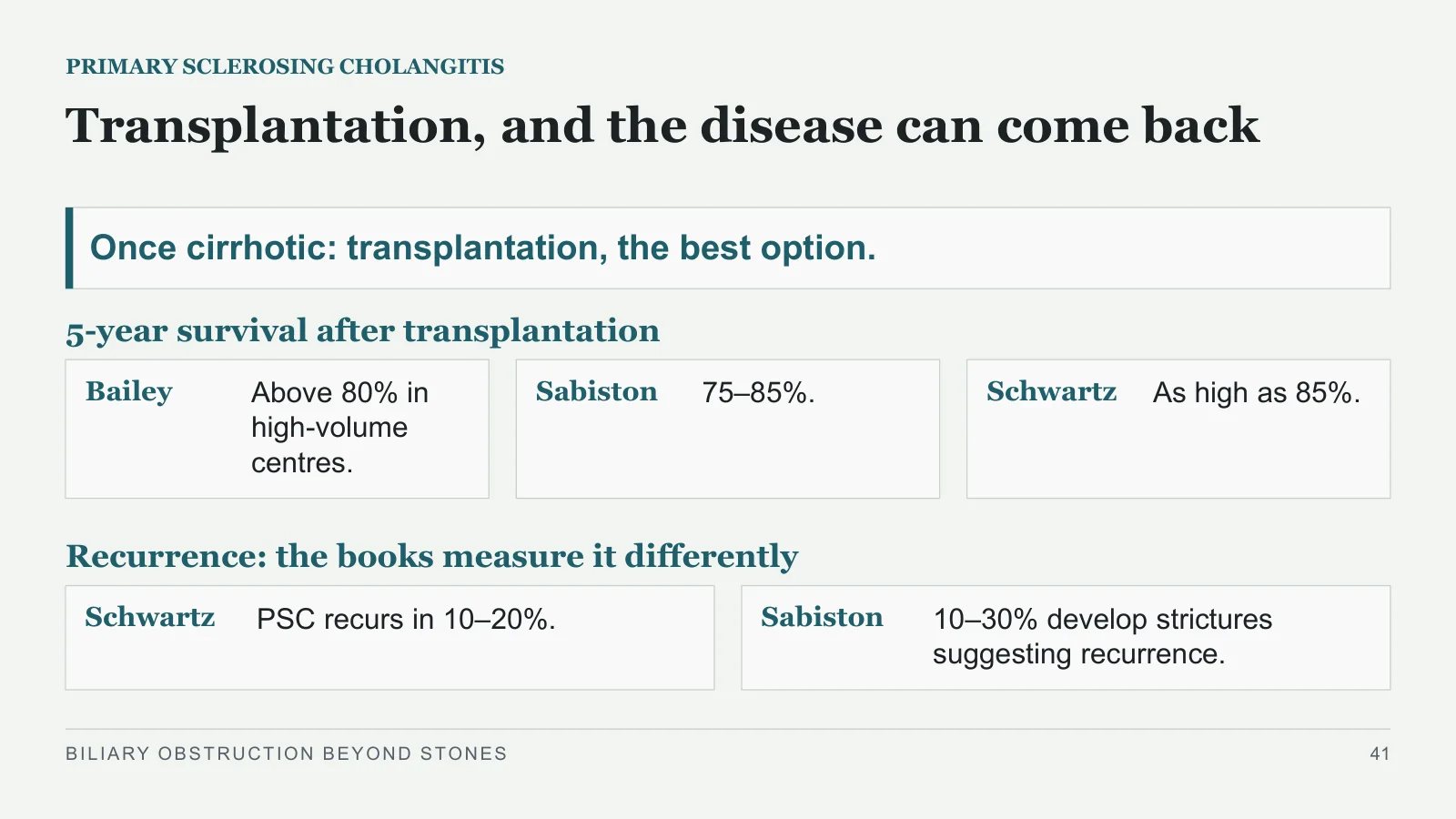
Transplantation, and the disease can come back
PRIMARY SCLEROSING CHOLANGITIS
Once cirrhotic: transplantation, the best option.
5-year survival after transplantation
Bailey
Above 80% in high-volume centres.
Sabiston
75–85%.
Schwartz
As high as 85%.
Recurrence: the books measure it differently
Schwartz
PSC recurs in 10–20%.
Sabiston
10–30% develop strictures suggesting recurrence.
BILIARY OBSTRUCTION BEYOND STONES
41
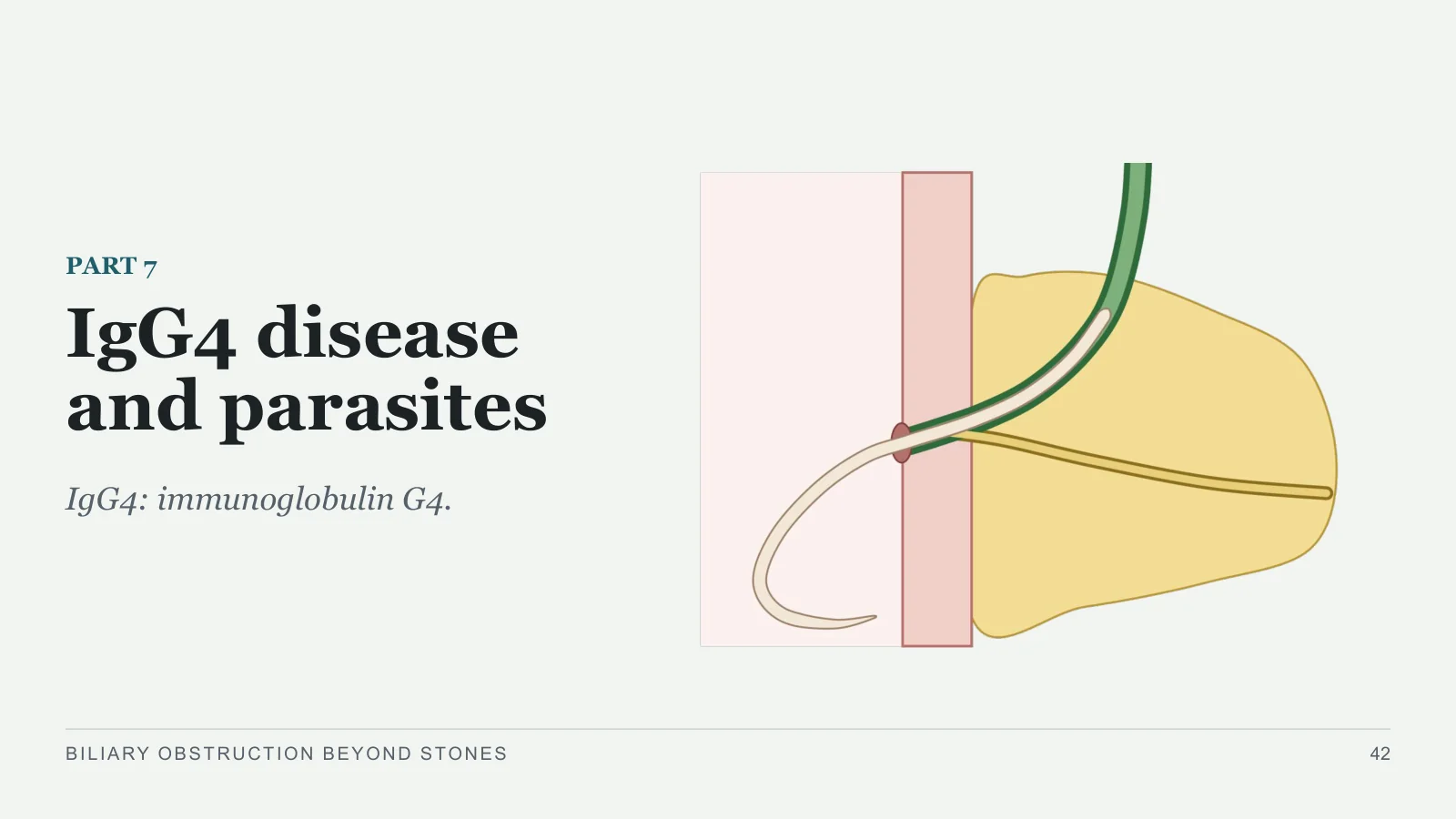
IgG4 disease and parasites
IgG4 disease and parasites
PART 7
IgG4: immunoglobulin G4.
BILIARY OBSTRUCTION BEYOND STONES
42
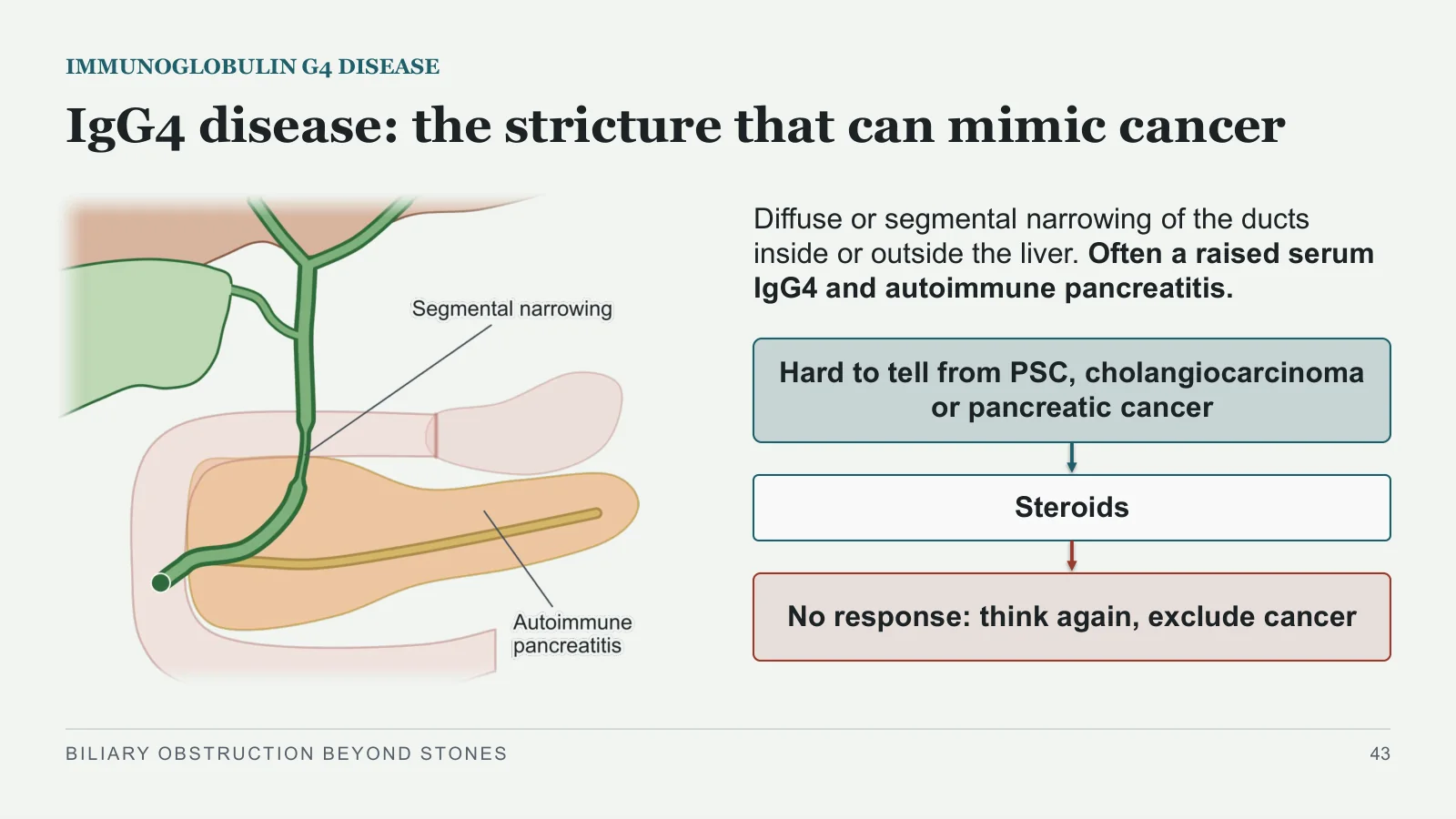
IgG4 disease: the stricture that can mimic cancer
IMMUNOGLOBULIN G4 DISEASE
Diffuse or segmental narrowing of the ducts inside or outside the liver. Often a raised serum IgG4 and autoimmune pancreatitis.
Hard to tell from PSC, cholangiocarcinoma or pancreatic cancer
Steroids
No response: think again, exclude cancer
BILIARY OBSTRUCTION BEYOND STONES
43
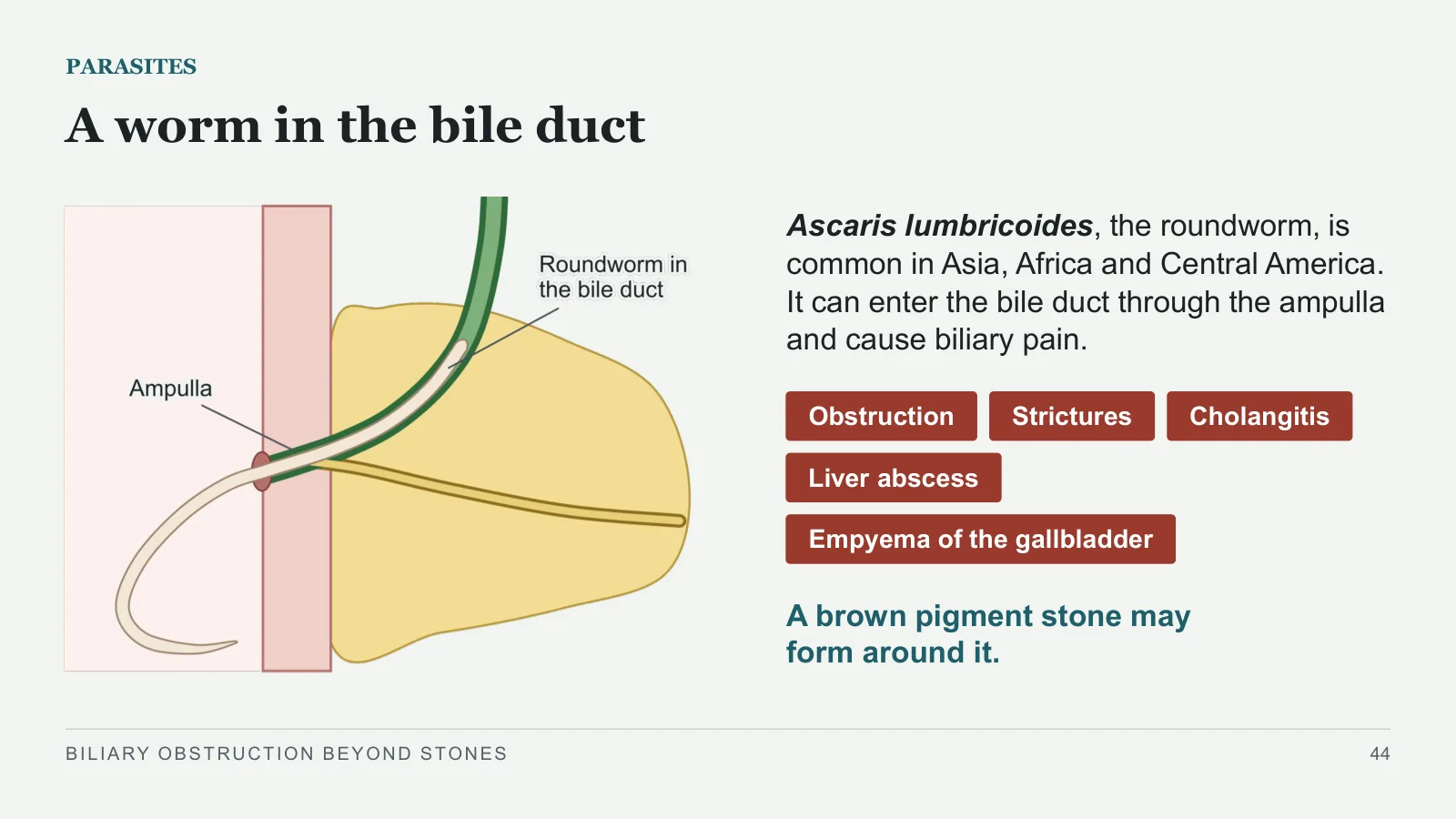
A worm in the bile duct
PARASITES
Ascaris lumbricoides, the roundworm, is common in Asia, Africa and Central America. It can enter the bile duct through the ampulla and cause biliary pain.
Obstruction
Strictures
Cholangitis
Liver abscess
Empyema of the gallbladder
A brown pigment stone may form around it.
BILIARY OBSTRUCTION BEYOND STONES
44
Coax it back, or pull it out
PARASITES
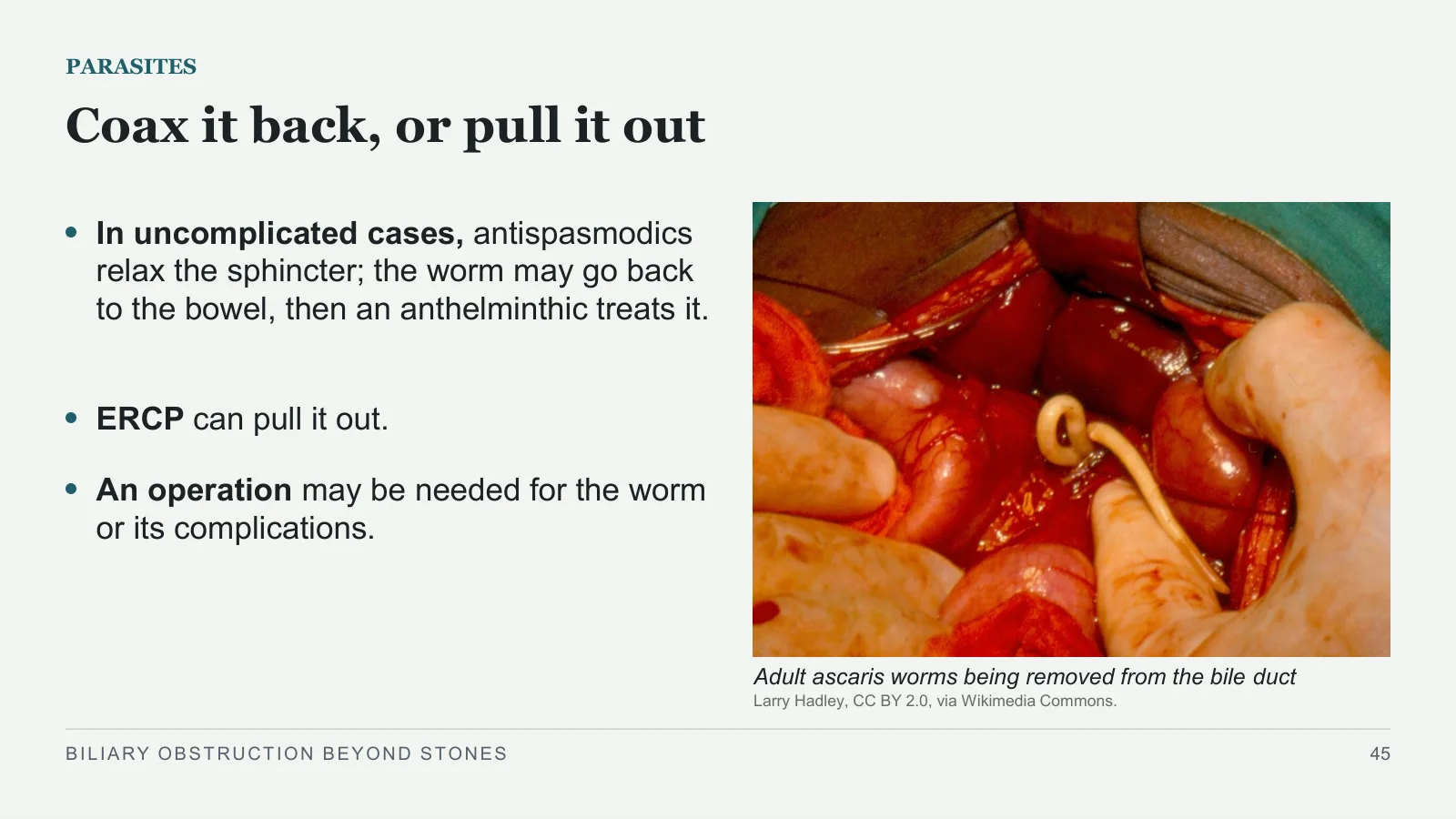
In uncomplicated cases, antispasmodics relax the sphincter; the worm may go back to the bowel, then an anthelminthic treats it.
ERCP can pull it out.
An operation may be needed for the worm or its complications.
Adult ascaris worms being removed from the bile duct
Larry Hadley, CC BY 2.0, via Wikimedia Commons.
BILIARY OBSTRUCTION BEYOND STONES
45
Flukes, and the risk of bile duct cancer
PARASITES
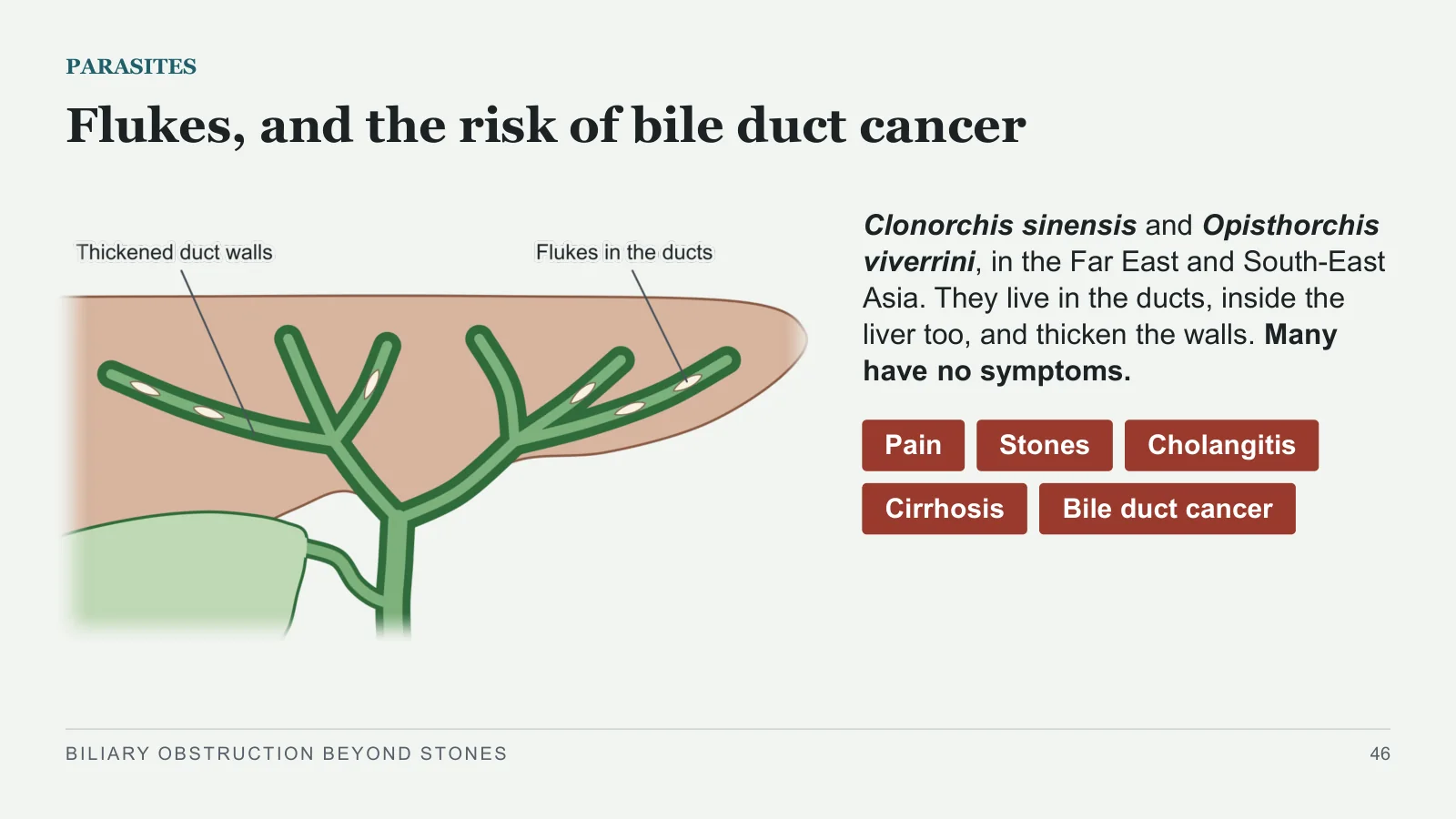
Clonorchis sinensis and Opisthorchis viverrini, in the Far East and South-East Asia. They live in the ducts, inside the liver too, and thicken the walls. Many have no symptoms.
Pain
Stones
Cholangitis
Cirrhosis
Bile duct cancer
BILIARY OBSTRUCTION BEYOND STONES
46
Stones and strictures inside the liver
RECURRENT PYOGENIC CHOLANGITIS
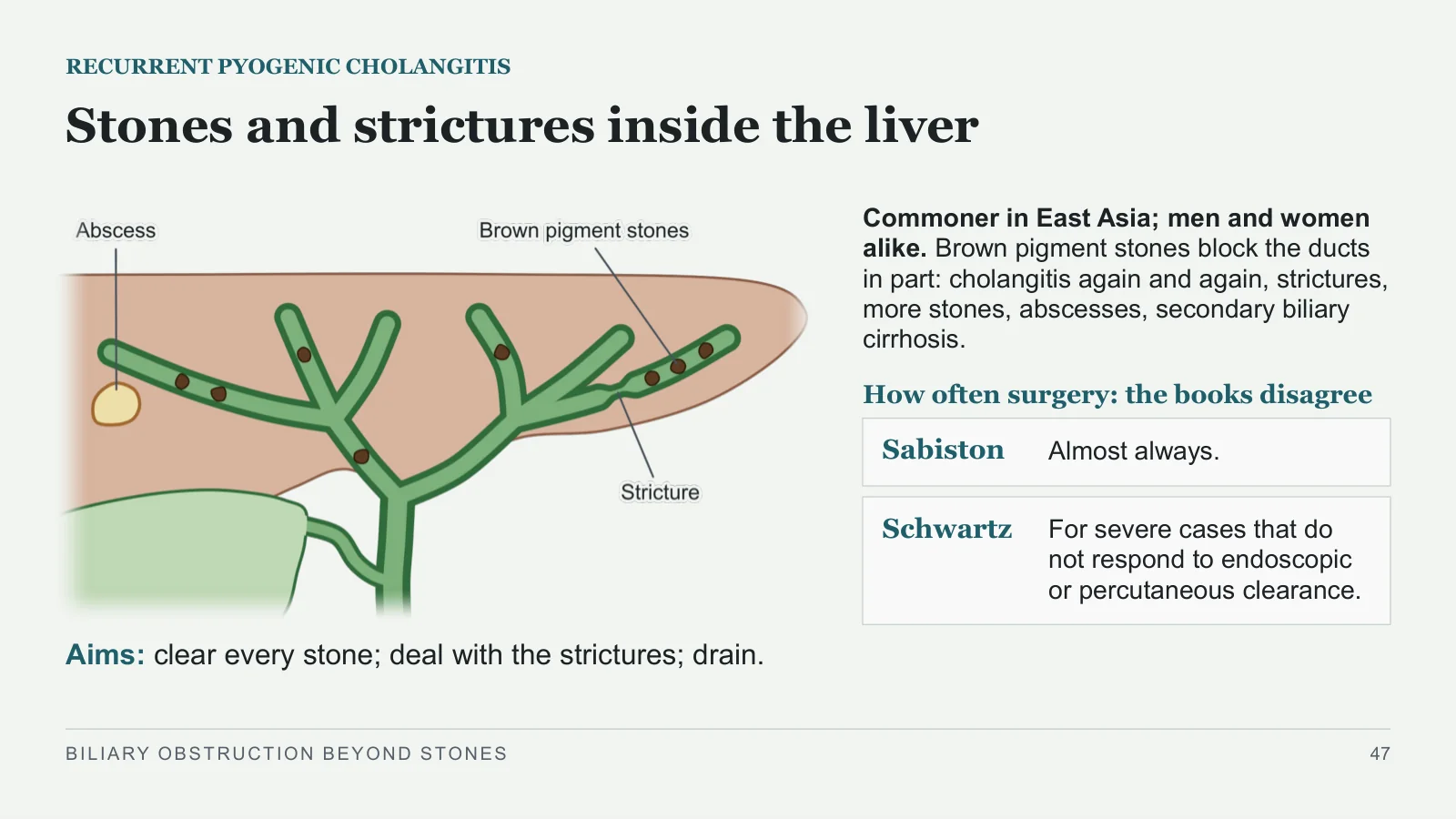
Aims: clear every stone; deal with the strictures; drain.
Commoner in East Asia; men and women alike. Brown pigment stones block the ducts in part: cholangitis again and again, strictures, more stones, abscesses, secondary biliary cirrhosis.
How often surgery: the books disagree
Sabiston
Almost always.
Schwartz
For severe cases that do not respond to endoscopic or percutaneous clearance.
BILIARY OBSTRUCTION BEYOND STONES
47
A hydatid cyst that bursts into the ducts
PARASITES
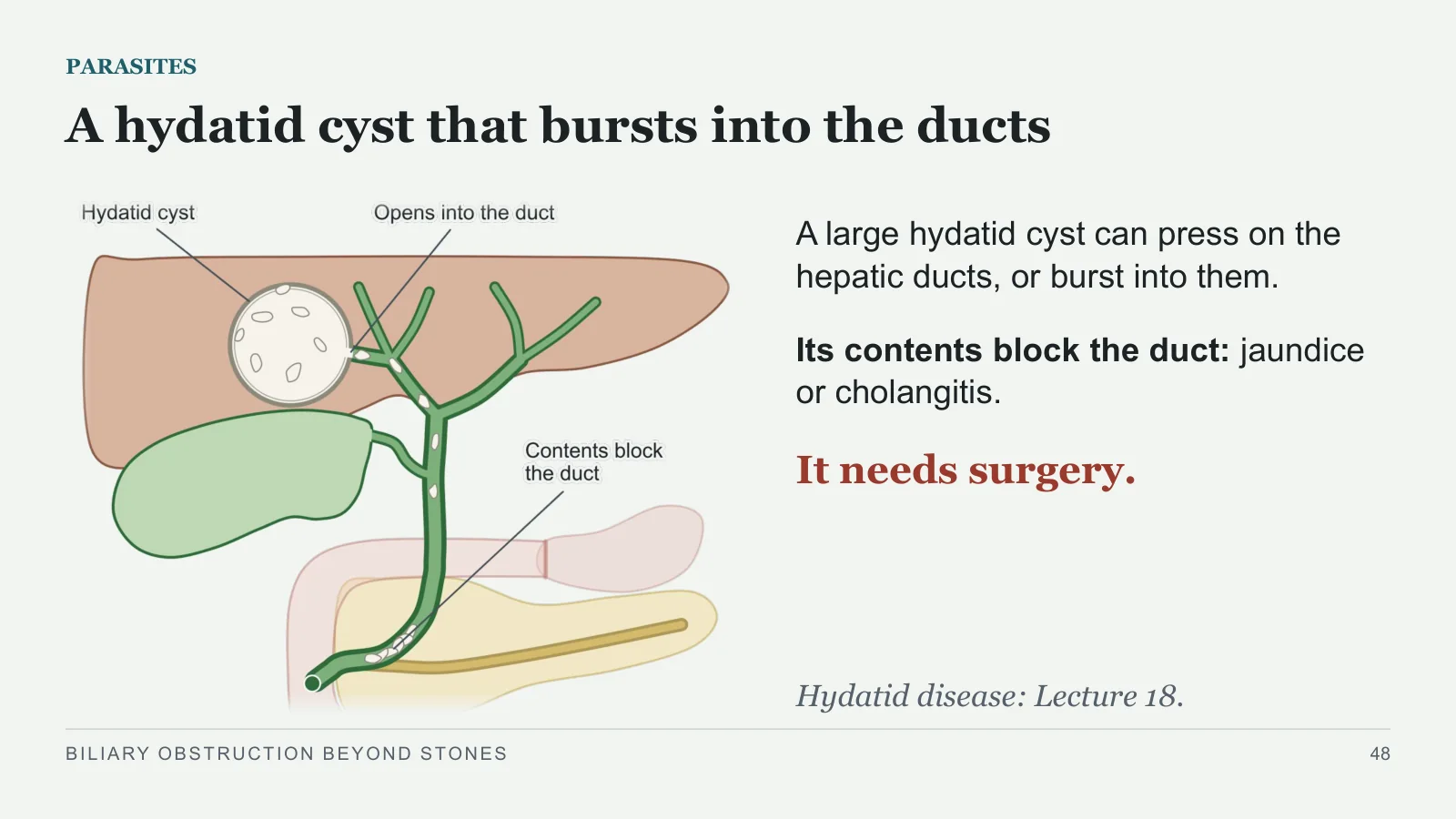
A large hydatid cyst can press on the hepatic ducts, or burst into them.
Its contents block the duct: jaundice or cholangitis.
It needs surgery.
Hydatid disease: Lecture 18.
BILIARY OBSTRUCTION BEYOND STONES
48
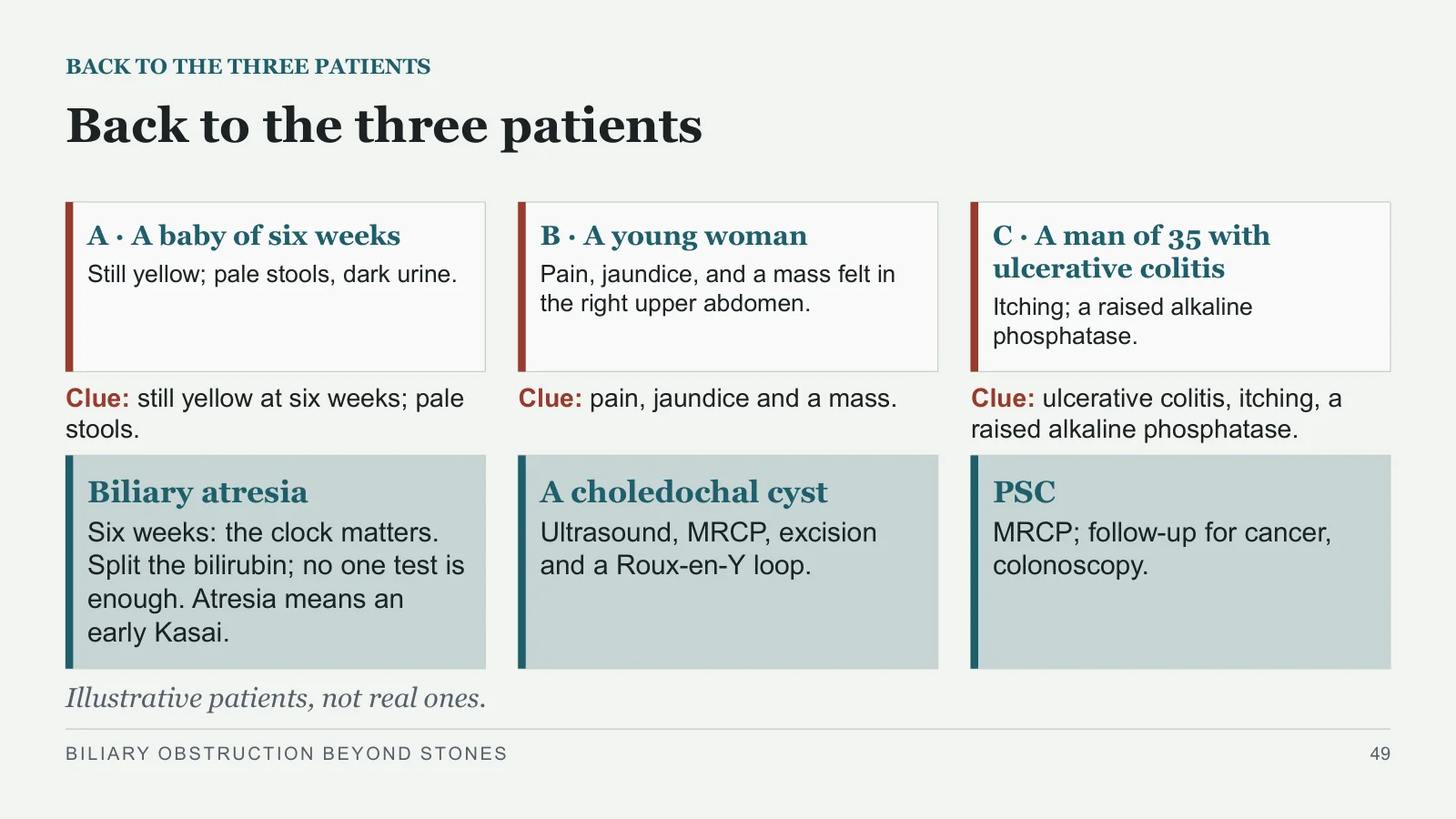
Back to the three patients
BACK TO THE THREE PATIENTS
A · A baby of six weeks
Still yellow; pale stools, dark urine.
Clue: still yellow at six weeks; pale stools.
Biliary atresia
Six weeks: the clock matters. Split the bilirubin; no one test is enough. Atresia means an early Kasai.
B · A young woman
Pain, jaundice, and a mass felt in the right upper abdomen.
Clue: pain, jaundice and a mass.
A choledochal cyst
Ultrasound, MRCP, excision and a Roux-en-Y loop.
C · A man of 35 with ulcerative colitis
Itching; a raised alkaline phosphatase.
Clue: ulcerative colitis, itching, a raised alkaline phosphatase.
PSC
MRCP; follow-up for cancer, colonoscopy.
Illustrative patients, not real ones.
BILIARY OBSTRUCTION BEYOND STONES
49
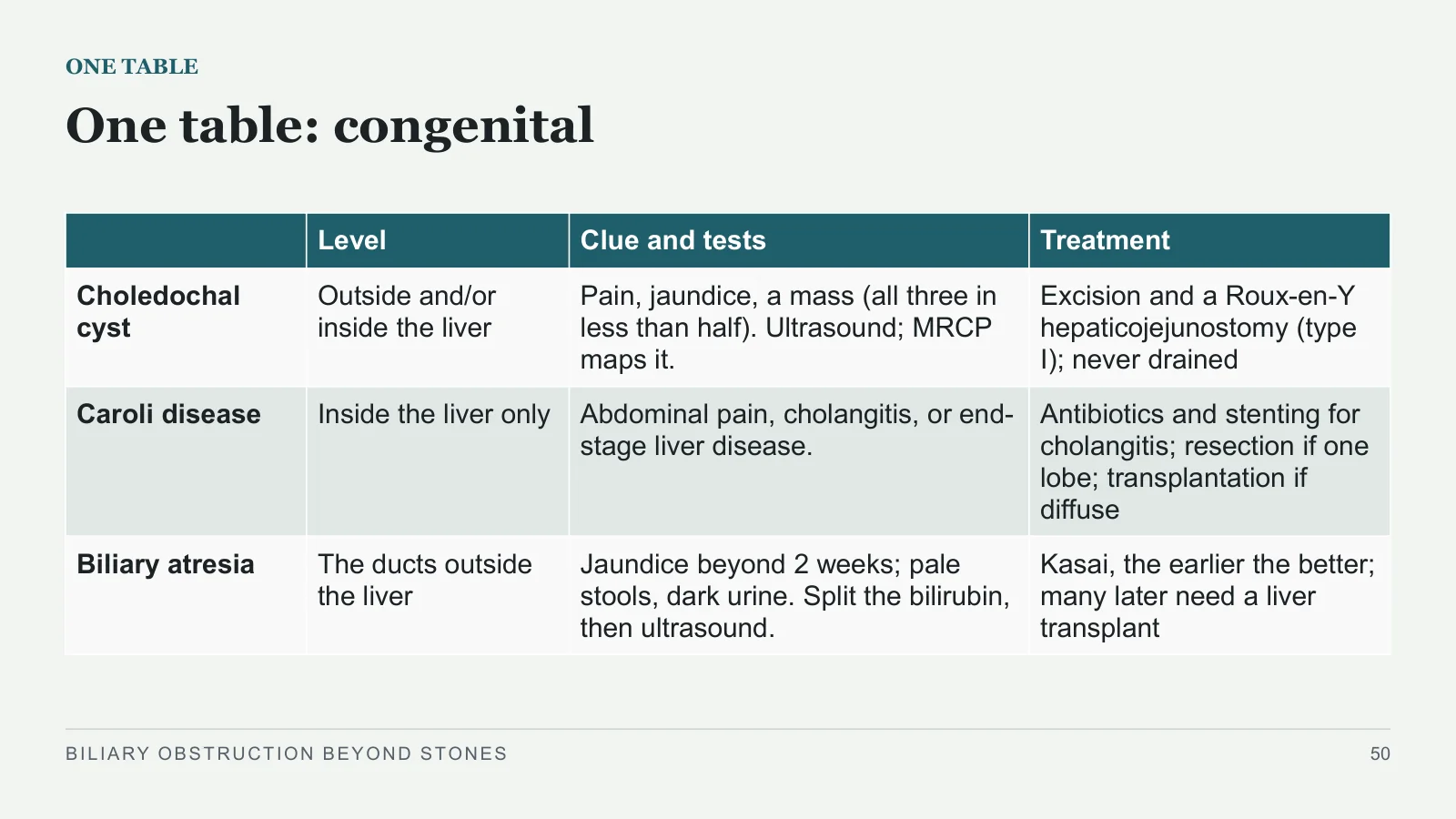
One table: congenital
ONE TABLE
BILIARY OBSTRUCTION BEYOND STONES
50
| Level | Clue and tests | Treatment | |
| Choledochal cyst | Outside and/or inside the liver | Pain, jaundice, a mass (all three in less than half). Ultrasound; MRCP maps it. | Excision and a Roux-en-Y hepaticojejunostomy (type I); never drained |
| Caroli disease | Inside the liver only | Abdominal pain, cholangitis, or end-stage liver disease. | Antibiotics and stenting for cholangitis; resection if one lobe; transplantation if diffuse |
| Biliary atresia | The ducts outside the liver | Jaundice beyond 2 weeks; pale stools, dark urine. Split the bilirubin, then ultrasound. | Kasai, the earlier the better; many later need a liver transplant |
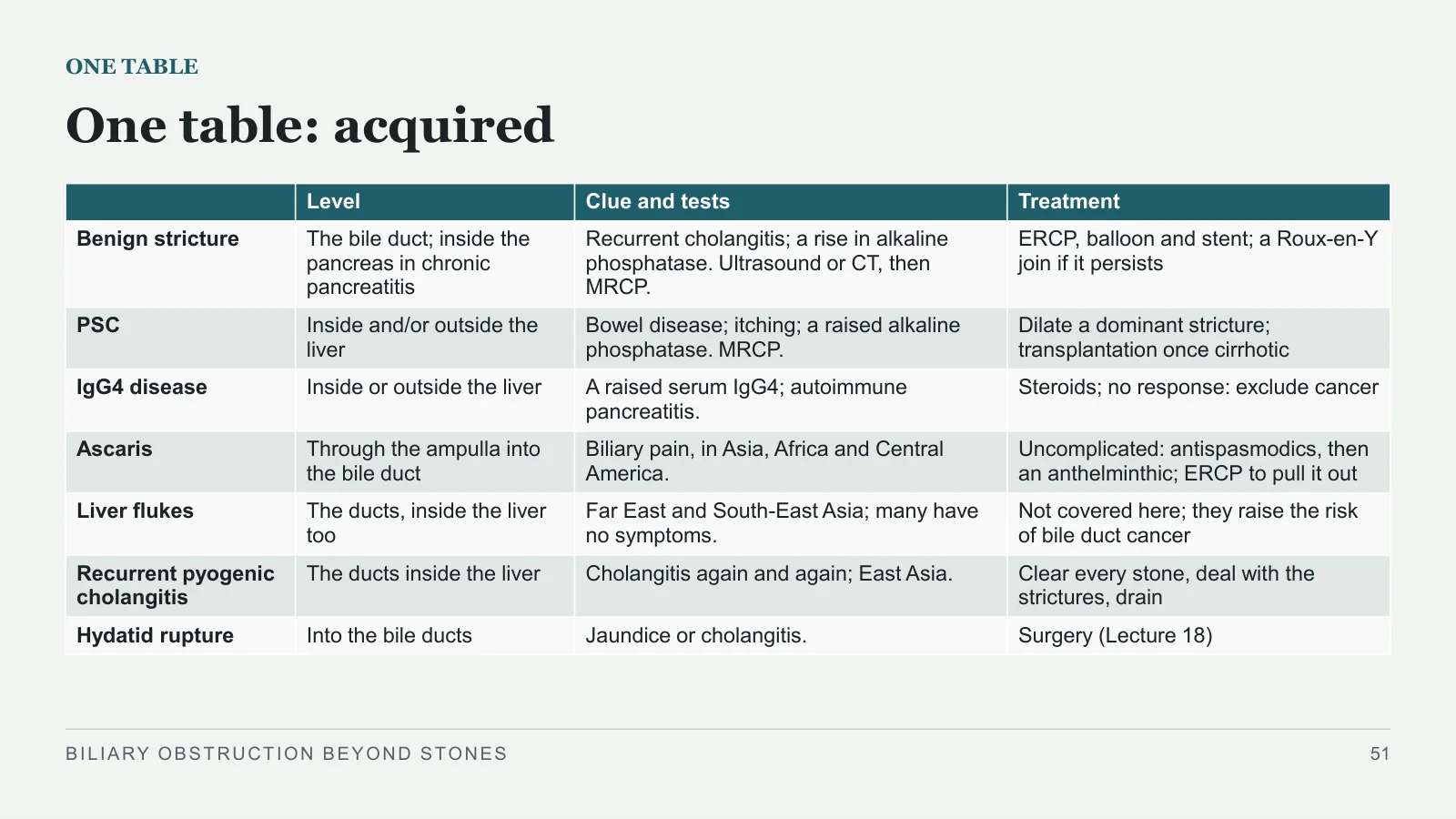
One table: acquired
ONE TABLE
BILIARY OBSTRUCTION BEYOND STONES
51
| Level | Clue and tests | Treatment | |
| Benign stricture | The bile duct; inside the pancreas in chronic pancreatitis | Recurrent cholangitis; a rise in alkaline phosphatase. Ultrasound or CT, then MRCP. | ERCP, balloon and stent; a Roux-en-Y join if it persists |
| PSC | Inside and/or outside the liver | Bowel disease; itching; a raised alkaline phosphatase. MRCP. | Dilate a dominant stricture; transplantation once cirrhotic |
| IgG4 disease | Inside or outside the liver | A raised serum IgG4; autoimmune pancreatitis. | Steroids; no response: exclude cancer |
| Ascaris | Through the ampulla into the bile duct | Biliary pain, in Asia, Africa and Central America. | Uncomplicated: antispasmodics, then an anthelminthic; ERCP to pull it out |
| Liver flukes | The ducts, inside the liver too | Far East and South-East Asia; many have no symptoms. | Not covered here; they raise the risk of bile duct cancer |
| Recurrent pyogenic cholangitis | The ducts inside the liver | Cholangitis again and again; East Asia. | Clear every stone, deal with the strictures, drain |
| Hydatid rupture | Into the bile ducts | Jaundice or cholangitis. | Surgery (Lecture 18) |
Viva and take-home
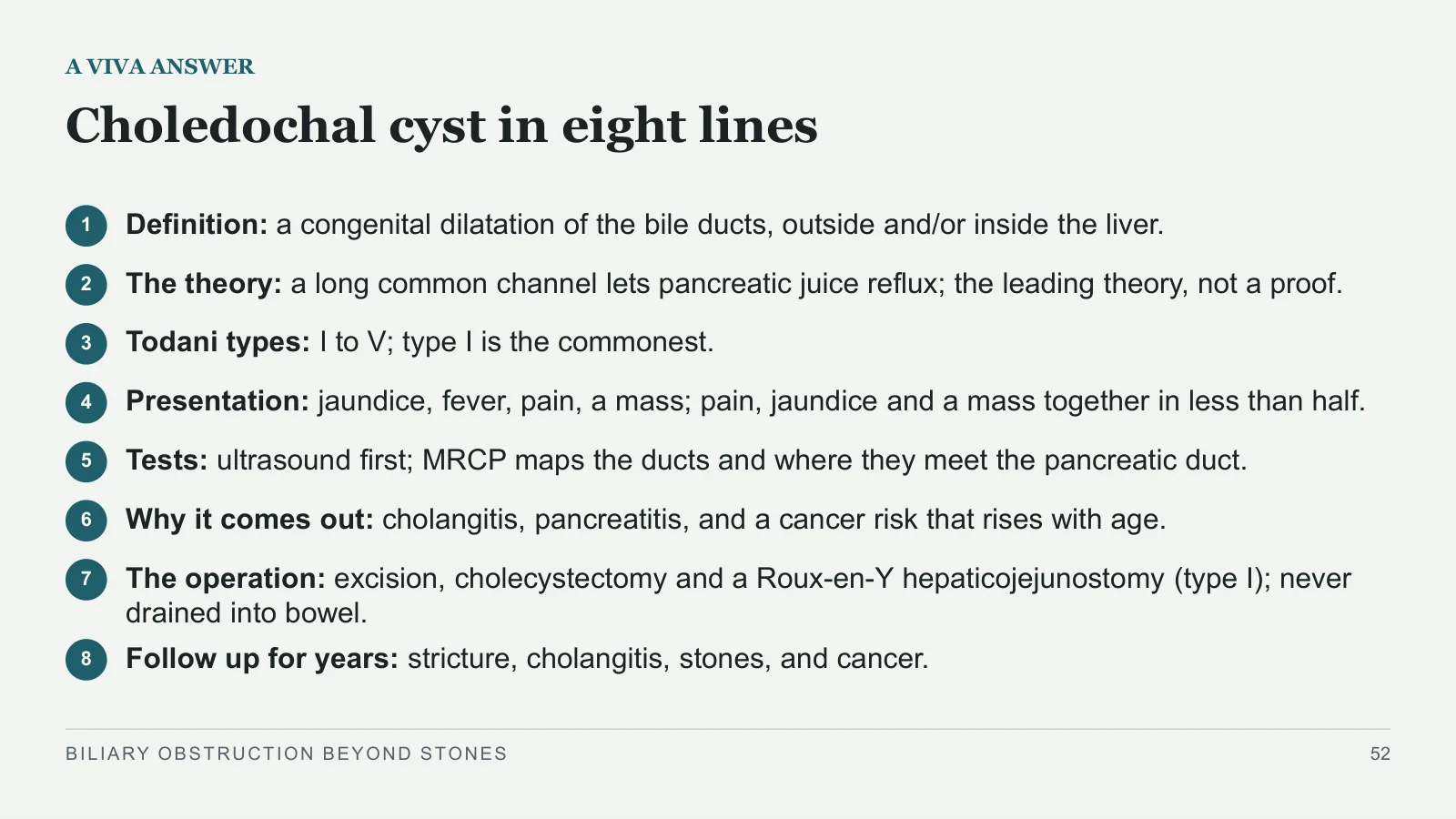
Choledochal cyst in eight lines
A VIVA ANSWER
1
Definition: a congenital dilatation of the bile ducts, outside and/or inside the liver.
2
The theory: a long common channel lets pancreatic juice reflux; the leading theory, not a proof.
3
Todani types: I to V; type I is the commonest.
4
Presentation: jaundice, fever, pain, a mass; pain, jaundice and a mass together in less than half.
5
Tests: ultrasound first; MRCP maps the ducts and where they meet the pancreatic duct.
6
Why it comes out: cholangitis, pancreatitis, and a cancer risk that rises with age.
7
The operation: excision, cholecystectomy and a Roux-en-Y hepaticojejunostomy (type I); never drained into bowel.
8
Follow up for years: stricture, cholangitis, stones, and cancer.
BILIARY OBSTRUCTION BEYOND STONES
52
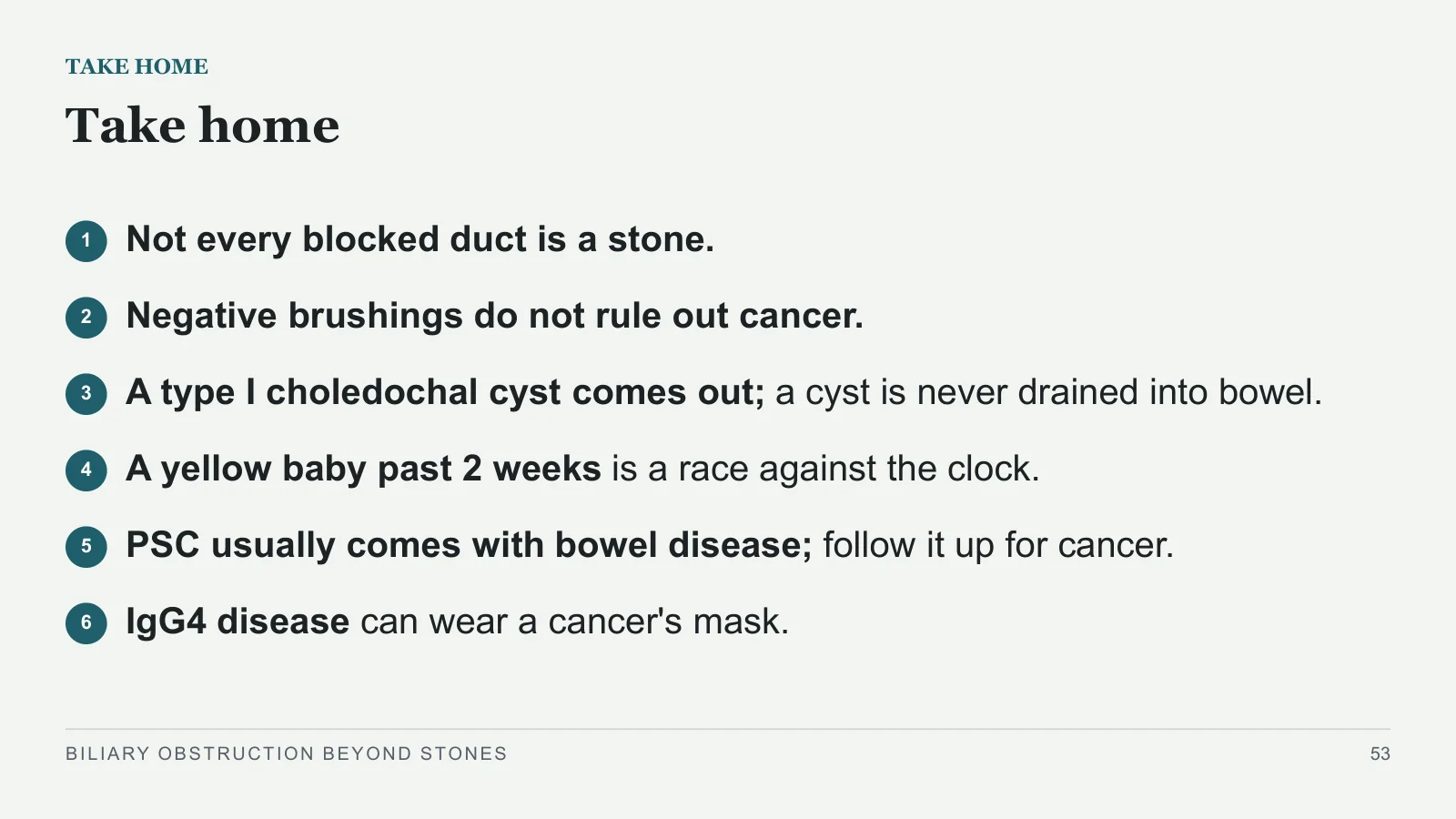
Take home
TAKE HOME
1
Not every blocked duct is a stone.
2
Negative brushings do not rule out cancer.
3
A type I choledochal cyst comes out; a cyst is never drained into bowel.
4
A yellow baby past 2 weeks is a race against the clock.
5
PSC usually comes with bowel disease; follow it up for cancer.
6
IgG4 disease can wear a cancer's mask.
BILIARY OBSTRUCTION BEYOND STONES
53
Sources and image credits
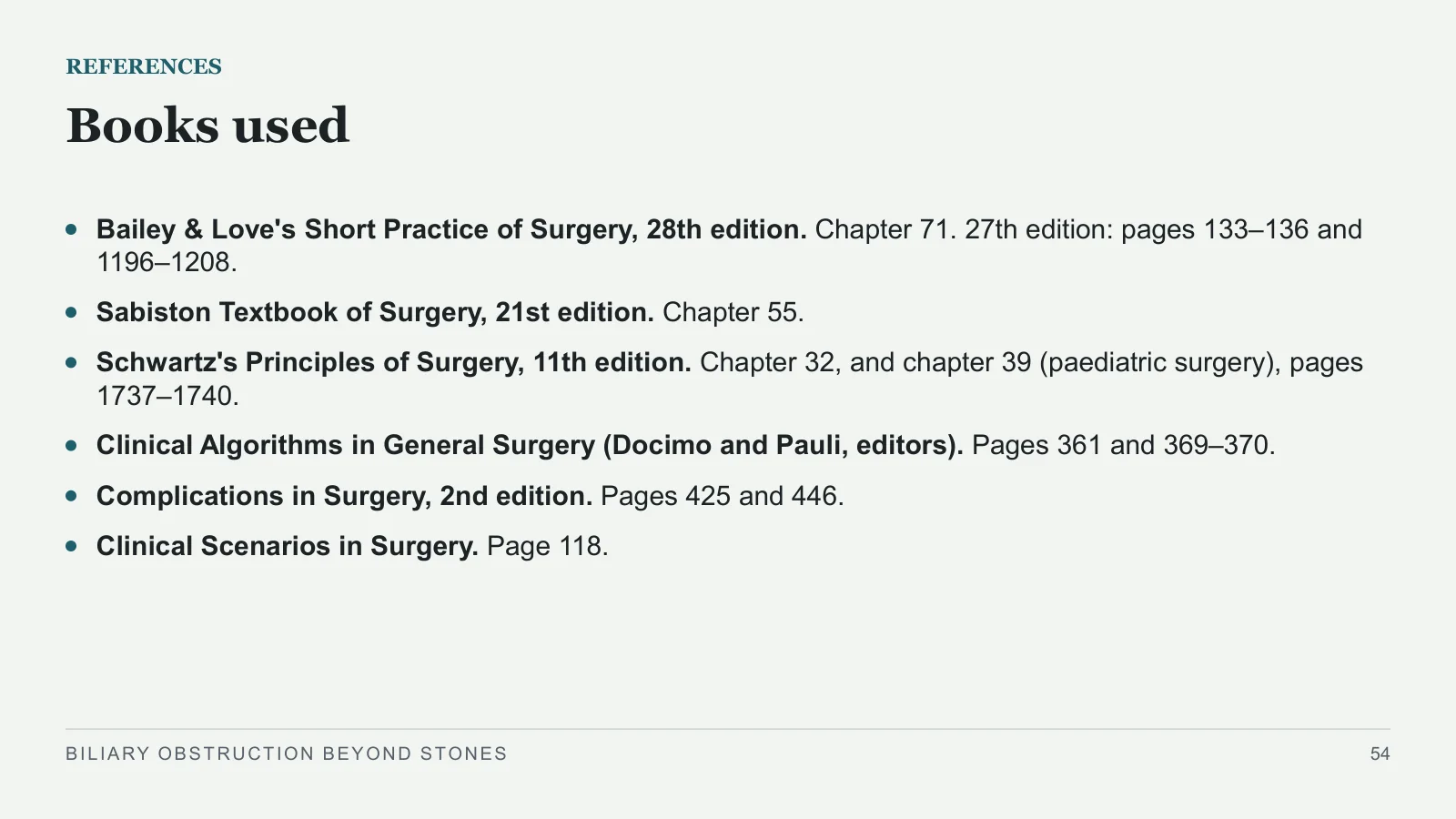
Books used
REFERENCES
Bailey & Love's Short Practice of Surgery, 28th edition. Chapter 71. 27th edition: pages 133–136 and 1196–1208.
Sabiston Textbook of Surgery, 21st edition. Chapter 55.
Schwartz's Principles of Surgery, 11th edition. Chapter 32, and chapter 39 (paediatric surgery), pages 1737–1740.
Clinical Algorithms in General Surgery (Docimo and Pauli, editors). Pages 361 and 369–370.
Complications in Surgery, 2nd edition. Pages 425 and 446.
Clinical Scenarios in Surgery. Page 118.
BILIARY OBSTRUCTION BEYOND STONES
54
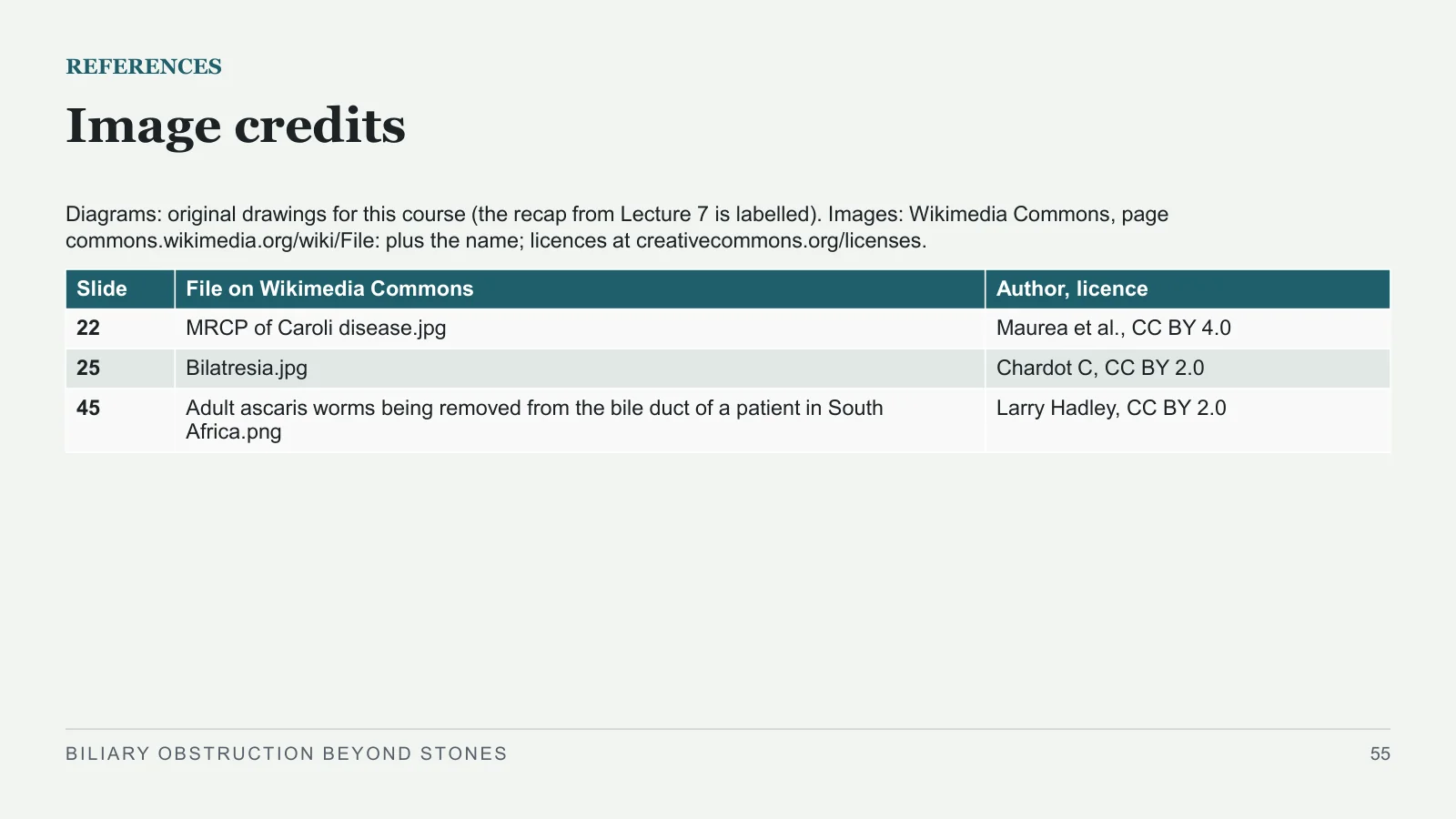
Image credits
REFERENCES
Diagrams: original drawings for this course (the recap from Lecture 7 is labelled). Images: Wikimedia Commons, page commons.wikimedia.org/wiki/File: plus the name; licences at creativecommons.org/licenses.
BILIARY OBSTRUCTION BEYOND STONES
55
| Slide | File on Wikimedia Commons | Author, licence |
| 22 | MRCP of Caroli disease.jpg | Maurea et al., CC BY 4.0 |
| 25 | Bilatresia.jpg | Chardot C, CC BY 2.0 |
| 45 | Adult ascaris worms being removed from the bile duct of a patient in South Africa.png | Larry Hadley, CC BY 2.0 |
Sources and image credits
Sources and image credits are reproduced from the designated slides.
Images
- Slide 22 · MRCP of Caroli disease.jpg · Maurea et al., CC BY 4.0 · CC BY 4.0
- Slide 25 · Bilatresia.jpg · Chardot C, CC BY 2.0 · CC BY 2.0
- Slide 45 · Adult ascaris worms being removed from the bile duct of a patient in South Africa.png · Larry Hadley, CC BY 2.0 · CC BY 2.0


Sources
- [1] REFERENCES
- [2] Books used
- [3] Bailey & Love's Short Practice of Surgery, 28th edition. Chapter 71. 27th edition: pages 133–136 and 1196–1208.
- [4] Sabiston Textbook of Surgery, 21st edition. Chapter 55.
- [5] Schwartz's Principles of Surgery, 11th edition. Chapter 32, and chapter 39 (paediatric surgery), pages 1737–1740.
- [6] Clinical Algorithms in General Surgery (Docimo and Pauli, editors). Pages 361 and 369–370.
- [7] Complications in Surgery, 2nd edition. Pages 425 and 446.
- [8] Clinical Scenarios in Surgery. Page 118.