Hepatobiliary surgery · Lecture 7
Postoperative complications · 55 slides
Problems after cholecystectomy.
Follow three patients after cholecystectomy to work through bile leaks, duct injuries, retained stones and recurring pain.
About the downloads
PowerPoint without speaker notes. SHA-256 checksums verify the downloaded files.
Contents · 12 parts
Opening cases
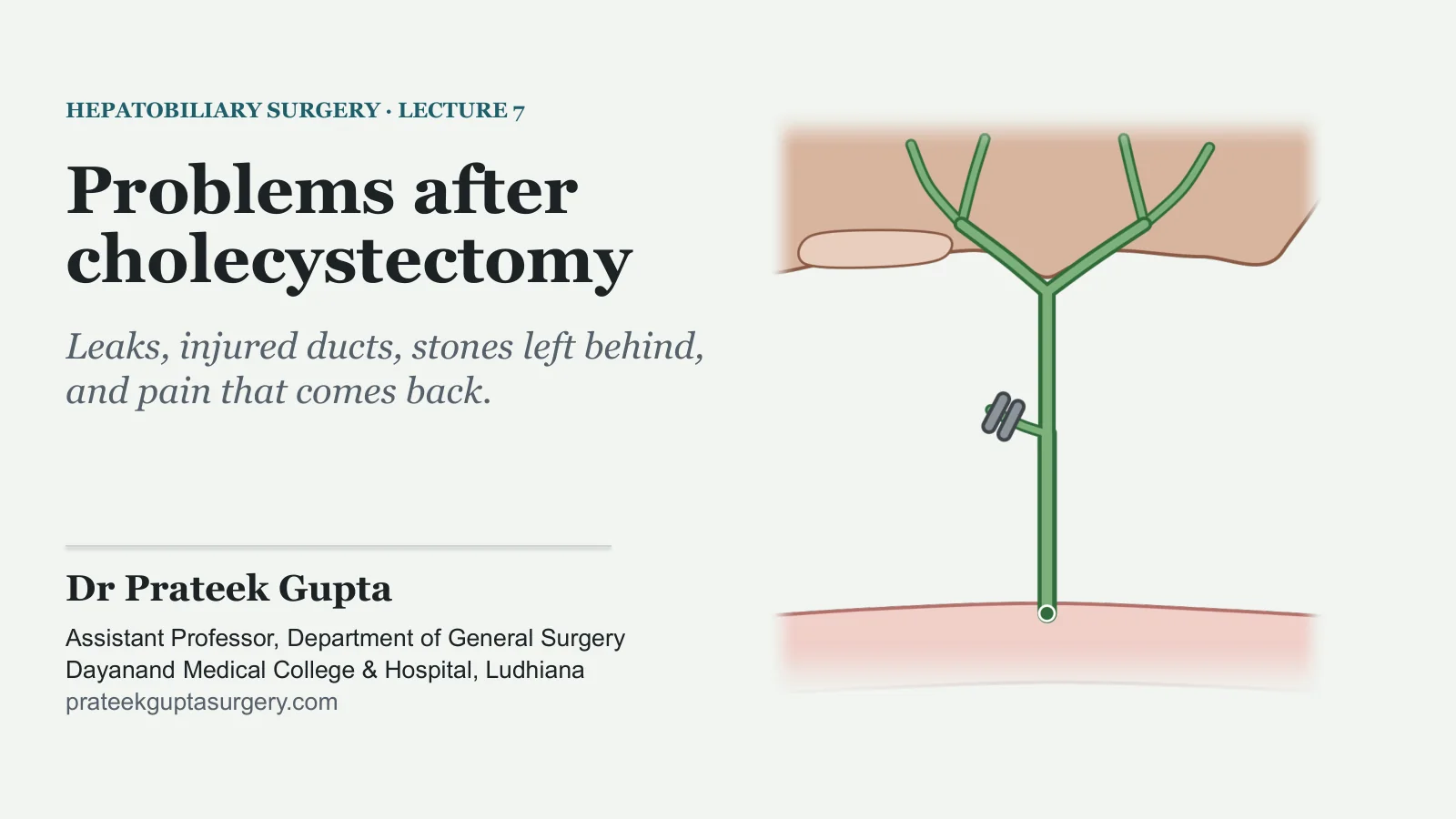
Problems after cholecystectomy
HEPATOBILIARY SURGERY · LECTURE 7
Problems after cholecystectomy
Leaks, injured ducts, stones left behind, and pain that comes back.
Dr Prateek Gupta
Assistant Professor, Department of General Surgery Dayanand Medical College & Hospital, Ludhiana prateekguptasurgery.com
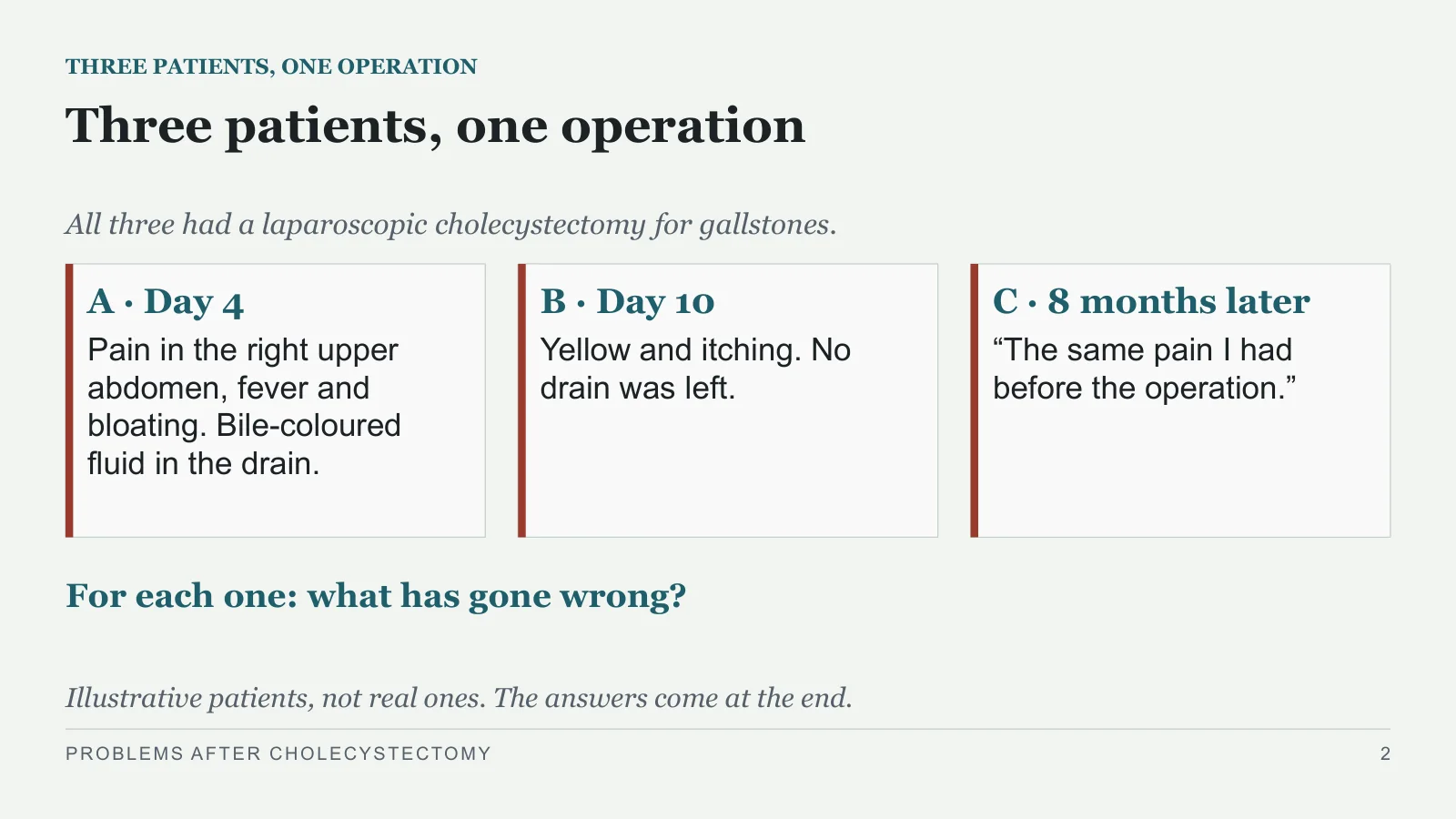
Three patients, one operation
THREE PATIENTS, ONE OPERATION
All three had a laparoscopic cholecystectomy for gallstones.
A · Day 4
Pain in the right upper abdomen, fever and bloating. Bile-coloured fluid in the drain.
B · Day 10
Yellow and itching. No drain was left.
C · 8 months later
“The same pain I had before the operation.”
For each one: what has gone wrong?
Illustrative patients, not real ones. The answers come at the end.
PROBLEMS AFTER CHOLECYSTECTOMY
2
What can go wrong, and when
What can go wrong, and when
PART 1
The problems in the order they turn up, and the sign that should make you look.
PROBLEMS AFTER CHOLECYSTECTOMY
3
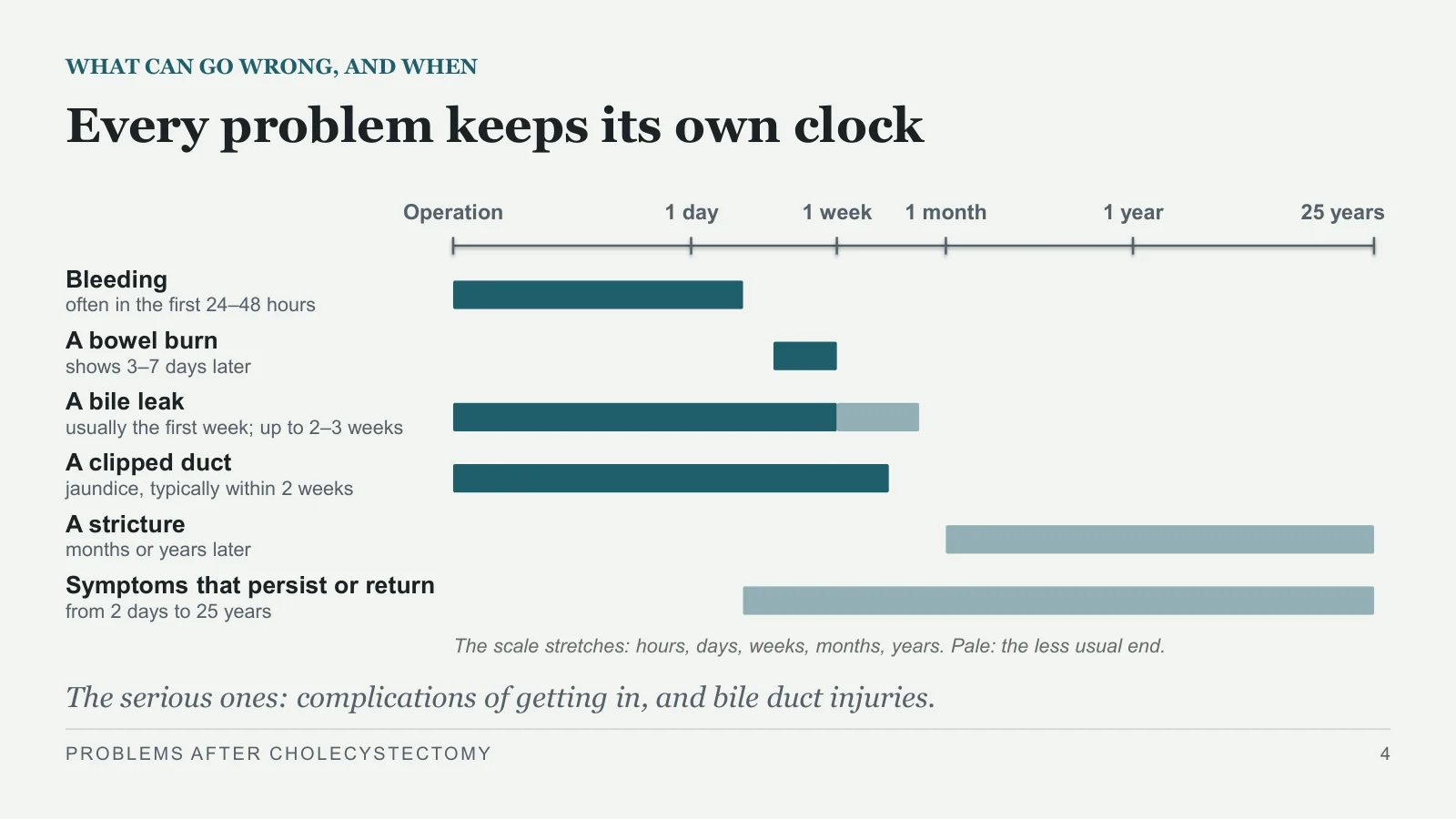
Every problem keeps its own clock
WHAT CAN GO WRONG, AND WHEN
Operation
1 day
1 week
1 month
1 year
25 years
Bleeding
often in the first 24–48 hours
A bowel burn
shows 3–7 days later
A bile leak
usually the first week; up to 2–3 weeks
A clipped duct
jaundice, typically within 2 weeks
A stricture
months or years later
Symptoms that persist or return
from 2 days to 25 years
The scale stretches: hours, days, weeks, months, years. Pale: the less usual end.
The serious ones: complications of getting in, and bile duct injuries.
PROBLEMS AFTER CHOLECYSTECTOMY
4
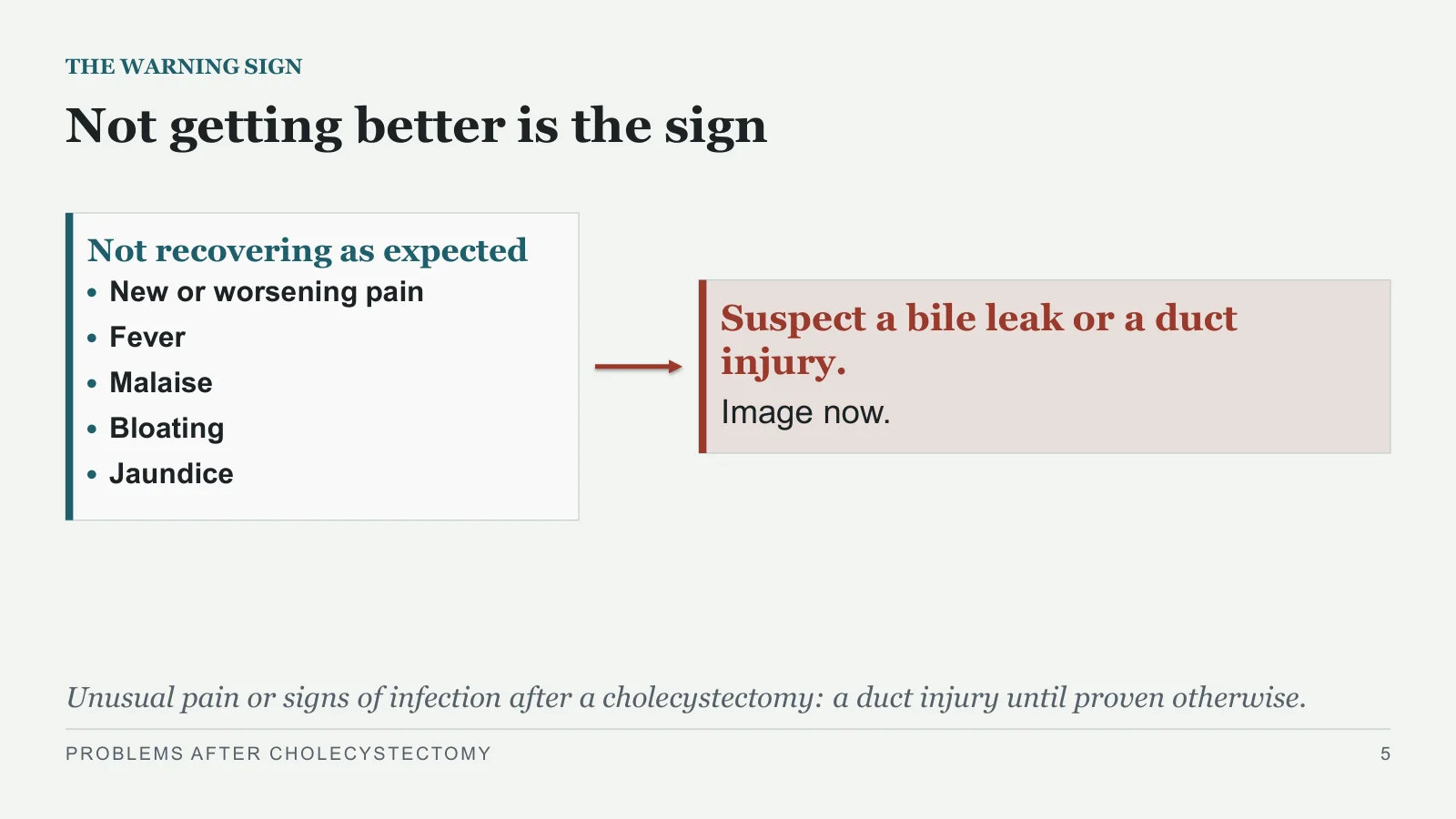
Not getting better is the sign
THE WARNING SIGN
Not recovering as expected
New or worsening pain
Fever
Malaise
Bloating
Jaundice
Suspect a bile leak or a duct injury.
Image now.
Unusual pain or signs of infection after a cholecystectomy: a duct injury until proven otherwise.
PROBLEMS AFTER CHOLECYSTECTOMY
5
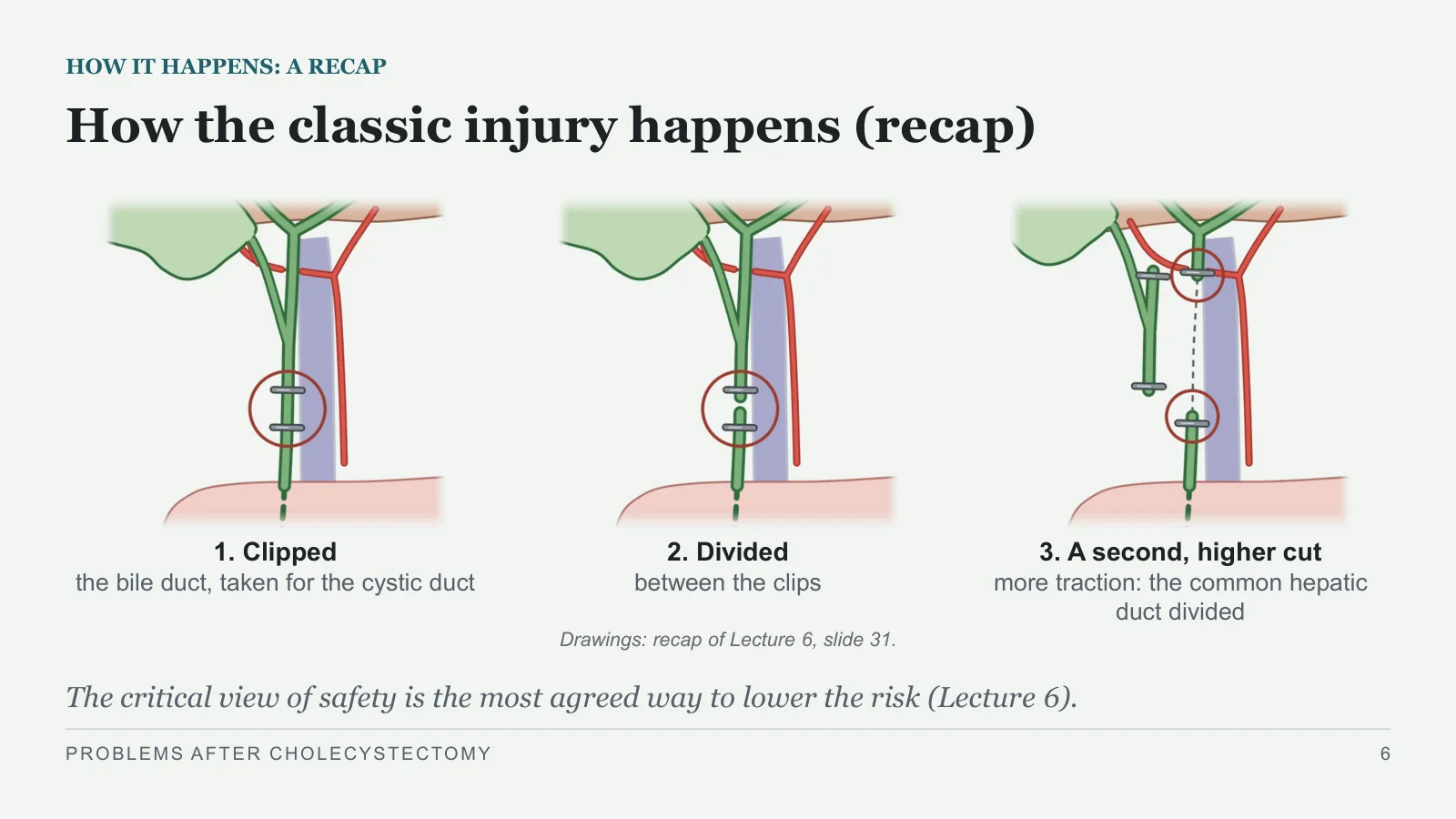
How the classic injury happens (recap)
HOW IT HAPPENS: A RECAP
1. Clipped
the bile duct, taken for the cystic duct
2. Divided
between the clips
3. A second, higher cut
more traction: the common hepatic duct divided
Drawings: recap of Lecture 6, slide 31.
The critical view of safety is the most agreed way to lower the risk (Lecture 6).
PROBLEMS AFTER CHOLECYSTECTOMY
6
Bile leak and biloma
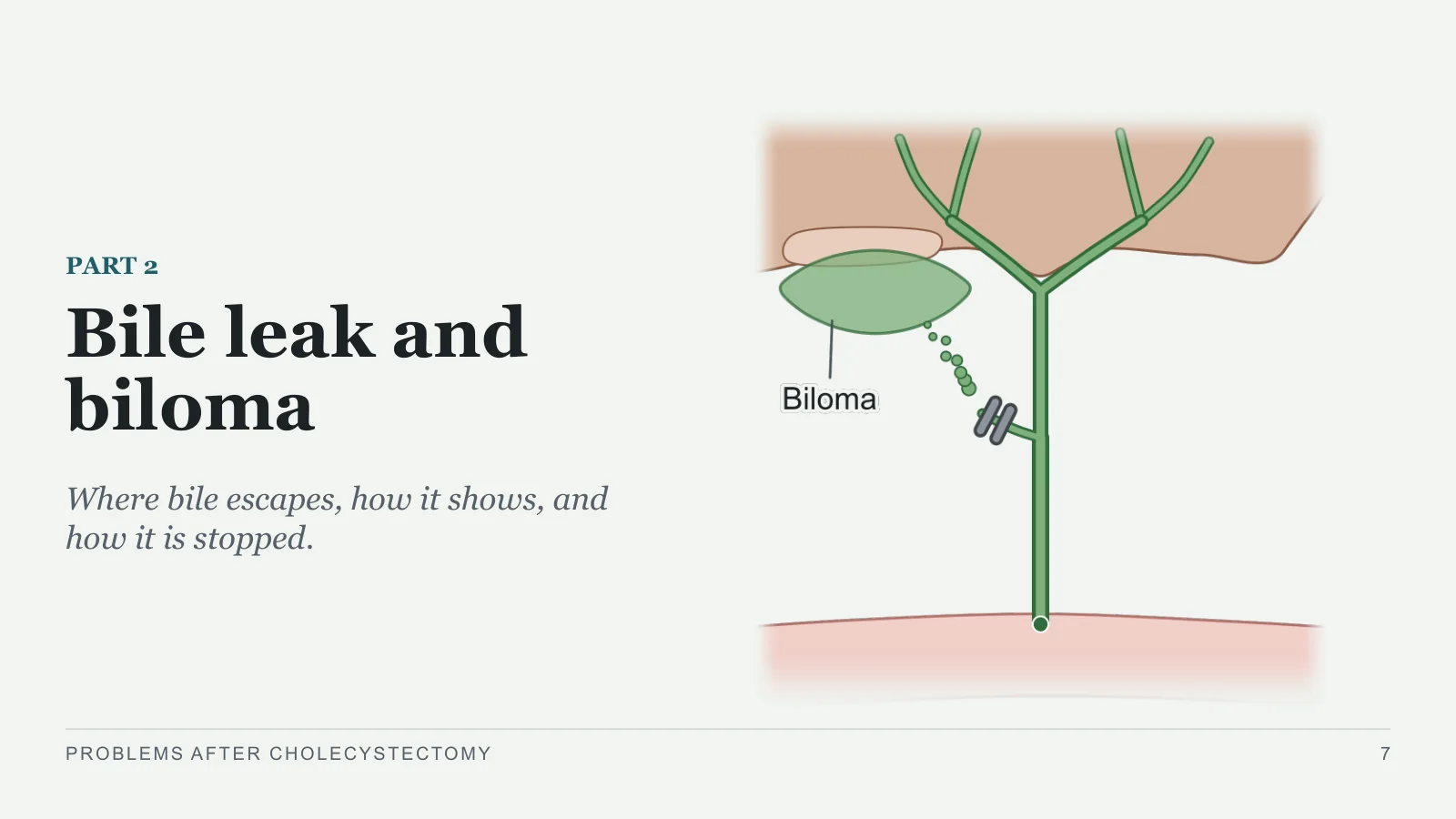
Bile leak and biloma
PART 2
Where bile escapes, how it shows, and how it is stopped.
PROBLEMS AFTER CHOLECYSTECTOMY
7
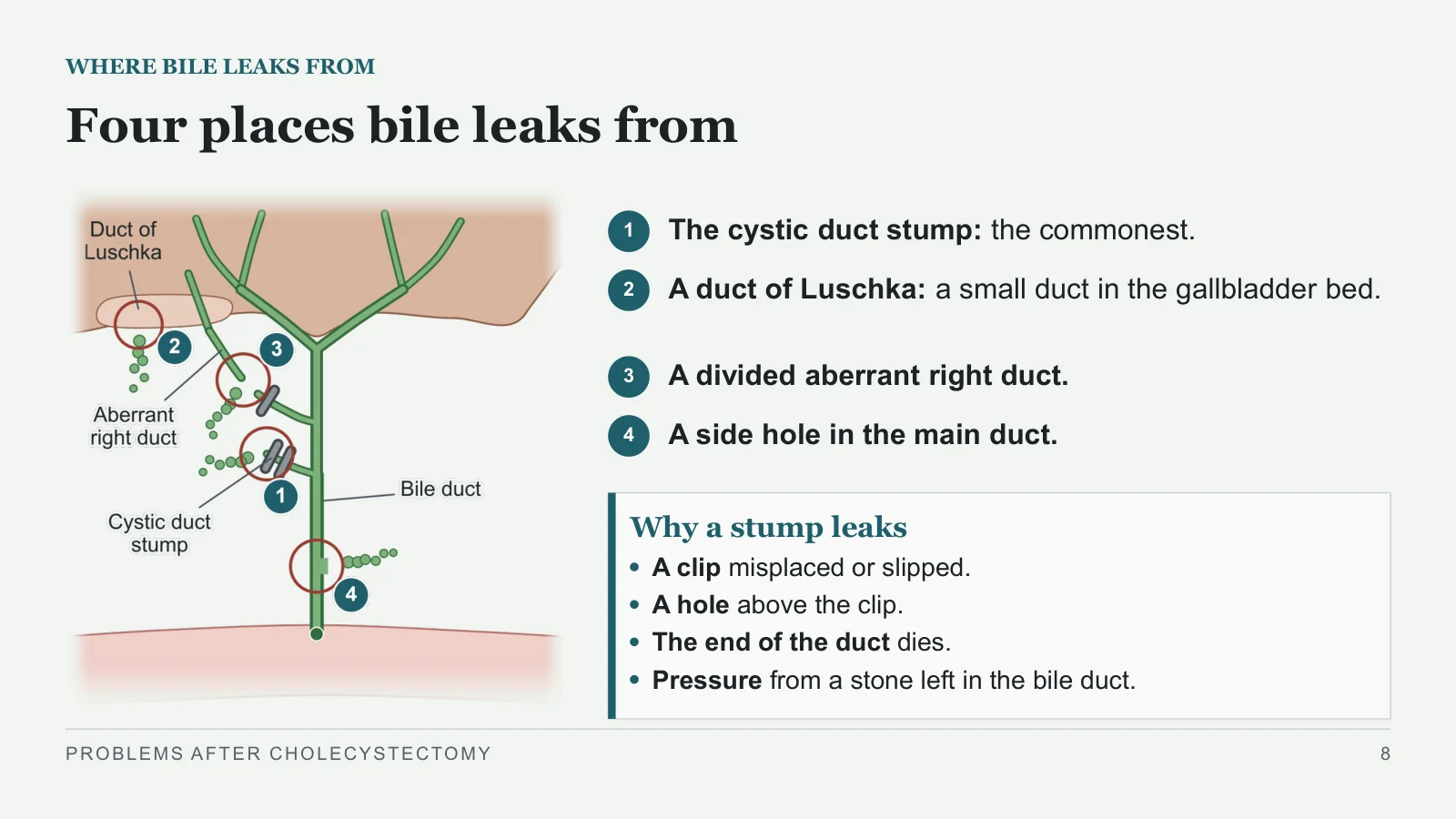
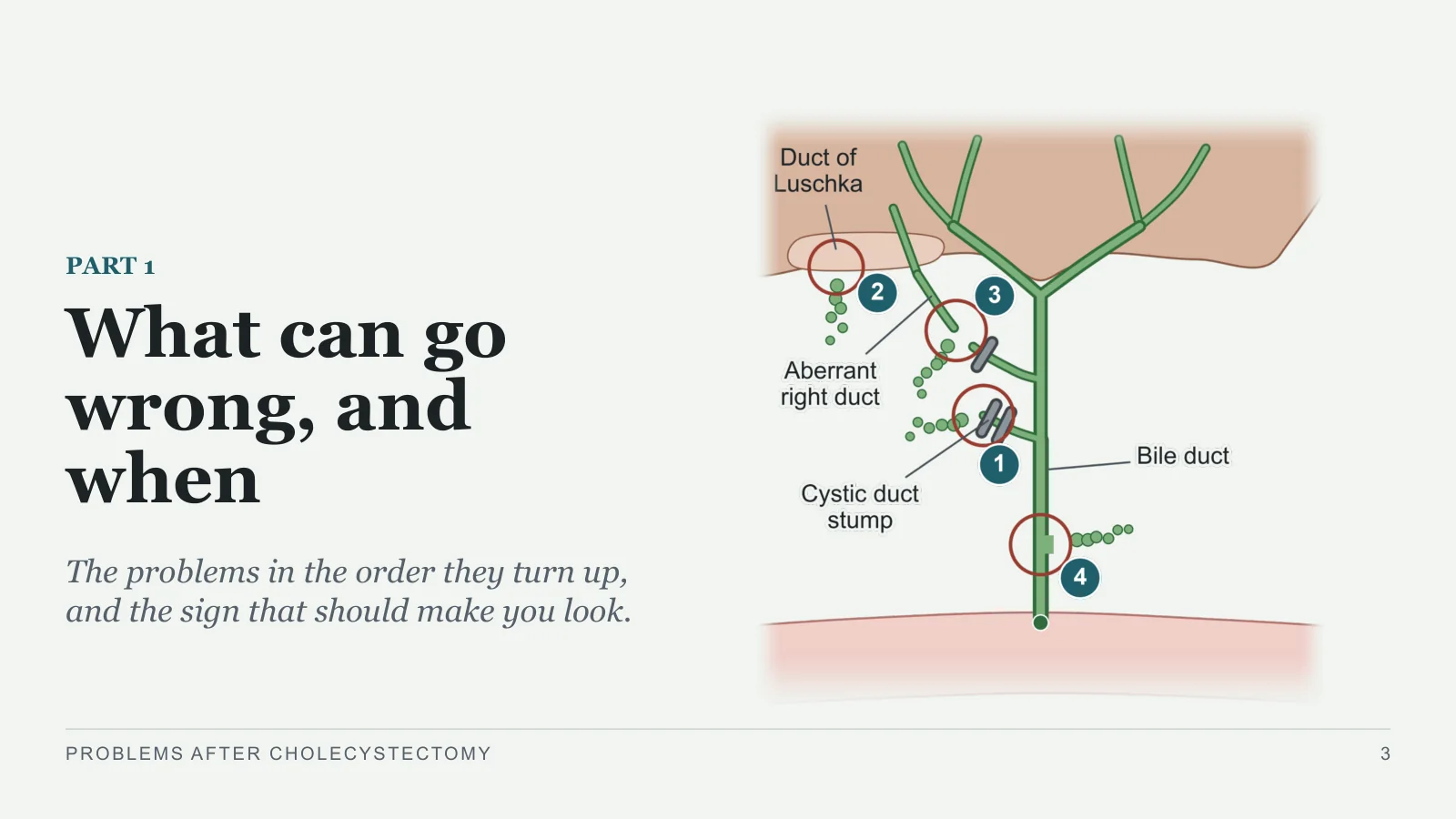
Four places bile leaks from
WHERE BILE LEAKS FROM
1
The cystic duct stump: the commonest.
2
A duct of Luschka: a small duct in the gallbladder bed.
3
A divided aberrant right duct.
4
A side hole in the main duct.
Why a stump leaks
A clip misplaced or slipped.
A hole above the clip.
The end of the duct dies.
Pressure from a stone left in the bile duct.
PROBLEMS AFTER CHOLECYSTECTOMY
8
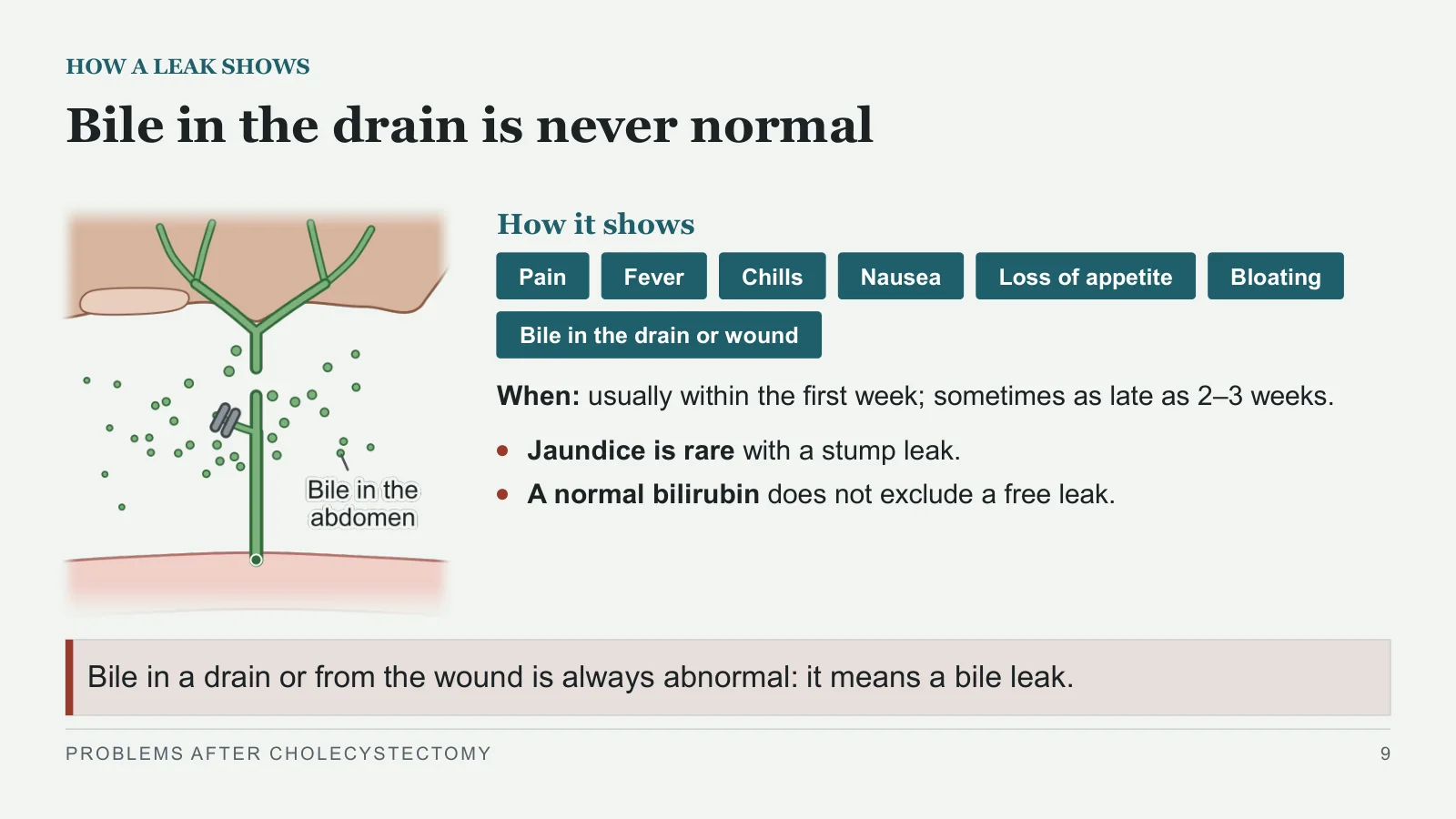
Bile in the drain is never normal
HOW A LEAK SHOWS
How it shows
Pain
Fever
Chills
Nausea
Loss of appetite
Bloating
Bile in the drain or wound
When: usually within the first week; sometimes as late as 2–3 weeks.
Jaundice is rare with a stump leak.
A normal bilirubin does not exclude a free leak.
Bile in a drain or from the wound is always abnormal: it means a bile leak.
PROBLEMS AFTER CHOLECYSTECTOMY
9
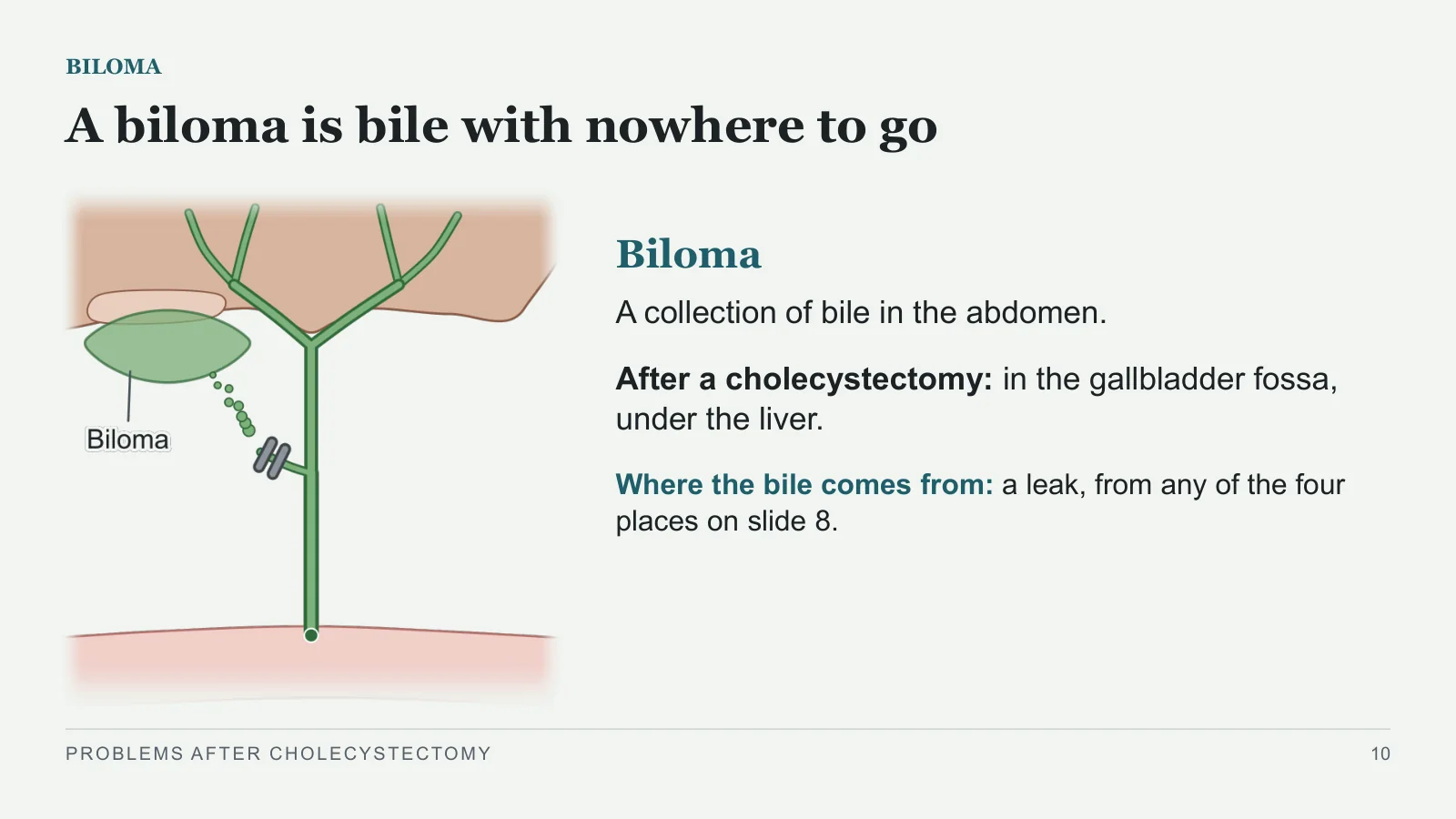
A biloma is bile with nowhere to go
BILOMA
Biloma
A collection of bile in the abdomen.
After a cholecystectomy: in the gallbladder fossa, under the liver.
Where the bile comes from: a leak, from any of the four places on slide 8.
PROBLEMS AFTER CHOLECYSTECTOMY
10
Three questions, three tests
PROVING THE LEAK
Is there a collection?
Ultrasound or CT (computed tomography): a collection, and whether the ducts are wide.
Is bile leaking?
HIDA scan (hepatobiliary scintigraphy): confirms a leak or a block; it shows little anatomy.
What is the anatomy?
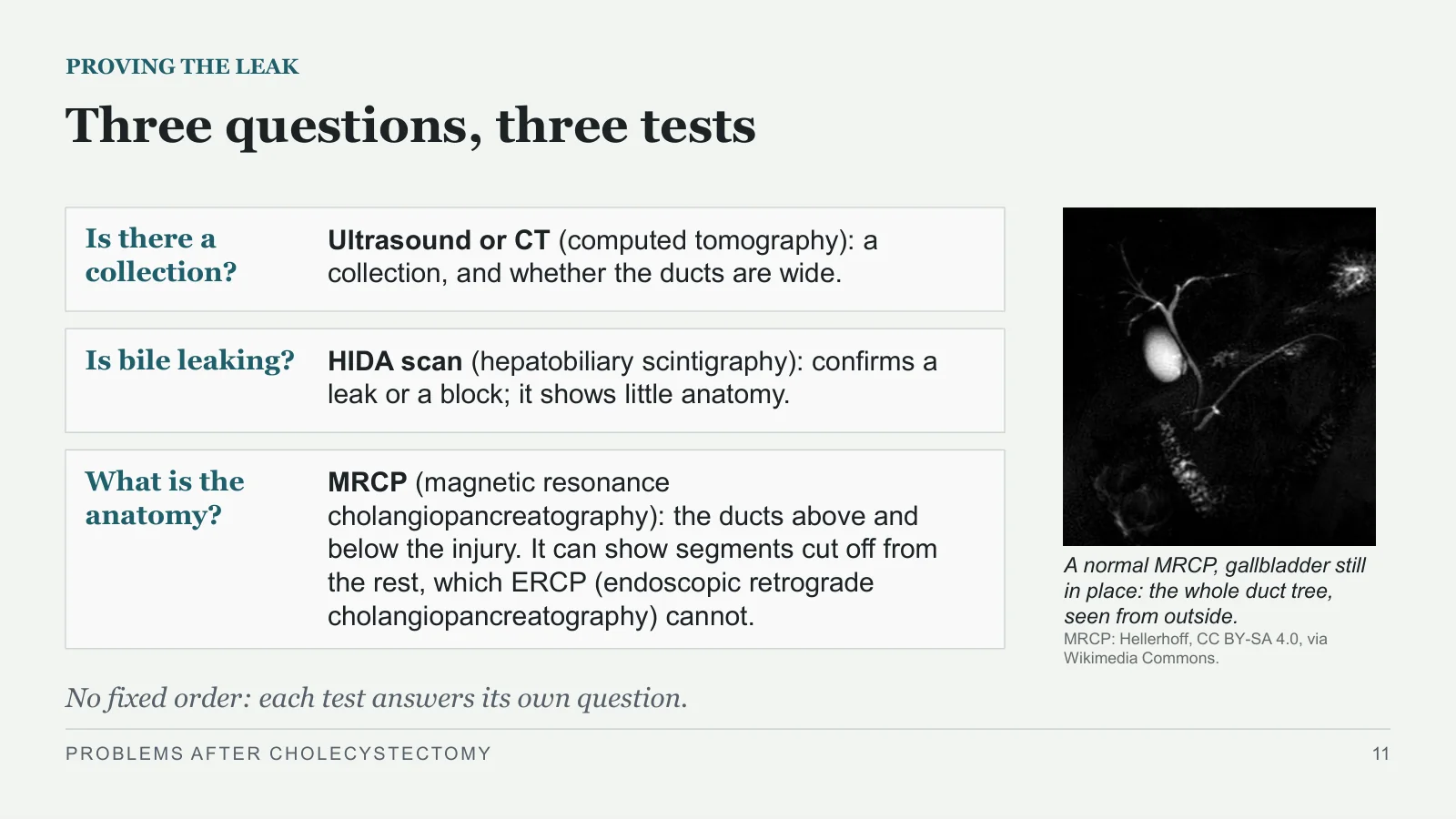
MRCP (magnetic resonance cholangiopancreatography): the ducts above and below the injury. It can show segments cut off from the rest, which ERCP (endoscopic retrograde cholangiopancreatography) cannot.
A normal MRCP, gallbladder still in place: the whole duct tree, seen from outside.
MRCP: Hellerhoff, CC BY-SA 4.0, via Wikimedia Commons.
No fixed order: each test answers its own question.
PROBLEMS AFTER CHOLECYSTECTOMY
11
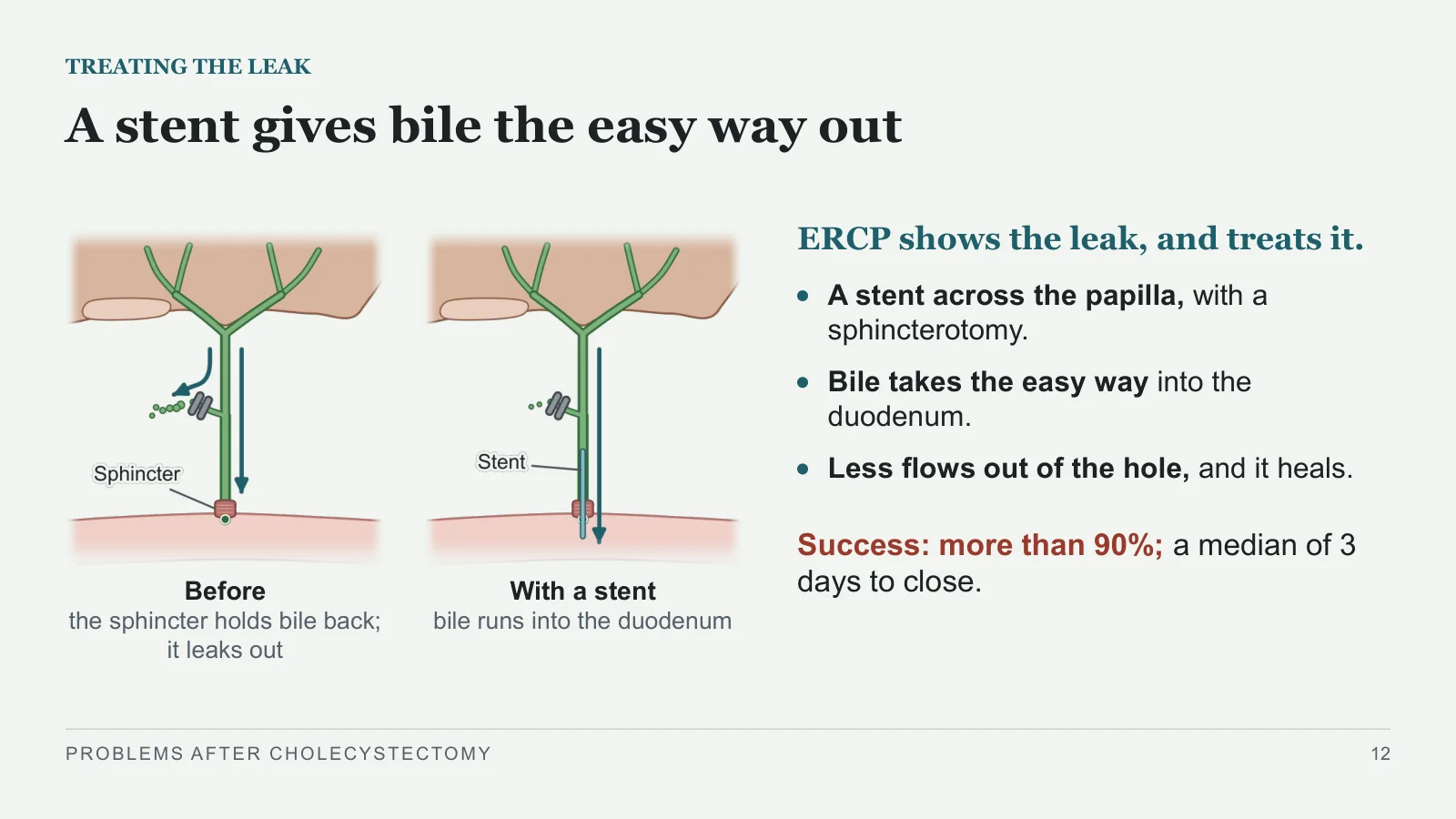
A stent gives bile the easy way out
TREATING THE LEAK
Before
the sphincter holds bile back; it leaks out
With a stent
bile runs into the duodenum
ERCP shows the leak, and treats it.
A stent across the papilla, with a sphincterotomy.
Bile takes the easy way into the duodenum.
Less flows out of the hole, and it heals.
Success: more than 90%; a median of 3 days to close.
PROBLEMS AFTER CHOLECYSTECTOMY
12
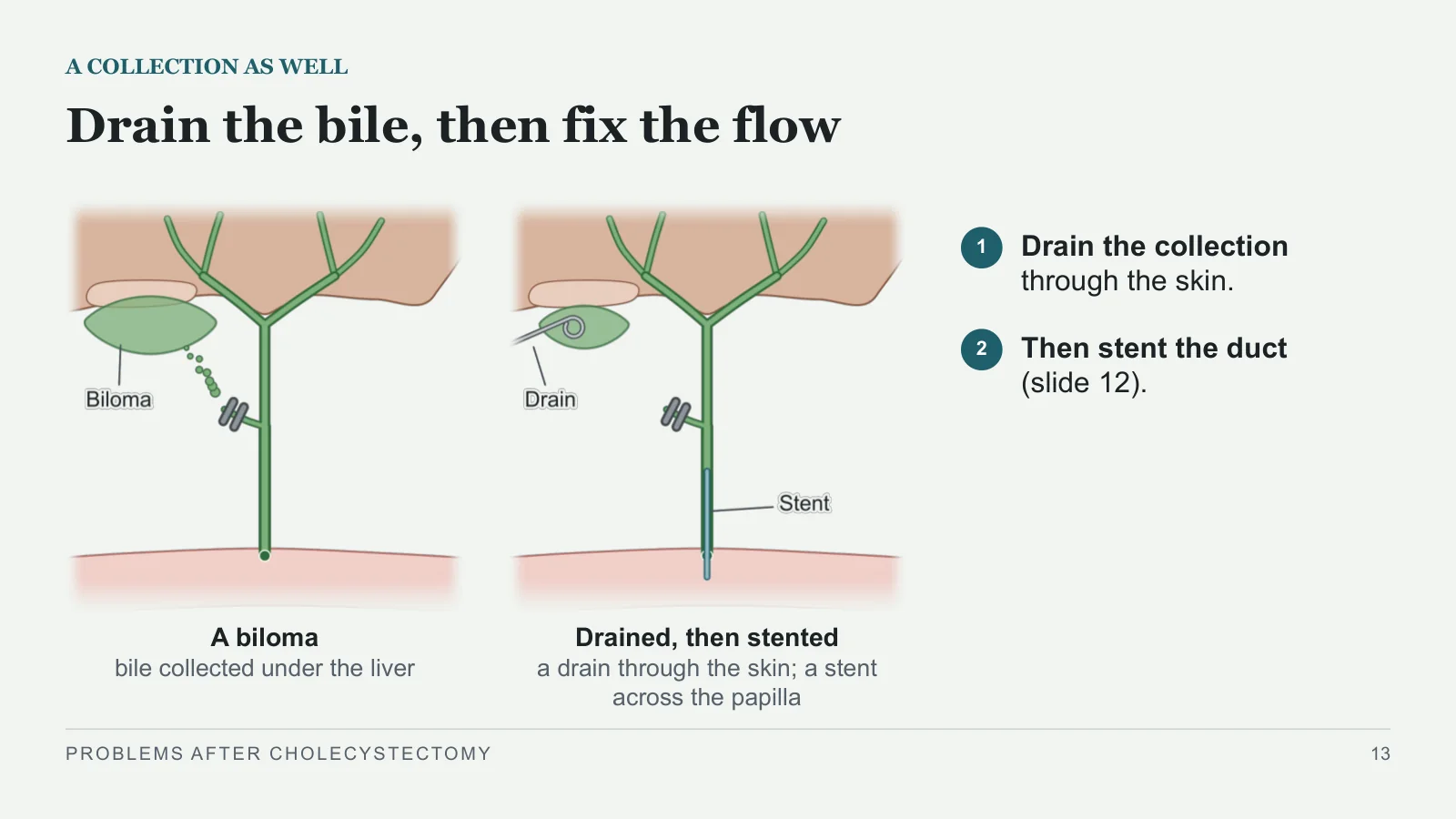
Drain the bile, then fix the flow
A COLLECTION AS WELL
A biloma
bile collected under the liver
Drained, then stented
a drain through the skin; a stent across the papilla
1
Drain the collection through the skin.
2
Then stent the duct (slide 12).
PROBLEMS AFTER CHOLECYSTECTOMY
13
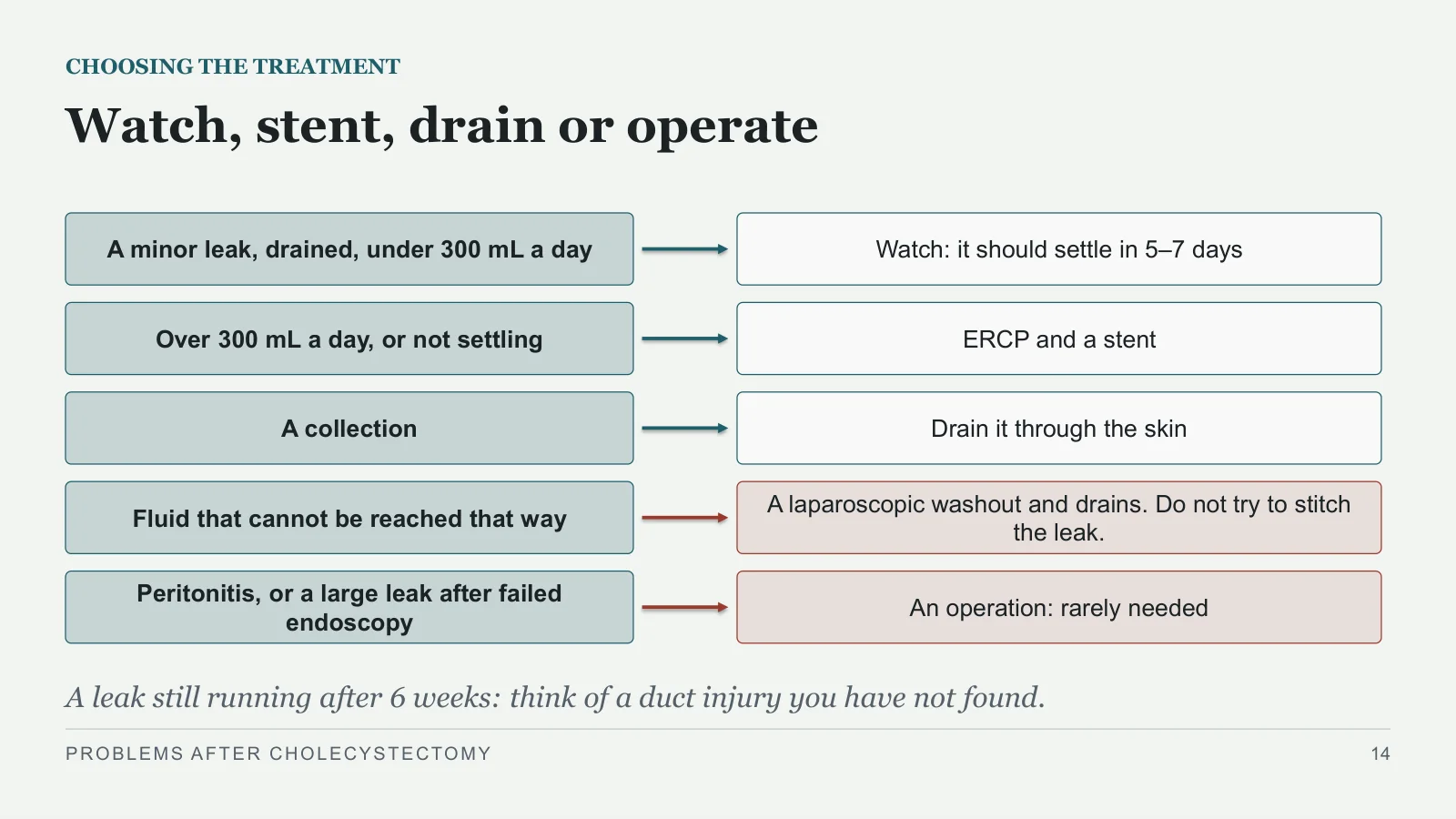
Watch, stent, drain or operate
CHOOSING THE TREATMENT
A minor leak, drained, under 300 mL a day
Watch: it should settle in 5–7 days
Over 300 mL a day, or not settling
ERCP and a stent
A collection
Drain it through the skin
Fluid that cannot be reached that way
A laparoscopic washout and drains. Do not try to stitch the leak.
Peritonitis, or a large leak after failed endoscopy
An operation: rarely needed
A leak still running after 6 weeks: think of a duct injury you have not found.
PROBLEMS AFTER CHOLECYSTECTOMY
14
Recognising bile duct injury
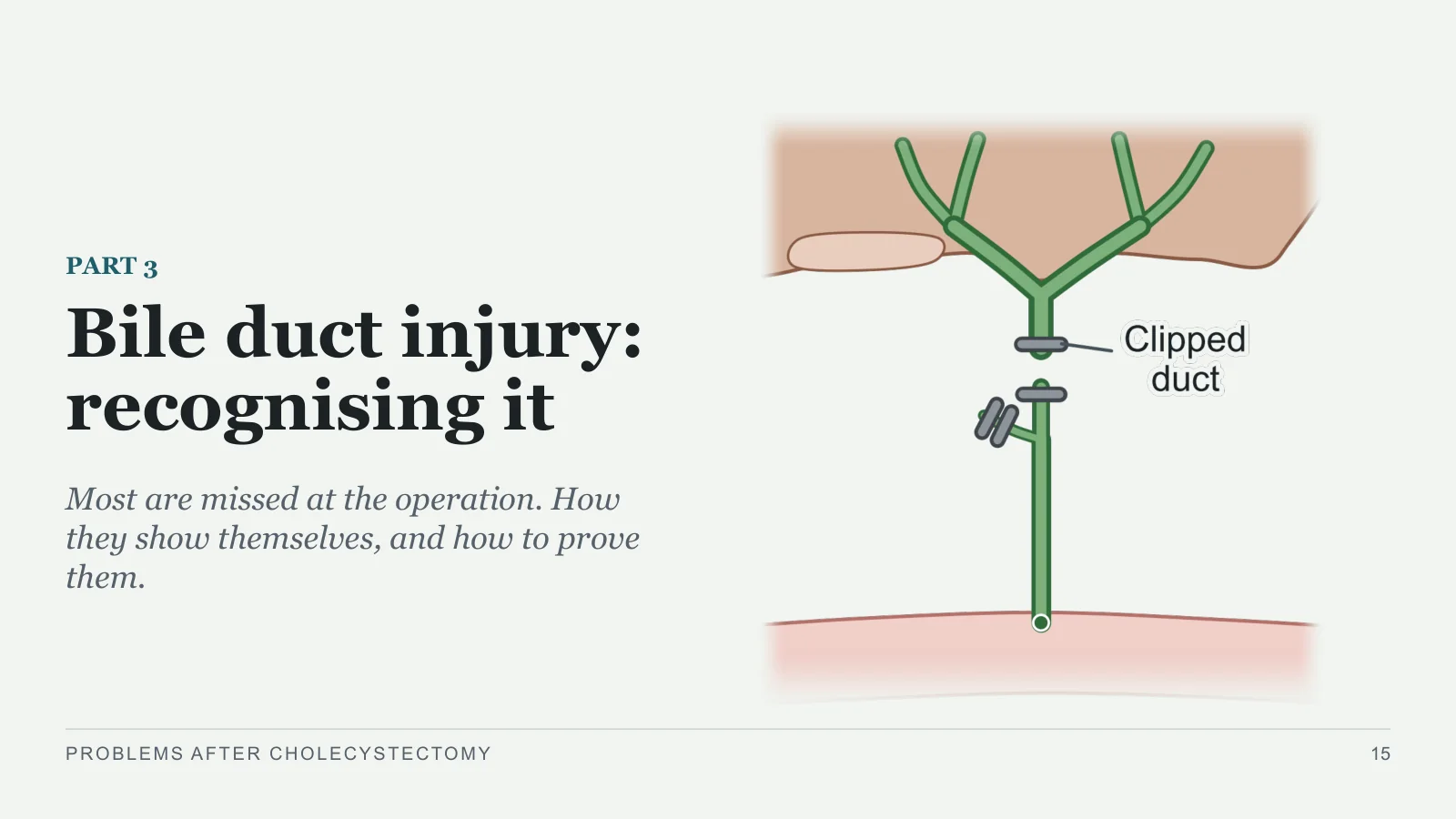
Bile duct injury: recognising it
PART 3
Most are missed at the operation. How they show themselves, and how to prove them.
PROBLEMS AFTER CHOLECYSTECTOMY
15
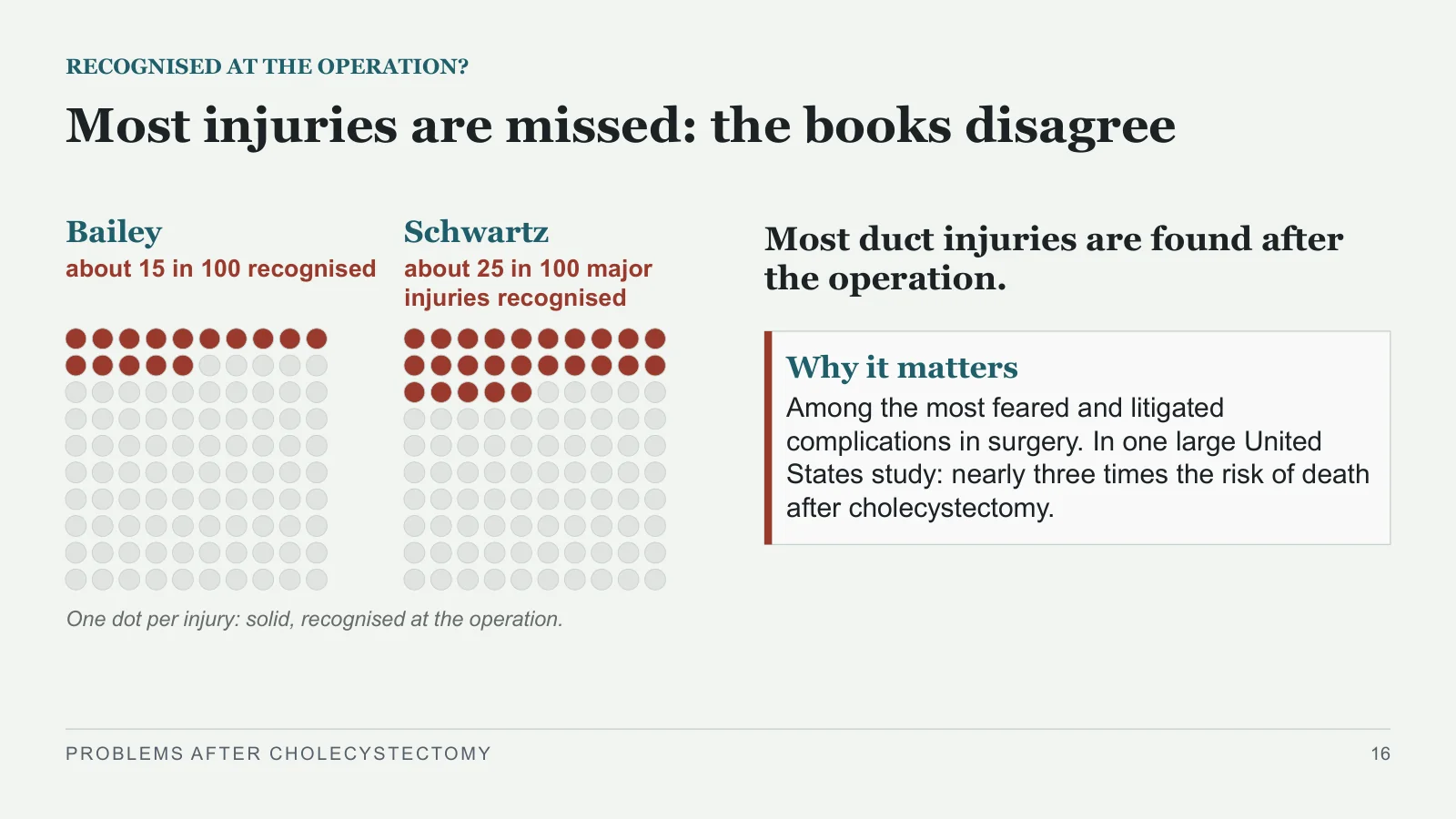
Most injuries are missed: the books disagree
RECOGNISED AT THE OPERATION?
Bailey
about 15 in 100 recognised
Schwartz
about 25 in 100 major injuries recognised
One dot per injury: solid, recognised at the operation.
Most duct injuries are found after the operation.
Why it matters
Among the most feared and litigated complications in surgery. In one large United States study: nearly three times the risk of death after cholecystectomy.
PROBLEMS AFTER CHOLECYSTECTOMY
16
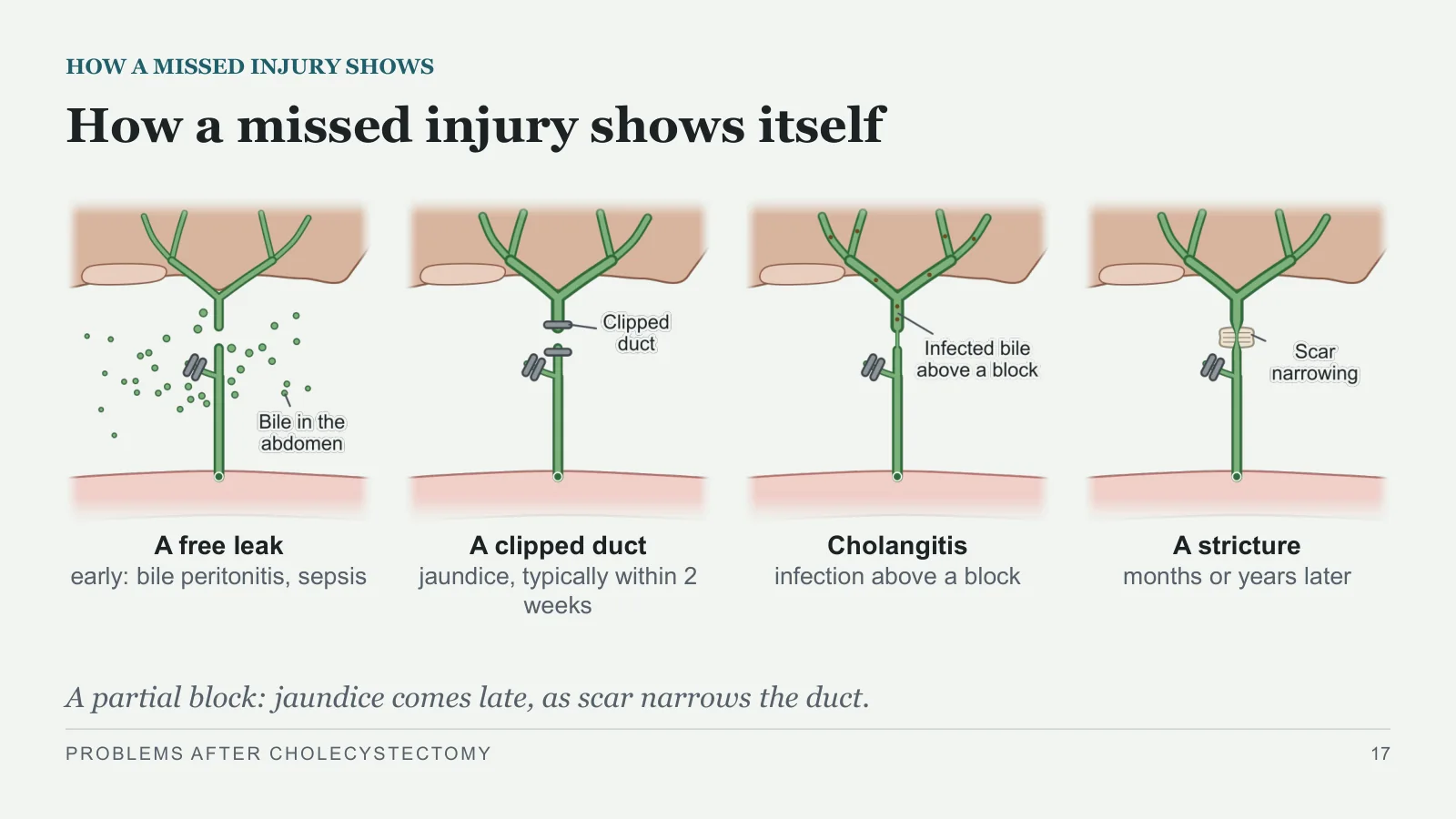
How a missed injury shows itself
HOW A MISSED INJURY SHOWS
A free leak
early: bile peritonitis, sepsis
A clipped duct
jaundice, typically within 2 weeks
Cholangitis
infection above a block
A stricture
months or years later
A partial block: jaundice comes late, as scar narrows the duct.
PROBLEMS AFTER CHOLECYSTECTOMY
17
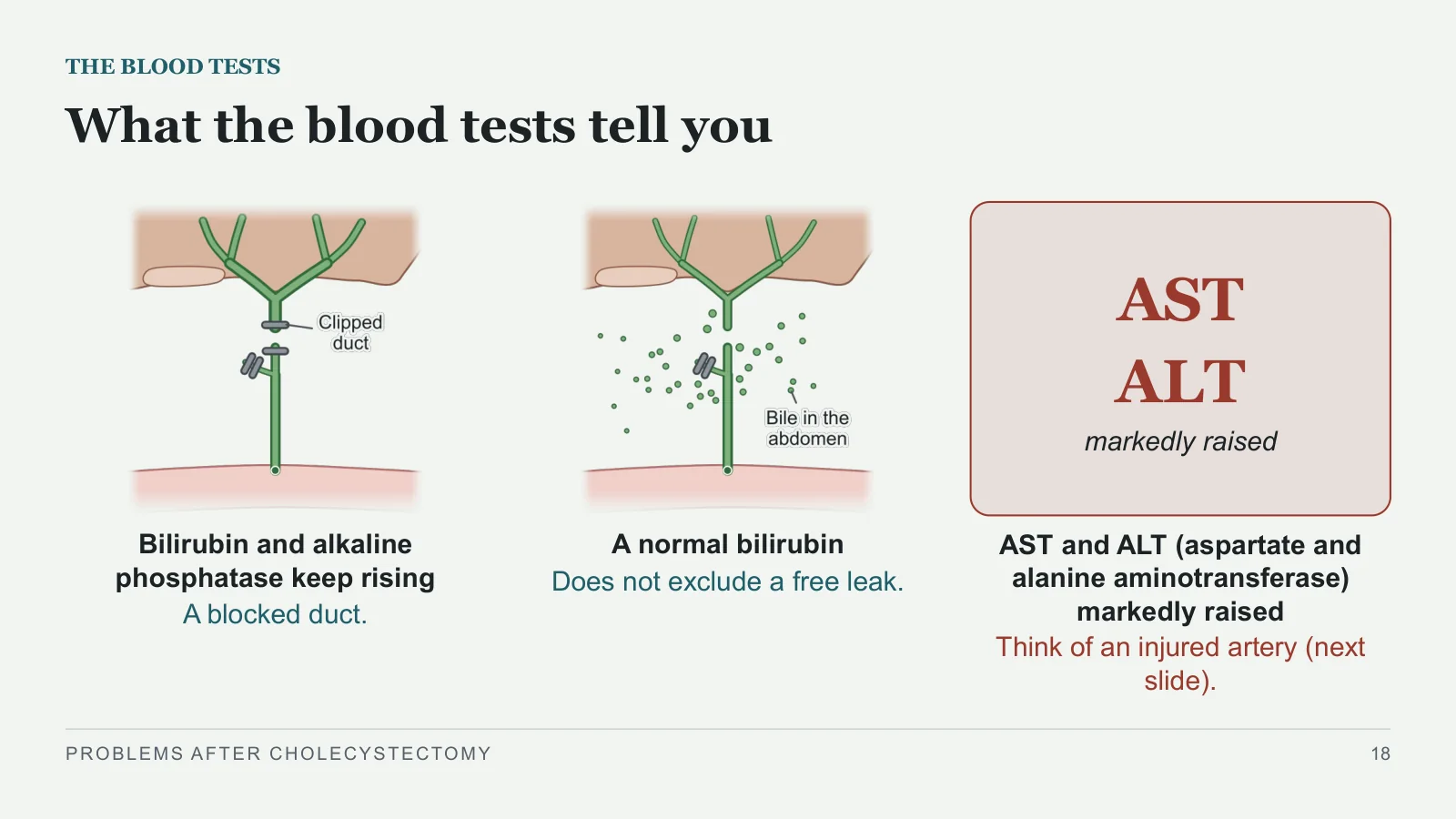
AST ALT markedly raised
THE BLOOD TESTS
What the blood tests tell you
Bilirubin and alkaline phosphatase keep rising
A blocked duct.
A normal bilirubin
Does not exclude a free leak.
AST and ALT (aspartate and alanine aminotransferase) markedly raised
Think of an injured artery (next slide).
PROBLEMS AFTER CHOLECYSTECTOMY
18
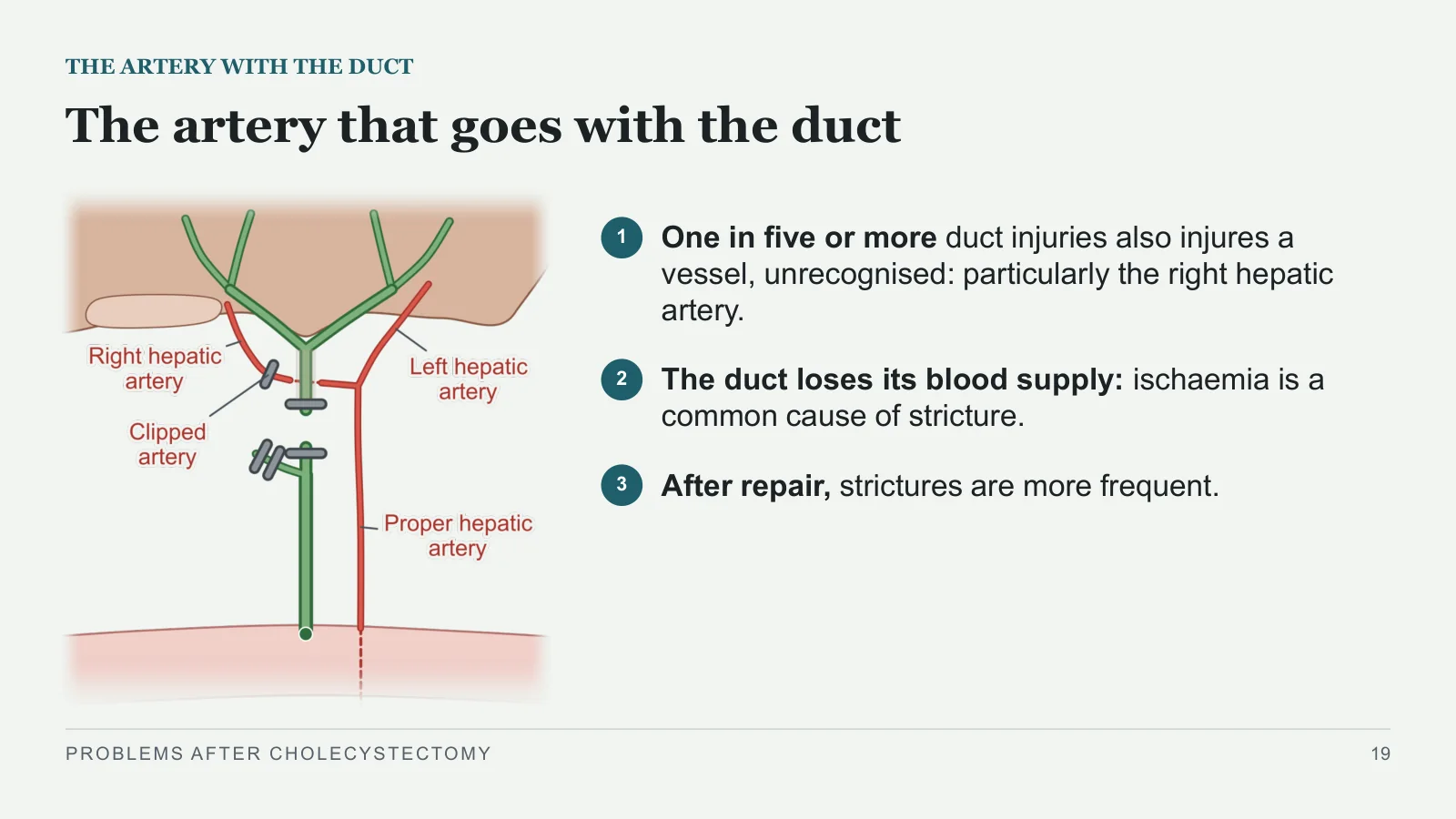
The artery that goes with the duct
THE ARTERY WITH THE DUCT
1
One in five or more duct injuries also injures a vessel, unrecognised: particularly the right hepatic artery.
2
The duct loses its blood supply: ischaemia is a common cause of stricture.
3
After repair, strictures are more frequent.
PROBLEMS AFTER CHOLECYSTECTOMY
19
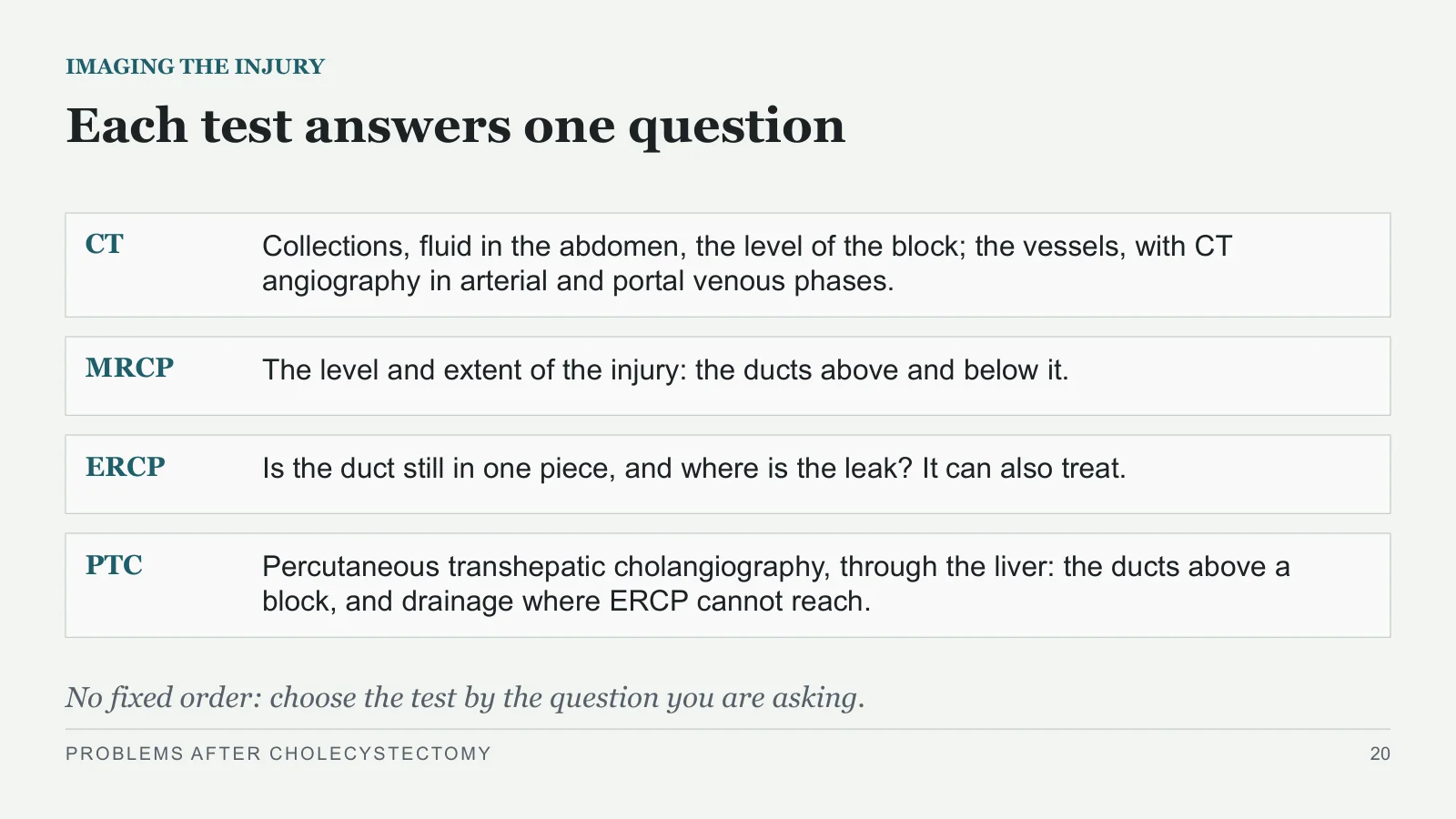
Each test answers one question
IMAGING THE INJURY
CT
Collections, fluid in the abdomen, the level of the block; the vessels, with CT angiography in arterial and portal venous phases.
MRCP
The level and extent of the injury: the ducts above and below it.
ERCP
Is the duct still in one piece, and where is the leak? It can also treat.
PTC
Percutaneous transhepatic cholangiography, through the liver: the ducts above a block, and drainage where ERCP cannot reach.
No fixed order: choose the test by the question you are asking.
PROBLEMS AFTER CHOLECYSTECTOMY
20
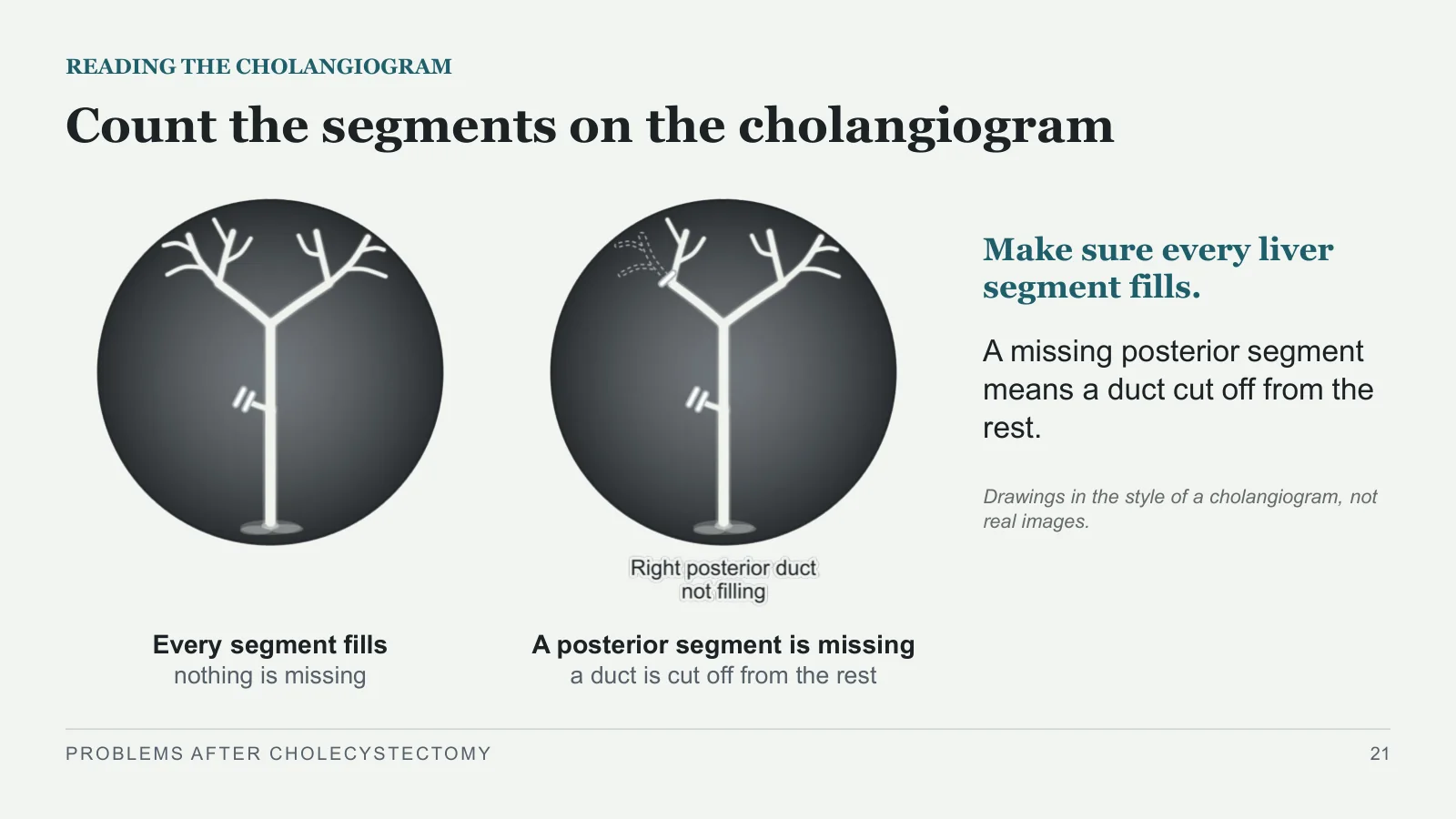
Count the segments on the cholangiogram
READING THE CHOLANGIOGRAM
Every segment fills
nothing is missing
A posterior segment is missing
a duct is cut off from the rest
Make sure every liver segment fills.
A missing posterior segment means a duct cut off from the rest.
Drawings in the style of a cholangiogram, not real images.
PROBLEMS AFTER CHOLECYSTECTOMY
21
Naming the injury
Naming the injury
PART 4
Strasberg's letters, Bismuth's levels, and why they matter for the treatment.
PROBLEMS AFTER CHOLECYSTECTOMY
22
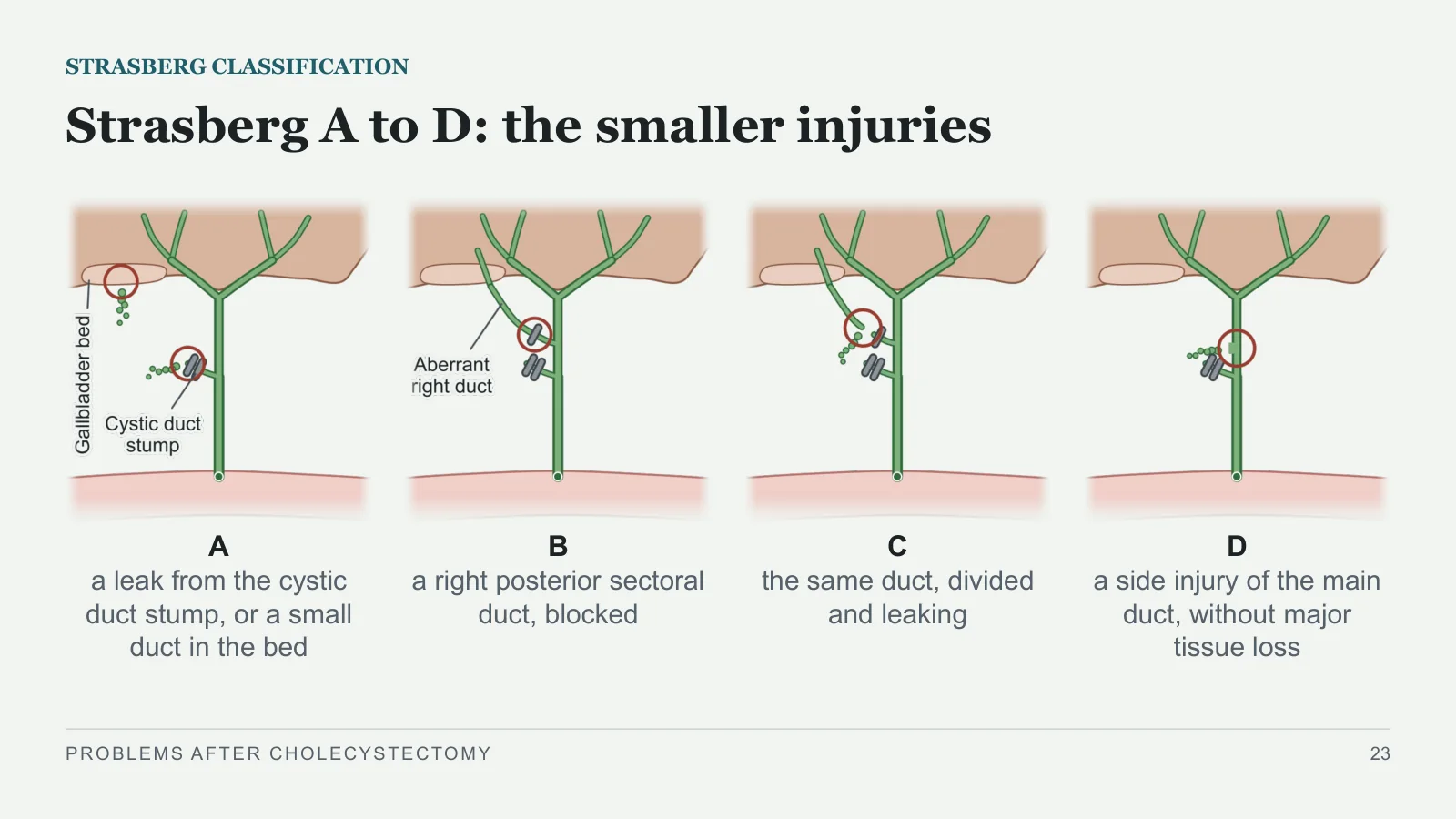
Strasberg A to D: the smaller injuries
STRASBERG CLASSIFICATION
A
a leak from the cystic duct stump, or a small duct in the bed
B
a right posterior sectoral duct, blocked
C
the same duct, divided and leaking
D
a side injury of the main duct, without major tissue loss
PROBLEMS AFTER CHOLECYSTECTOMY
23
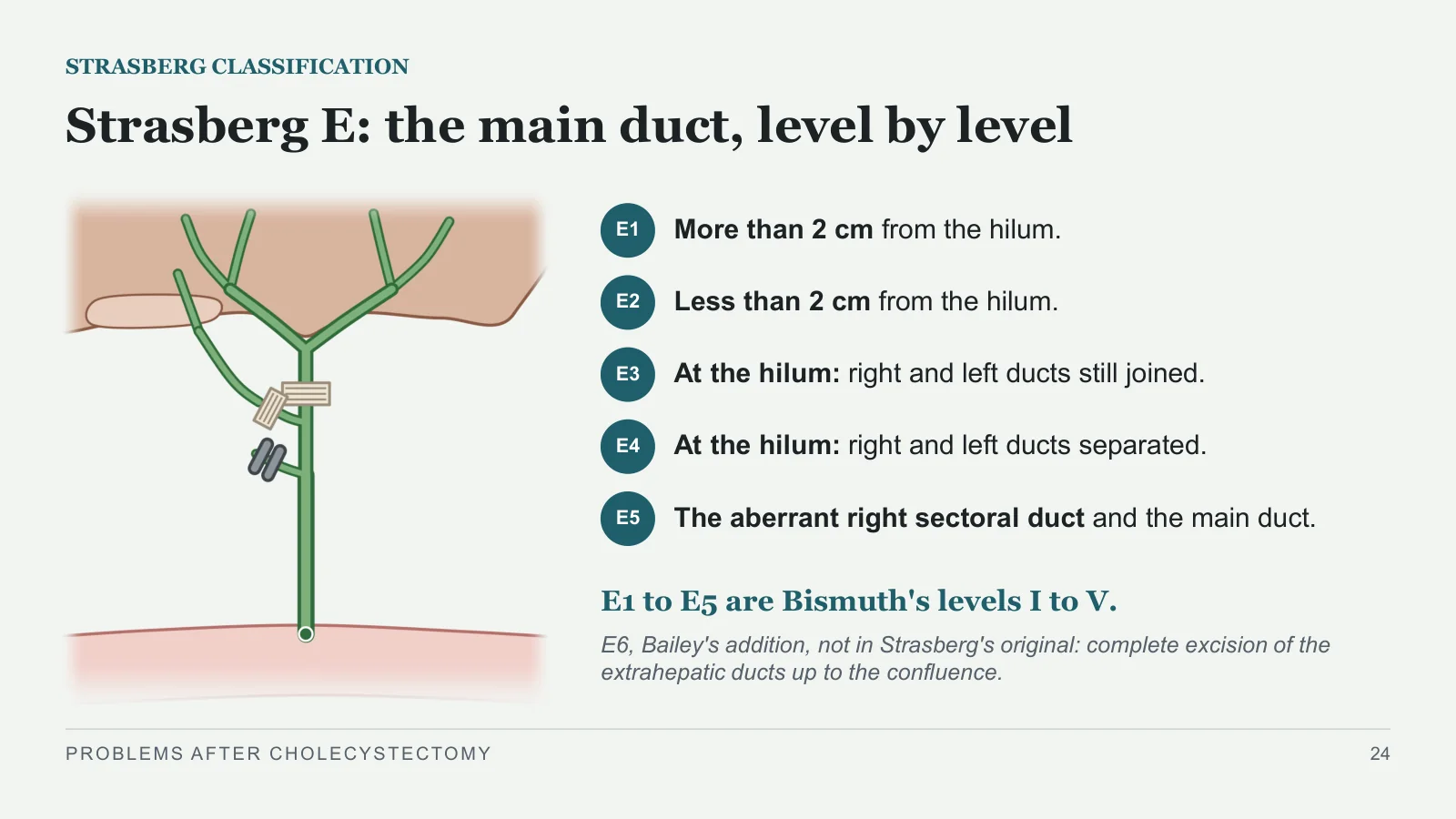
Strasberg E: the main duct, level by level
STRASBERG CLASSIFICATION
E1
More than 2 cm from the hilum.
E2
Less than 2 cm from the hilum.
E3
At the hilum: right and left ducts still joined.
E4
At the hilum: right and left ducts separated.
E5
The aberrant right sectoral duct and the main duct.
E1 to E5 are Bismuth's levels I to V.
E6, Bailey's addition, not in Strasberg's original: complete excision of the extrahepatic ducts up to the confluence.
PROBLEMS AFTER CHOLECYSTECTOMY
24
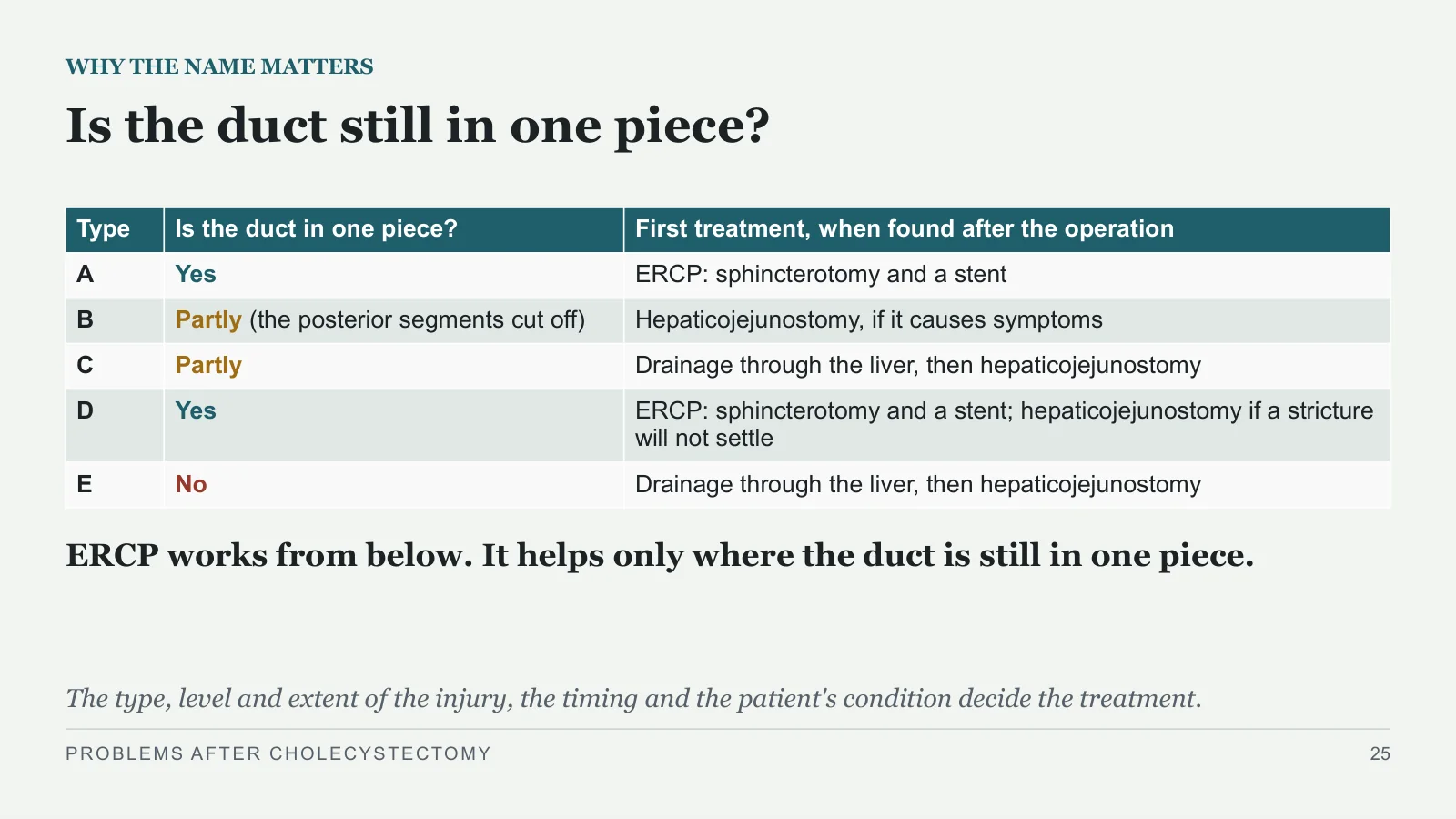
Is the duct still in one piece?
WHY THE NAME MATTERS
ERCP works from below. It helps only where the duct is still in one piece.
The type, level and extent of the injury, the timing and the patient's condition decide the treatment.
PROBLEMS AFTER CHOLECYSTECTOMY
25
| Type | Is the duct in one piece? | First treatment, when found after the operation |
| A | Yes | ERCP: sphincterotomy and a stent |
| B | Partly (the posterior segments cut off) | Hepaticojejunostomy, if it causes symptoms |
| C | Partly | Drainage through the liver, then hepaticojejunostomy |
| D | Yes | ERCP: sphincterotomy and a stent; hepaticojejunostomy if a stricture will not settle |
| E | No | Drainage through the liver, then hepaticojejunostomy |
First action
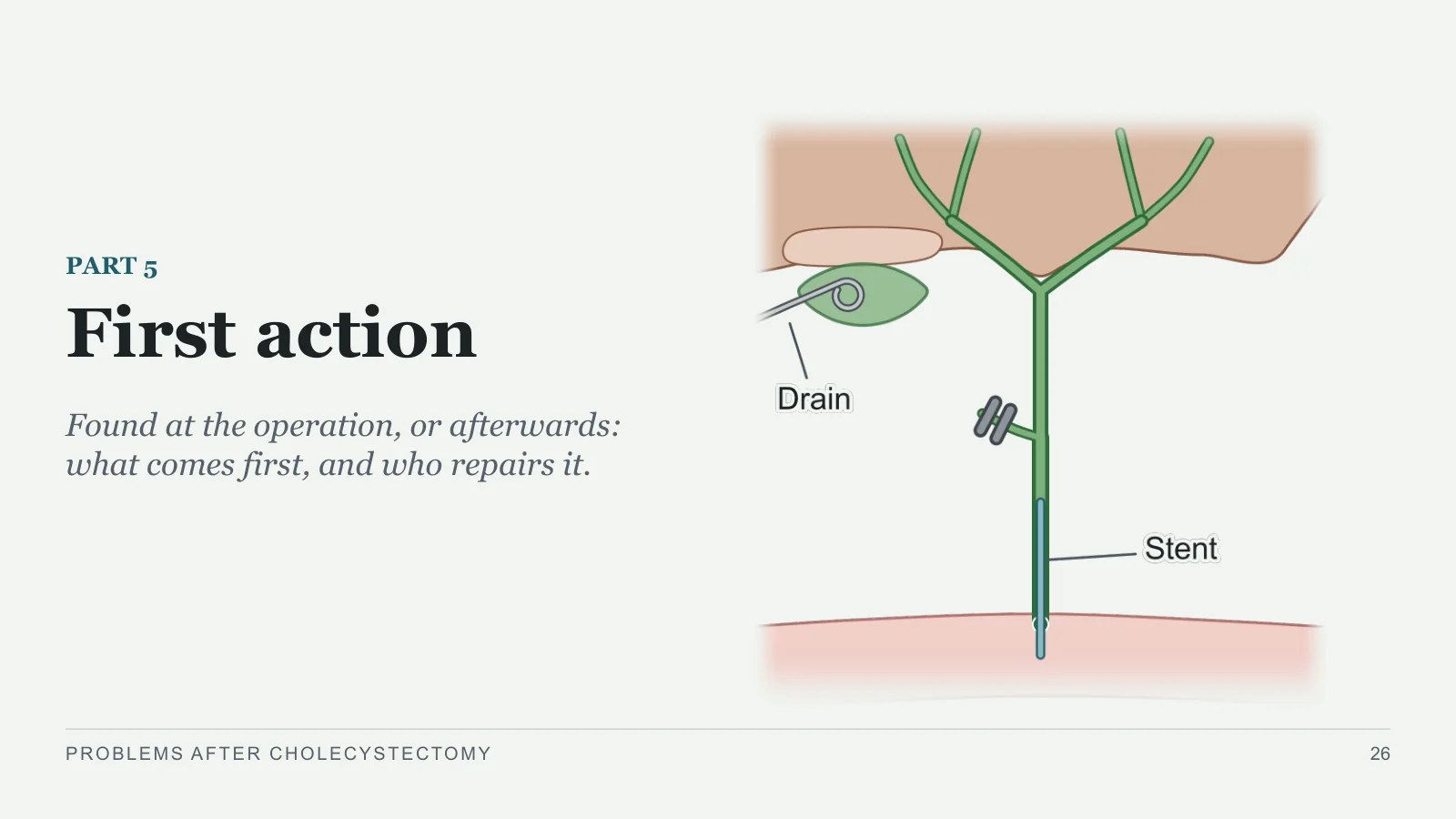
First action
PART 5
Found at the operation, or afterwards: what comes first, and who repairs it.
PROBLEMS AFTER CHOLECYSTECTOMY
26
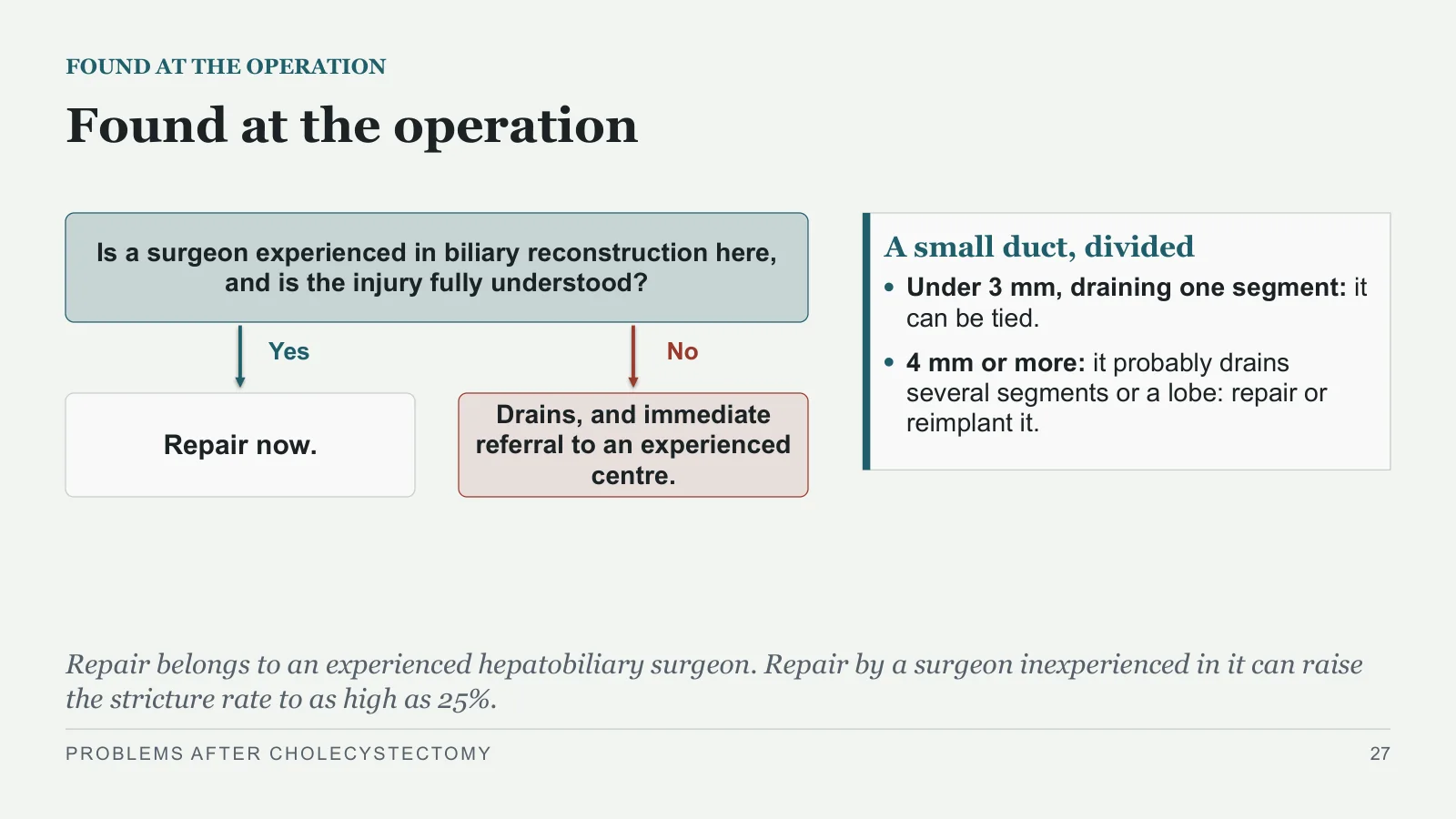
Found at the operation
FOUND AT THE OPERATION
Is a surgeon experienced in biliary reconstruction here, and is the injury fully understood?
Yes
Repair now.
No
Drains, and immediate referral to an experienced centre.
A small duct, divided
Under 3 mm, draining one segment: it can be tied.
4 mm or more: it probably drains several segments or a lobe: repair or reimplant it.
Repair belongs to an experienced hepatobiliary surgeon. Repair by a surgeon inexperienced in it can raise the stricture rate to as high as 25%.
PROBLEMS AFTER CHOLECYSTECTOMY
27
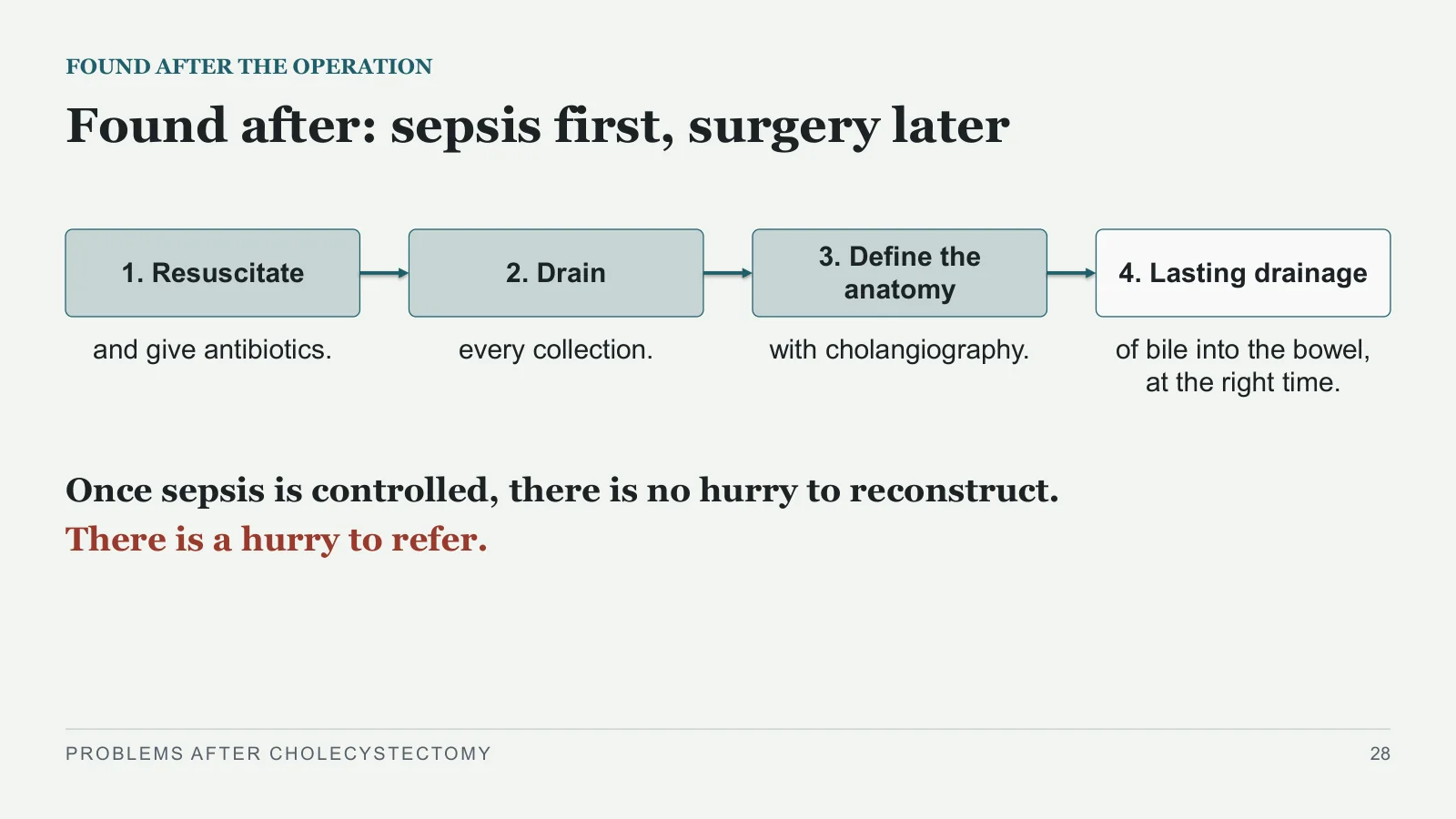
Found after: sepsis first, surgery later
FOUND AFTER THE OPERATION
1. Resuscitate
and give antibiotics.
2. Drain
every collection.
3. Define the anatomy
with cholangiography.
4. Lasting drainage
of bile into the bowel, at the right time.
Once sepsis is controlled, there is no hurry to reconstruct.
There is a hurry to refer.
PROBLEMS AFTER CHOLECYSTECTOMY
28
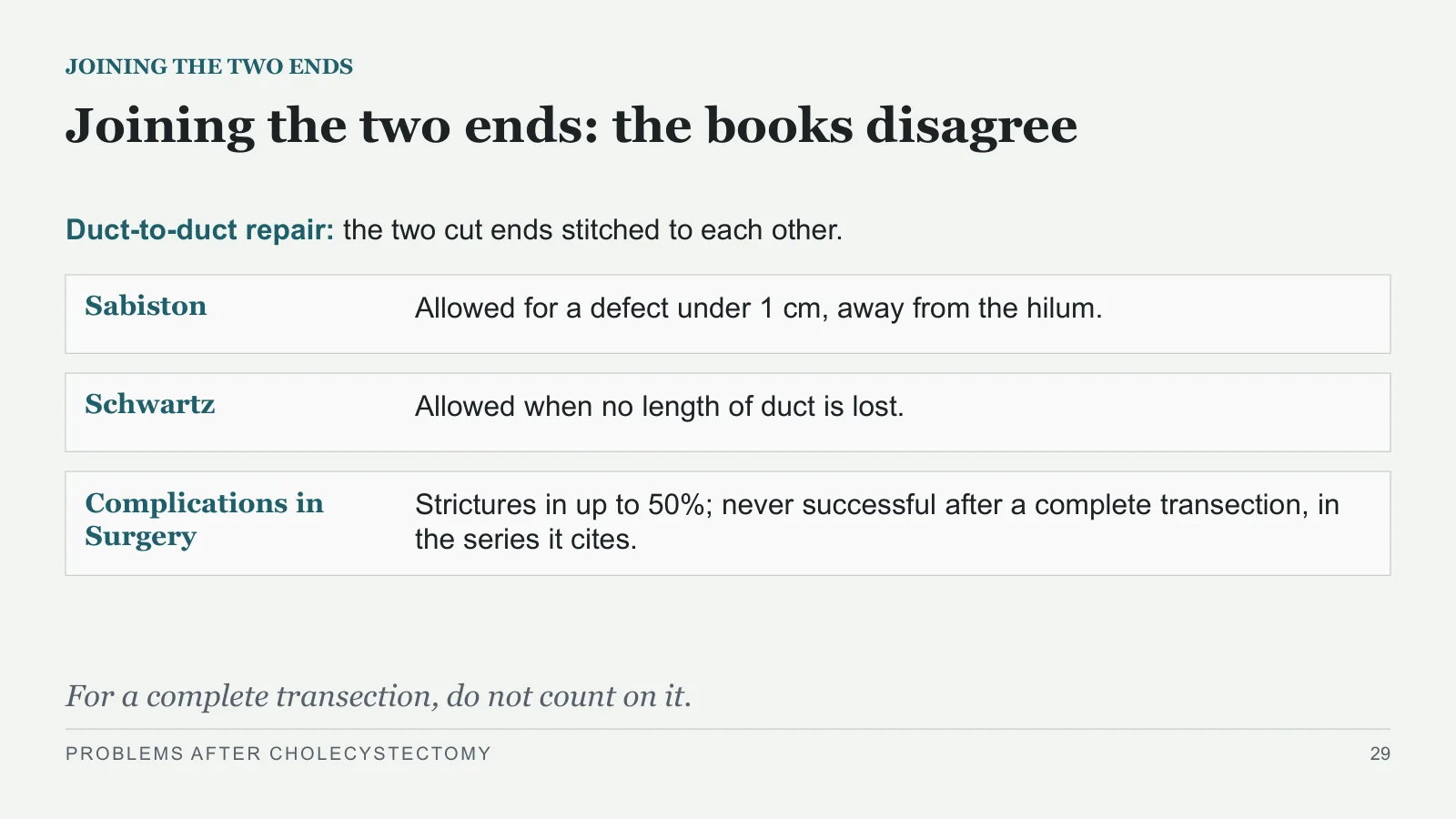
Joining the two ends: the books disagree
JOINING THE TWO ENDS
Duct-to-duct repair: the two cut ends stitched to each other.
Sabiston
Allowed for a defect under 1 cm, away from the hilum.
Schwartz
Allowed when no length of duct is lost.
Complications in Surgery
Strictures in up to 50%; never successful after a complete transection, in the series it cites.
For a complete transection, do not count on it.
PROBLEMS AFTER CHOLECYSTECTOMY
29
Repair
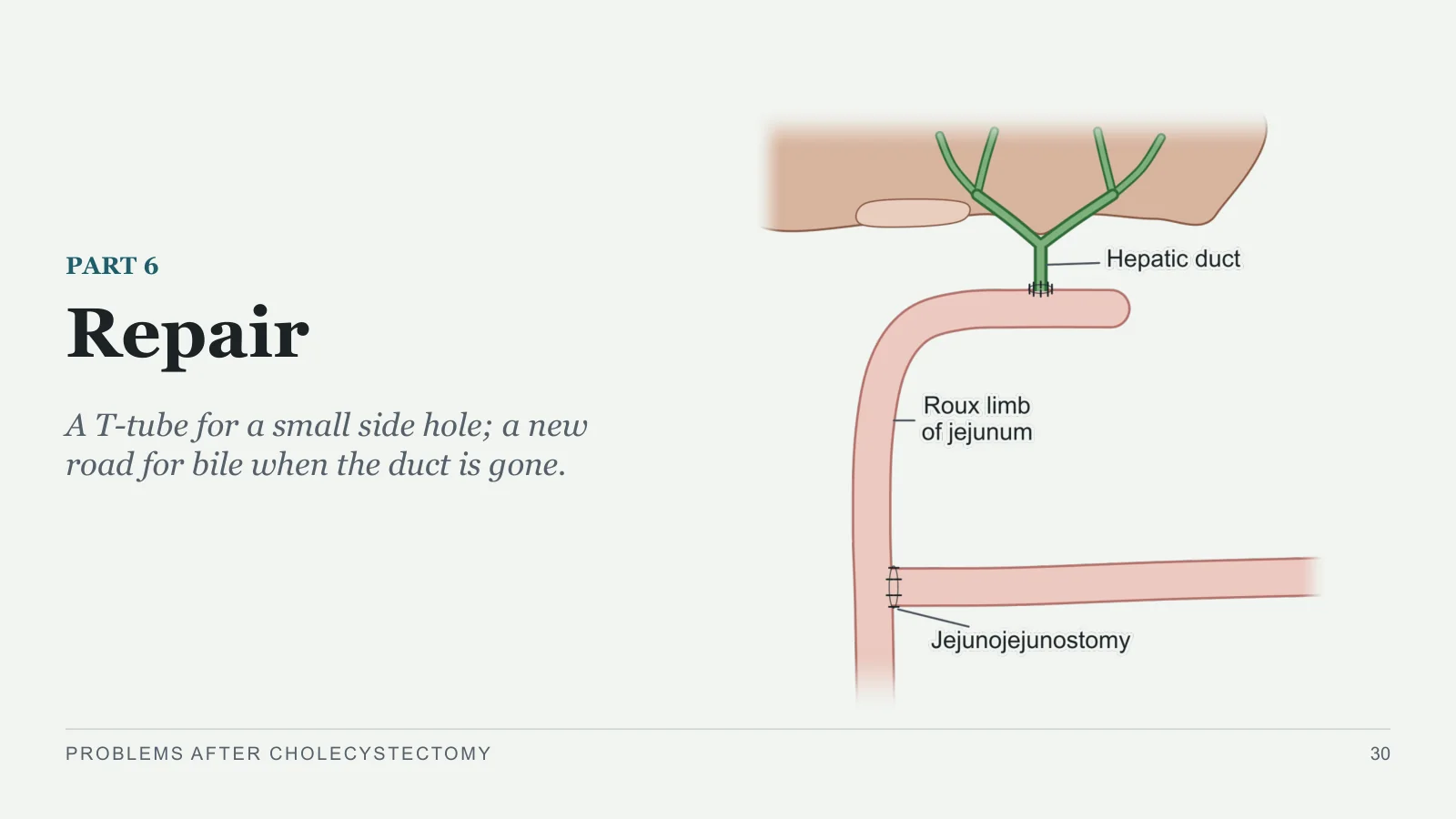
Repair
PART 6
A T-tube for a small side hole; a new road for bile when the duct is gone.
PROBLEMS AFTER CHOLECYSTECTOMY
30
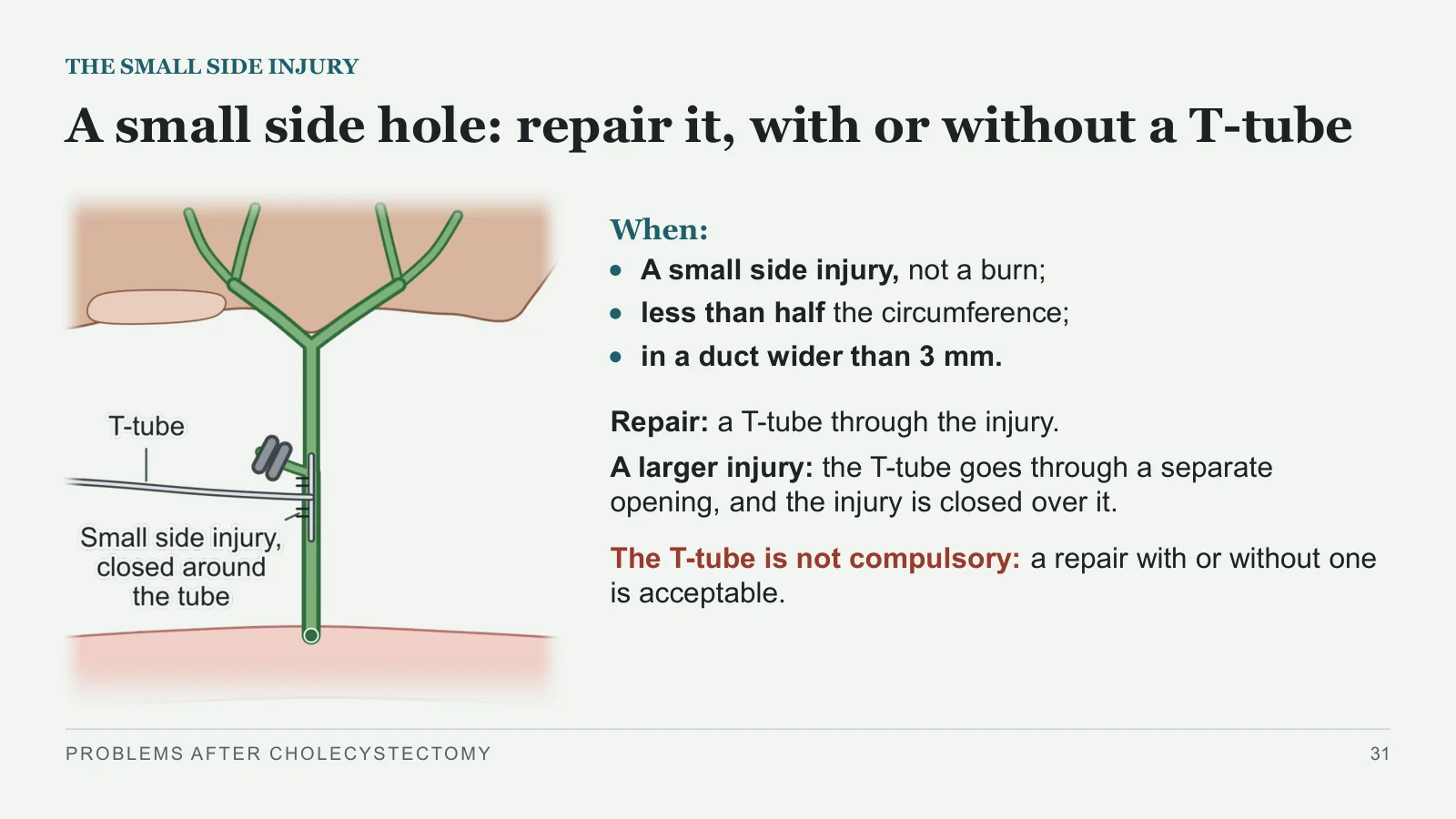
A small side hole: repair it, with or without a T-tube
THE SMALL SIDE INJURY
When:
A small side injury, not a burn;
less than half the circumference;
in a duct wider than 3 mm.
Repair: a T-tube through the injury.
A larger injury: the T-tube goes through a separate opening, and the injury is closed over it.
The T-tube is not compulsory: a repair with or without one is acceptable.
PROBLEMS AFTER CHOLECYSTECTOMY
31
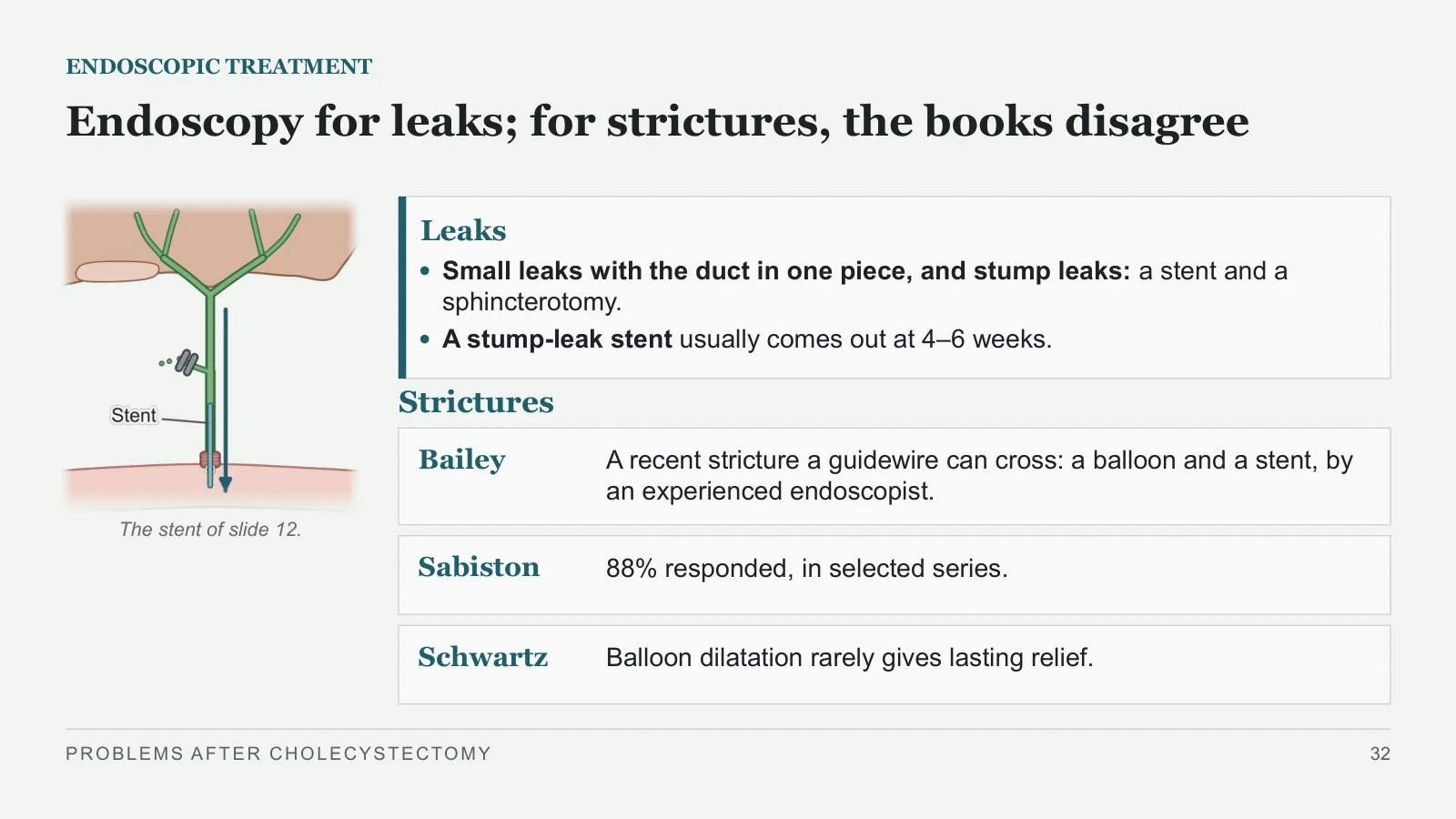
Endoscopy for leaks; for strictures, the books disagree
ENDOSCOPIC TREATMENT
The stent of slide 12.
Leaks
Small leaks with the duct in one piece, and stump leaks: a stent and a sphincterotomy.
A stump-leak stent usually comes out at 4–6 weeks.
Strictures
Bailey
A recent stricture a guidewire can cross: a balloon and a stent, by an experienced endoscopist.
Sabiston
88% responded, in selected series.
Schwartz
Balloon dilatation rarely gives lasting relief.
PROBLEMS AFTER CHOLECYSTECTOMY
32
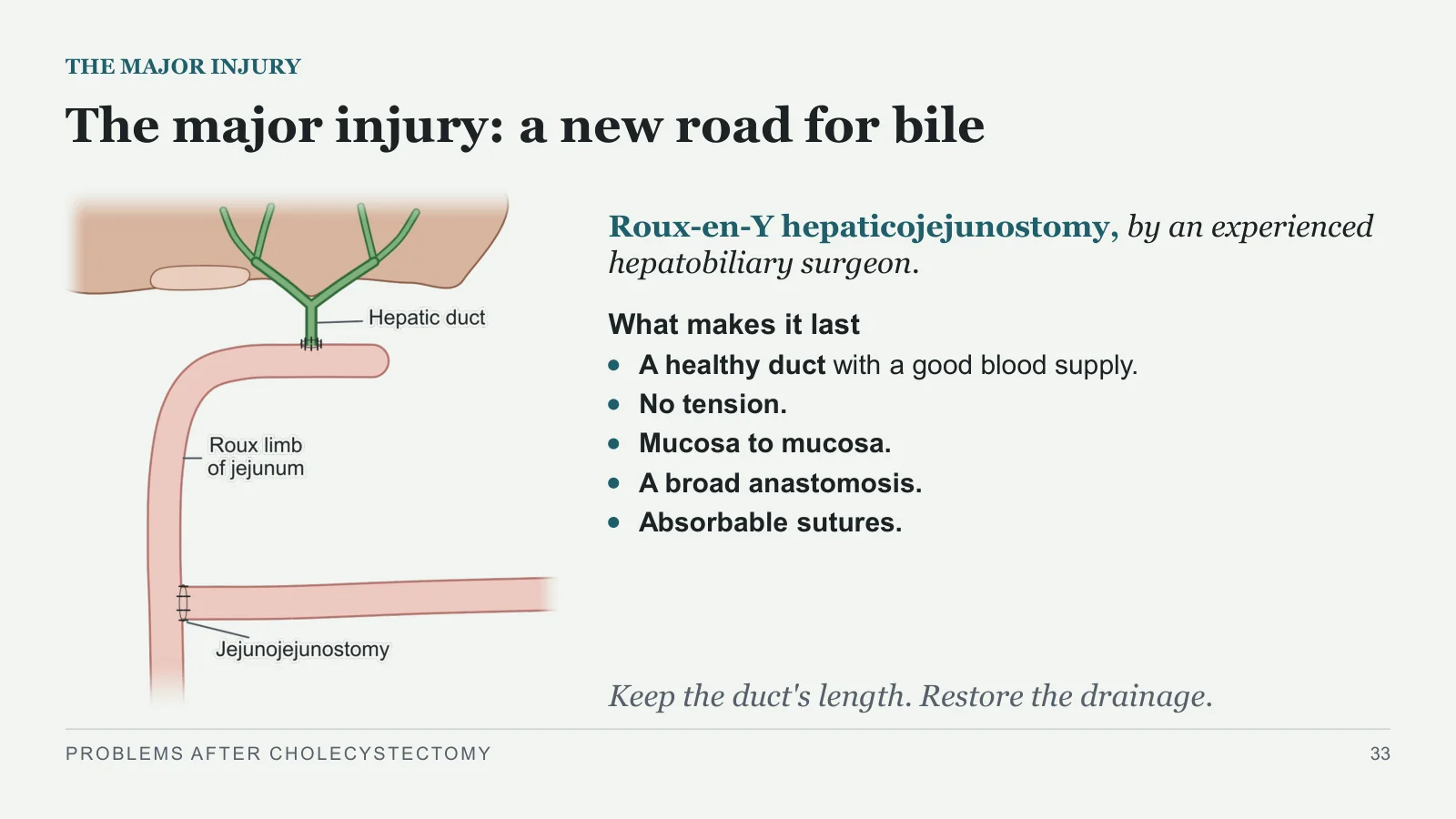
The major injury: a new road for bile
THE MAJOR INJURY
Roux-en-Y hepaticojejunostomy, by an experienced hepatobiliary surgeon.
What makes it last
A healthy duct with a good blood supply.
No tension.
Mucosa to mucosa.
A broad anastomosis.
Absorbable sutures.
Keep the duct's length. Restore the drainage.
PROBLEMS AFTER CHOLECYSTECTOMY
33
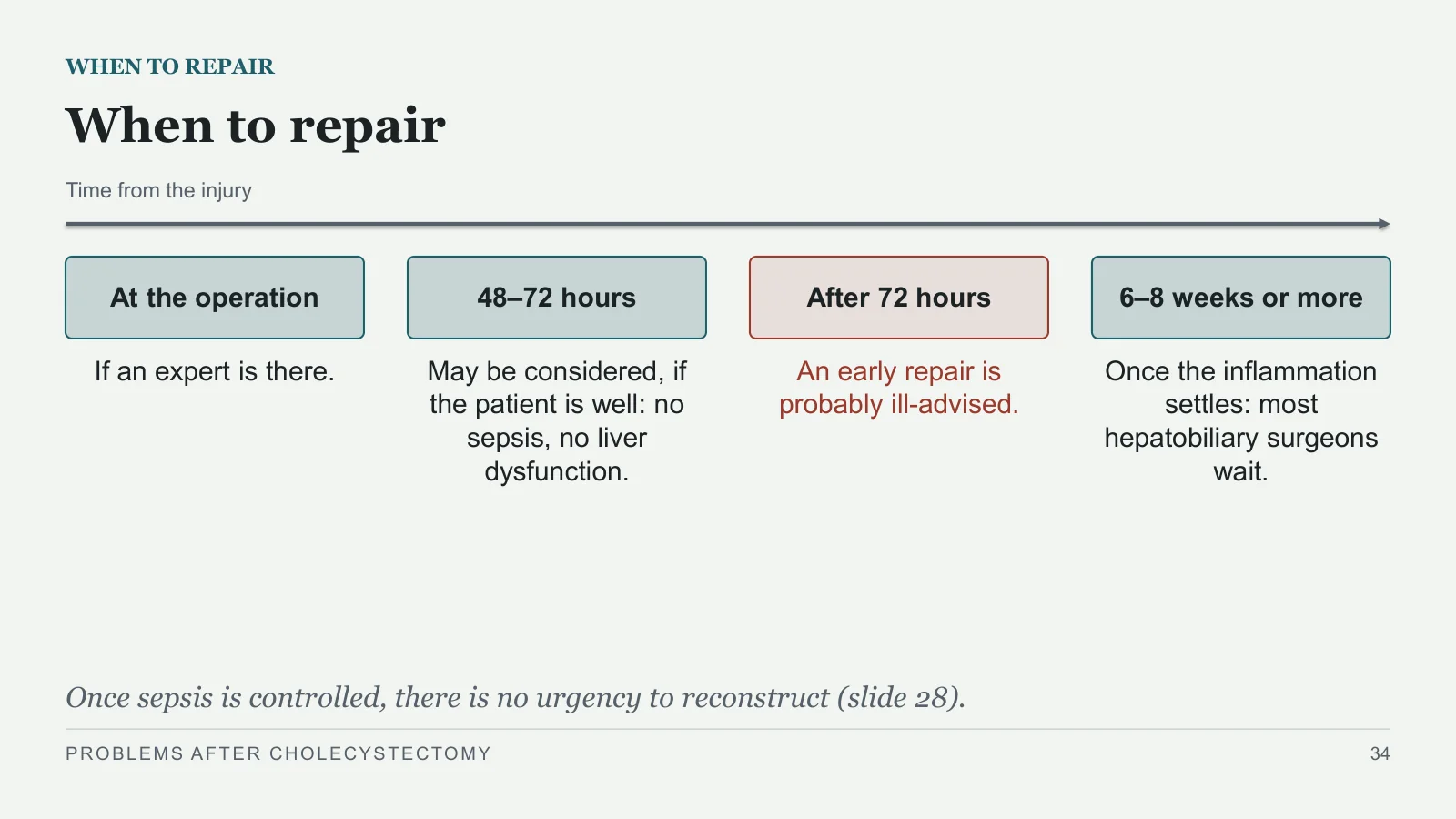
When to repair
WHEN TO REPAIR
Time from the injury
At the operation
If an expert is there.
48–72 hours
May be considered, if the patient is well: no sepsis, no liver dysfunction.
After 72 hours
An early repair is probably ill-advised.
6–8 weeks or more
Once the inflammation settles: most hepatobiliary surgeons wait.
Once sepsis is controlled, there is no urgency to reconstruct (slide 28).
PROBLEMS AFTER CHOLECYSTECTOMY
34
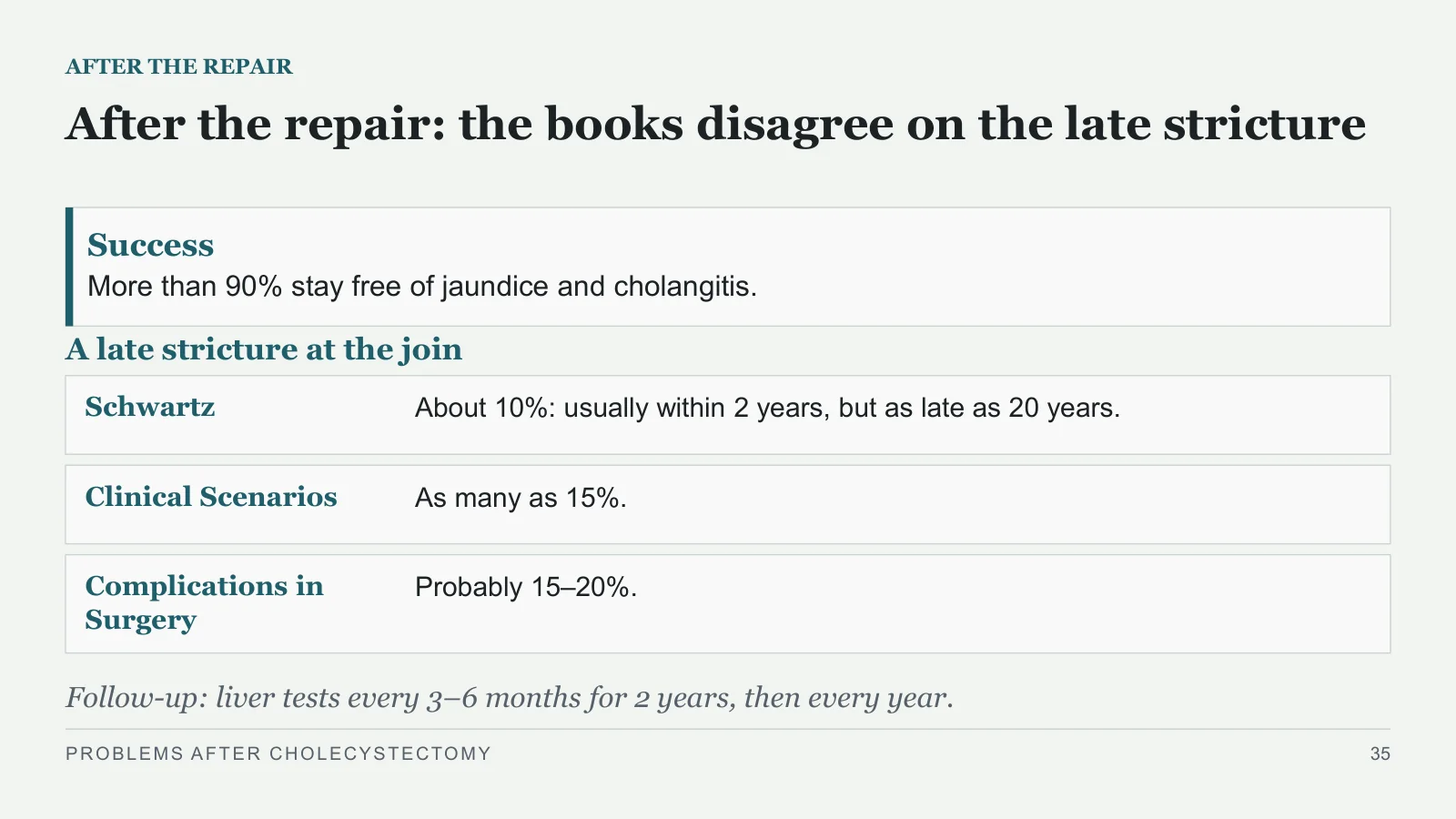
After the repair: the books disagree on the late stricture
AFTER THE REPAIR
Success
More than 90% stay free of jaundice and cholangitis.
A late stricture at the join
Schwartz
About 10%: usually within 2 years, but as late as 20 years.
Clinical Scenarios
As many as 15%.
Complications in Surgery
Probably 15–20%.
Follow-up: liver tests every 3–6 months for 2 years, then every year.
PROBLEMS AFTER CHOLECYSTECTOMY
35
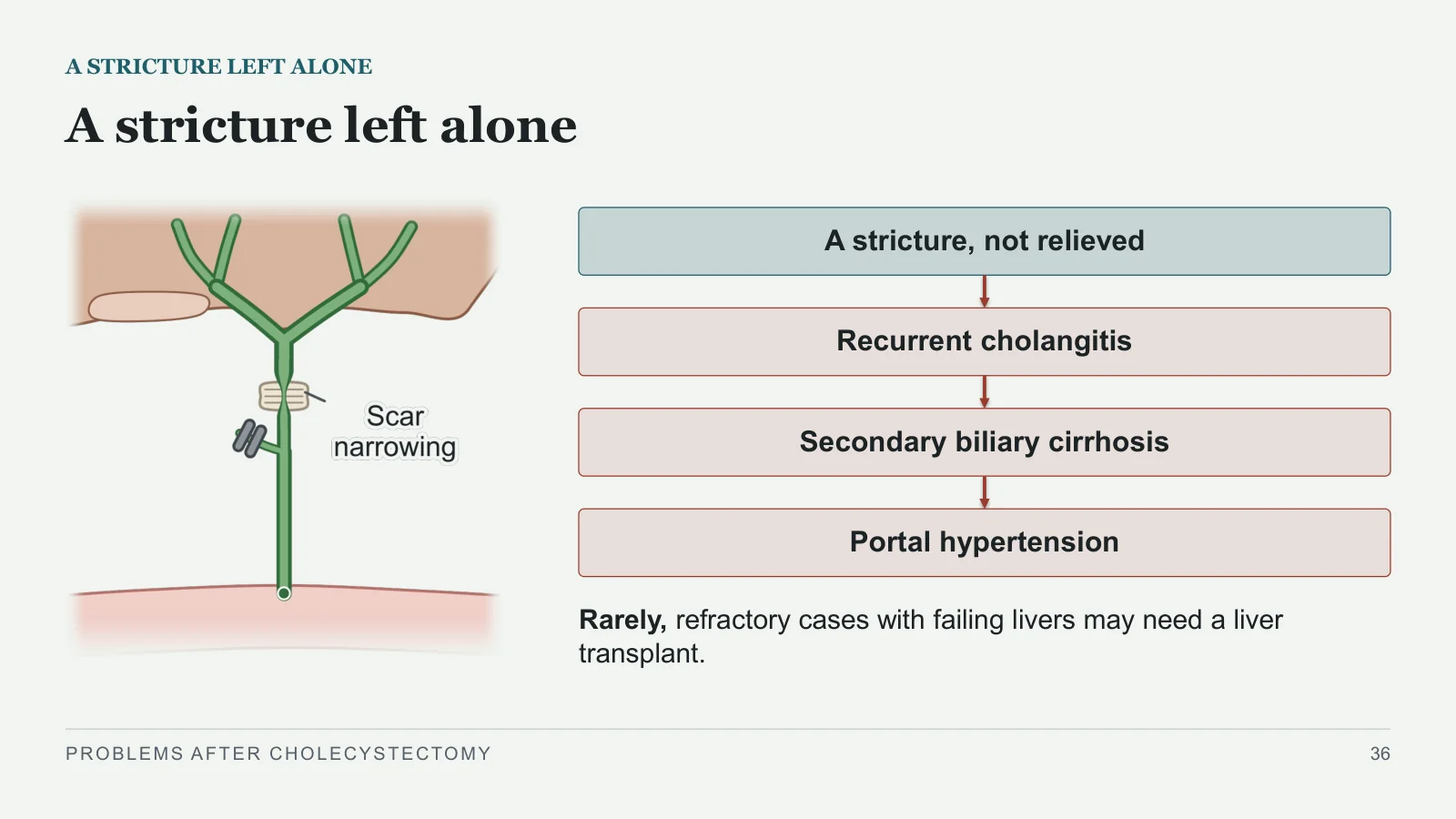
A stricture left alone
A STRICTURE LEFT ALONE
A stricture, not relieved
Recurrent cholangitis
Secondary biliary cirrhosis
Portal hypertension
Rarely, refractory cases with failing livers may need a liver transplant.
PROBLEMS AFTER CHOLECYSTECTOMY
36
Stones after the operation
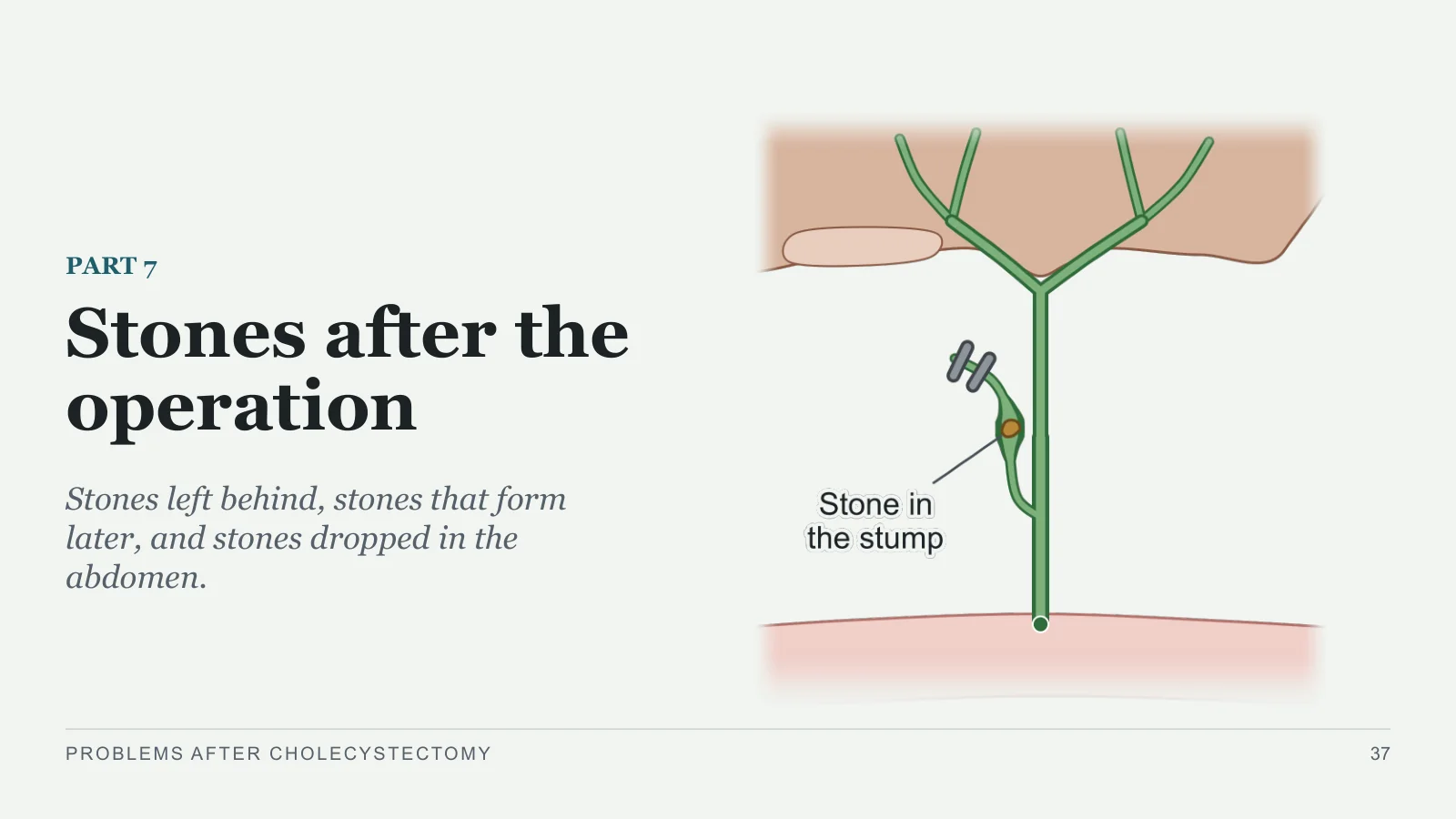
Stones after the operation
PART 7
Stones left behind, stones that form later, and stones dropped in the abdomen.
PROBLEMS AFTER CHOLECYSTECTOMY
37
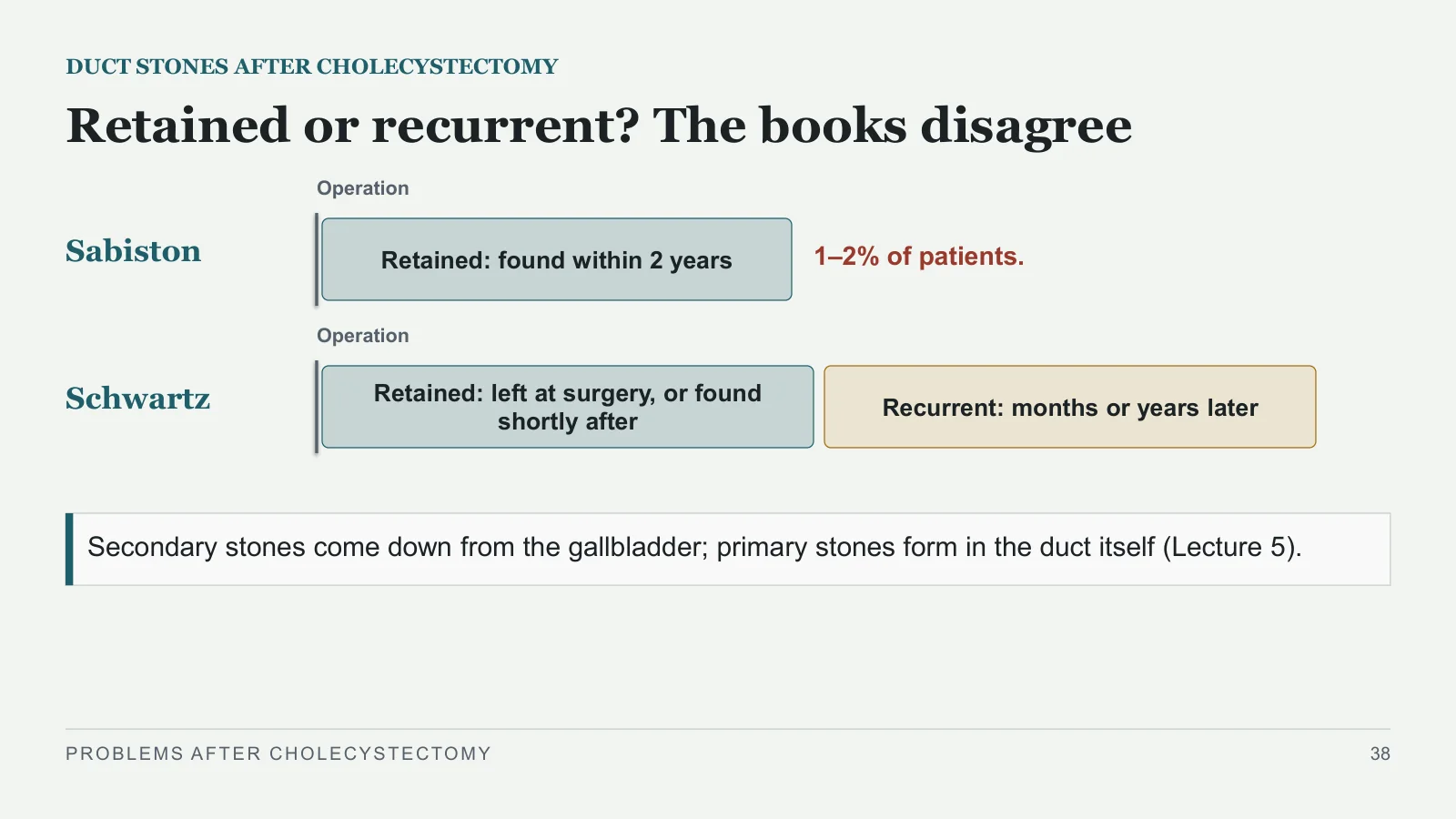
Retained or recurrent? The books disagree
DUCT STONES AFTER CHOLECYSTECTOMY
Sabiston
Operation
Retained: found within 2 years
1–2% of patients.
Schwartz
Operation
Retained: left at surgery, or found shortly after
Recurrent: months or years later
Secondary stones come down from the gallbladder; primary stones form in the duct itself (Lecture 5).
PROBLEMS AFTER CHOLECYSTECTOMY
38
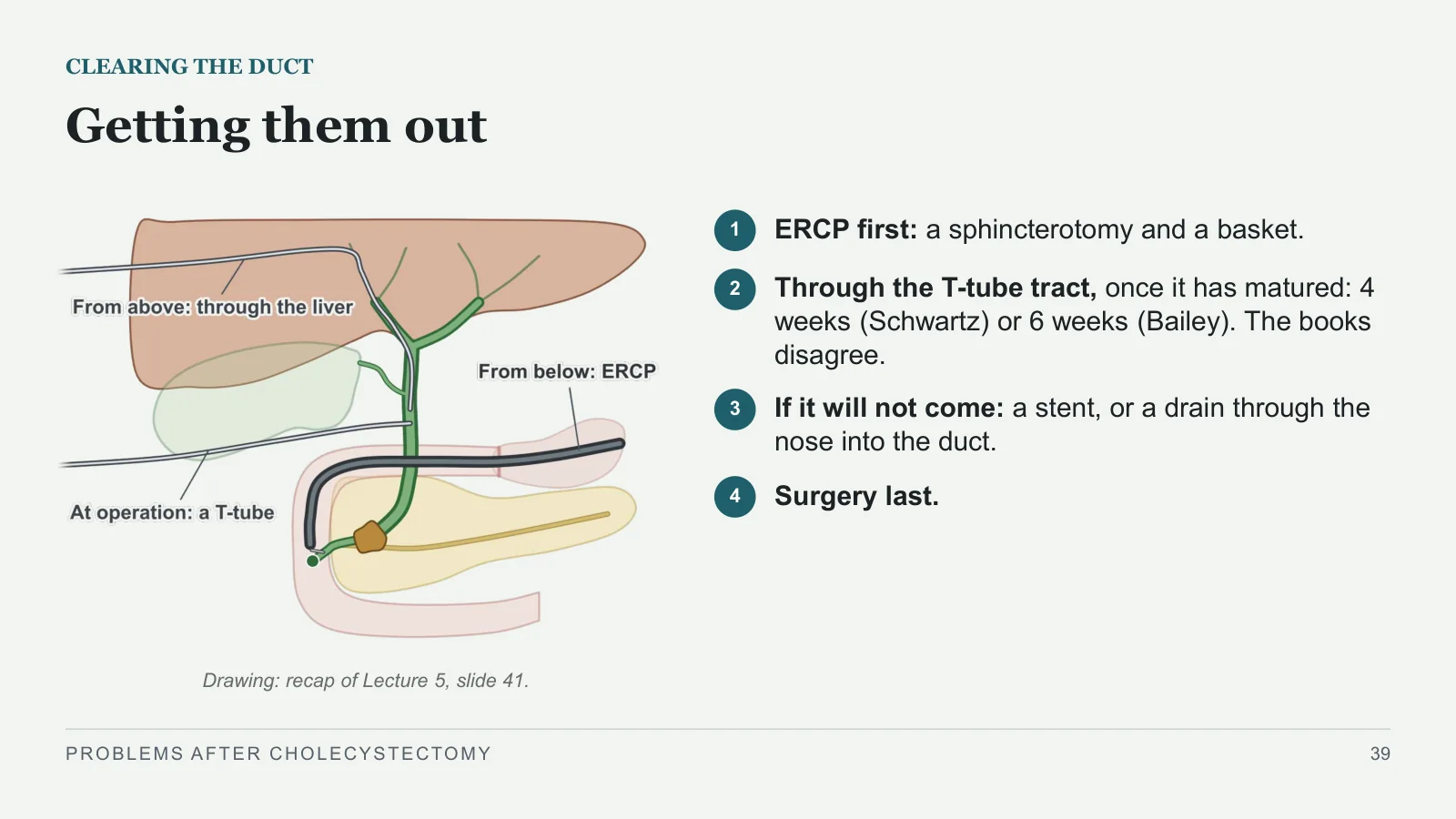
Getting them out
CLEARING THE DUCT
Drawing: recap of Lecture 5, slide 41.
1
ERCP first: a sphincterotomy and a basket.
2
Through the T-tube tract, once it has matured: 4 weeks (Schwartz) or 6 weeks (Bailey). The books disagree.
3
If it will not come: a stent, or a drain through the nose into the duct.
4
Surgery last.
PROBLEMS AFTER CHOLECYSTECTOMY
39
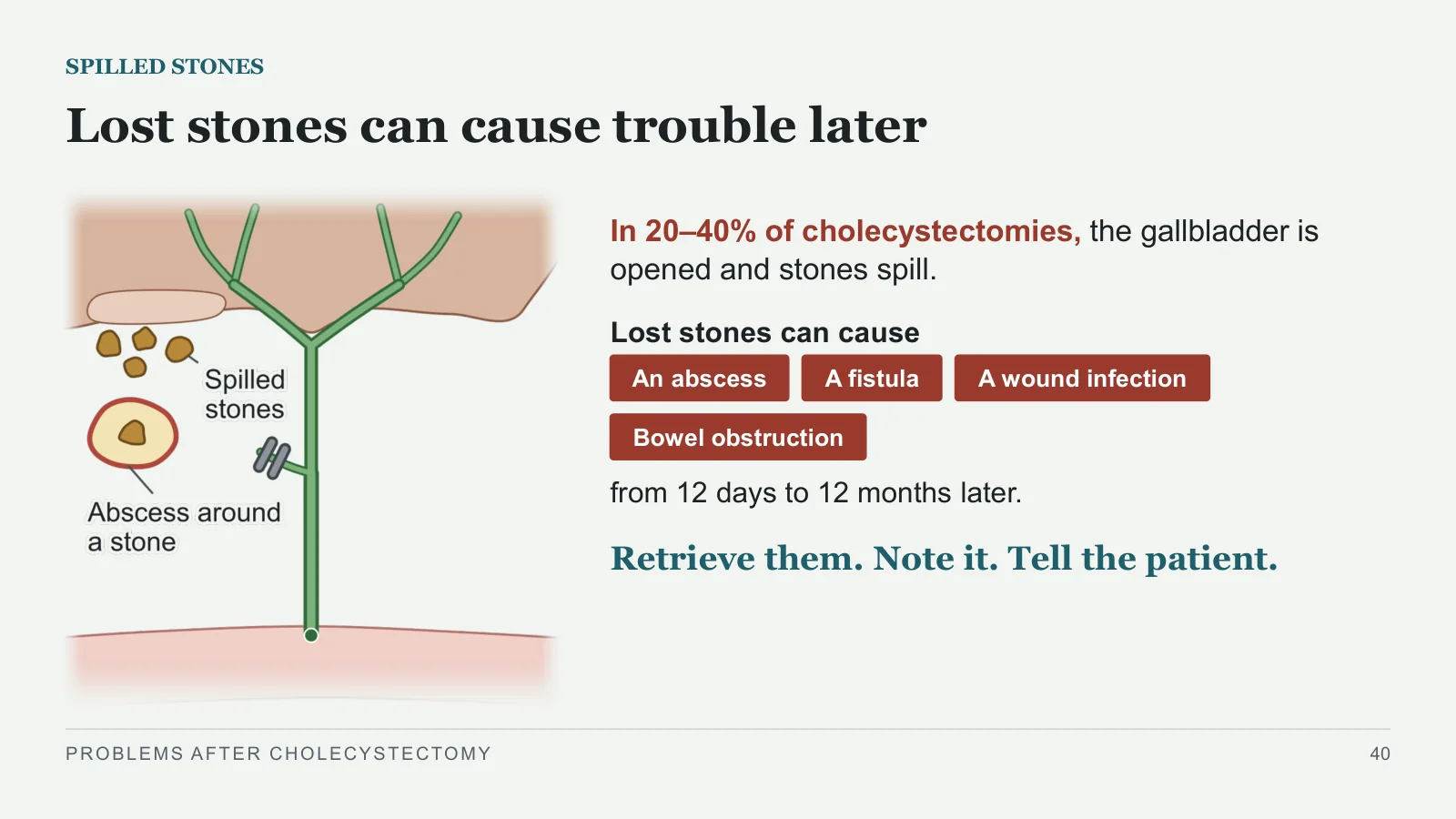
Lost stones can cause trouble later
SPILLED STONES
In 20–40% of cholecystectomies, the gallbladder is opened and stones spill.
Lost stones can cause
An abscess
A fistula
A wound infection
Bowel obstruction
from 12 days to 12 months later.
Retrieve them. Note it. Tell the patient.
PROBLEMS AFTER CHOLECYSTECTOMY
40
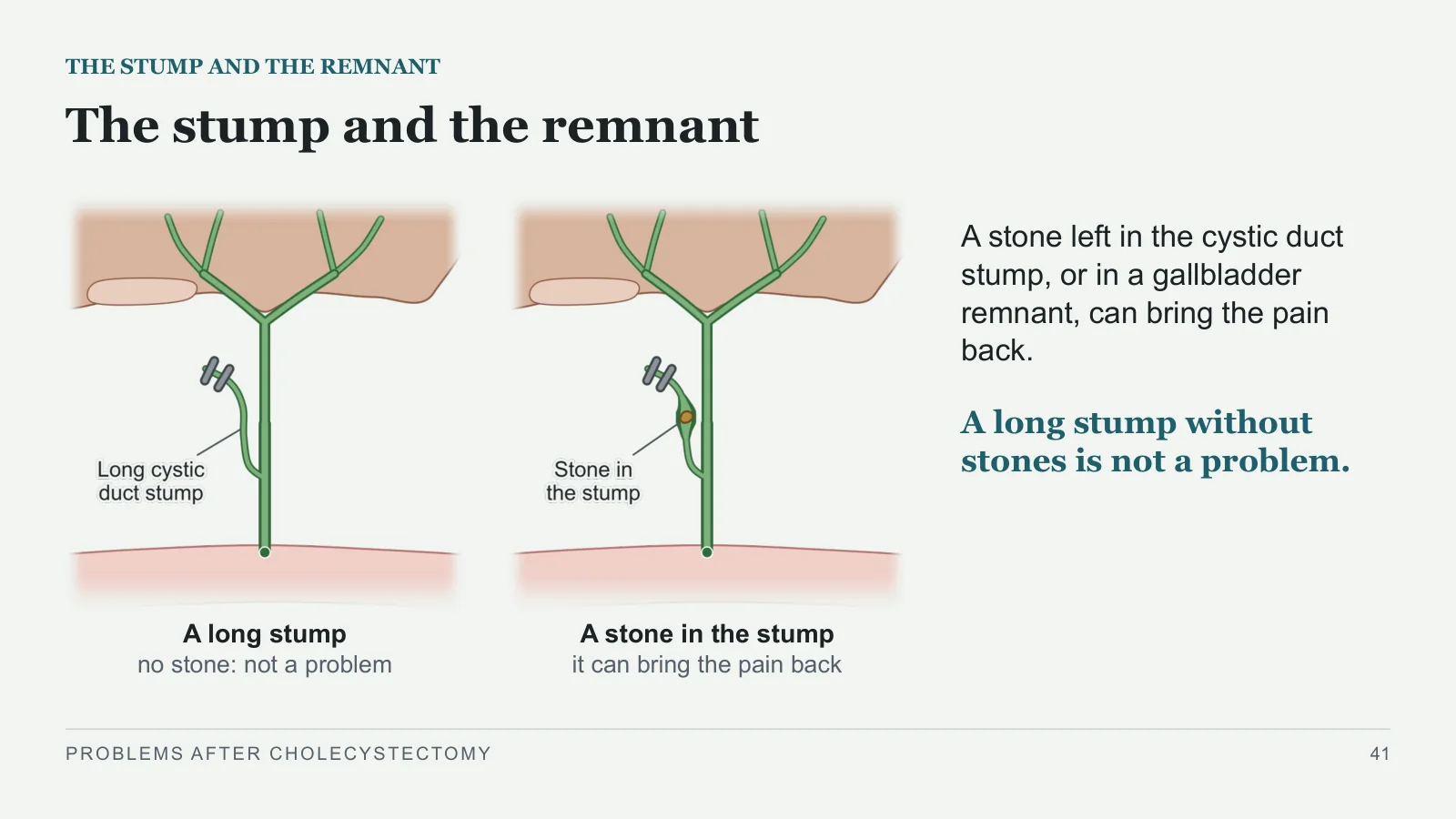
The stump and the remnant
THE STUMP AND THE REMNANT
A long stump
no stone: not a problem
A stone in the stump
it can bring the pain back
A stone left in the cystic duct stump, or in a gallbladder remnant, can bring the pain back.
A long stump without stones is not a problem.
PROBLEMS AFTER CHOLECYSTECTOMY
41
Pain that comes back
Pain that comes back
PART 8
Is it the ducts, or was it never the gallbladder?
PROBLEMS AFTER CHOLECYSTECTOMY
42
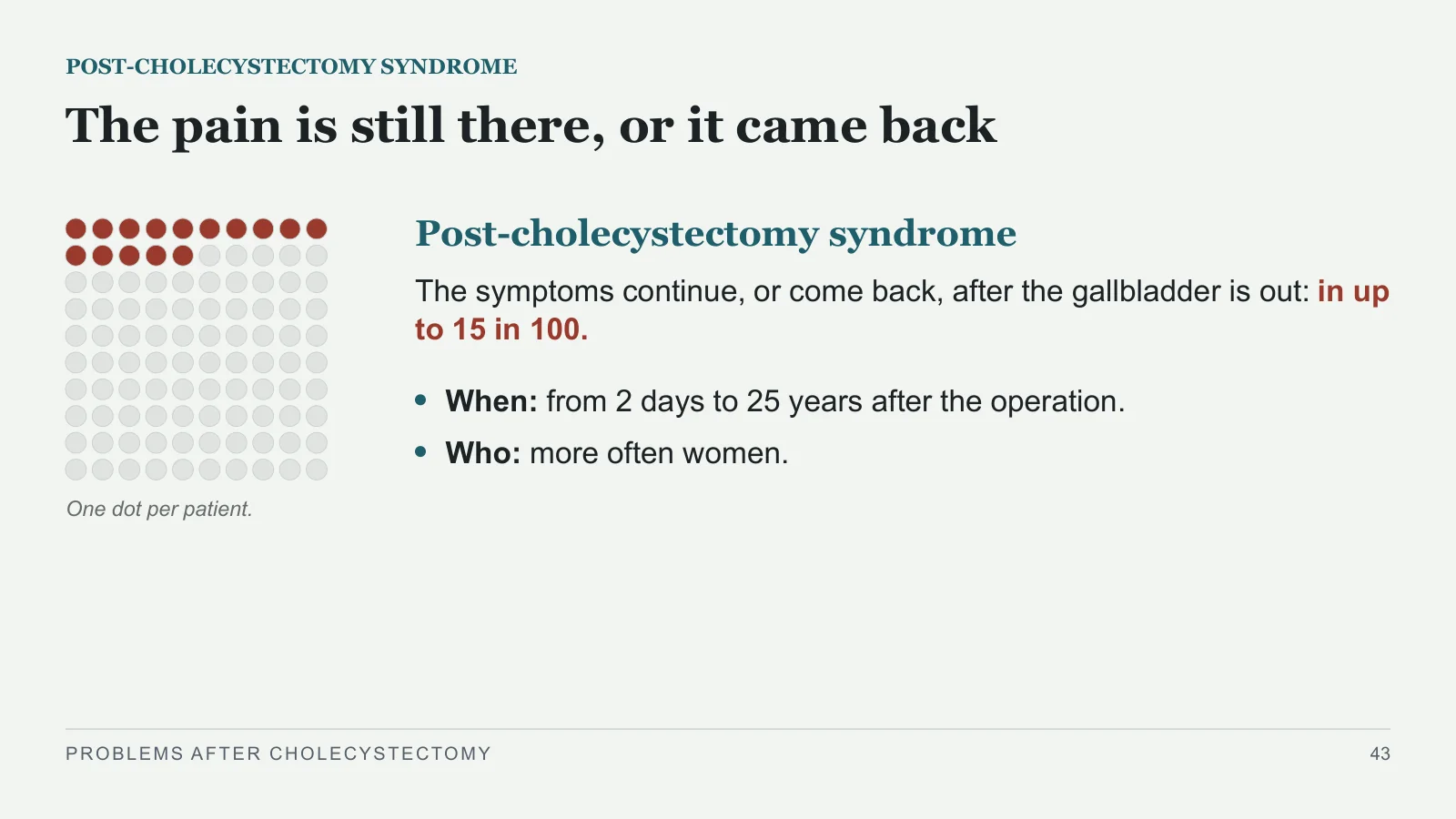
The pain is still there, or it came back
POST-CHOLECYSTECTOMY SYNDROME
One dot per patient.
Post-cholecystectomy syndrome
The symptoms continue, or come back, after the gallbladder is out: in up to 15 in 100.
When: from 2 days to 25 years after the operation.
Who: more often women.
PROBLEMS AFTER CHOLECYSTECTOMY
43
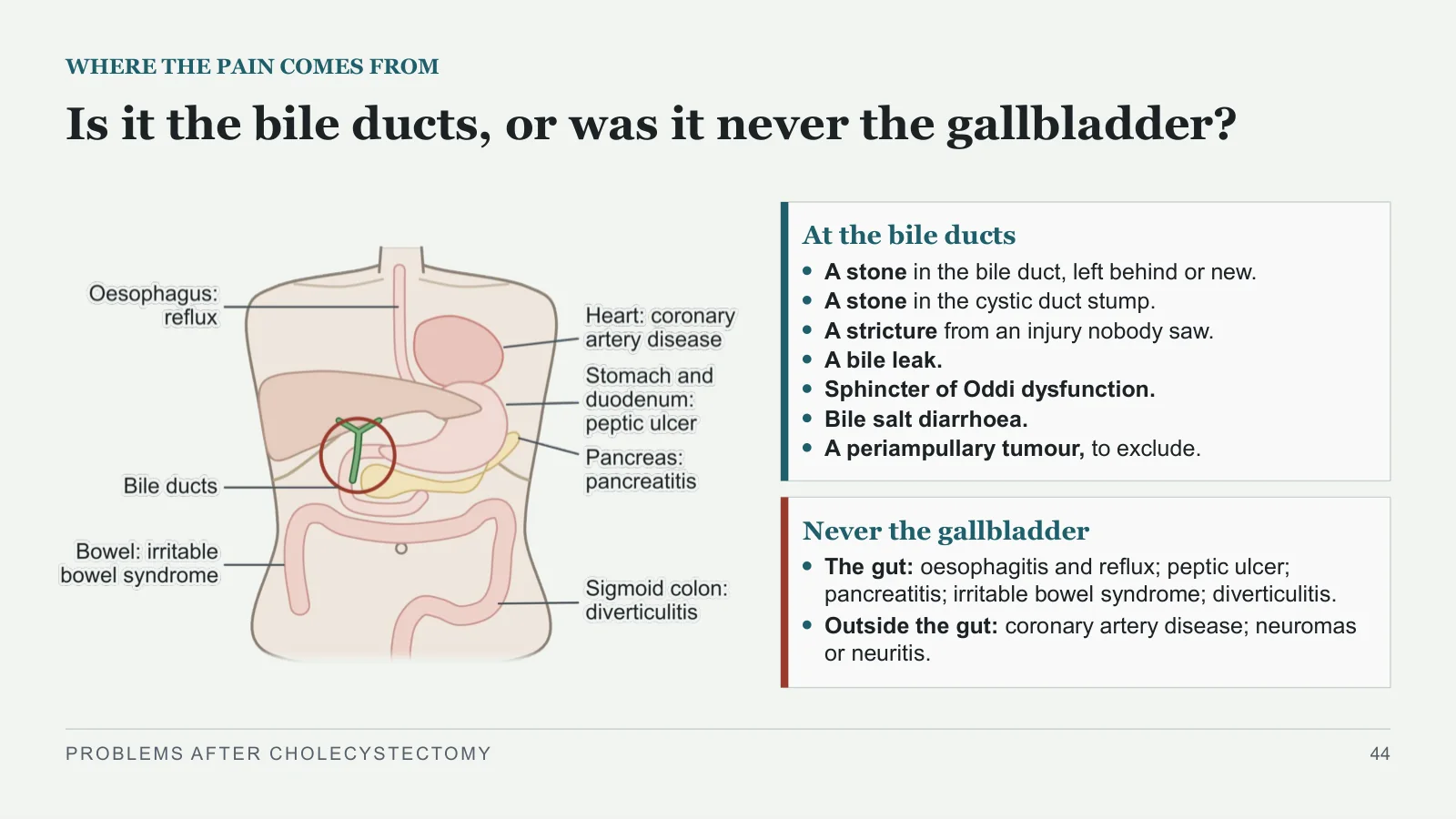
Is it the bile ducts, or was it never the gallbladder?
WHERE THE PAIN COMES FROM
At the bile ducts
A stone in the bile duct, left behind or new.
A stone in the cystic duct stump.
A stricture from an injury nobody saw.
A bile leak.
Sphincter of Oddi dysfunction.
Bile salt diarrhoea.
A periampullary tumour, to exclude.
Never the gallbladder
The gut: oesophagitis and reflux; peptic ulcer; pancreatitis; irritable bowel syndrome; diverticulitis.
Outside the gut: coronary artery disease; neuromas or neuritis.
PROBLEMS AFTER CHOLECYSTECTOMY
44
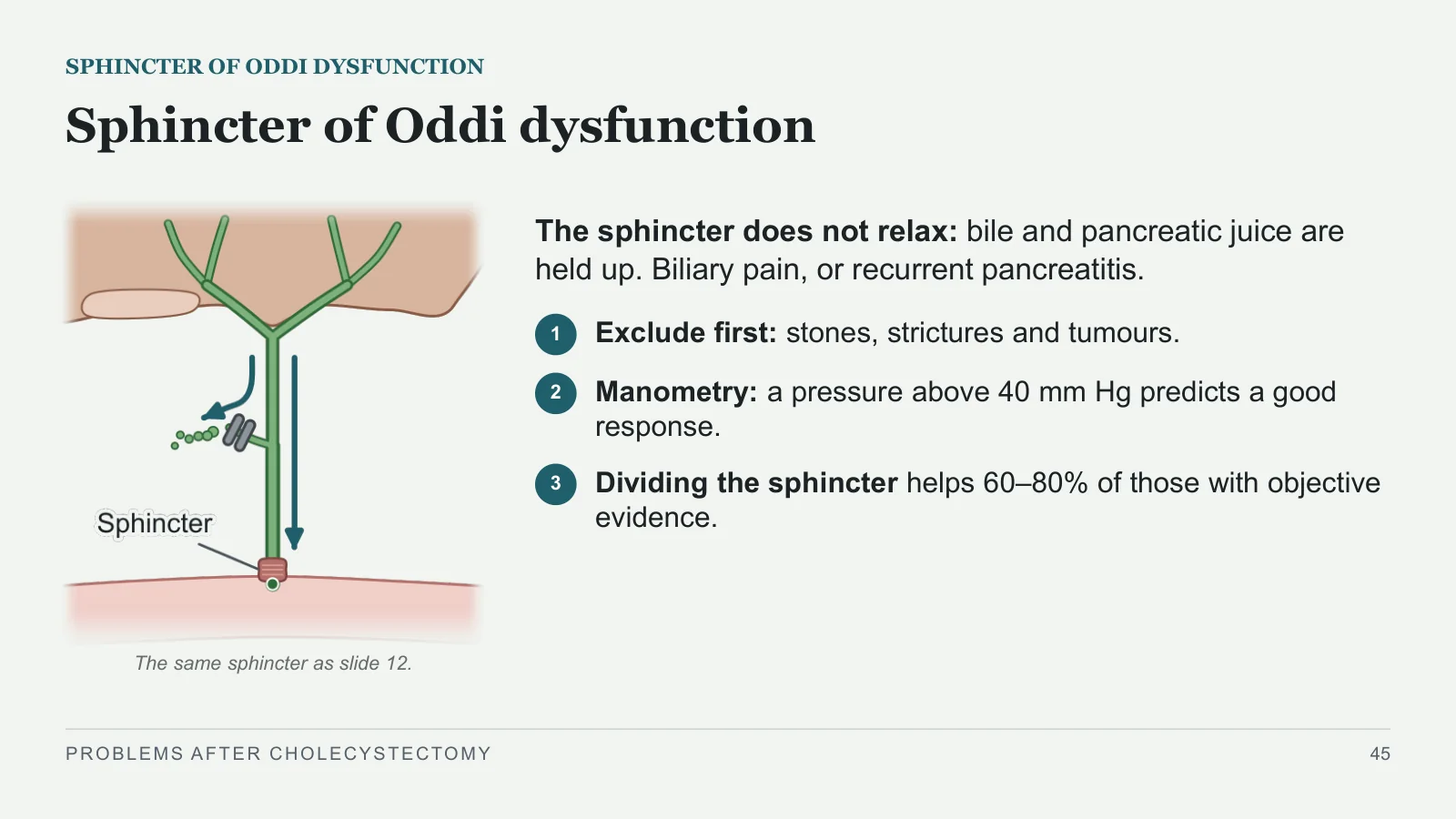
Sphincter of Oddi dysfunction
SPHINCTER OF ODDI DYSFUNCTION
The same sphincter as slide 12.
The sphincter does not relax: bile and pancreatic juice are held up. Biliary pain, or recurrent pancreatitis.
1
Exclude first: stones, strictures and tumours.
2
Manometry: a pressure above 40 mm Hg predicts a good response.
3
Dividing the sphincter helps 60–80% of those with objective evidence.
PROBLEMS AFTER CHOLECYSTECTOMY
45
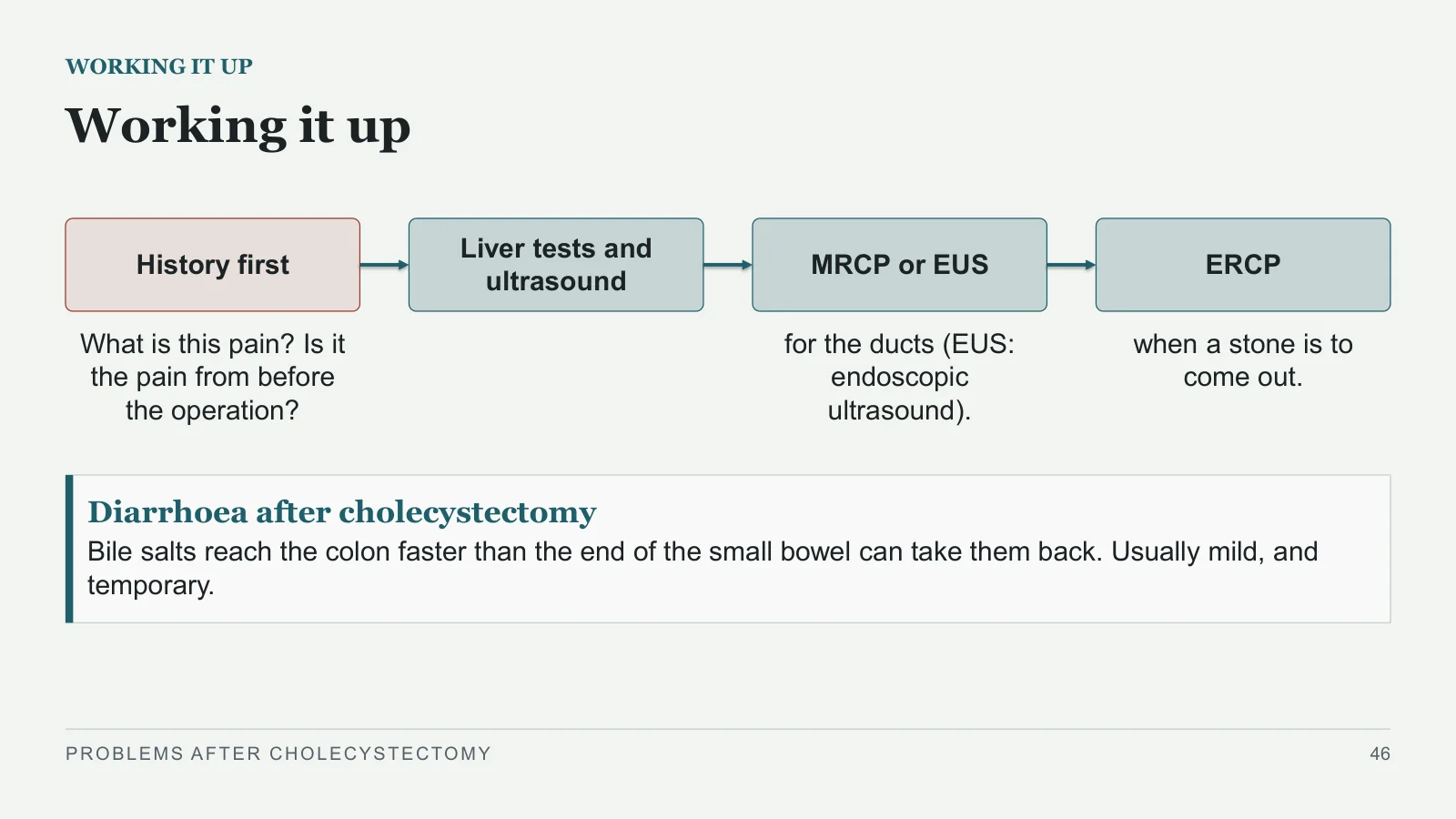
Working it up
WORKING IT UP
History first
What is this pain? Is it the pain from before the operation?
Liver tests and ultrasound
MRCP or EUS
for the ducts (EUS: endoscopic ultrasound).
ERCP
when a stone is to come out.
Diarrhoea after cholecystectomy
Bile salts reach the colon faster than the end of the small bowel can take them back. Usually mild, and temporary.
PROBLEMS AFTER CHOLECYSTECTOMY
46
The other problems
The other problems
PART 9
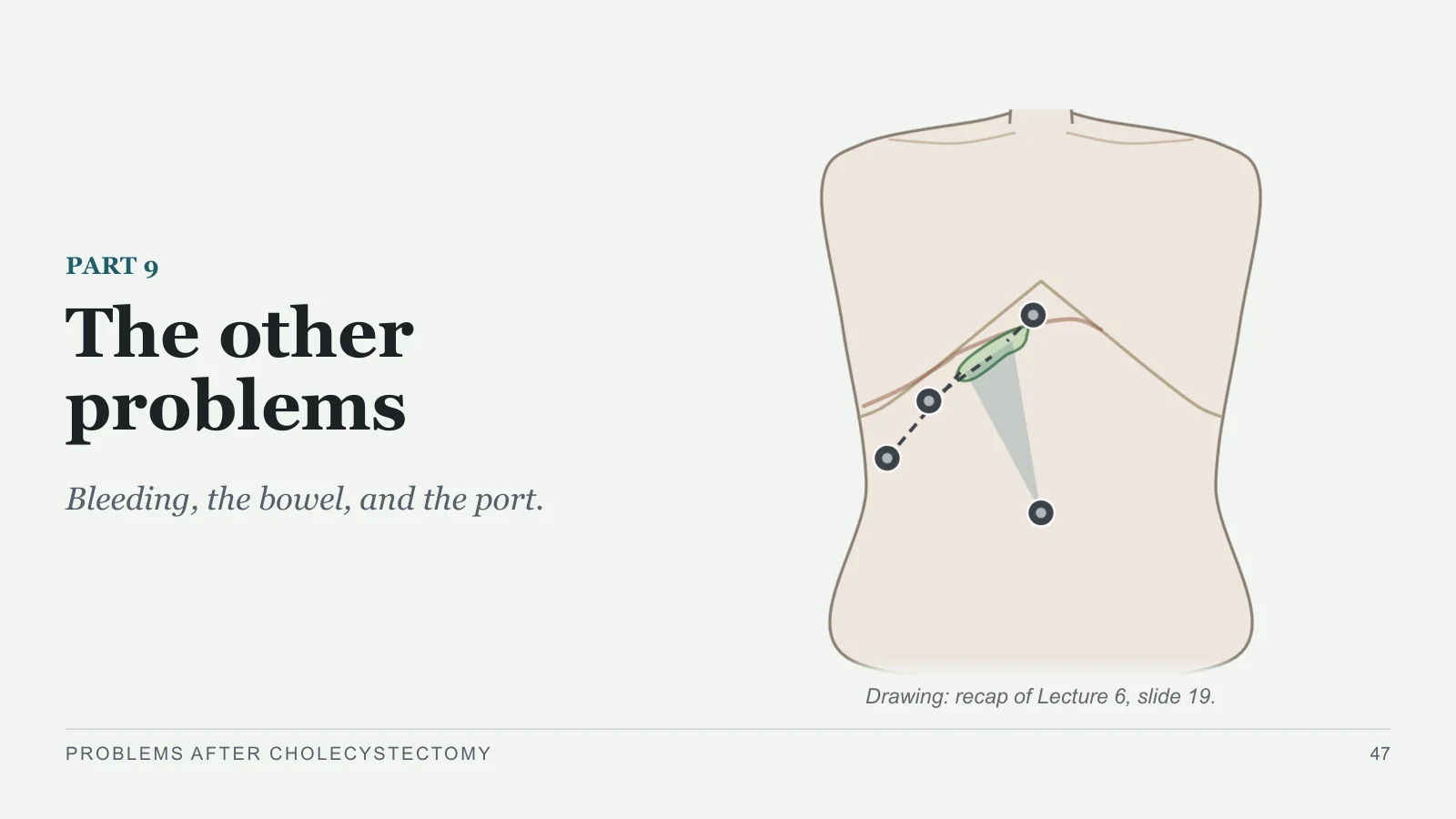
Bleeding, the bowel, and the port.
Drawing: recap of Lecture 6, slide 19.
PROBLEMS AFTER CHOLECYSTECTOMY
47
Bleeding, the bowel and the port
THE OTHER PROBLEMS
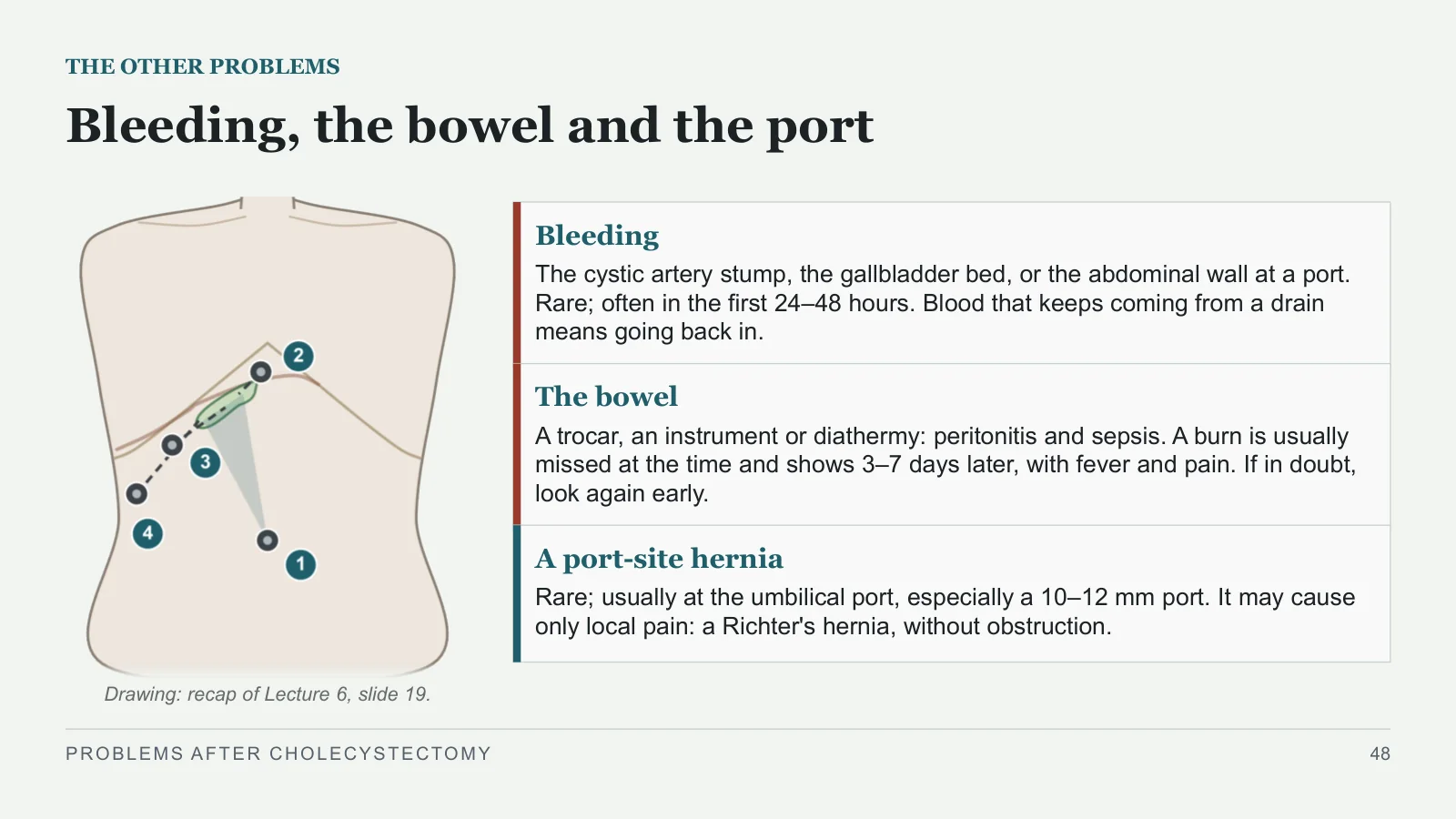
Drawing: recap of Lecture 6, slide 19.
Bleeding
The cystic artery stump, the gallbladder bed, or the abdominal wall at a port. Rare; often in the first 24–48 hours. Blood that keeps coming from a drain means going back in.
The bowel
A trocar, an instrument or diathermy: peritonitis and sepsis. A burn is usually missed at the time and shows 3–7 days later, with fever and pain. If in doubt, look again early.
A port-site hernia
Rare; usually at the umbilical port, especially a 10–12 mm port. It may cause only local pain: a Richter's hernia, without obstruction.
PROBLEMS AFTER CHOLECYSTECTOMY
48
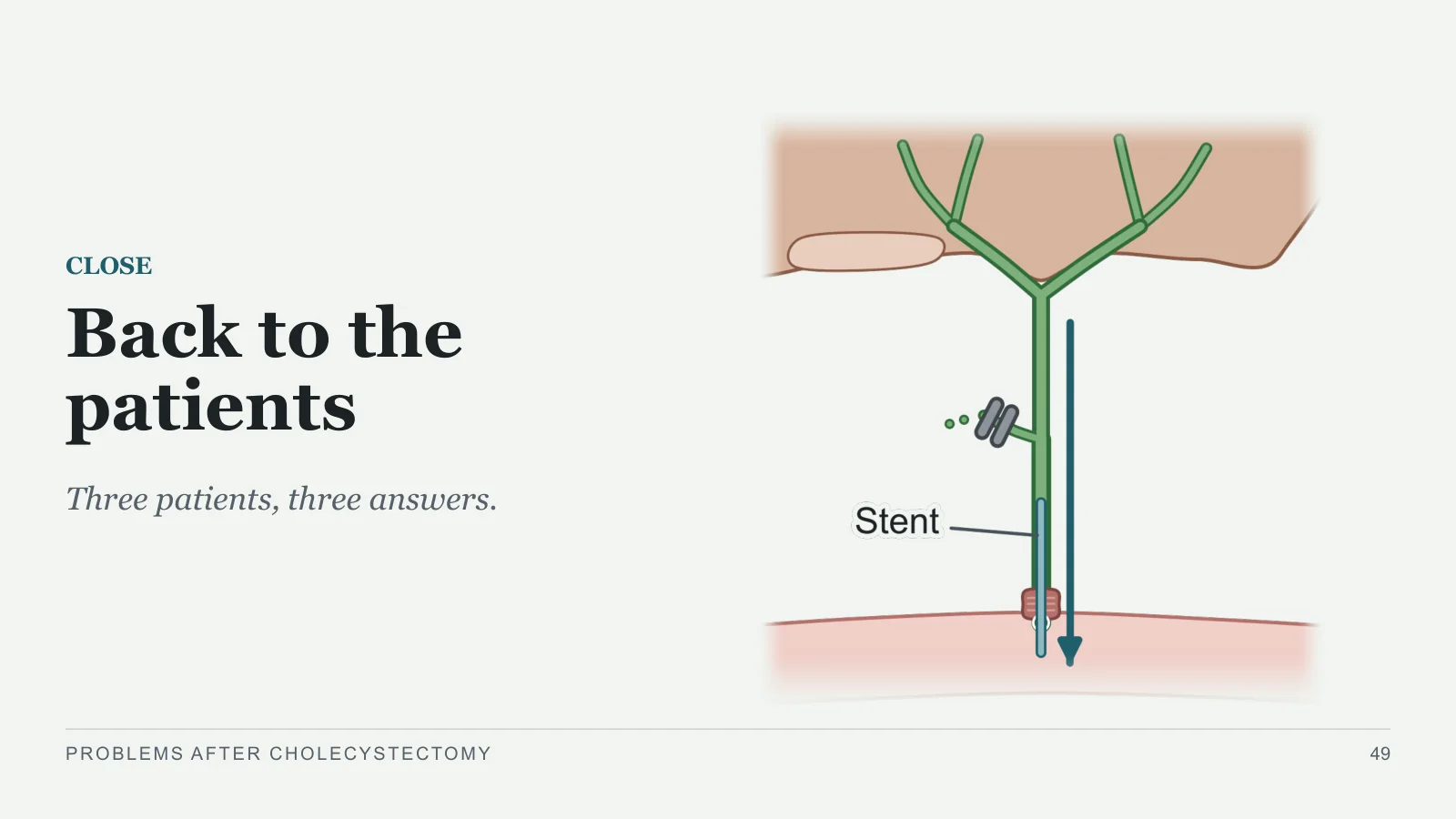
Back to the patients
CLOSE
Three patients, three answers.
PROBLEMS AFTER CHOLECYSTECTOMY
49
Case recap and take-home
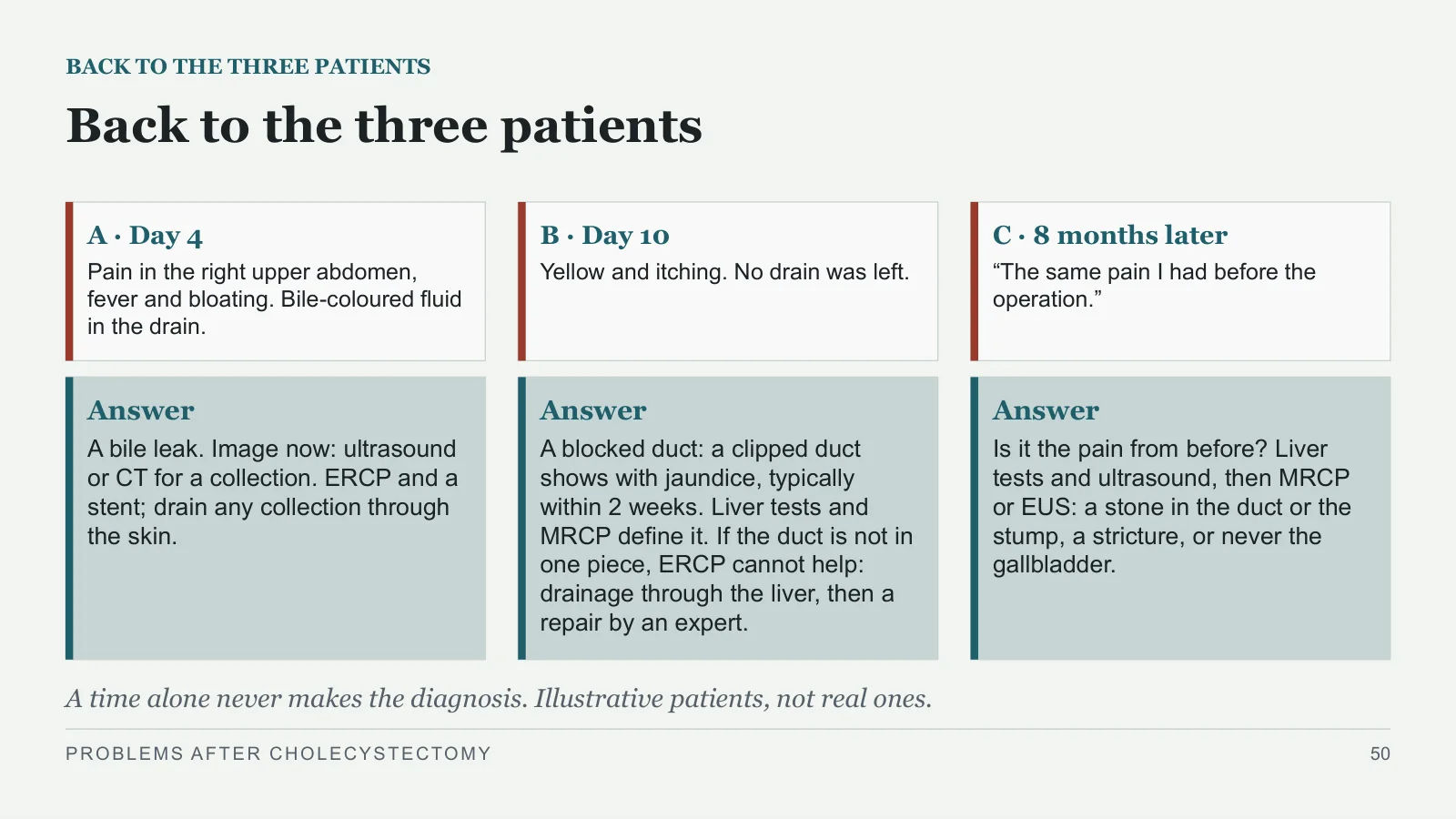
Back to the three patients
BACK TO THE THREE PATIENTS
A · Day 4
Pain in the right upper abdomen, fever and bloating. Bile-coloured fluid in the drain.
Answer
A bile leak. Image now: ultrasound or CT for a collection. ERCP and a stent; drain any collection through the skin.
B · Day 10
Yellow and itching. No drain was left.
Answer
A blocked duct: a clipped duct shows with jaundice, typically within 2 weeks. Liver tests and MRCP define it. If the duct is not in one piece, ERCP cannot help: drainage through the liver, then a repair by an expert.
C · 8 months later
“The same pain I had before the operation.”
Answer
Is it the pain from before? Liver tests and ultrasound, then MRCP or EUS: a stone in the duct or the stump, a stricture, or never the gallbladder.
A time alone never makes the diagnosis. Illustrative patients, not real ones.
PROBLEMS AFTER CHOLECYSTECTOMY
50
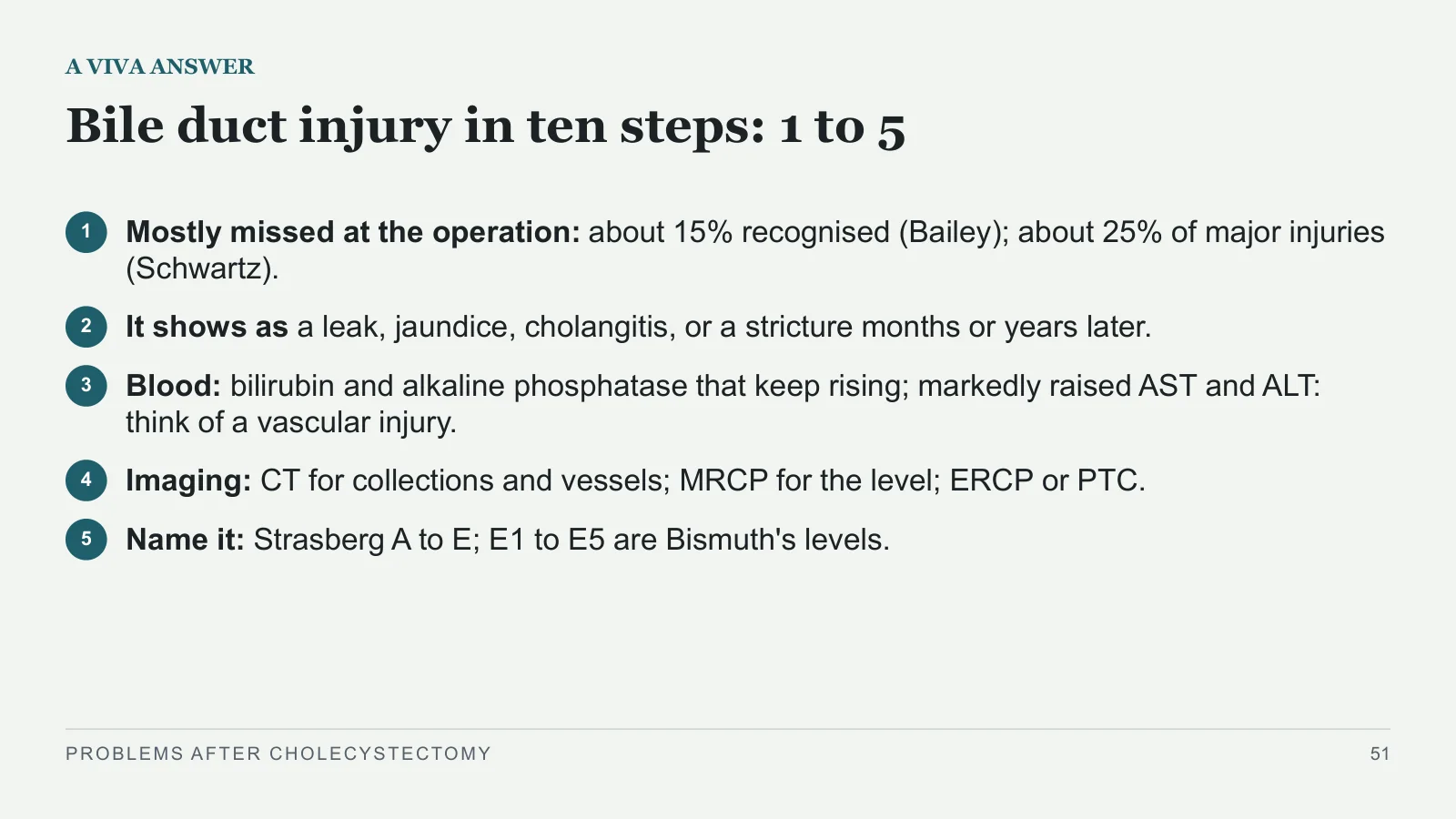
Bile duct injury in ten steps: 1 to 5
A VIVA ANSWER
1
Mostly missed at the operation: about 15% recognised (Bailey); about 25% of major injuries (Schwartz).
2
It shows as a leak, jaundice, cholangitis, or a stricture months or years later.
3
Blood: bilirubin and alkaline phosphatase that keep rising; markedly raised AST and ALT: think of a vascular injury.
4
Imaging: CT for collections and vessels; MRCP for the level; ERCP or PTC.
5
Name it: Strasberg A to E; E1 to E5 are Bismuth's levels.
PROBLEMS AFTER CHOLECYSTECTOMY
51
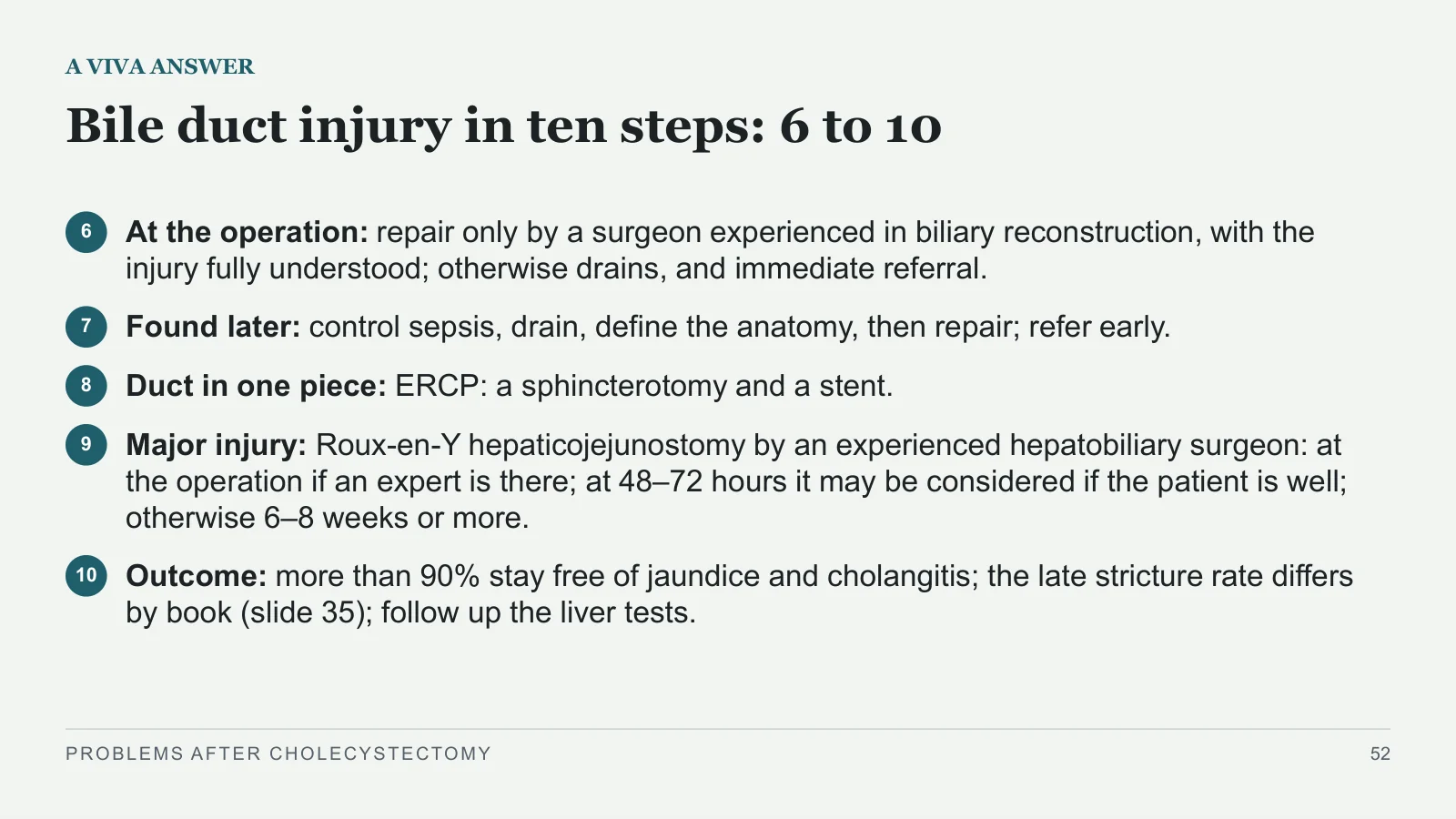
Bile duct injury in ten steps: 6 to 10
A VIVA ANSWER
6
At the operation: repair only by a surgeon experienced in biliary reconstruction, with the injury fully understood; otherwise drains, and immediate referral.
7
Found later: control sepsis, drain, define the anatomy, then repair; refer early.
8
Duct in one piece: ERCP: a sphincterotomy and a stent.
9
Major injury: Roux-en-Y hepaticojejunostomy by an experienced hepatobiliary surgeon: at the operation if an expert is there; at 48–72 hours it may be considered if the patient is well; otherwise 6–8 weeks or more.
10
Outcome: more than 90% stay free of jaundice and cholangitis; the late stricture rate differs by book (slide 35); follow up the liver tests.
PROBLEMS AFTER CHOLECYSTECTOMY
52
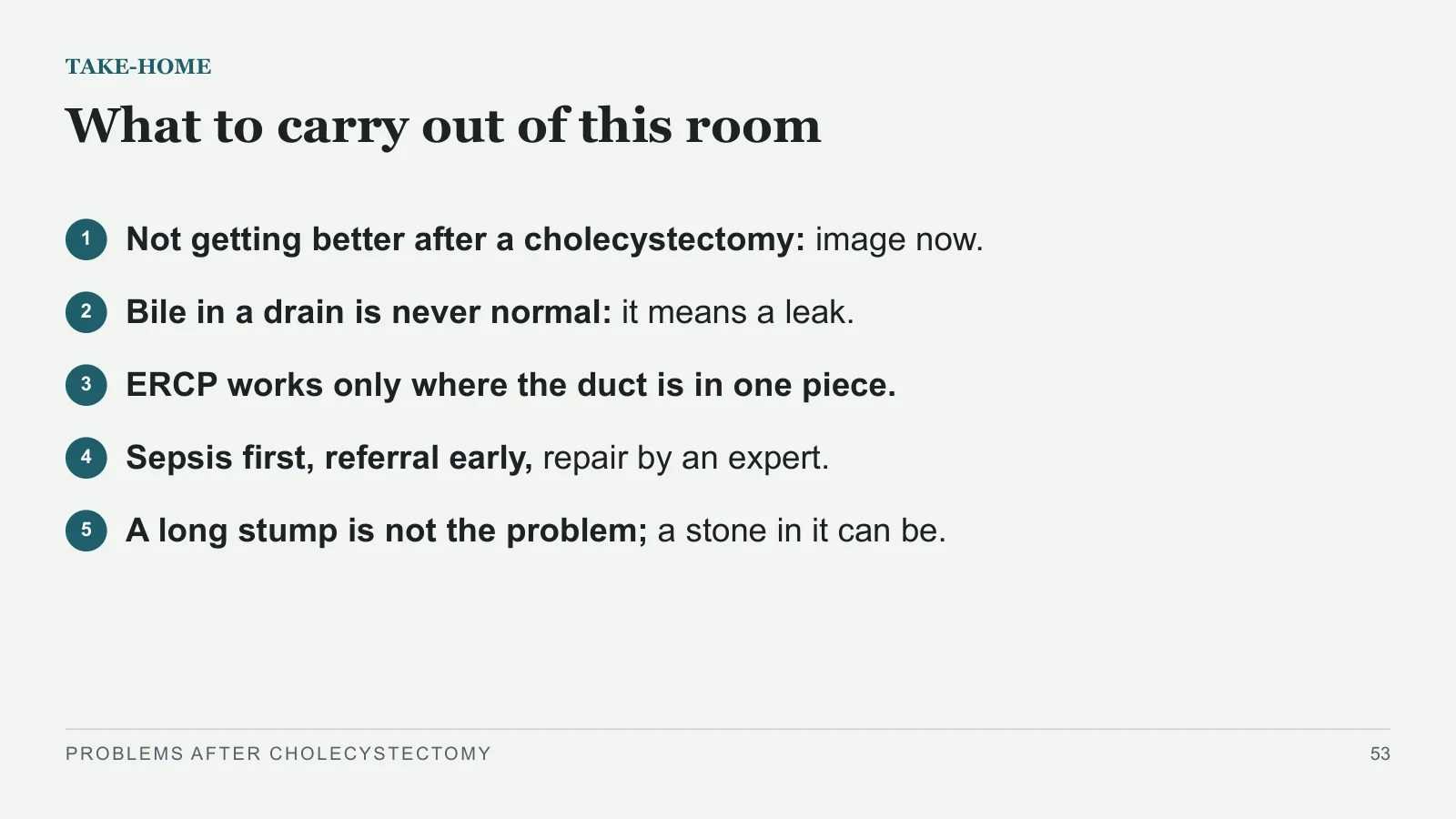
What to carry out of this room
TAKE-HOME
1
Not getting better after a cholecystectomy: image now.
2
Bile in a drain is never normal: it means a leak.
3
ERCP works only where the duct is in one piece.
4
Sepsis first, referral early, repair by an expert.
5
A long stump is not the problem; a stone in it can be.
PROBLEMS AFTER CHOLECYSTECTOMY
53
Sources and image credits
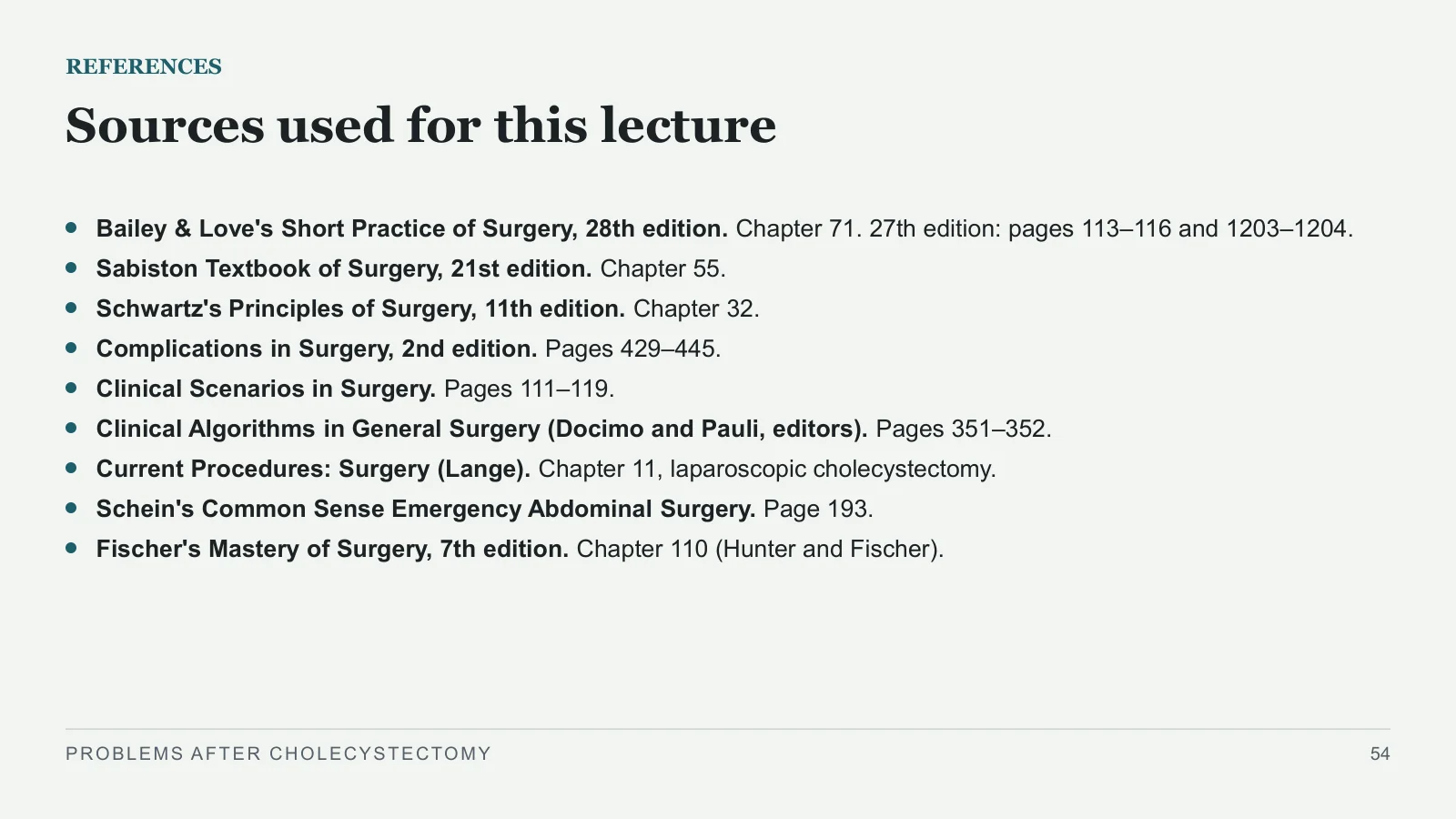
Sources used for this lecture
REFERENCES
Bailey & Love's Short Practice of Surgery, 28th edition. Chapter 71. 27th edition: pages 113–116 and 1203–1204.
Sabiston Textbook of Surgery, 21st edition. Chapter 55.
Schwartz's Principles of Surgery, 11th edition. Chapter 32.
Complications in Surgery, 2nd edition. Pages 429–445.
Clinical Scenarios in Surgery. Pages 111–119.
Clinical Algorithms in General Surgery (Docimo and Pauli, editors). Pages 351–352.
Current Procedures: Surgery (Lange). Chapter 11, laparoscopic cholecystectomy.
Schein's Common Sense Emergency Abdominal Surgery. Page 193.
Fischer's Mastery of Surgery, 7th edition. Chapter 110 (Hunter and Fischer).
PROBLEMS AFTER CHOLECYSTECTOMY
54
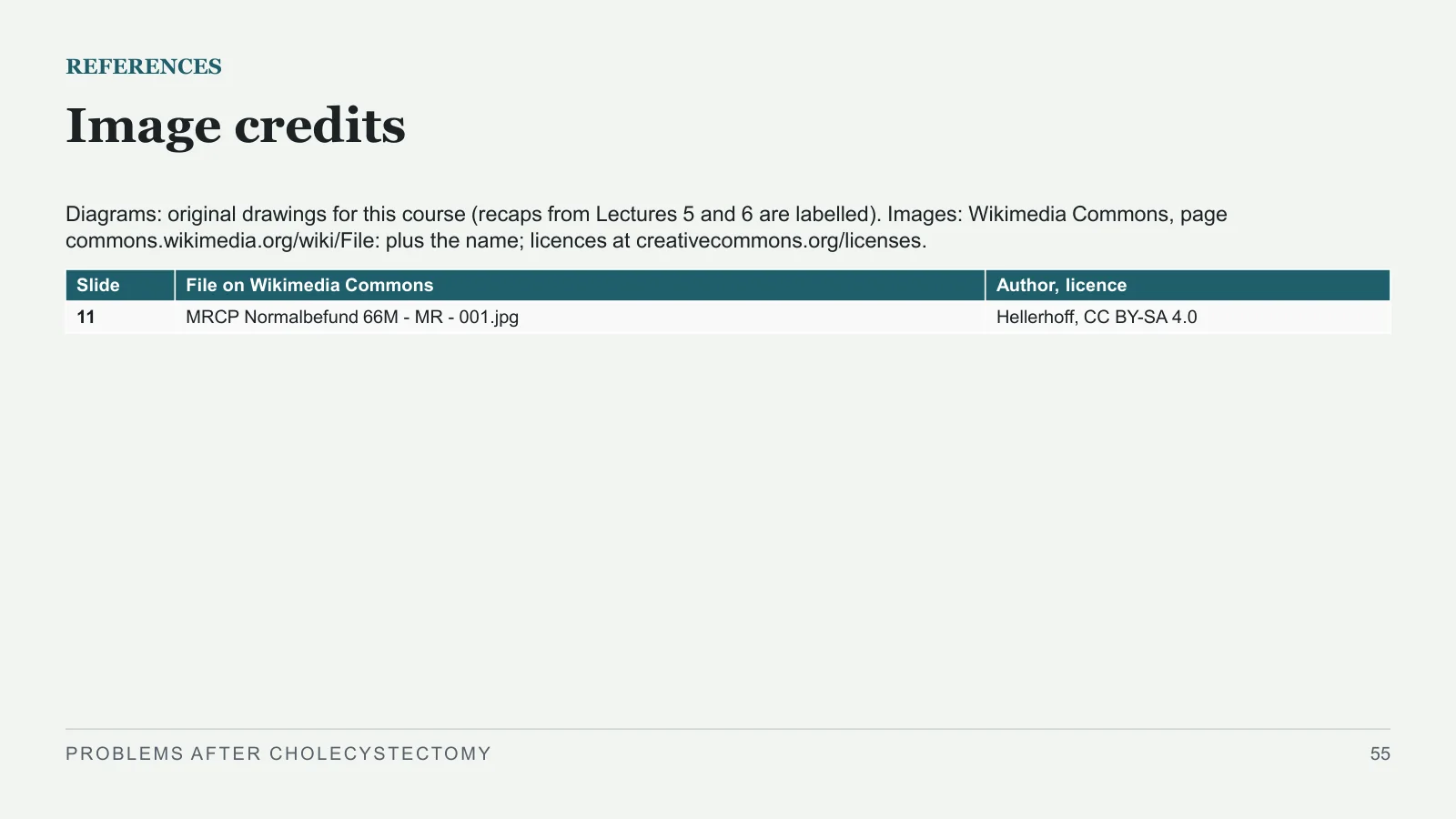
Image credits
REFERENCES
Diagrams: original drawings for this course (recaps from Lectures 5 and 6 are labelled). Images: Wikimedia Commons, page commons.wikimedia.org/wiki/File: plus the name; licences at creativecommons.org/licenses.
PROBLEMS AFTER CHOLECYSTECTOMY
55
| Slide | File on Wikimedia Commons | Author, licence |
| 11 | MRCP Normalbefund 66M - MR - 001.jpg | Hellerhoff, CC BY-SA 4.0 |
Sources and image credits
Sources and image credits are reproduced from the designated slides.
Images
- Slide 11 · MRCP Normalbefund 66M - MR - 001.jpg · Hellerhoff, CC BY-SA 4.0 · CC BY-SA 4.0

Sources
- [1] REFERENCES
- [2] Sources used for this lecture
- [3] Bailey & Love's Short Practice of Surgery, 28th edition. Chapter 71. 27th edition: pages 113–116 and 1203–1204.
- [4] Sabiston Textbook of Surgery, 21st edition. Chapter 55.
- [5] Schwartz's Principles of Surgery, 11th edition. Chapter 32.
- [6] Complications in Surgery, 2nd edition. Pages 429–445.
- [7] Clinical Scenarios in Surgery. Pages 111–119.
- [8] Clinical Algorithms in General Surgery (Docimo and Pauli, editors). Pages 351–352.
- [9] Current Procedures: Surgery (Lange). Chapter 11, laparoscopic cholecystectomy.
- [10] Schein's Common Sense Emergency Abdominal Surgery. Page 193.
- [11] Fischer's Mastery of Surgery, 7th edition. Chapter 110 (Hunter and Fischer).